


Metis破圈进入L2前五,揭秘其颠覆性去中心化策略背后的秘密


Original author:@GryphsisAcademy, @auggest_crypto
TL;DR:
1. Of the founding team of Metis"Vitalik Buterin’s mother/best friend"Such rumors, whether they are gimmicks or true, are actually beneficial to Metis.
2. Metis’ ecological projects have developed rapidly, covering all hot spots in the market and attracting many well-known developers to settle in, demonstrating its precise capture and application of market hot spots.
3. Metis recently launched an ecological incentive project totaling billions of dollars to attract more high-quality projects to be deployed on Metis, continuously expanding its ecological territory, demonstrating its positive work attitude and contribution to ecological growth.
4. Different from other Layer 2, Metis first focuses on decentralized sorters to make key breakthroughs. By creating a sorter pool and node staking mechanism, it ensures network security and decentralization, and solves the centralized single sorting of other Layer 2s. server problem.
5. The $METIS token has a wide range of uses, including network fees, node staking, governance voting, etc. It not only serves as a value target, but also contributes to network development.
1. Project Summary
Metis is an Ethereum Layer 2 network. By introducing innovative technologies such as decentralized sequencer pools and Hybrid Rollup, it is unique among many Layer 2 networks. It is committed to ensuring high throughput and fast transactions while ensuring the stability of the network. Decentralization and security.
2. Project details
2.1 Team
The team currently has a size of about 11-50 people, with an average tenure of 1.8 years. The total number of employees has increased by 4% in the past six months.
Elena Sinelnikova(Co-Founder): The founder of the blockchain non-profit organization Crypto Chicks. This organization is a female organization dedicated to blockchain education, mainly providing opportunities for women to learn and enter the blockchain field.
Kevin Liu(Co-FounderProduct Lead): Kevin is the co-founder and CEO of ZKM (zkm.io) and the strategic director of the MetisDAO Foundation, responsible for overseeing the formulation and promotion of the foundations internal strategic plans. Kevin completed his MBA at the University of Chinese Academy of Sciences and is an active researcher on token economics, DAOs, and governance protocols.
Yuan Su(Co-FounderCTO): Yuan Su holds a bachelors degree in computer science and a masters degree in business administration. He held multiple management positions at IBM Canada and CaseWare in 2003 and has extensive experience in software engineering and management. In 2022, Yuan founded Nuvo Technology Company.
2.2 Financing status
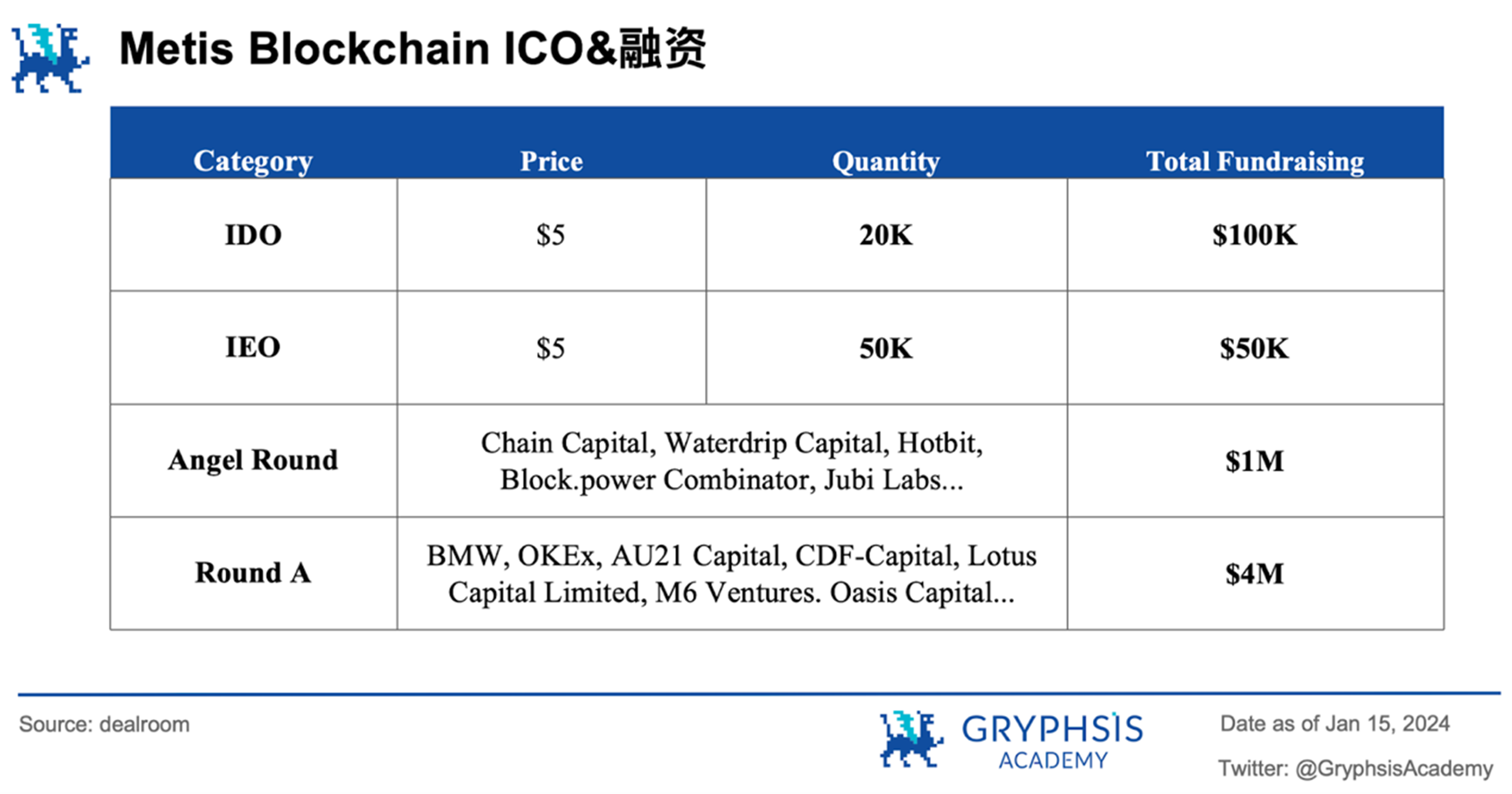
Metis has successively completed angel and seed round financing of US$1 million, and US$4 million in Series A financing. Investment institutions include OKEx’s Block Dream Fund, Genblock Capital, Cryptomeria Capital, etc.
Institutions currently participating in investing in Metis include Gate.io, DFG, AU 21, HOT labs, CatcherVC, Parsiq, Chain Capita, Genblock Capital, OK, etc.
2.3 Recent developments
2.3.1 Community Testing
Source: https://x.com/MetisDAO/status/1746940547619545590?s=20
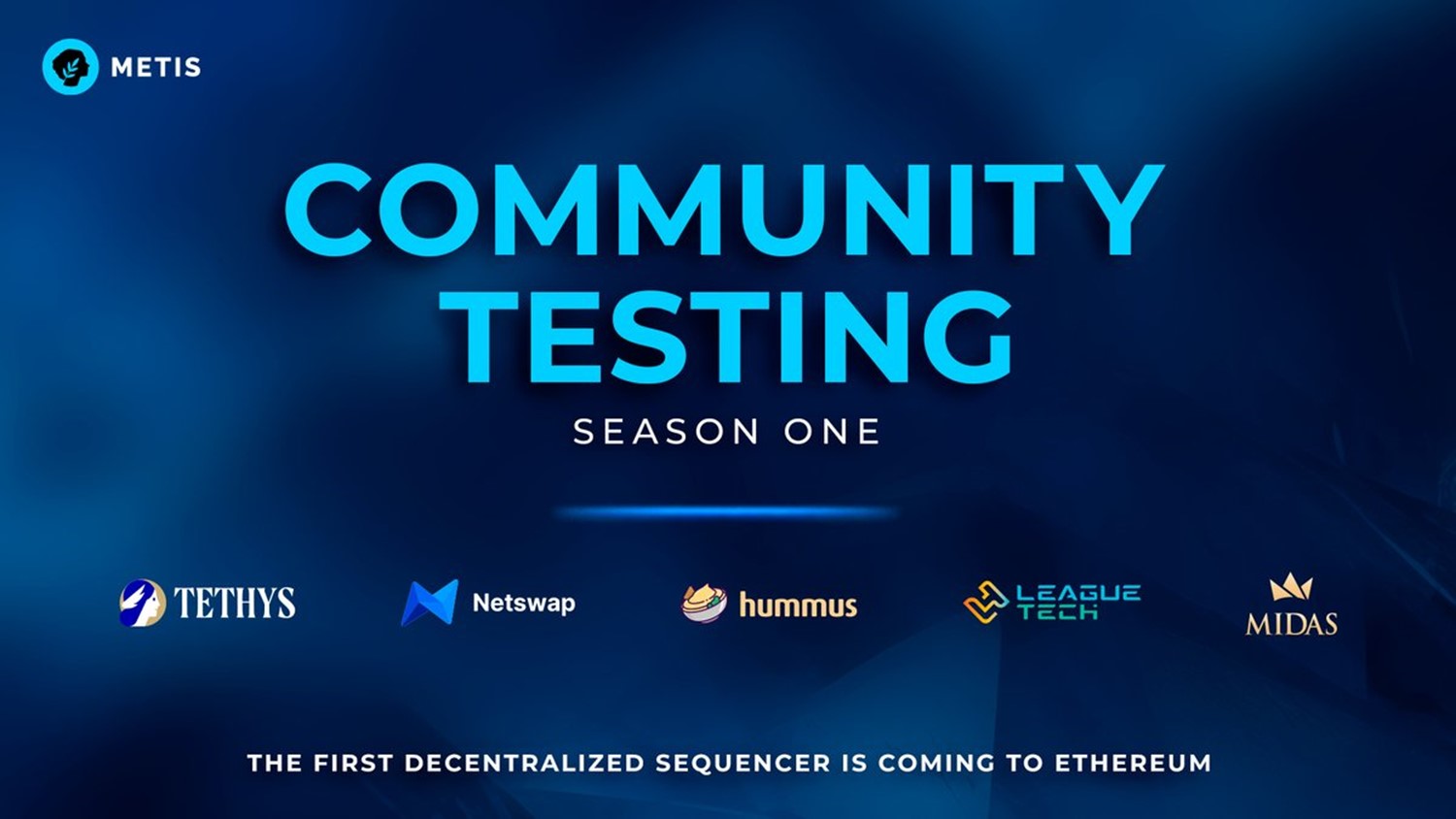
On January 16, Season 1 Community Testing was launched on the Sepolia test network to test the POS Sequencer pool by exploring various Dapps. Users will also receive corresponding Testing Points rewards.
Applications currently supporting Season 1Co mmunity Testing include Hummus Exchange, League.Tech, Tethys Finance, Midas Games, Netswap, and other projects such as Enki, League.Tech, etc. will be added in the future. Each Dapp corresponds to a different point pool, and each operation also has a different point ratio. Participants can obtain the test network $METIS through the network to participate and earn points at zero cost.
Current details regarding points and rewards:
All participants can earn points by completing corresponding tasks and can repeat a single operation, but each repetition can only earn 75% of the previous points.
If the amount held is greater than the total number of points, the points number will change to the amount (increase points).
The more points you get, the higher the rewards you will get, which is directly proportional to the participants point ranking.
It is worth noting that Metis’ EDF plan launched in December 2023 (a total of 4.6 M $METIS) will allocate $3 M of tokens to achieve Sequencer decentralization. It can be seen that this community test not only has zero cost and rich incentives, but also paves the way for the subsequent Sequencer profit sharing blueprint. It can be expected that as a member of the Metis community, the feedback from actively participating in ecological construction is something that other Layer 2 currently cannot provide.
2.3.2 MetisEDF
On December 18, Metis officially launched the MetisEDF (Ecosystem Development Fund) plan, allocating 4.6 M of $METIS (worth $5.5 billion) of ecological funds to the implementation of decentralized Sequencer (as mentioned above), Grants of Dapps, and Dapp Building Mining incentives (below), liquidity incentives and other ecological development activities, etc.
The full name of Dapp Building is BMR (Builder Mining Rewards), which will allocate 10,000 $METIS tokens to ecological projects every month, of which 4,000 tokens are linked to transaction volume indicators.
There are no restrictions on ecological projects, whether it is DeFi, ReFi, DeSci, NFT, DAO, or GameFi, you can get incentives. The reward distribution is calculated by calculating the number of transactions of the project as a proportion of the total number of transactions in the ecosystem to ensure that all project partners can receive fair returns.
Source: https://metisdao.medium.com/dapps-wanted-4c4938ee0c70
2.3.3 MetisJourney
On December 6, Metis provided an incentive program worth $5M, #MetisJourney, to the Defi category to incentivize and attract more related Dapps deployments.
Basically, Metis will focus next on: decentralized Sequencer community testing, migrating the DA layer to Ethereum, realizing Sequencer decentralization, and focusing on the ecological deployment of the LSD project.
The above are only the main developments so far in December 2023. In just two months, Metis has provided billions of dollars as an incentive plan, ranging from the decentralized testing of Sequencer with the participation of the entire ecological community, to every project. party’s activity incentives. From financial support, community support to ecological resources, these actions have all expanded the influence and activity of Metis.
And these are also positively reflected in its ecological data. As of writing, Metis’s TVL/single-day highest TPS has ranked among the top 5 of Layer 2. Within one month, TVL has increased by 120%, and its price has increased by 337.16. %; The current TPS of Metis is 9.36 transactions per second. Although there is a large gap compared with zkSynce Era, Arbitrum and other networks, comprehensive data and update dates can be seen that Metiss network updates and iterates faster (such as Optimism Networks The last highest data was in July last year), and the performance and speed are also relatively excellent.
These data fully prove Metis strong development momentum and market recognition in the Layer 2 field, demonstrating its huge potential and value in the Layer 2 market.
3. Technical framework
3.1 Hybrid Rollups
As early as March 2023, Metis proposed the Hybrid Rollup solution. By combining OP-Rollup and ZK-Rollup technologies, Metis can combine the advantages of ZK-Rollup and OP-Rollup at the same time.
For example, OP-Rollups optimistic assumption that all transactions are correct allows for rapid on-chain processing, improving the processing speed of the network; ZK-Rollup has advantages in proving transaction validity and protecting user privacy. By combining the two, Metis DAOs Hybrid Rollup will achieve:
1) EVM compatible: Even a hybrid Rollup solution is still compatible with EVM, allowing existing Dapps to be easily integrated.
2) Enhanced security: By incorporating validity proof, Rollup adds an additional layer of security based on the fraud proof design. The validity proof ensures the accuracy of off-chain transactions and reduces centralization risks.
3) Lightning-fast transaction confirmation: Using ZK Rollup technology, transactions can be quickly finalized and the confirmation time is reduced.
4) Optimized capital efficiency: With Hybrid Rollups ability to minimize Gas consumption, users can allocate resources more wisely and optimize their capital efficiency.
ZKM launched by the Metis DAO Foundation, an open source ZKP system service provider based on MIPS technology, develops the ZK Rollup component zkMIPS, a functional component that can solve the shortcomings of OP Rollup and ZK Rollup, and combines the advantages of the two Rollups. Realize efficient application of Hybrid Rollup.
By splitting transactions between two rollup types, ZKM can:
Quickly process simple transactions on OP Rollup
Use ZK Rollup in transactions requiring higher security
Avoid including too many fraud proofs on the main chain, thereby reducing costs
This hybrid approach aims to achieve an optimal rollup solution by balancing trade-offs between speed, security and cost, thereby making ZKM adaptable to a wide range of transactions and users with different needs.
3.2 Decentralized sorter
The Sequencer in the Layer 2 Rollup solution is responsible for collecting, sorting, and submitting user transactions. And because of the sorting function it is responsible for, MEV gray income is prone to exist. The sorter obtains additional income by disrupting or preempting transactions, or prioritizing transactions with high Gas, making transactions no longer decentralized, or a single sort. An attack on a server affects the entire network.
In order to solve this problem, Metis makes Sequencer decentralized through a series of designs and technologies. The following are the basic concepts for understanding the framework:
1. Tendermint consensus algorithm
In a certain consensus round, validator A is selected as the proposer and collects a batch of transactions and packages them into a new block. Other validators check the validity of the block and vote. If the final approval votes exceed 2/3, the block will reach finality.
2. Threshold Signature Scheme (TSS) Multi-Party Computation (MPC)
Both are cryptographic techniques, where:
a) Threshold signature scheme: Threshold signature is a special digital signature technology that allows a group of users to share control of a key. In this scheme, the key is split into multiple parts (or shares), with each user holding one part. A valid digital signature can only be generated when a sufficient number of users (up to a set threshold) act together. This method can increase the security of the system because an attacker must simultaneously obtain a sufficient number of key shares to attack the system.
b) Multi-party computation (MPC): It allows multiple parties to jointly calculate the output of a function without directly sharing the input. For example, for the sake of student privacy protection, the test scores of a class cannot be released to others, but the average score needs to be calculated. Then only each student needs to provide their own score input, without knowing the input of other participants, to get the results. Other non-participants can only know the final results, but participants can know their own data and results to achieve privacy protection.
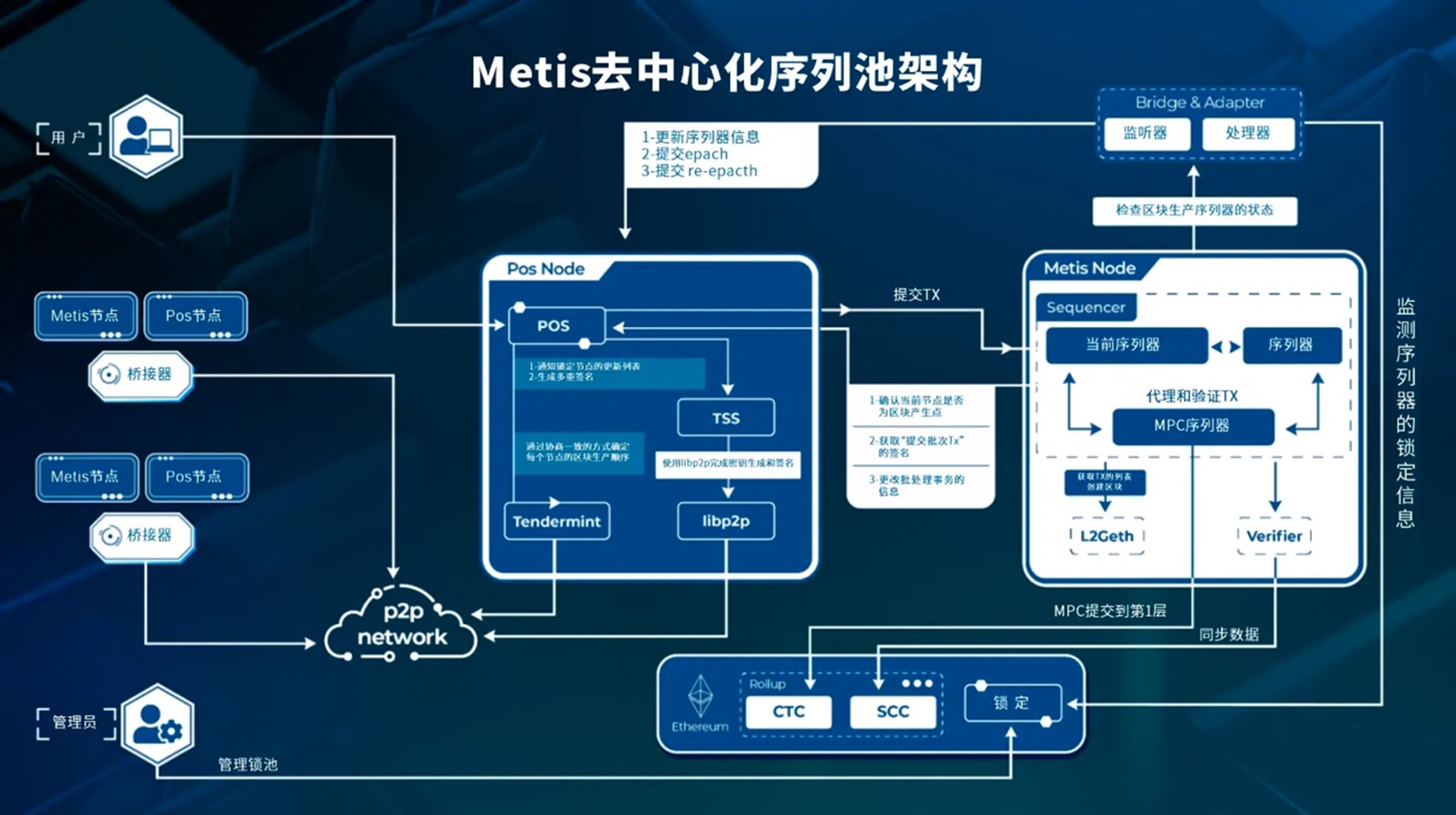
Metis turns the traditional single-point Sequencer into a Sequencer Pool, and achieves decentralization (anti-MEV + solving single-point failures) by introducing a node pledge mechanism, rotation mechanism, etc.
1)Sequencer Pool
Source: Metis Chinese Blog
For cost-effectiveness reasons, current Layer 2 basically runs its own centralized single Sequencer, but this also introduces a single point of failure problem, that is, once attacked, the entire network will come to a standstill and be affected. Metis has set up a Sequencer node pool to solve such problems. Even if a sequencer in the pool goes offline for any reason, the network can still operate normally.
In terms of anti-MEV, originally only a single sequencer central entity could see the contents of the transaction pool. Now Metis introduces multiple sequencers. Any sequencer that enters through staking has the right to see the contents of the transaction pool and process transactions.
Therefore, in such a situation, if a certain sorter wants to do evil, first of all, there is no guarantee that he will actually be selected to process transactions. Secondly, other sorters are observing the transaction pool, and if discovered, they will be fined. In addition, when a transaction enters the sequencer pool, it needs to use the Tendermint consensus algorithm, that is, ⅔ of the sequencer signature to package and submit the transaction, which further ensures that the transaction will not be disrupted.
Expand the number of sorter nodes through the sorter pool to increase competition and transparency, and then introduce a consensus algorithm to disperse rights and eliminate the technical risk of single control, thereby improving the decentralization of the sorter.
2) Node pledge
We know that MEV is the cake of miners. When Metis used the sequencer pool to make its interests public, miners could not control it alone, which shook their interests. Will the miners resist the strike, leading to a reduction in network processing efficiency, especially the loss of users assets caused by Defi transactions, causing the loss of users, and the reduction in user usage, causing miners to be unable to make ends meet, ultimately forming a vicious cycle?
In essence, the decentralization of the sorter is not a technical trade-off, but a dispute of interests. The biggest difficulty in realizing the decentralization of the sorter is not a technical problem, but the resistance of vested interests.
As for the miners income, how does Metis do it?
Metis has introduced a node pledge mechanism. Nodes must pledge the network token $METIS to participate in the network. To become a sequencer node, you need to pledge at least 20,000 $METIS (worth approximately US$2.4 million).However, once the sequencer participates in transaction block generation, it can receive both the Gas income from processing transactions and additional $METIS staking incentives.This not only makes up for the MEV income lost by the miners, but also acts as a positive flywheel to make the miners’ income even greater. How is it done specifically?
First of all, in terms of anti-MEV, it is not friendly to miners, but it is friendly to users. Users no longer need to pay extra Gas for fast transaction processing, nor will they be robbed by miners and damage their original interests. This kind of mechanism is at least not available in other Layer 2 currently. When the interests of users are protected, users will flood into the network; at this time, the transaction volume increases, and the more gas fees the miners receive; because Metis uses the native token $METIS as network gas, each transaction of the user will increase the amount of gas. If the purchase demand for METIS causes its price to stabilize/increase, the token pledge incentives held by miners will also appreciate in value with the development of the ecosystem.
In addition, verifiers are also set up. When a sequencer is found to be doing evil, a part of the assets that have been confiscated by the evil node will be rewarded to encourage the verification of verifiers.
By setting the node participation threshold, the sunk cost of the node is increased, because once it is found to have done evil, all large amounts of pledged tokens will be forfeited. By setting token incentives for node pledges, the enthusiasm of nodes to participate is increased, and the interests of the network and the interests of miners are bound. But at the same time, staking also controls the circulation of tokens in the market. While maintaining the currency price, it also urges nodes not to do evil easily and lose high-value assets, realizing using tokens to protect the network.
3) Sequencer rotation
After the transaction is processed, it needs to be broadcast to other nodes for ledger synchronization (Proposer), which is responsible for finalizing the transaction. In order to ensure that the Proposer node encounters problems during the transaction finalization stage, Metis introduces a rotation mechanism.
All Sequencer Lists are stored in an address controlled by MPC, and the Sequencer selected from the pool for processing is determined by the POS mechanism. Block producers are selected in a fairer way based on their respective Sequencer node voting weights (related to the amount of pledge) and combined with the random drop of hash values. Of course, if a Sequencer is shut down or stops serving, it will also be rotated, ensuring that the network runs 24/7 and avoiding network paralysis.
Metiss sequencer pool is fully linked to the pledge amount, binding node interests and network interests, fully ensuring the censorship resistance and decentralization of Sequencer, and returning network benefits to all contributors involved in construction and operation.The networks capital volume is basically supported by the Defi category. Metis decentralized sorter undoubtedly brings a strong attraction to its Defi products. From this, Defi Lego such as Farming, LSD, Lending, CDP, etc., will build a Metis where a hundred flowers bloom step by step.
3.3 MVM
Metis designed its own virtual running environment MVM based on OP-Rollup, which is compatible with EVM and separates computing and storage modules. Not only does it allow any existing Ethereum dApp to be easily built on Metis, but it also brings better processing efficiency and lower gas fees to users.
Since MVM is designed based on OP-Rollup, it inherits its fraud proof workflow. When the verifier packages the transaction results on the chain, there will be a challenge period that allows anyone to challenge it by raising a fraud certificate. If accepted, the erroneous status update is undone. The MVM_Verifier in MVM plays this role.
By running calculations and storage separately, transactions are first calculated off-chain, and the transaction storage status is retained on the chain, thereby reducing on-chain costs and achieving efficient processing brought about by concurrent operations.
4. Economic Model
4.1 Allocation mechanism
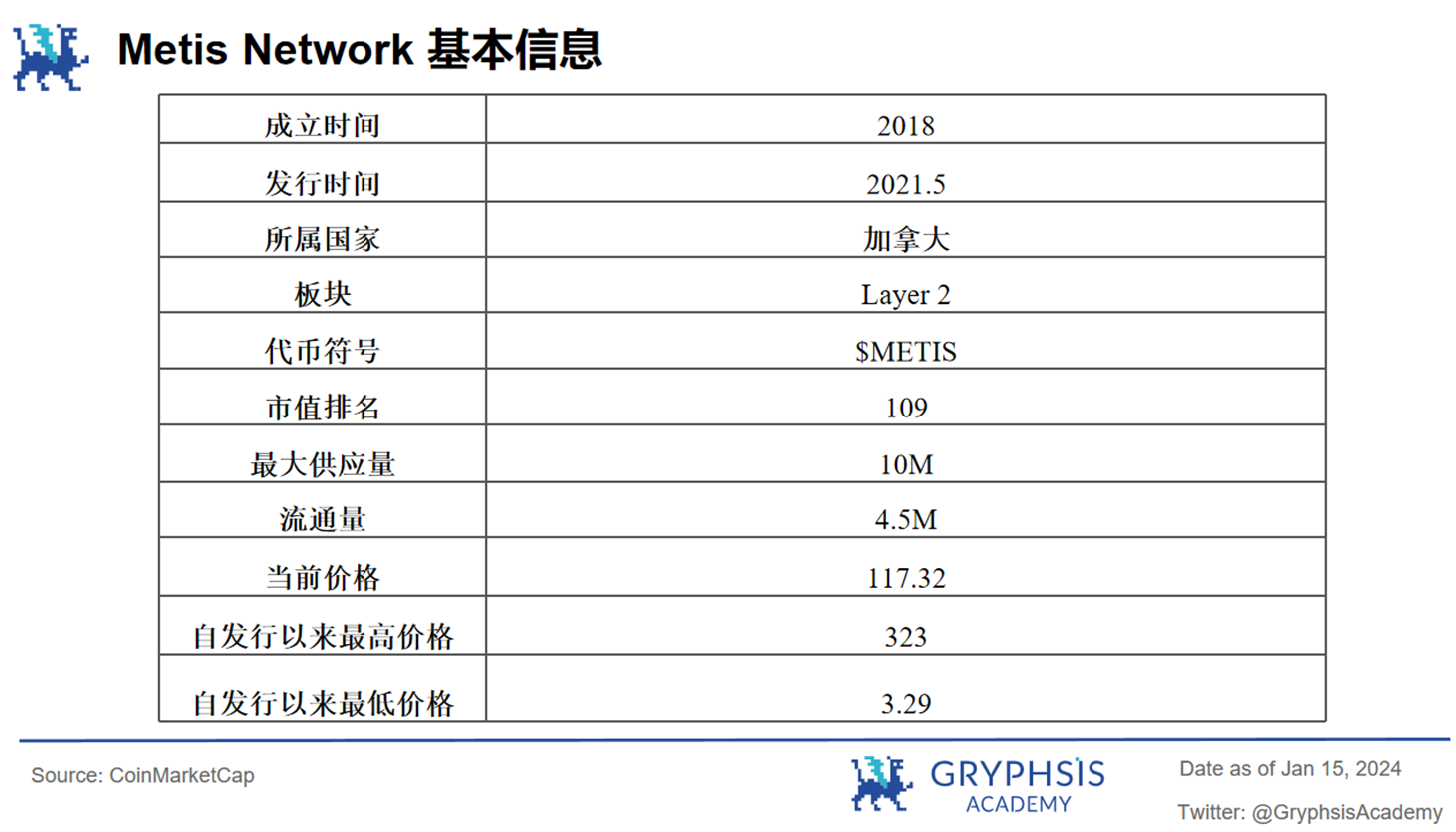
The native token of Metis is $METIS, with a total issuance limit of 10 M and will be issued in May 2021. The shares corresponding to advisors, founding teams, and investors have been unlocked, and the remaining tokens will be allocated to community development.
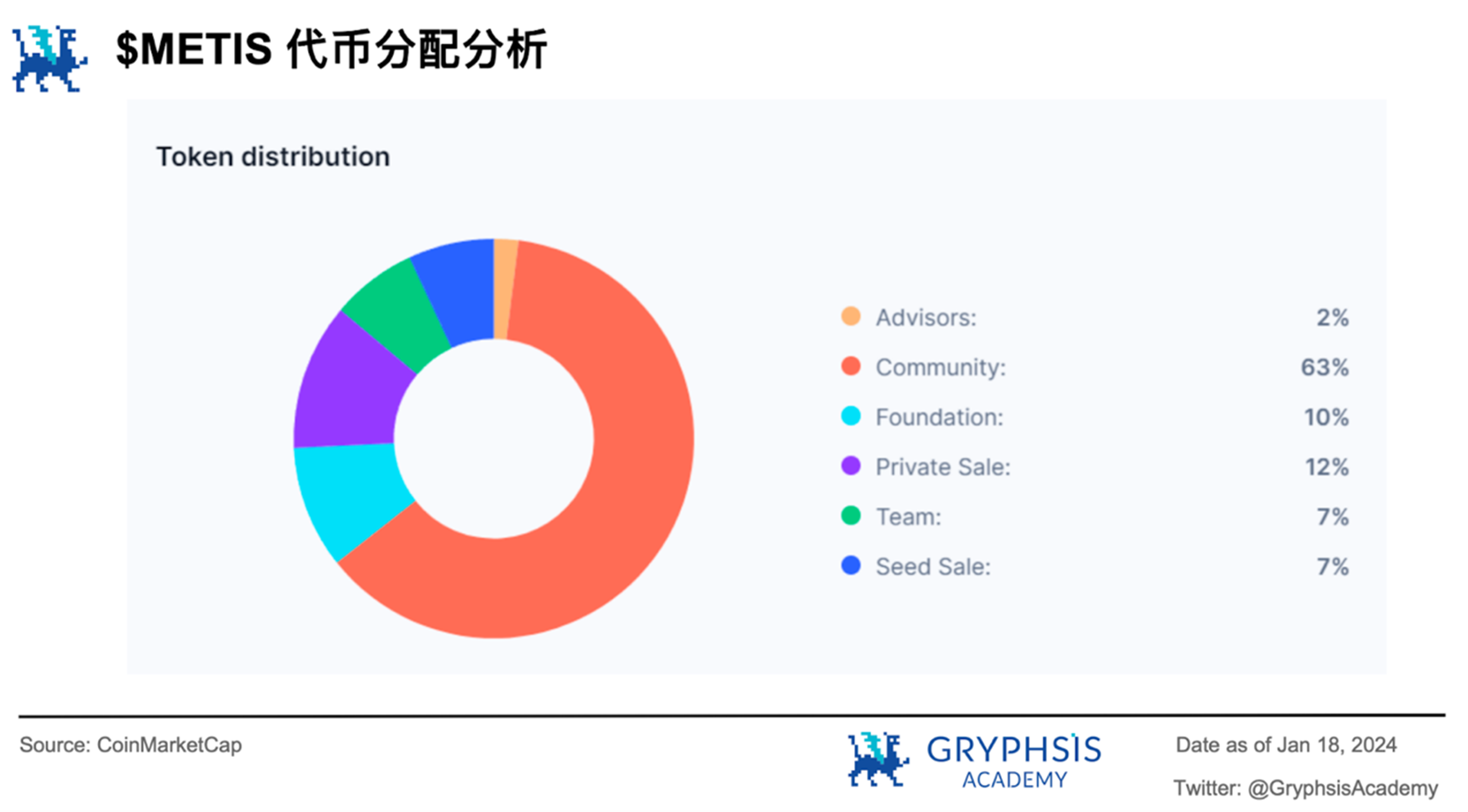
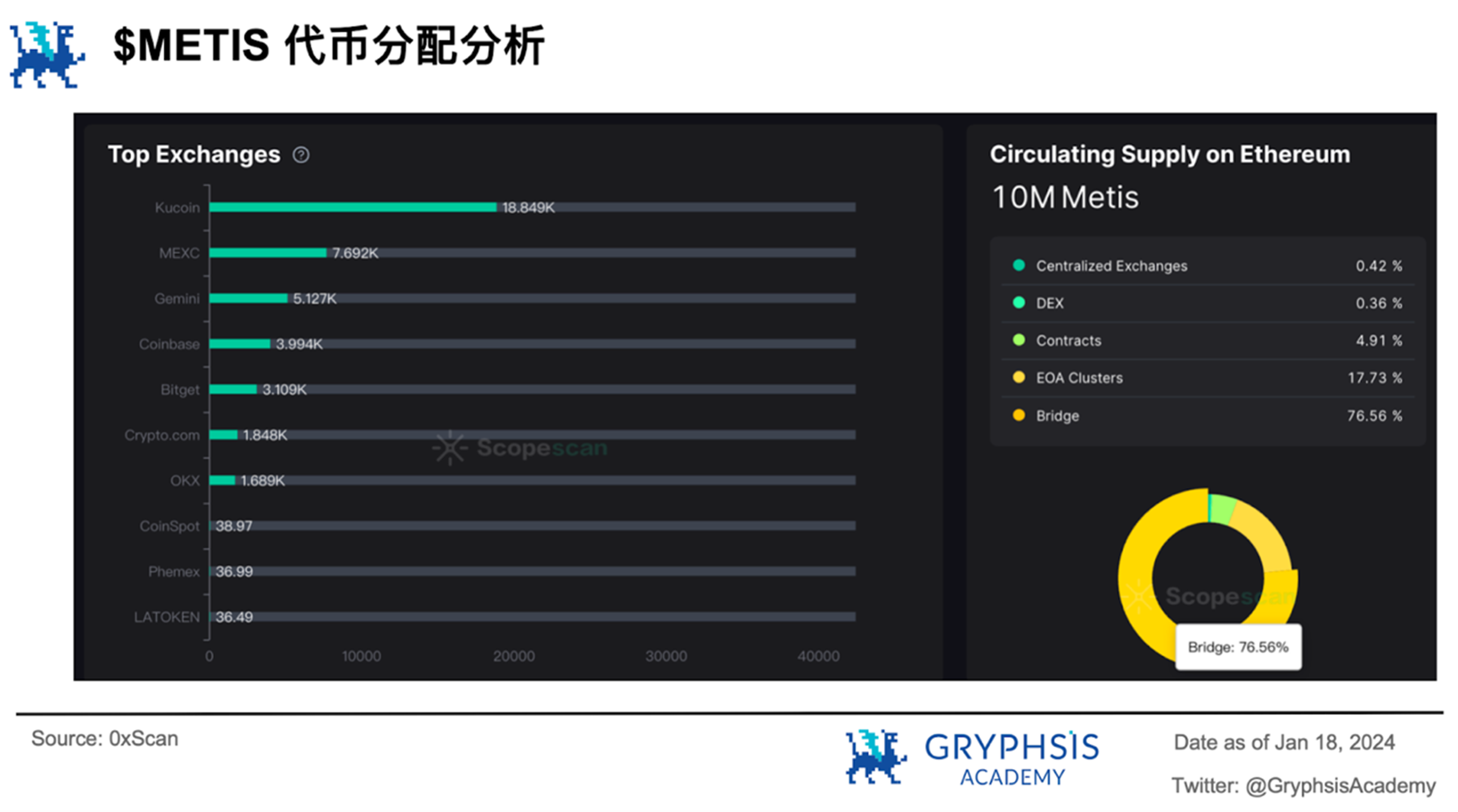
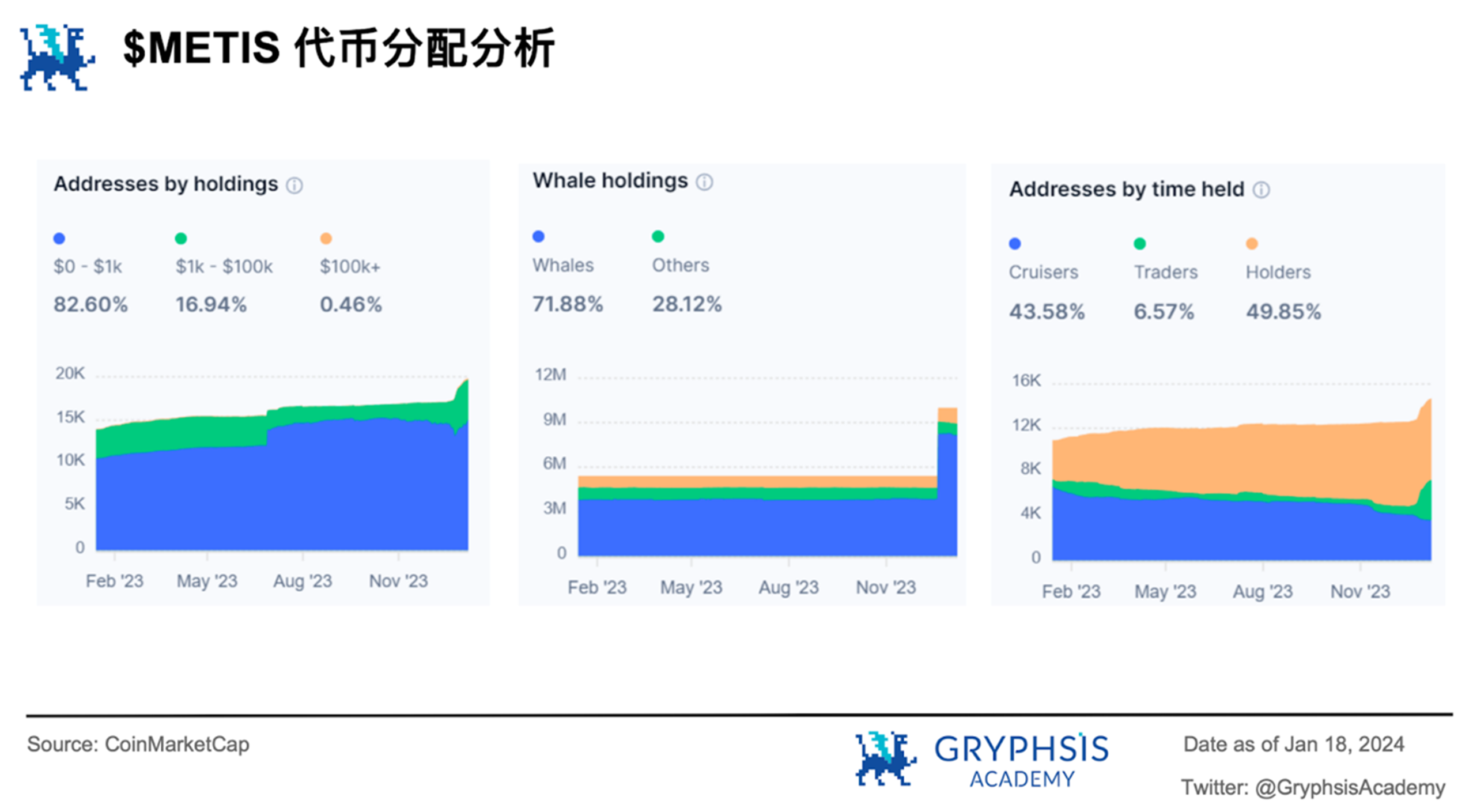
There are currently 4.5 M of $METIS in circulation. Through 0x scan analysis of the circulating supply, nearly 76.53% of the tokens are in Metis Bridge. EOA addresses hold 17.94%. The number of held addresses has increased by 17.5% in the past month. , and Holder is basically a long-term positive, with more than half of the holders holding $METIS tokens for more than 1 year. The token value of about 80% of holders does not exceed $1K, and only a few holders own tokens of more than $100K. From the perspective of holding amount, the distribution of tokens is relatively scattered and relatively decentralized.
In addition, among the CEXs that support $METIS, Kucoin, MEXC, and Gemini have the best liquidity.
4.2 Token usage
$METIS is mainly used for the following parts:
1) Network transaction fee: When users use Metis interactively, $METIS will be required as transaction gas. The network will return 30% of transaction fees to the protocol to support the development of the protocol.
2) POS staking: Nodes must pledge to participate in the network; at the same time (sorter) nodes can receive $METIS block rewards and staking rewards at the same time.
3) Community governance: Holding $METIS has ecological governance rights and participates in voting for network proposals.
$METIS Unlike other Layer 2 such as Optimsim, Arbitrums token can only be used for governance.$METIS has rich usage scenarios, which undoubtedly brings more purchase demand for tokens. At the same time, it controls market circulation through token pledge. The two-pronged approach has caused the price of $METIS to increase by 299.82% in the past month (of course, this does not exclude the active participation of project parties). other factors in doing things).
And the CEX currently online on $METIS does not include well-known exchanges such as Binance. If the decentralized sorter test can be successfully completed and the single point of failure of the sorter and the core problem of evil Layer 2 are solved, I believe that $METIS and the ecosystem will have quality. leap.
5. Ecological projects
Metis current ecosystem covers Defi, Infrastructure, Wallet, Gamefi, DEX, SocialFI, NFT, Bridge, etc., among which the Defi and infrastructure categories are the majority in the ecosystem. Among them are WAGMI developed by the famous developer Daniel (who once brought 1 billion US dollars in TVL to the Fantom ecosystem), as well as rising star projects that have been launched on the test network such as League Tech, Hercules, Enki, etc. Next, we will focus on introducing them one by one. .
1) WAGMI

WAGMI (formerly Popsicle Finance) officially deployed to Metis on January 10 and received a Grant of $2M from Metis.
WAGMI is developed by well-known developer Daniele Setagalli. Daniele has attracted billions of dollars in ecological projects for the Avalanche and Fantom ecosystems. The WAGMI developed by it will settle in Metis, whether in terms of industry influence, development technology, or ecological resources, etc., it will undoubtedly greatly enhance the markets benefits to Metis and increase market value expectations.
As a comprehensive Defi solution, WAGMI currently provides functions such as Swap, liquidity pool and GMI, and will support arbitrage robots, perpetual trading, etc. in the future.
Once it supports perpetual contract trading, it will allow the creation of liquidity pools for leveraged trading without permission. Liquidity pools can also be created for users to use ecosystem projects such as Revenant, Hummus, Netswap, Athena, Tethys, etc. Transactions with native tokens greatly expand users’ trading space and bring higher activity and liquidity to the ecosystem.
In addition, on January 2, WAGMI announced its cooperation with DWF Labs market maker, and DWF purchased 26.6 million $WAGMI. Whether it is the development of this project or the strategic deployment on Metis, WAGMI and Daniele behind it are likely to have a strong positive impact on Metis.
2)Enki

ENKI is the first Native LSD protocol on Metis and is launching a decentralized sequencer based on Metis Sequencer.testnet(Opened on January 19th).ENKI is an important part of the Metis node and aims to simplify the staking process of the orderers in the Metis ecosystem to increase staking returns so that even users holding less Metis can participate.
Users can earn income by staking $METIS. Metis decentralized POS Sequencer community test requires each Sequencer to stake 20,000 $METIS. For nodes with insufficient funds, they can go to the ENKI platform to allow community users to participate in node staking and obtain node testing incentives and node mining incentives.
At the same time, ENKI, as Metis, will focus on the LSD track in the near future, and the platforms TOKEN will have important value in the Metis ecosystem.
Overall, ENKIs solution lowers the threshold for user participation, enables more users to participate in the Metis ecosystem, and provides a more inclusive and efficient staking and revenue platform.
3) League Tech

League Tech is a SocialFi platform on Metis, similar to Friend.tech on Metis, introducing new features such as shorting mechanism, dynamic reputation, badge system, league creation and betting, and three-tier access model, etc.
It is currently actively deployed and ready to participate in community testing.
4)Hercules

Hercules is a DEX developed exclusively for Metis using CamelotDEX technology, providing a variety of Defi financial services. It mainly provides the following types of services:
I) Dynamic AMM: Support dynamic asset liquidity based on UniSwap V2 model
II) Directional Swap Fee: Customize the fee based on direction (buy or sell)
III) NFT Liquidity Position: Obtain non-fungible collateralized positions (spNFTs) after opening a position and enjoy additional composability to achieve greater capital efficiency.
V) Customized Launchpad: A customized platform that provides multiple token issuance strategies: fair issuance, recommendation, discount, airdrop, whitelist, etc.
Hercules has rich financial services and is committed to becoming the premier DEX for Metis by creating a wide range of financial instruments.
5) NUVO
Metis first inscription project, Nuscriptions, has NIP-20 and NIP-721 protocols and provides an efficient DeFi solution by solving the problems of congestion and high fees, which can be used for inscription deployment, minting and transfer.
It mainly contains two main product functions:
1) NuMarket: A dynamic trading platform for asset flows between EVMs and Inscriptions, enhancing accessibility and market dynamics.
2) NuDex: A specialized derivatives trading market that can initiate transactions at 0 cost (no $METIS Gas required). It provides functions such as perpetual contract trading, margin trading, spot trading, lending and borrowing, and provides a cutting-edge financial experience.
As an inscription protocol, NUVO also provides asset flows and derivatives transactions, providing rich support for the liquidity of other assets such as inscriptions.
In addition, in addition to these emerging protocols, some leading Defi applications also actively support Metis, such as AAVE, Stargate, Sushi, etc., bringing a large number of users and liquidity to Metis. The support of these top DeFi applications not only verifies the reliability and stability of Metis technology, but also greatly improves Metis market recognition and influence.
Of course, Metis also has some native projects worth paying attention to, such as NetSwap (the first native DEX), Tethys Finance (financial services platform), Hummus Protocol, etc. Taking advantage of Metis’ technical advantages, especially the Defi category, it also improves user experience and ecological support. Not easy to underestimate.
6 Conclusion
Since its inception, Metis has grown as its co-founder is"Vitalik Buterin’s mother/best friend"The identity of the company has attracted widespread market attention, whether as a gimmick or a real existence. This market popularity has brought a lot of beneficial exposure to Metis.
Metis current ecological projects are booming, covering all the hot spots in the market, such as Inscription NUVO, League Tech (Friend.tech) on the social level, Enki on the LSD track, etc., as well as many well-known developers such as Daniele (who has given Fantom brings billions of TVL) and others to settle in. We can see with the naked eye that Metis has accurately captured and applied market enthusiasm, and its prosperous ecosystem and active developers have undoubtedly laid the foundation for the explosion of Metis.
Metis has recently launched many ecological incentive projects totaling billions of dollars. While maintaining existing projects, it attracts more high-quality projects to be deployed on Metis, constantly expanding the ecological territory, and its positive attitude has also brought great changes to the ecosystem. Small volume and application growth.
Compared with other Layer 2, Metis first focused on decentralized sorters to make key breakthroughs. By creating a sorter pool and node staking mechanism, and currently promoting community testing, it not only maintains network security and decentralization, but also sorts. The unfair profits of the sequencer are returned to the community, solving the problem of centralized single sequencer that other Layer 2 has always had.
The $METIS token is more effective than other Layer 2 tokens. From network fees, node staking to governance voting, $METIS not only serves as a value target, but also contributes to network development.
References
https://research.web3 caff.com/zh/archives/13877? ref= 964
https://www.techflowpost.com/article/detail_15652.html
https://www.techflowpost.com/article/detail_15313.html
https://foresightnews.pro/article/detail/10817
https://candidac.org/t/proposal-decentralize-testnet-sequencer-and-activate-community-testing/1032
https://x.com/2lambro/status/1745032998561669416?s=20
[Statement] This report is@GryphsisAcademystudent@auggest_cryptooriginal work. The authors are solely responsible for all content, which does not necessarily reflect the views of Gryphsis Academy, nor the views of the organization that commissioned the report. Editorial content and decisions are not influenced by readers. Please be aware that the author may own the cryptocurrencies mentioned in this report. This document is for informational purposes only and should not be relied upon for investment decisions. It is strongly recommended that you conduct your own research and consult with an unbiased financial, tax or legal advisor before making any investment decisions. Remember, the past performance of any asset does not guarantee future returns.





