Interpretation of 10,000 words: What exactly is Nostr?


Original author: 0x00pluto (X: @0x00pluto)
Question: What exactly is Nostr?
In the process of continuous digging, I found a large amount of article information from the Internet (special thanks to the authors of these articles), so I organized the information according to the structure.
On the one hand, I hope it will be useful to everyone, and on the other hand, I will make a summary to improve the learning effect.
Because of my love, I continue to learn and explore~
Let’s first introduce the project in plain English.
Project Nostr, imagine a borderless social square where everyone can talk, share and listen freely, with no central broadcast tower and no dedicated broadcaster. It is a decentralized social network that does not rely on any single server or company to store and manage information. Instead, it uses a decentralized approach where everyone can set up their own relay, just like adjusting the radio frequency at home, to receive messages from others.
In this network, your identity is protected by a pair of keys—one public and one private, a bit like your home email address and keys. Your address is public, so people know where to send letters, but the key is private, so only you can open your mailbox and retrieve your mail. Every message you send is signed with your private key, ensuring that the sender is you, just like signing the letter yourself.
Nostr is like a vast ocean of countless small mailboxes. Everyone is free to throw messages into the sea, and others can choose to monitor your channel and pick up these messages. There is no central control, everyone is the master of their own voice, building a social network that truly belongs to everyone.
For those of you who need to briefly understand the project, this is enough. Below are the complete study notes.
0.Project Introduction
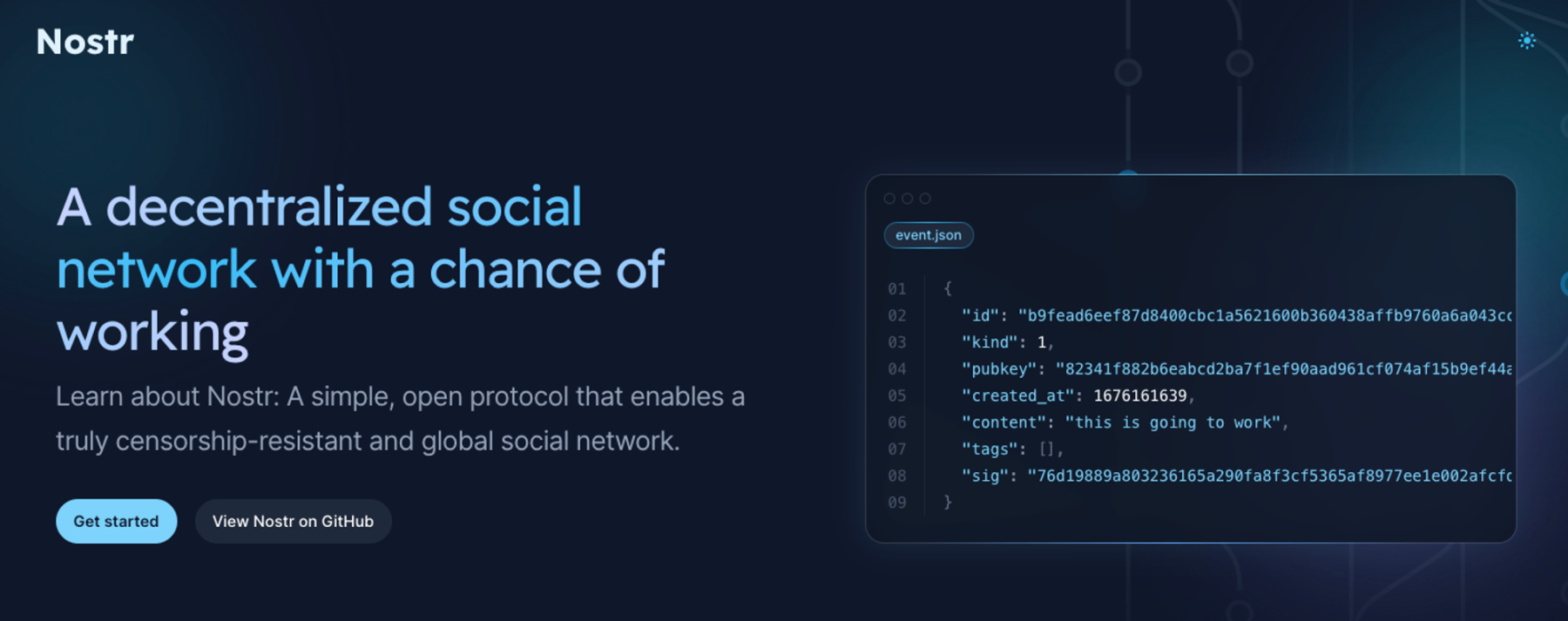
Nostr is a decentralized social network protocol that provides an open and permissionless social platform through a distributed network.
1. Research points
1.1. Core investment logic
Team: Currently, there is not much information about the specific members of the Nostr team. However, depending on the open source nature and decentralization philosophy of the project, the team may be composed of developers across disciplines who collaborate to advance the project.
Financing: As an open source protocol, the Nostr project has no clear financing information. Open source projects often rely on community support, which may include donations, volunteer contributions, and possibly sponsor support.
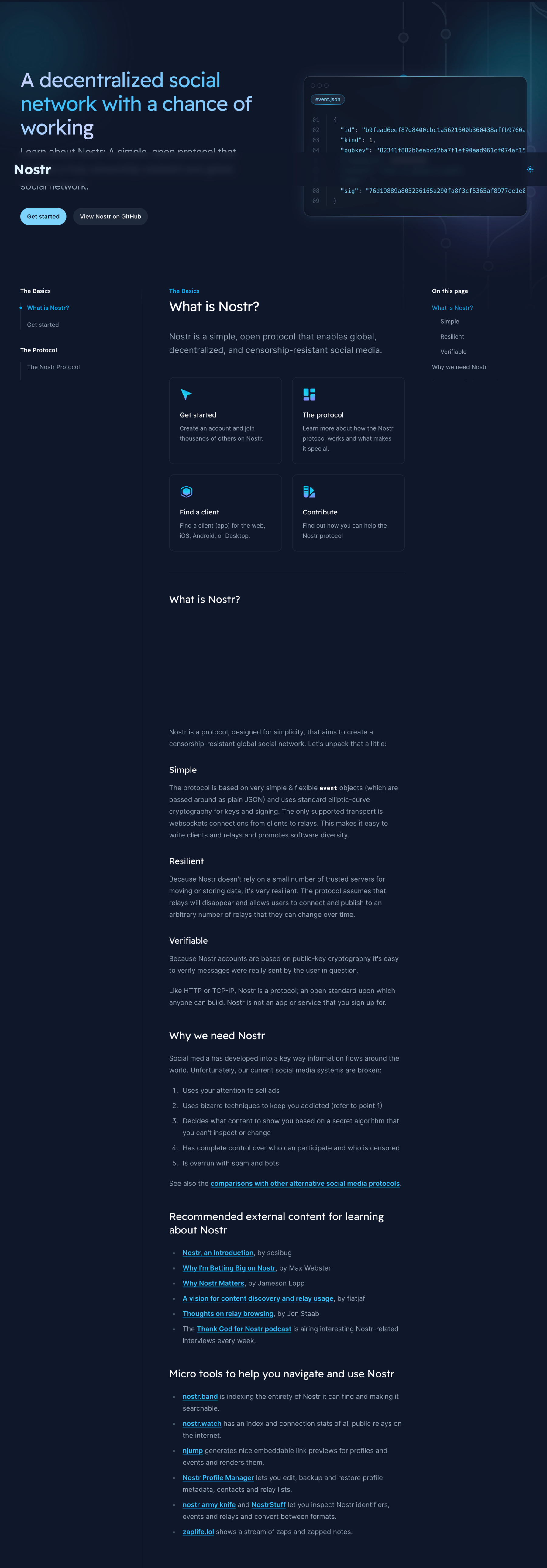
Technical aspects: Nostr uses concise data structures and network protocols to implement its functions. Event is the basic unit of data, and Relay is the node used to deliver events. Users interact with Relay through the client to complete functions such as information publishing and subscription.
Track: The decentralized social network track where Nostr is located is gradually becoming a hot spot in the field of blockchain and cryptography, especially in terms of privacy protection and censorship resistance. The potential of this track continues to grow as users’ awareness of social platform autonomy and data ownership increases.
1.2. Valuation
Since Nostr is an open source project and has not been commercialized, there is currently no clear market valuation. Valuation usually requires consideration of multiple factors such as user base, business model, revenue stream and market potential, and this information is not applicable or fully transparent to Nostr.
1.3. Project risks
Technical implementation risks: Nostr relies on the stability and scalability of decentralized technology, and any technical flaws may affect user experience and system security.
Market acceptance: Decentralized social networks have not yet been widely accepted by the public, and user habits and market education may be challenges.
Regulatory risks: Different countries and regions have different legal attitudes towards encryption technology and decentralized applications, and there may be regulatory uncertainty.
Security risks: As a decentralized network, Nostr may face security threats, including but not limited to 51% attacks, node collusion, etc.
In summary, Nostr, as a decentralized social protocol, demonstrates a unique way of building a social network, but it also faces implementation challenges and market risks. Investors should fully evaluate these factors when considering supporting such projects.
2. Project Overview
2.1. Basic project information
Nostr is a decentralized protocol designed to create a censorship-resistant global social network. It does not rely on a central server, uses encryption keys and signatures to secure communications, and forwards posts through multiple relay servers.
2.2. Team situation
2.2.1. Overall situation
The overall situation of the Nostr project team is somewhat mysterious, because as a decentralized open source project, it does not have a clear team structure like a traditional company. Initially, discussions on Nostr began in a Telegram group in November 2020, where participants discussed the possibility of a decentralized social network and ways to fund such a project. From the beginning, team members have been thinking about how to effectively promote the Nostr platform.
2.2.2. Core members
The founder of Nostr is Fiatjaf, who is also a developer of Bitcoin and Lightning Network. He provided important technical support for the establishment of Nostr. Former Twitter CEO Jack Dorsey also expressed support for Nostr and joined the project as a supporter and spokesperson, providing funding for it. Both of these two are key figures in the project. Their addition not only increases Nostrs visibility, but also adds trust and credibility to the development of the project.
2.3. Financing situation
Nostr is an open source decentralized social network protocol, so its financing situation is different from traditional commercial companies. Judging from the information obtained so far, Nostr has not experienced a financing round in the traditional sense. In the early days of Nostrs development, community members may have participated in the construction and development of the project as volunteers out of love for the project and support for the concept of decentralization. As the project developed, former Twitter CEO Jack Dorsey donated 14 Bitcoins to Nostr. This support may be one of the ways Nostr obtains funds. Information about other investors has not yet been identified.
2.4. Past development and roadmap
2.4.1. Past development
The Nostr project started in 2020, and its decentralized features and censorship resistance have attracted attention since its inception. The growth of the project is closely related to the active participation of the community, especially when Jack Dorseys participation greatly increased the visibility of Nostr, which had a positive promotion effect on the development of the project.
2.4.2. Current progress
Currently, the Nostr protocol already has multiple client applications, such as Damus based on the Nostr protocol, which is designed as a decentralized social platform. The emergence and development of these applications shows that the Nostr ecosystem is gradually growing.
2.4.3. Development plan and roadmap
Although there are currently no specific development plans and roadmap details, Nostr’s openness and decentralized features have attracted active exploration and innovation from many developers and community members. Based on the activity level of the community and current development trends, it is foreseeable that the Nostr ecosystem will continue to develop in the future, and more business models and applications may emerge.
3. Project analysis
3.1. Project background
The context in which the Nostr project emerged is multifaceted. First, it is a reflection and innovation on the existing social media model, especially in terms of censorship resistance and decentralization. Second, Nostr emerged as a response to data privacy violations and censorship policies under the control of centralized social platforms. Against this background, Nostr aims to redefine people’s online social experience through a decentralized approach that enables users to bypass the control and censorship mechanisms of centralized social media companies.
3.1.1. Development background
The design concept of the Nostr protocol comes from challenging the existing social media model, especially the pursuit of freedom of speech and resistance to censorship. Due to censorship and privacy issues on existing social platforms, people are gradually seeking a more open and free social network environment. The core idea of Nostr is to provide users with a censorship-resistant social experience through a decentralized network protocol.
3.1.2. Technical background
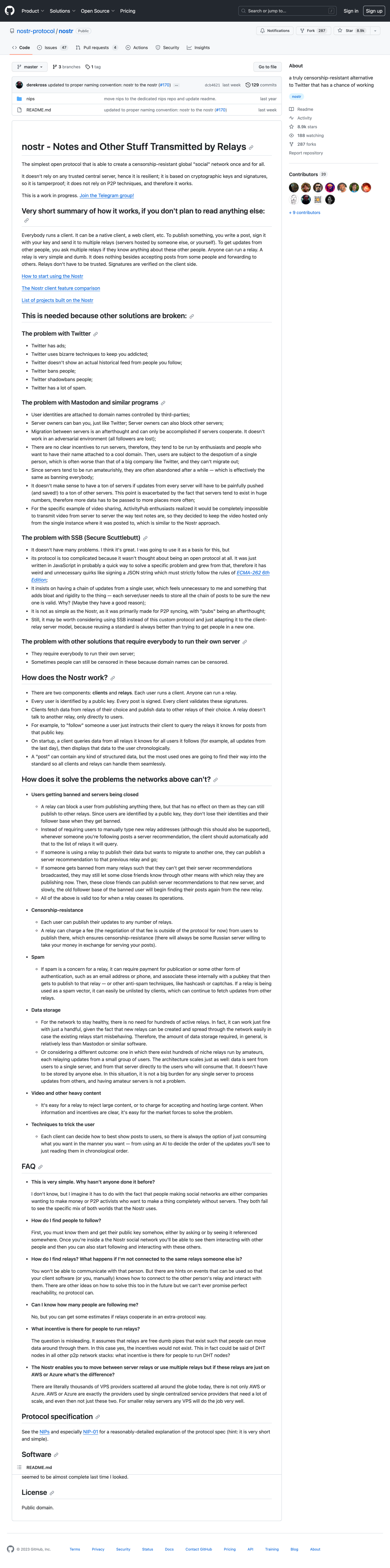
Technically, Nostr adopts an account system based on public and private key pairs, which does not rely on traditional usernames and passwords, but uses a public and private key system similar to cryptocurrency, which increases user anonymity and security. The public-private key pair is the core of a users identity. The public key is similar to a username, and the private key is used for signatures, ensuring that the source of the information is verifiable and secure. Nostr does not rely on any central server, but operates through clients and relays, where relays are responsible for forwarding messages between users but do not store any information, so there is no single point of failure or possibility of censorship.
Against this technological backdrop, Nostr seeks to break down the control traditional social media companies have over user data, and the censorship policies they may impose. This design gives users more autonomy and freedom of speech. In addition, Nostrs technical architecture and philosophy are also closely linked to the concepts of cryptocurrency and Web3. Its close integration with the cryptocurrency community is also one of the reasons why it has gained attention.
3.2. Project principle
The core idea of the Nostr project is to build a concise, open source decentralized social protocol. Its goal is to create a global, censorship-resistant social network platform. Nostr works based on several basic concepts, including public-private key pairs, clients, and relays. Together, these elements support the operation of the Nostr protocol.
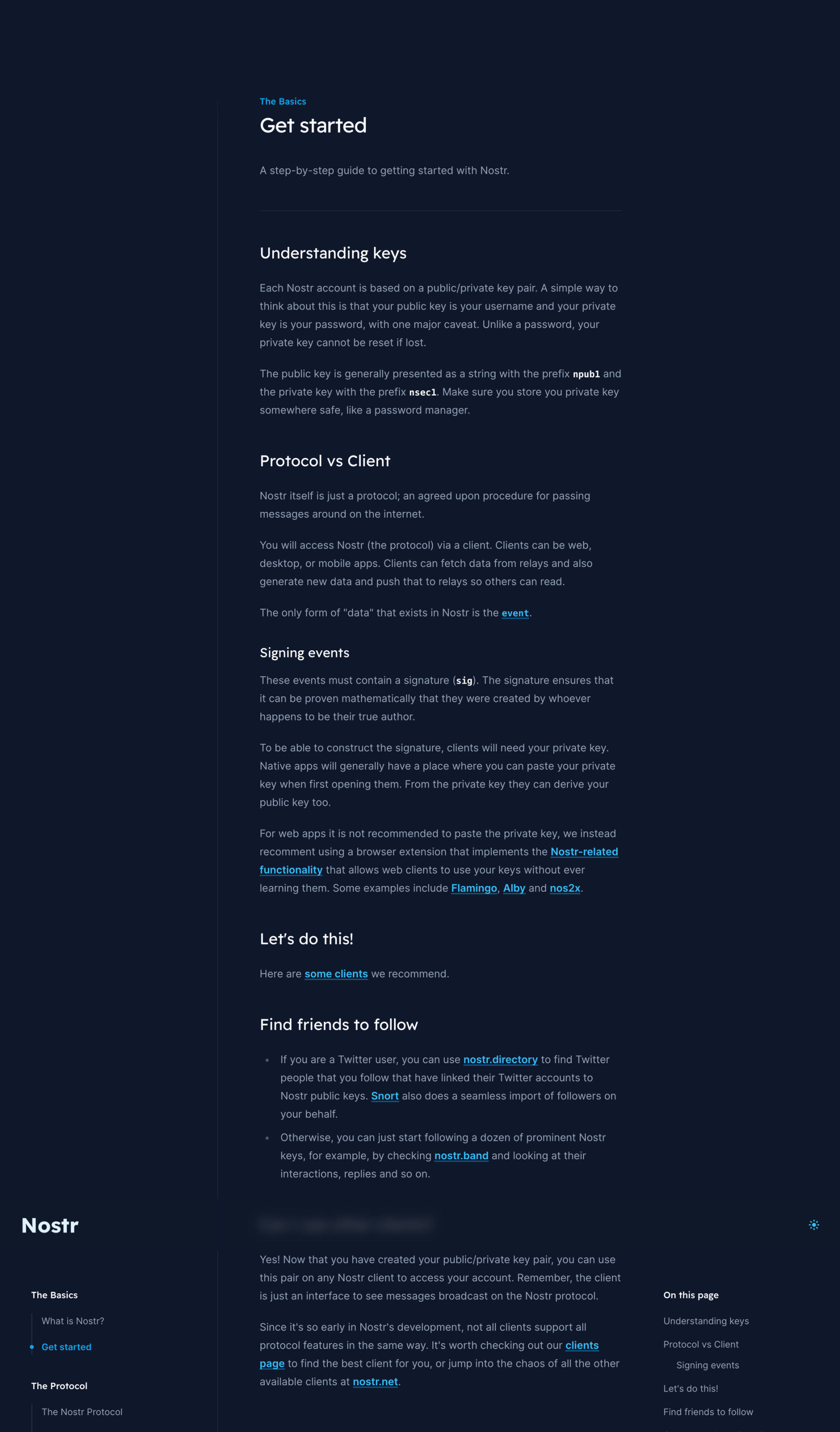
The public-private key pair is the basis of the Nostr account, similar to the identity authentication method of cryptocurrency, where the public key is equivalent to the username and the private key is the password. This design ensures the security and privacy of user identities, but also means that once the private key is lost, it cannot be reset like a traditional password.
Nostr does not rely on any central server, but operates through cryptographic keys and signatures. Each user runs a client, which can be a local or Web client, and performs content publishing and updates through the repeater. Users need to sign content with their own keys and send it to multiple relays, which can be other users or their own hosted servers. To get updates, users can query these relays for information. This design of Nostr allows anyone to run a relay, simplifying the data transfer process, while also ensuring that the relay does not need to be trusted because all signatures are verified on the client side.
Nostr aims to allow each relay (repeater) and even each user to control their own data, reducing dependence on third-party services, which is in contrast to the way some existing social platforms such as Twitter operate. Platforms such as Twitter may restrict users due to business models, censorship policies and other factors, while Nostr attempts to solve these problems through a decentralized approach.
The key principle and core business logic of this project lies in its decentralized structure and key-based user authentication system, which are designed to create a durable social network space that is not controlled and censored by a central authority. This approach allows users to communicate and publish content freely without sacrificing privacy and security.
3.3. Project technical characteristics
The Nostr project leverages a number of key technical features to achieve its vision of a decentralized social network. The project uses a unique service framework that includes the client and the so-called Relay. In this framework, the client can connect to one or more Relays distributed in different locations, but these Relays do not communicate directly with each other and remain independent.
This structure allows clients to run independently of each other and independently of the Relay, which acts as a data store. Users can share their Relay access URL privately on some centralized social platforms or through other software, so that other users can load the data stored in the corresponding Relay through the Nostr client software to achieve communication.
Users need to meet two conditions when using the Nostr application: download the Nostr client software and subscribe to Relay. Users can choose to build their own Relay server or subscribe to existing public Relay services. Public Relay that provides registration functions has also appeared in the Nostr ecosystem. Users can use them to generate key pairs and use services without building a Relay server by themselves.
In terms of technical implementation, when the client sends data to Relay, it needs to send the data to all subscribed Relays. This is a requirement of the protocol, although it is not mandatory. Regarding accounts, Nostrs user accounts do not rely on Relay and can be generated directly locally on the client. The private key is used as the password and the public key is equivalent to the account number.
In terms of data transmission, the websocket protocol is used for data transmission between the client and Relay, and the data format is Json. The standard data format follows a simple structure: [command, parameters, parameters...]. For example, when the client publishes an event, it will use the EVENT command and attach event data in JSON format. The specific action of the event depends on the value of the parameter kind.
3.4. Project ecological application
Nostrs ecosystem includes multiple projects, in addition to Damus, an iOS application based on the Nostr protocol that provides basic social media functions such as homepage, private messages, search, and notifications. Another app is Amethyst, which is only available on Android and provides group chat functionality. A key feature of these products is that users do not need an account and password, but use a private key to log in and a public key as an ID.
In addition to these applications, Nostr also recommends a number of front-end social applications, such as Anigma, Branle, Nostr.ch and Nostros, each of which provides users with different styles and different running environments of the front-end world. In total, the Nostr ecosystem has developed 46 projects so far, including some interesting small applications, such as NIP-05 (a unique domain name specification proposal), Jester (an online chess game based on Nostr), Blockcore Notes (a note-taking app that supports Nostr and Web5) and NostrID (a Nostr ID management app developed for iOS).
As for the projects operation process, Nostr focuses on the social infrastructure at the protocol layer, while the specific productization capabilities are implemented by third-party apps. Users social behaviors between different apps are interoperable. This design makes Nostr’s ecosystem both decentralized and flexible.
3.5. Project data
The data of the Nostr project since its launch has shown a certain growth trend. Discussions on the Nostr project in Telegram began on November 16, 2020, focusing on issues such as the possibility of a decentralized social network and financial support. The team then continued to explore and develop its browser-based application over the next period, and in December began discussing technical issues such as using private keys and standardizing event types. In December 2022, former Twitter CEO Jack Dorsey joined Nostr as a supporter and spokesperson, which brought a significant increase in attention to the project, and the number of stars of the Nostr protocol on GitHub increased significantly. As for social media data, the number of users of the Damus app has exceeded 720,000 in just a few days. The data shows the development and user acceptance of Nostr from its initial stages to the present day.
4. Industry space and potential
4.1. Track analysis
4.1.1. Project classification
The Nostr project falls under the category of social media protocols and aims to solve the censorship and data ownership issues of existing social platforms through a decentralized approach.
4.1.2. Market (track) scale
From the beginning of the 21st century to the present, the rapid development of social media has given birth to many social media giants, such as Twitter, WeChat, Instagram, etc. With the rise of the concept of decentralization, social media protocols have begun to focus on censorship resistance and immutability, which provides a broad space for development of projects such as Nostr.
4.1.3. Core competitive factors
The main competitive advantages of decentralized social media protocols, such as Nostr, over traditional social media platforms are decentralization, permissionlessness, and censorship resistance. Projects like Nostr use these selling points to attract users from existing markets and fight against centralized social media giants.
4.2. Competitive product analysis
As a decentralized social network protocol, Nostr may face competing products including ActivityPub, Farcaster and Lens Protocol. These protocols or platforms are also committed to building a decentralized social network ecosystem, each with different technical characteristics and community development strategies. Nostrs competitive advantage may lie in its simple and scalable design, as well as its emphasis on privacy and user autonomy.
5. Preliminary value assessment
5.1. Core issues
Question 1: Which business cycle is the project in?
The Nostr project is currently in the early stages of development. Since its launch in November 2020, Nostr has been gradually developing its social protocol. By the beginning of 2023, the Nostr protocol and its Nostr-based application Damus began to experience a surge in the number of users, with the number of public keys reaching 500,000+, showing a rapid growth trend.
Question 2: What are the main operational variables of the project?
The main operating variables of the Nostr project include the simplicity of the technical architecture, the resolution of user trust issues, and its de-tokenized economic model. It operates by the simplest way of sending information outbound using public keys. User growth and community formation rely on Nostrs censorship resistance and openness, but these factors are currently difficult to quantify and measure.
Question 3: What is the management and governance method of the project?
Searches have not yet found clear information about Nostrs management and governance methods. Nostrs design philosophy tends to be decentralized and liberal, presupposing a simple operating mode for clients and relays, and leaving economic incentives and other aspects to the market.
Question 4: Does the project have a solid competitive advantage?
Nostr’s competitive advantage lies in its minimalist technical design and its ability to resist censorship. Users are free to use multiple relays and constantly change them to maintain freedom and privacy of communication. In addition, support for Bitcoin and the Lightning Network also provides Nostr with unique advantages.
Question 5: How does Relay work? Who can build it?
Relay, or repeater, is an integral part of the Nostr protocol and is responsible for delivering user messages to the network. Any individual or organization with a server can build its own Relay node. The setup process is not complicated. Users can choose various cloud servers or VPS hosts, and take advantage of the free trial services of some platforms, so that they can trial run Relay without incurring costs. Additionally, a domain name needs to be registered and resolved to the servers IP address.
Specific operations include using an SSH client to remotely log in to the server, installing the Umbrel tool, and installing the Nostr Relay application with one click through a simple command. After the installation is completed, the user can enter the domain name in the browser to access the backend, enter the app store to install Nostr Relay, and after everything is set up, you can start using the relay.
This process not only simplifies the technical threshold, but also enables anyone interested in decentralized social networks to contribute their part to maintain and enhance the health and vitality of the Nostr network.
Question 6: What is the relationship between Nostr and blockchain?
Nostr’s relationship with blockchain technology is indirect, they share the idea of decentralization but operate differently. Nostr is an open source decentralized social network protocol that is not a blockchain project but aims to provide infrastructure for decentralized applications. The Nostr protocol consists of a client and a relay. The client is responsible for signing and verifying information, which is operated by the user. The relay can capture, store and forward any connected client information to other clients. Anyone can run a relay, but unlike blockchains, Nostrs relays do not communicate directly with each other.
Nostrs design allows for the flexible use of various tags and event types so that users can customize their interactions based on specific scenarios. For example, add the ID of another event to the tag to reference the content, or add the ID of the event you want to be deleted to delete the posted content. This design makes Nostr highly flexible and scalable in terms of functionality.
The main difference between Nostrs operation and traditional blockchain projects is that Nostr does not rely on blockchain technology to maintain the network or verify transactions. It does not use a chain structure to store data, but relies on the relay to handle the transmission and storage of data. This means that Nostr does not require mining or other cryptocurrency-related mechanisms to operate. Therefore, the decentralized nature of the Nostr protocol mainly stems from its network structure and open source code characteristics, rather than blockchain technology.
In summary, Nostr is a decentralized social protocol that is independent of the blockchain. Its innovation lies in providing an open network that anyone can participate in, but it does not rely on blockchain technology to achieve its decentralization. goals. Nostr provides a decentralized platform through its unique client and relay structure. Anyone can build and run their own relay, thereby supporting the construction of decentralized social media platforms.
6. SWOT analysis
Strengths
Nostr is an open social protocol, which means anyone can build or modify the client, encouraging innovation.
Through Bitcoin rewards, it provides an economic incentive model that is different from traditional social media and reduces reliance on advertising.
Project Nostr has attracted attention and support from high-profile figures such as Jack Dorsey, which has increased its visibility and credibility.
Weaknesses
Currently, applications in the Nostr ecosystem are in their early stages, with imperfect functionality and bugs in the user experience.
A lack of enough users and content creators to join could limit its growth and influence.
Opportunities
As a decentralized protocol, Nostr has the opportunity to disrupt existing social media monopolies and attract users with high demands for privacy and free speech.
Other technologies, such as the Lightning Network, can be integrated to expand its functionality and application scenarios.
Threats
Regulatory pressure may pose challenges for cryptocurrencies and decentralized services.
Existing social media giants may take steps to suppress or imitate Nostrs features, thereby affecting its uniqueness.