






Potential impact of EIP-4844: To what extent can it improve scalability and reduce transaction fees?


Original author: 0x fan, Smarti Lab
Original compilation: Peng SUN, Foresight News
TL;DR:
1. We use two calculation methods to evaluate the possible reduction in gas fees, TPS (transactions per second) and the ability to accommodate Rollups after implementing EIP-4844.
2. It is estimated that EIP-4844 may accommodate more Calldata, ranging from 38 times to 192 times, with Calldata sizes of 10 KB and 2 KB respectively. Since more Calldata can be accommodated in the same block, the cost per unit of Calldata will also be reduced accordingly.
3. Assuming that the Calldata size of each Rollup is uniformly 2 KB, EIP-4844 can only accommodate up to 384 Rollups.
4. Under normal circumstances (i.e. when the block reaches the target size), Ethereum will reach 175 TPS via EIP-4844, with a maximum of 350.
5. Contrary to popular belief, EIP-4844 alone is not enough to significantly improve Ethereum’s scalability.
6. Utilizing alternative DA layers (such as Celestia) or DAC (such as zkPorter), improving the compression rate of L2 transaction data and increasing the proportion of zk Rollups will have an important impact on further improving the scalability of Ethereum.
Proto-danksharding (also known as EIP-4844) proposes to implement most of the logic and rules that Danksharding may use in the future. Currently, due to the high storage cost on L1, the transition fee for L2 is also relatively high. To solve this problem, EIP-4844 introduces a new data type Blob, which is cheaper and larger than calldata, providing another way for rollup data storage.
With the upcoming launch of EIP-4844, L2 sequencers may become more profitable. This is because the sequencer is responsible for importing transaction batches into L1 and paying data fees, and the L1 data fees paid by the sequencer will be significantly reduced. Low transaction fees have the potential to generate more MEV by increasing the number of orders on L2.
The Cancun upgrade will include EIP-4844, but there is no exact time for the upgrade yet. The Ethereum Foundation research team stated that the Cancun upgrade may be launched at the end of October. However, it is more likely to be launched around the first quarter of 2024.
So, to what extent can EIP-4844 reduce transaction fees?Currently, L2 transaction fees mainly consist of two parts:
Rollup cost:The cost of packaging, submitting and storing transactions on Ethereum.
Execution cost:Cost of running transactions on L2
L2 Transaction Fee = Rollup Costs + Execution Costs
= [ L1 Gas Price * (Calldata + Fixed Overhead) ] + [ L2 Gas Price * L2 Gas Used ]
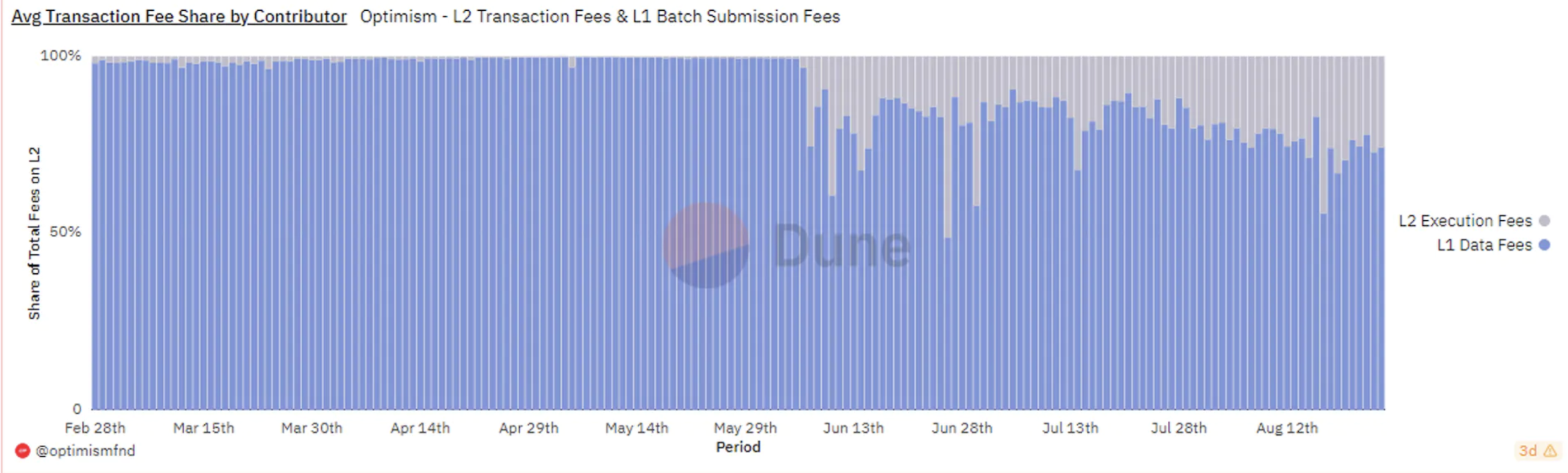
Taking Optimism as an example, currently, nearly 80% of the total transaction fees come from L1 storage costs (ie, Calldata costs). We ignore the impact of other fees for now and propose two methods to estimate how much L2 transaction fees may be reduced after EIP-4844.
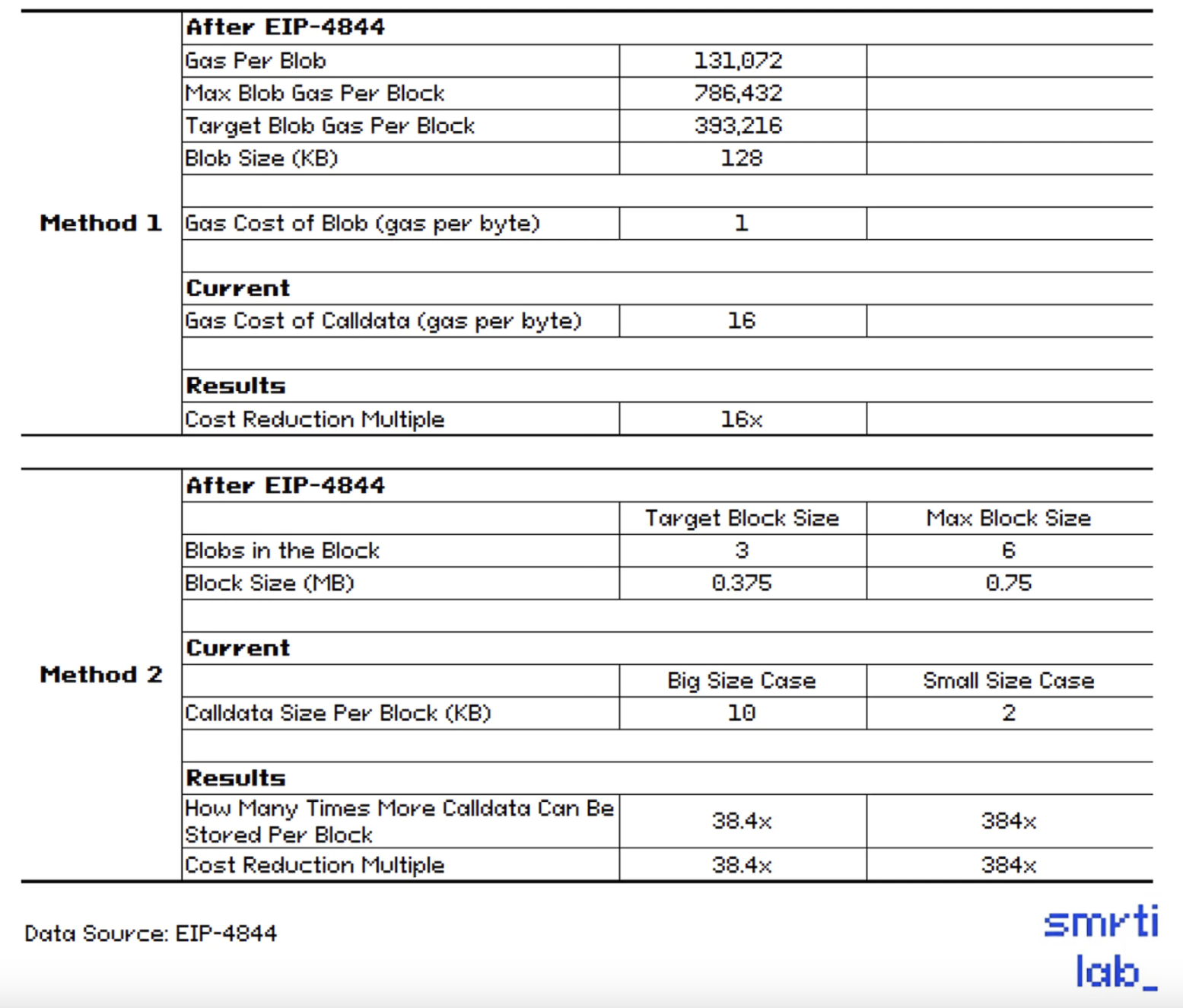
existEIP-4844 , after the proposal is implemented, the size of each Blob is 128 KB, and each Blob consumes 131,072 Gas. Therefore, on average each Blob data byte will consume 128 * 1024 / 131, 072 = 1 Gas. In comparison, currently storing a single Calldata byte consumes 16 Gas. This shows that the storage cost of L2 transactions will be reduced by 16 times.
However, this method only compares the storage cost per byte and does not consider the total Gas capacity of the block. Since the total amount of Gas that a single block can carry may change after EIP-4844, L2 transaction storage costs may be reduced by more than 16 times.
The second method considers the block size and checks the number of times the current Calldata can be accommodated under different block sizes. According to the current parameters, under the target block size scenario, a block can accommodate 3 blobs (0.375 MB) and a maximum of 6 blobs (0.75 MB). Considering that the current Calldata of each block occupies approximately2-10 KB, after EIP-4844, can accommodate up to 0.75 * 1024 / 2 = 384 times the Calldata.
However, as the block size increases from the target value to the maximum value, the gas price increases exponentially. therefore,In the more common case (i.e. when the block reaches the target size), EIP-4844 can accommodate 38 - 192 times the Calldata of 10 KB and 2 KB Calldata respectively.As the capacity of Calldata within the block increases, the storage cost of Calldata will also decrease accordingly. Therefore, the cost of L2 transactions will also be reduced accordingly.
In addition, assuming that the Calldata size of each Rollup is uniformly 2 KB, EIP-4844 can only accommodate up to 384 Rollups. This does not reach the thousands of rollups that many people envisioned.
Based on this, we can also derive the order of TPS that Ethereum can achieve after EIP-4844. Currently, an average L2 transaction costs approximately3000 GasCalldata. Considering that Calldata has a gas cost of 16 per byte, this indicates that each L2 transaction on L1 is approximately 187 bytes.
After EIP-4844, the target block size is 0.375 MB, and Ethereum generates a block every 12 seconds. Therefore, the available space per second is 0.375 / 12 * 1024 = 32 KB, which can accommodate 32 * 1024 / 187 = 175 transactions. Therefore, under normal circumstances (i.e. when the block reaches the target size), Ethereums TPS after the EIP-4844 upgrade should be 175, with a maximum of 350.
Although higher TPS can improve efficiency, it is worth noting that even with the implementation of EIP-4844, Ethereum is still not as good as Visa, which currently has a TPS of up to 1700. This gap may still cause L1 and L2 network congestion, especially in high-demand scenarios.
Therefore, EIP-4844 alone is not enough to allow Ethereum to achieve greater scalability.We still need a more cost-effective and efficient data availability solution to store more Calldata (such as a DA layer like Celestia or a DAC like zkPorter), which are still critical to achieve scalability.
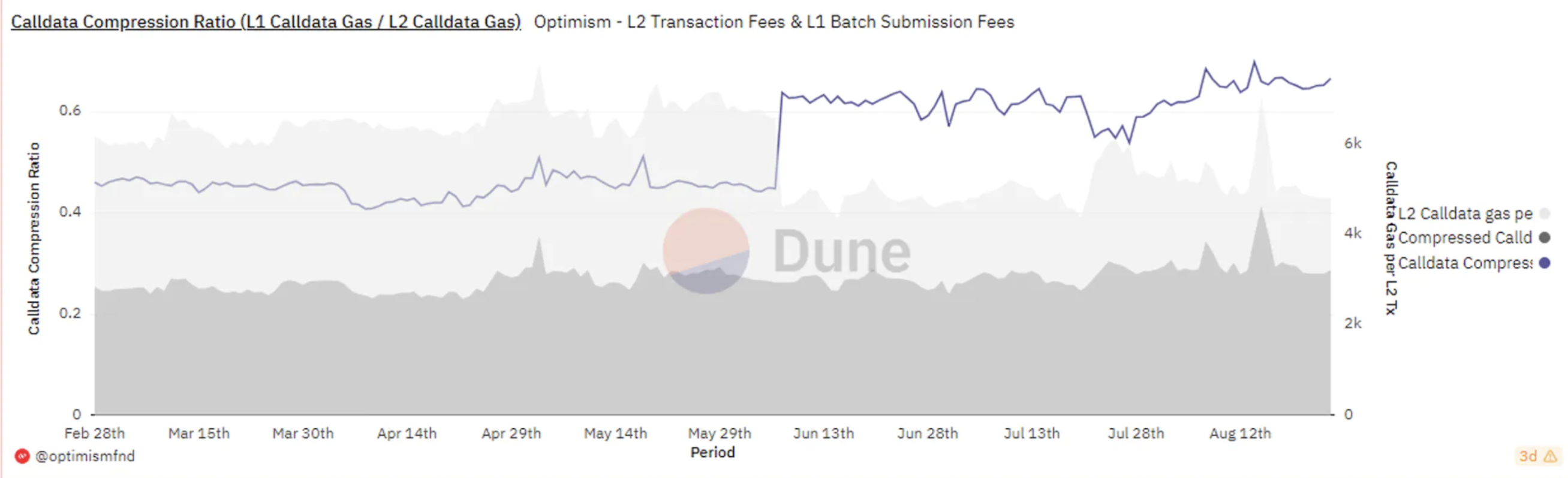
Finally, the compression ratio of L2 transactions directly affects the size of Calldata stored in L1. The higher the compression ratio, the lower the L1 cost required. As zkRollup continues to develop, the amount of data that needs to be stored on L1 will become less and less, which will also be more conducive to improving the scalability of Ethereum. Because zkRollup is different from Optimistic Rollup, zkRollup only needs to store state changes instead of the entire transaction.
in conclusion
In this article, we use two different calculation methods to evaluate the possible reductions in gas fees, TPS (transactions per second), and the ability to accommodate rollups after implementing EIP-4844. The results show that, assuming that the Calldata size of each Rollup is uniformly 2 KB, EIP-4844 can only support less than 400 Rollups at most. This is a far cry from the demand for thousands of Rollups that many expected. Utilizing alternative DA layers or DACs, increasing the compression rate of L2 transaction data, and increasing the proportion of zk rollups will all have a significant impact on further improving Ethereums scalability.


