






Building Future Finance: Prospects and Opportunities of NoFi


Original author: Ben Basche
Original compilation: Block unicorn
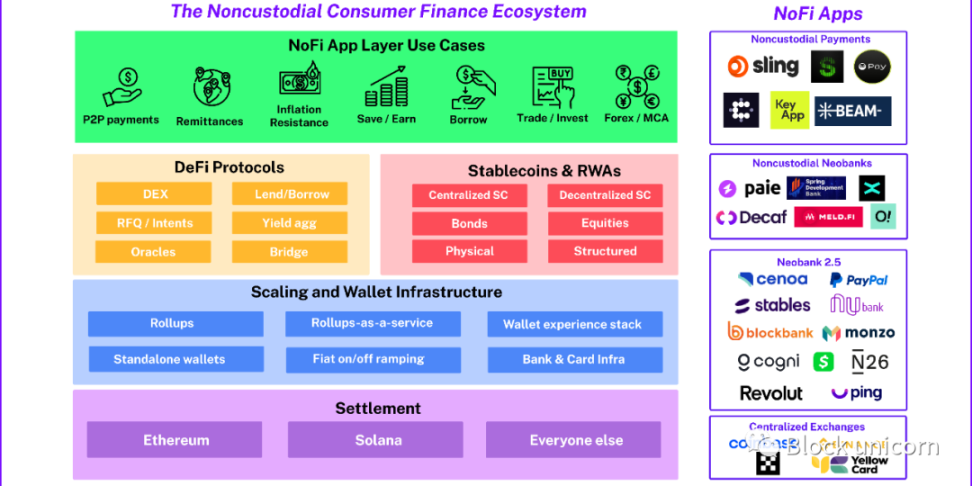
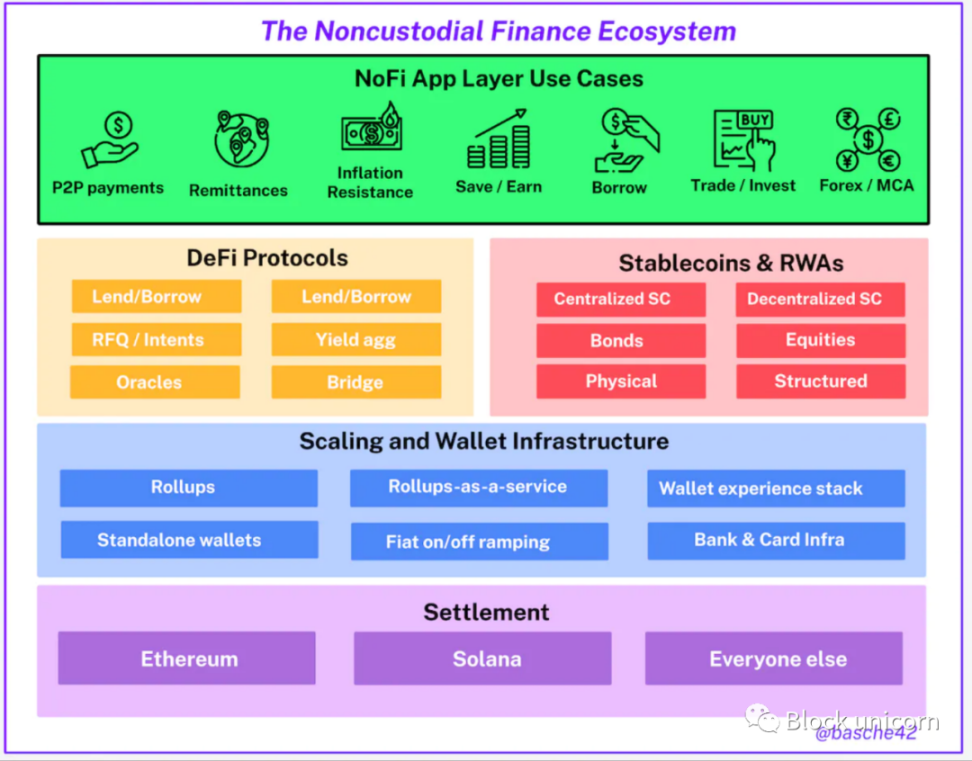
While decentralized finance (DeFi), non-fungible tokens (NFTs) and the metaverse form the basis of an exciting new crypto-native internet, crypto/Web3 as a concept that persists (let alone a The new technological paradigm) will not last unless it meets the needs of ordinary people and escapes its own closed niche. Luckily for those of you who showed people a crypto-financial utopia on Thanksgiving, after years of being merely dubbed “the future of finance,” it looks like crypto is finally starting to see a flurry of consumer-facing apps built on top of blockchain technology. , the vigorous development of daily financial applications. This rising use of non-custodial finance (NoFi) is guiding crypto to find an obvious opportunity for mass adoption in general markets. NoFi applications cannot build on the previous waves of speculative crypto adoption without innovations in settlement, scaling, smart contracts, wallet infrastructure, and DeFi protocols. Although there are currently 5 to 10 million people transacting on the blockchain every month, the service market of Universal Finance has billions of people, which also means that there is still a huge potential market waiting for non-custodial finance to develop (NoFi) .
Synchronous development
In the early days of the adoption of a new technology paradigm, we often see parallel developments around similar ideas and problem areas, sometimes with slightly different solutions and hypotheses. I highlighted this in a previous blog post about the Wallet Experience Stack, which represents the convergence of the B2B middleware ecosystem for wallet-enabled identity and commerce in Web3, with various players approaching it in diverse ways this problem. Were seeing something similar in the Web3 world of consumer finance, with wallets, payment apps, emerging banks, and centralized exchanges all converging around a few common and obvious use cases enabled by blockchain rails with real functionality. Lets look at some examples.
Non-hosted payment application
One of the ironies of cryptocurrencies is that payments—perhaps the most obvious quintessential use case for cryptocurrencies since their inception—have been the last to really develop and gain momentum. Paying with volatile assets like Bitcoin and Ethereum was clearly a niche activity and supported the likes of DeFi and NFTs, but it was only with the advent of stablecoins and cheap block space that blockchain payments really started to take off. their spring.
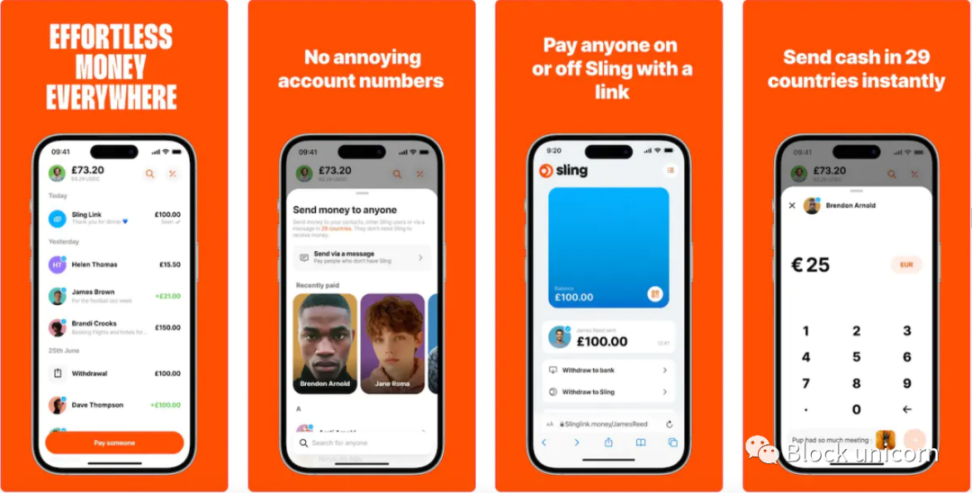
The most basic function of a crypto wallet — sending tokens — is finally human enough to provide a Web2-level experience. We now see a number of apps and infrastructure focused on enabling this, including trendy consumer “crypto Venmo” and global payment apps like Eco’s Sling and Beam. There is even a community crowdfunding and building an AA (Account Abstraction) powered peer-to-peer payment app for the meme token $SEND.
Unlike crypto wallets, these apps look and function more like stripped-down versions of early Cash apps, often focusing on peer-to-peer payments for students and young people, or specifically on providing remittance services to foreigners and money transmitters.
Non-custodial/semi-custodial new bank
While some emerging non-custodial fintechs are targeting narrow payments use cases (a huge use case in itself), others are approaching their products more holistically, combining payments with attached stablecoin yields, crypto multi-currency accounts , investment functions and a combination of crypto-legal currency hybrid accounts that integrate traditional banking and card systems. Projects like Decaf and Paie (both Solana applications) come to mind as well as the upcoming Linked IBAN smart contract wallet from Obvious. Even Malaysias government-in-exile is creating a new, non-custodial bank for its citizens called Spring Development Bank on Polygon. To be clear, these are centralized entities, and while in their centralized capacity they interact with traditional KYC financial systems on behalf of users, their fundamental functionality and value proposition lies with users interacting with their non-custodial wallets (or semi-custodial/MPC ) to interact on the chain. Many features that once required using a bank (or challenger bank) are starting to move on-chain, and these non-custodial neobanks provide users with a streamlined interface to take advantage of on-chain lending, borrowing, and earning in a great user experience and all functions of the transaction protocol. In some cases, non-custodial neobank functionality will be paired with traditional banking functionality, but as users’ financial “tasks” increasingly move on-chain, traditional financial systems like centralized exchanges are now beginning to Crypto users have an impact) is becoming more and more like a dumb switch.
New Bank 2.5
While most non-custodial payment apps and neobanks to date have been emerging crypto-native startups, we have also seen significant activity in the existing neobank/challenge banking space, including existing neobanks setting up noncustodial banks for their users. / Semi-custodial wallets and offering crypto services, as well as custodial crypto-focused new banking and investment models that offer similar services in a custodial format. While not exactly full Web3 non-custodial neo-banks, they utilize blockchain technology directly or indirectly to provide their services, we can refer to this category as New Bank 2.5. Based in Turkey and focusing on regions such as Turkey and Argentina, Cenoa provides users with a custody solution as an inflation hedge in countries most affected by local currency fluctuations, access to USD stablecoins and on-chain yield protocols. More recently (and perhaps more importantly) of course is PayPal, which has expanded its crypto endeavors from custodial crypto buying and selling to EVM-based stablecoins and companion embedded wallets, similar to Yellow Card in Africa. In addition to the typical fintech itself becoming a crypto-new bank, NuBank in Brazil, N 26 in Germany, Monzo and Revolut in the UK, and Cogni in the US are also following a similar path. Neobanks operate in a competitive environment and are perceived as challengers to old-fashioned consumer banks, but in the crypto space they find themselves from challengers to challenged. They are becoming a new hybrid bank of traditional finance and encryption by increasing their investment in encryption services. It wouldn’t be surprising to see these larger traditional consumer banks start to think in a similar way.
Centralized exchange
Centralized exchanges are one of the oldest “applications” in the crypto space, and although they represent “centralization” in the crypto environment, they are redoubling their efforts to develop their own non-custodial wallets and quasi-super applications, and through the center Decentralized infrastructure serves an increasing number of these “fintech” encryption cases. Binance Payments (often denominated in USDT or Tron USDT) has significant influence and daily usage in cross-border remittance channels and emerging markets, particularly in Latin America. Coinbases offering of USDC yields in its main app and staking aggregation in its Coinbase Wallet app, coupled with the semi-payment features it has launched in Base (e.g., Beam Eco), provide financial services to their existing users . Centralized exchanges are well-positioned to provide financial services to existing users and have invested in growth areas such as standalone wallets to capture more and more emerging use cases.
While the exact scope and approach may vary, what are all the above players starting to converge around? what is that? Might be actual consumer crypto fintech use case, early product market fit?
Users and Use Cases
Much has been written about the early adopters of the crypto-native economy, but for cryptocurrencies, the most important user base is clearly the early majority (in Jeffrey Moores words), which is an area that can really make sense. A group that solves daily financial product problems. In order to move from early adopters to early majority, a technology paradigm needs to cross the chasm, from early adopters trying to see the value in new things, to early majority, people who are just trying to get something done with their lives.
Moore also described what usually happens, first, a set of vertical use cases emerges, like a set of bowling pins, they get promoted, and can then fall down together because adjacent use cases are horizontal and generalization provide ample opportunity. It will all culminate in a tornado, where early use cases converge, fueled by massive adoption from an early majority, creating huge integrated winning platforms, and a series of applications that find product-market fit. In our world of non-custodial finance, we have seen the following “bowling pins” appear that give us a picture of what a tornado might look like.
pay
As mentioned before, although sending value from A to B is very obvious in the design of encryption, for many years, the significance of encrypted payment is no more than a novelty or some very local encryption applications (or crimes). Implementation details. It’s become an inside joke within crypto circles that the classic reference use case doesn’t even have real momentum. But this is changing rapidly, firstly it is interesting that TRON and Binance are gaining real momentum in emerging market everyday payments and now more and more crypto application layers are trying to wrap their heads around It just works to reposition consumer payments. Of course, a key catalyst here is the emergence of stablecoins like USDT, BUSD, and USDT, which have taken hold in other parts of the non-custodial fintech space. Broadly speaking, we can divide the payment dynamics that crypto is seeing into two near-term areas and one medium-term area - peer-to-peer Venmo-like payments, remittance payments, and B2C payments. Creating a Web3 version of Venmo is perhaps the most obvious encrypted decentralized application, but in reality the full power and The benefits can then be realized in a consumable way. These same benefits also apply to international remittance payments, with Latin America<>America and Africa<>Remittance corridors between Europe are starting to see significant crypto remittance traffic.
inflation resistance
Particularly in emerging markets, inflation resistance is closely tied to payments and remittances. The main factor here is again stablecoins - especially USD stablecoins - as people in countries with weak or volatile currencies are looking for ways to preserve their wealth. Latin America is again at the forefront of this trend, which is to be expected given its volatile currency backdrop, but we can see this trend in terms of people wanting to keep the gold standard as a store of value - the dollar (no offense to financial zealots ). Custody-free financial apps can provide anyone in the world with basic access to USD (often easier/cheaper than traditional FX channels), as long as they somehow swap in from fiat. These dollars can be kept, put into an interest-bearing account, and sent to anyone around the world with a compatible wallet at increasingly lower costs.
Savings/ Earnings
Everyone with excess cash needs somewhere to store and preserve this value, and we are seeing non-custodial financial applications leveraging on-chain infrastructure to provide users with an easy-to-use, consumer-friendly interface to earn yield and interest. While on-chain rates were once low, more aggressive interest policies from centralized stablecoin issuers to match the off-chain fixed income environment have pushed on-chain rates closer to those in off-chain money markets. Even without the huge base rate advantage over savings account rates that DeFi had during its boom phase, a variety of different permissionless yield products still (relatively speaking) enable people to grow their savings effectively. DEX LP positions for stable or blue-chip currency pairs, conservative money market positions, stablecoin risk-free rates, and conservative yield aggregation strategies all offer potential on-chain revenue streams for custody-free financial applications on behalf of their users, regardless of Be it for their stable assets (thus expanding the inflation hedging use case in these cases) or for any volatile/investment assets. We see the outlines of this experience in web3-native apps that focus on user experience, such as Instadapp and Zerion, which make depositing funds into a profit position a matter of one or two clicks, as well as in apps like the previously mentioned Cenoa A consumer application, reducing it entirely to a savings function.
loan
On-chain borrowing is harder to bring to consumers than lending because most of the worlds credit is low-collateralized/uncollateralized, but we are still seeing interesting progress and innovation. No-custodial financial apps haven’t gone all out in this regard yet (with the exception of Binance which actually offers crypto loans to users), but we can expect this to change soon as progress is made on the underlying protocol and the ability to pass to the interface middle. MakerDAOs Spark protocol allows you to borrow DAI (and spend it with an optional linked debit card) at a fixed 3.19% interest rate, which is very attractive in todays environment, as long as you are willing to post double the collateral for the loan. It will be interesting to see if it attracts any retail borrowers who are priced out of personal loans under the current interest rate and credit score regime and want to lock in a low-rate loan to make a purchase without actually spending the money. Alchemix offers self-pay loans - which might apply to buying a car or making a down payment on a house. DeFi protocols like Goldfinch are diving deep into non-collateral lending to serve off-chain businesses, and this idea could potentially scale to millions of small businesses, and the experience gained from this will definitely inform the next round of trying to build more accessibility Credit applications provide information, whether it is an uncollateralized oracle-based model, a post-Sybil credit model, or an innovative new mortgage protocol with more attractive features. The ultimate boss is the opaque, centralized, Orwellian credit institutions and traditional bank credit ecosystem. Once DeFi comes up with better solutions, non-custodial finance will be able to present them to consumers.
Forex/Multi-Currency Account
For certain user groups, such as international students, expats, freelancers, and digital nomads, frequently handling multiple currencies is a part of life. Although you get paid in one currency, you need to repatriate your home currency back home, you need to pay for a SaaS application in another currency, you have multiple customers or part-time jobs that pay you in multiple currencies, these are all things that need to be transferred between different currencies A case of quick exchange of funds. Conducting this exchange through the traditional banking system can be cumbersome, slow and expensive, and for some, the administrative expense may actually be unaffordable. Through stablecoins and decentralized exchanges (DEXs) provided by uncustodial financial applications, people can have a crypto multi-currency account that contains multiple stablecoins that they can send, exchange or save according to their needs. Within these same user bases, multi-currency accounts have become a popular feature for non-crypto fintech/emerging banking applications, as more crypto emerging banks focus on these use cases, and existing fintechs begin to explore With blockchain as an alternative, the two sets of use cases are expected to start converging over time.
Transaction/ Investment
Trading is the first core use case for crypto, so we wont spend too much time discussing it here, just to point out that the opportunity to invest in and even trade risky assets is something that the traditional fintech space has been pushing for a while in terms of equities ( Considering Robinhood), this is a legitimate user demand that no-custodial fintech applications will obviously provide to their users. Decentralized exchanges (DEXs), bridges, and aggregators make it relatively simple for consumer applications to offer non-custodial cryptocurrency trading to their users, allowing their users to assume some risk exposure. As more real-world asset tokenization (RWA) comes on-chain, the prospect of offering trading in everything from cryptocurrencies, stocks, FX, real estate to fixed income from a single application becomes obvious for custodial fintech applications. If a digital dollar DeFi yield protocol can hedge against current inflation and hit a monthly savings goal, why not use the same app to simply invest the remaining funds into the latest hot cryptocurrency or stock?
implementation mode
Of course, the simultaneous evolution that occurs around the problem space is accompanied by the simultaneous evolution around the solution space. As we finally start to see NoFi applications that can reasonably compete in large-scale markets, we can see some common threads underpinning the different approaches. Lets start at the high-level settlement layer, work our way down to the application layer, and then dive into some key technical topics.
Elimination of multi-party computation (MPC), account abstraction, and other seed phrases
Its clear that the next billion users arent going to securely store 24-word phrases, and over the past 12 months the crypto industry has largely taken the meme seriously and rolled out a number of different implementations, standards and software development tools to help dApp developers provide a web2-style login experience with encrypted wallets. I cover this area in detail in my Wallet-Centric Experience Stack article, but it bears repeating that secure self-hosted solutions that provide web2-style login and recovery capabilities are important to the growth of the NoFi application layer. Whether the specific implementation is based on MPC, smart accounts, or a hybrid of the two, NoFi applications are leveraging the latest and greatest wallet experience stack middleware innovations and bringing them to the masses. Eco from Beam leverages ERC-4337 compliant smart accounts and account abstraction infrastructure on Optimism (and soon Base) to provide a seedless onboarding process and a sub-5 cent payment experience, Even if the user has never set up a wallet before, it can be accessed through the link.
Solana
As a known Ethereum fan, I have to admit that I have to give Solana the credit it deserves. Sling, Decaf, and Key.app all run on Solana, and theyre probably the 3 smoothest NoFi apps in existence. While Solana has always excelled in terms of cost (despite the decentralization trade-off), Solanas notable presence in the NoFi space has been the quality of its app builders and its positioning of value to everyday users. So while Ethereums sidechain ecosystem is quickly catching up with Solana in terms of cost and speed, from an innovative NoFi user experience perspective, Solanas application ecosystem may be a step ahead in some aspects.
Zaps, Meta Transactions, Intentions
Without going into a ton of details about the intentions of the blockchain and the future of MEV, Ill just mention that packaging multiple on-chain operations together to allow for easy transactions on behalf of users is not just for speculators to gain access to Best limit order price. Whether it’s on-chain “zaps” or “schemes” of multiple transactions to be executed together, or off-chain signed messages representing the user’s wishes, NoFi applications can take advantage of combining multiple types of transactions and transaction-like instructions to simply Give users what theyre looking for. In the NoFi app, you will soon see these small frictions removed, such as convert to USDC and save or convert to ETH and stake buttons.
Block unicorn Note: Zaps refers to the operation of summarizing a series of interactive processes into one-step/one-click execution, referred to as Zaps.
Integrate cryptocurrency and traditional financial banking and payment systems
Another theme we are seeing implemented in this NoFi (non-custodial finance) wave is the merging of cryptocurrencies and traditional finance in some meaningful ways. One is that the entities operating these applications are often able to add added value to users by establishing relationships with banks or partnering with some banking infrastructure provider. Non-custodial neobanks, which are essentially just 95% non-custodial wallets, can add fiat to cryptocurrency services and bank accounts to deepen the value provided by these applications. Being able to automatically deposit a portion of your paycheck into a non-custodial wallet makes other services within the wallet more valuable and necessary, while being able to swipe or tap to pay with cryptocurrency at the grocery store extends the value even further. Users need to undergo real-name verification when using these services, which means they give up some anonymity, but for most users, real life is already real-name verification, which just makes cryptocurrency better integrated into their lives. . With Visa and Mastercard already experimenting with payments with smart accounts and account abstractions on EVM, a hybrid world that ties on-chain and off-chain together in the user interface is becoming more common.
Tokenization of Real Assets
As mentioned before, more and more high-quality real-world assets are being tokenized, enabling new types of consumer financial products that would otherwise not be possible. The most obvious and straightforward way is through stablecoins themselves. Issuers like Circle and Tether are issuing tokens by investing billions in short-term notes and are increasingly passing on proceeds from Treasury bonds and other short-term off-chain securities to on-chain stablecoin holders. Another example is the recent wave of on-chain U.S. Treasury bonds, which crypto investors can obtain from platforms such as Ondo Finance. While youll need to go through real-name verification (and there are geo-restrictions depending on the product you want to use), once youve done that youll be able to earn handsomely in a user-friendly on-chain wallet without having to go through confusing Brokerage application click to browse. As more valuable real-world assets are tokenized and brought on-chain, they create more potential financial products for regular users.
Why now?
To understand why we are now seeing explosive growth in these use cases (like it or not, the TRX chain has 2 million DAU), and why even serious players like PayPal are getting on board, we need to cast our gaze on a few factors, Together they move things forward.
stable currency
The first and most obvious reason for NoFi’s rapid rise now is the maturity of the stablecoin ecosystem. A digital dollar (and a growing list of other fiat currencies) is arguably blockchain’s killer app so far. As we’ve talked about in most examples, stablecoins are the lifeblood of actual day-to-day commerce in a way that volatile cryptocurrencies can’t. Digital, frictionless fiat currencies are permeating a variety of applications, geographies and domains. This momentum is accelerating, not slowing down, with Circle alone generating over $700 million in revenue from their $26 billion USDC issuance in the first half of 2023, already exceeding their 2022 total revenue.
Tether is making a ton of profits, and if things continue, they could become systemically important holders of U.S. Treasuries. However, more important than huge issuance totals or revenue statistics is the adoption by ordinary users and businesses to do the mundane and necessary things mentioned above, especially those with no or little prior banking services in developing countries people. In developed markets, we havent seen their explosive use in the mainstream yet, but theres reason to believe that may change (more on that later).
The maturity of the expansion solution
In the blockchain scaling wars, I don’t want to prematurely declare victory on the trilemma in terms of practical applications. Although there is still a lot of architecture, engineering, and decentralization that needs to be built in the blockchain scaling ecosystem, we are getting closer. Decentralized blockchain has become too expensive and cumbersome to achieve the end of daily use. Solanas transaction costs have been reduced to almost negligible levels, and the Ethereum ecosystems Manhattan Project-style focus on Rollup-centric roadmap is finally starting to show real results. Not only will we see a significant reduction in rollup costs from EIP 4844, but we will also see all the scaling benefits that have not yet been realized in the zk space, in addition, we will also see the creation of a thriving L2 infrastructure ecosystem, so that applications will be able to easily launch dedicated Rollapps for their applications for maximum control, performance and monetization. Cryptocurrencies in general, and Ethereum in particular, have had a tough time with scaling, and these efforts are producing excellent good enough L2 solutions that can fit almost any use case with just a hard score cross. As a result, NoFi applications are entering the most permissive blockspace environment in cryptocurrency history, with multiple good and constantly improving network options to choose from.
Innovation in Wallet Technology
As mentioned above, products like MPC, account-abstracted smart accounts and GAS-less transactions, and products like Privy and Web3 Auth tie the entire wallet stack together for applications that want to build on top of cryptographic functionality with deep native wallet capabilities. The developer of the program provides a more convenient way. The next round of crypto neobanks and non-custodial fintech apps will not need to worry about users seed phrases or require an installed wallet. Not only are these blockchains finally cheap enough, but applications can also be added to interact frictionlessly with state-of-the-art smart accounts with just a few lines of JavaScript code.
macro tail wave
Taking a step back from cryptocurrency itself and looking at the context within which it operates, we can see that the world surrounding cryptocurrencies is evolving in a direction that makes this NoFi innovation more attractive and necessary. Inflation volatility has returned with force, especially in developing countries with weak currencies, and the desire to avoid exposure to international and local inflation volatility is growing. E-commerce is trying to penetrate every corner of the planet, but in areas where local banking and payment infrastructure is weak, or where Internet access is lacking, the enthusiasm for traditional financial technology innovation has been suppressed. The long and tedious path to market efficiency is being driven by cutting out centralized (i.e. expensive) intermediaries.
Blockchain as a vehicle for competition
All of the above factors and more come together to give blockchain multiple vehicles to compete in fintech applications. Rather than relying on speculative future values or ideologies, cryptocurrencies are starting to incorporate sober and tangible realities into their value propositions in this emerging NoFi space.
transaction cost
Centralized intermediaries have a certain profit requirement, and the more centralized intermediaries are stacked together to move value from one place to another, the more profits will be collected from consumers and businesses. Blockchain has the ability to incorporate intermediaries into smart contracts, essentially doing more with fewer resources. In no other area where it is so clear that cryptocurrencies are starting to win is in reducing transaction costs for international payments. While it costs nearly $100 to send a payment between two countries using the international wire transfer system, sending via USDC costs less than a dollar. As gas costs and scalability become less of an issue on the outlook, the clear advantages in transaction costs of cryptocurrency payment systems will permeate every possible consumer and business-facing service offering through the use of blockchain To achieve this, every profit that can be recovered in this way will be recovered. Autonomous DeFi protocols may design more profit spaces from finance, and NoFi applications can return these profits to consumers through better financial products.
composability
Composability is bigger than simple interoperability, it refers to how different parts of an ecosystem connect to each other to create higher order and more complex value. From the most basic perspective, NoFi products based on EVM wallets immediately gain the ability to make payments with any other on-chain EVM wallet, interact with DeFi protocols, read identity NFTs from other applications, and create EVM application logic that uses the wallet. While this is a somewhat abstract property that is inseparable from interoperability and network effects in general, the unique composability of cryptocurrencies allows a variety of services to be combined to achieve greater end customer value. When combined with the next attribute - permissionlessness, NoFi builders instantly gain a massive sandbox when enabling their users to connect to the blockchain, easily enabling transactions, borrowing, lending, payments, or any combination They or something built on top of them.
No permission required
When building fintech applications, integrating with other complementary providers or value-added services can be a tedious, expensive and time-consuming process. Its completely different than crypto protocol integration because while there may still be some user experience issues when using some of these protocols, the fact remains that anyone in the world can have a wallet where their application is and they plug into Compound or Aave to add a basic savings feature to their app. This permissionless integration leads to faster innovation cycles and a wider range of potential building blocks for building compelling financial products and experiences.
Reduced business footprint and liability
One of the more interesting aspects of non-custodial finance, which makes it an attractive approach for fintech players, is the way the non-custodial nature itself creates a different division of responsibilities involving users, developers and other services. Along with the permissionless nature described above, non-custodiality not only reduces the initial up-front friction when integrating something like DEX trading into your application, but (in many jurisdictions) is less expensive than integrating traditional stock trading Legal and regulatory perspectives empower you to do so. The same applies to activities like lending and lending, which are usually reserved for traditional banks, but through DeFi protocols, anyone with a wallet (including your customers) can access. A NoFi app could offer a suite of financial services, a BD license, an MTL license, or even a banking license, if you can account for transferable on-chain (and your exact jurisdiction) and regulated third parties provider, such as a regulated switch. There are even experiments with more decentralized wealth management on-chain with actual advisors (although again, this is not legal advice). This completely upends the way fintech applications are developed, as it means that there can be a wider range of potential players in the financial services space. By minimizing the off-chain footprint of the business, and earning money through things like taxes on transactional interfaces, NoFi apps can actually access markets they wouldnt otherwise be able to access non-crypto.
User experience (UX)
Is user experience (UX) a potential selling point for crypto financial services? I thought it was because of the user experience that we couldnt achieve mass adoption? While not wishing to downplay the work that still needs to be done to improve the crypto user experience, over time we can actually expect crypto to deliver significant benefits in terms of user experience over non-encrypted technologies. Take login and payment as an example. To fully realize this requires a certain number of crypto-enabled apps and users who already have wallets, but people are able to simply connect to wallets and pay without entering any additional information because they control their own private keys , which will lead to a better experience than web2 over time. Compared to the annoying wire transfer screens when sending an international payment from a bank, instant crypto payments may essentially be less clicks than their fastest web2 counterparts. Currently, UX is as much for crypto as it is against it, but that will soon change (for some of the reasons mentioned above), opening up the opportunity for a basically inverted sovereign UX, the simplicity of UX that wallets imply. The embodiment of innovation will attract users in terms of pure ease of use.
Whats next?
Non-custodial finance (NoFi) is starting to enter the sweet spot, and I think the number of players vying for this opportunity will grow by an order of magnitude over the next few years. Not only will this space become extremely competitive, but it will also merge with existing competitive dynamics in fintech and new banking, with the two becoming a dynamic whole. Its hard to predict exactly who will emerge as the winner, but there are some future directions worth watching.
Social and social finance
Parallel to nearly all this non-custodial finance (NoFi) stuff is a thriving ecosystem of decentralized social networking, much of which revolves around cryptocurrencies. Protocols like Lens, Farcaster, and BlueSky will open up a whole new design space for social applications, and with this explosion in social network design, the business model innovations of creators and others are likely to merge with the emerging NoFi meta-field. In the last week weve seen a very interesting experiment in the depths of crypto Twitter regarding social tokens in Friend.tech, although still in a very early and niche stage, but with more and more innovations happening in the so-called In the field of decentralized social (De-So), the two parties will interact with each other. Perhaps the most impactful example is what would happen if Twitter/X got into cryptocurrency payments. In addition, there are currently ongoing on-chain experiments on community finance, micro-loans, social insurance and basic income schemes, which are finally becoming technically relatively simple, and we should look forward to a multi-player financial sector oriented towards solving peoples actual real-world problems development of.
B2C Messaging and Conversational Blockchain Commerce
Messaging protocols like XMTP are finally starting to see adoption in consumer wallets, not just in consumer wallets like Coinbase Wallet, but also in b2b-oriented experience stack provider Dynamic.xyz. This starts to hint at a very powerful set of business use cases that could involve conversations between consumers and dapps or even merchants. Conversational support, sales and marketing will enter wallet-based commerce and bring additional layers of consideration to NoFi applications. Will they become b2c platforms themselves (like Decaf is doing with its consumer wallet and merchant crypto PoS solution), or try to become a universal client for blockchain commerce, allowing applications to support transactional behavior on behalf of users Messaging? This will open up a whole new realm of trusted business communications, a situation made even more dire as artificial intelligence clogs all our digital communication channels and spammers become more effective.
Experience stack providers will focus more on NoFi as an application scenario
I anticipate that the wallet experience stack providers mentioned in this and my other articles will increasingly focus on NoFi as a vertical. In addition to games, NFT and traditional DeFi, these consumer-facing financial applications are the perfect embodiment of the value proposition of middleware products, and they provide a web2-like experience on the web3 track. There are more than 40 well-funded companies and projects in this space, and their attention will lead to better NoFi development solutions and more killer apps.
Momentum finally emerging in developed markets
Much of the early NoFi progress has focused on emerging markets, or involved people associated with those emerging markets. This makes sense intuitively, as typically these regions are underserved in their markets, while richer countries tend to overserve consumers. But as the aforementioned forces play out in the system, well see more and more innovation happening where consumers are overserved in some obvious dimensions, but underserved in some less obvious dimensions market. This is likely to take the form of a gradual transfer of innovation from developing countries back to more developed countries.
Unmanaged super app
Finally, while this article assumes many different approaches to NoFi applications, it is entirely possible that these financial unfinished features could be aggregated by a few dominant players to create a non-custodial network similar to WeChat or GoTo. Super App. Not only do these apps do all of the above, but they also connect the entire decentralized internet together through some sort of dApp browser (or, more likely, an applet-style framework of small applications). Some general purpose web3 wallets certainly want this to happen, and many are fundraising with this as an investment theme. While I think one of the current batch of web3 all-in-one wallets may reach super application size and scope, I think it is more likely to be an existing huge technology company and smartphone manufacturer, or from a more focused mass market NoFi applications from the perspective of a more limited initial scope.
Finish
While Im excited for completely avant-garde use cases that come directly from on-chain culture, a fully decentralized internet and metaverse will take time, and NoFi exists now and is the bridge from crypto to the early majority of users.
[Disclaimer] There are risks in the market, and investment needs to be cautious. This article does not constitute investment advice, and users should consider whether any opinions, views or conclusions in this article are suitable for their particular situation. Invest accordingly and do so at your own risk.


