






Ether.fi and OpenSea's Love-Hate Relationship: Legal Risks Exposed by a Sudden Delisting Event


Conflict between Ether.fi Project and OpenSea
The Ether.fi project announced on Tuesday that OpenSea has banned the trading of its NFTs that require staked Ethereum.
Mike Silagadze, CEO of Ether.fi, stated in an open letteron Medium:"We launched the ether.fan NFT series supported by staked ETH." He continued, "It has been very successful in all aspects. We minted all 3,000 NFTs within one day, with over 6,200 ETH locked."
Subsequently, Silagadze stated that the entire series was listed on OpenSea for trading. "Then we were devastated. All the tradable NFTs on OpenSea disappeared. The new NFTs seemed to be disabled with a mysterious error message. We received no notification or warning. None of our contacts at OpenSea has reached out to us. This series was disabled inexplicably."
Silagadze explained that after about a week without any response, OpenSea finally responded with a "standard letter," stating that the marketplace "does not allow for NFT series that involve registered or licensed financial activities."
What is Ether.fi?
According to the official website, Ether.fi is a special type of NFT that requires ETH staking for minting. In summary, it is an "interest-paying NFT."
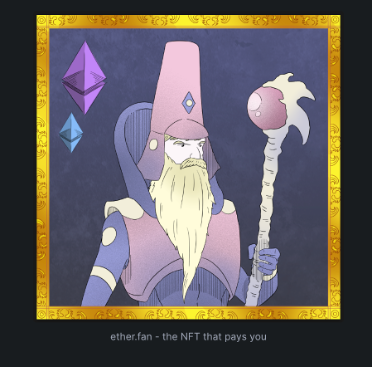
Screenshot of Ether.fi official website. Source: Ether.fi official website
By staking ETH, buyers can mint fan NFTs (the protagonist in this conflict, Ether.fan, is distinct from the project Ether.fi) to earn membership points and receive additional staking rewards. Additionally, the website states that fan NFTs can also "enable you to participate in exclusive events and showcase your commitment to decentralized Ethereum."
All ETH staked through ether.fan will be distributed to independent node operators running physical nodes in different geographical regions and used to reward the use of DVT (Rhino.fi exchange token). Fan NFTs participate in a loyalty rewards program, with increasing staking rewards and a share of protocol revenue as the staking time increases.
Staking is completed through ether.fi's non-custodial staking protocol, and all protocol earnings will be returned to stakers and independent node operators to subsidize the cost of staking hardware, with a small portion allocated for payment of ether.fi interns' expenses.
According to a previous report by Odaily, Ether.fi completed a funding round in February, led by North Island Ventures and Chapter One, with a total amount of $5.3 million.
Arguments from OpenSea and Both Parties' Responses
OpenSea responded to Ether.fi in an email, stating that OpenSea does not allow NFTs with financial activities requiring registration or licensing.
The underlying meaning of this sentence is that there is currently no definitive conclusion as to whether ETH is a security (even though SEC did not classify ETH as a security in several previous lawsuits, many speculate that SEC is giving up on treating Ethereum as a security and filing a lawsuit), and staking services may also have securities nature, so whether registration is required is still pending. OpenSea is unwilling to take the legal risk of listing financial activities-related NFTs such as Ether.fi, which led to this delisting incident.
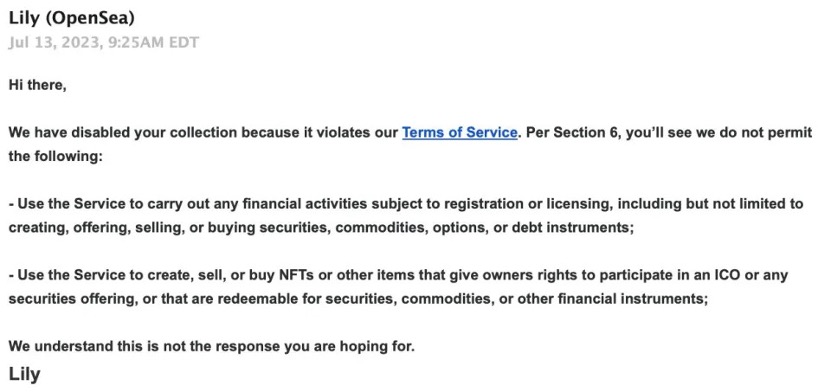
OpenSea's response email. Source: Decrypt
However, this delisting has been criticized by the Ether.fi team as being "overly conservative." In an open letter, Xilajadze wrote, "This means that OpenSea's position is that staked ETH needs to be licensed and registered. This position is very conservative, even SEC has not explicitly stated this."
In this open letter, it is not difficult to see that Xilajadze himself is very angry. He wrote, "Before the release, we have been communicating with OpenSea to ensure that ether.fan is compatible with its market, integrate its API to keep the metadata up-to-date, and ensure the proper display of the collection. We have been working on these aspects in the weeks leading up to the release."
"But throughout the process, we have received no indications that any of our actions would be a problem." Subsequently, the delisting incident occurred.
He wrote:
"OpenSea has been operating an essentially unlicensed casino where people engage in devastating gambling and spend millions on images of monkeys, etc. Apparently, all of this is acceptable, but listing a practically functional collection is not allowed simply because it has utility."
In fact, I don't think OpenSea has any malicious intentions here. I don't believe anyone is intentionally doing anything wrong. It may be a lack of communication within their organization. OpenSea is now a company with over 300 employees, and there may be teams that are not familiar with each other. When a company grows in size, it tends to be under the practical control of its legal and accounting teams and stops taking any slightly risky actions."
Aside from the initial email, OpenSea did not respond to any requests for comments from the cryptocurrency media. However, a spokesperson provided the following response:
"While we won't disclose specific details of actions taken against individual collectibles, what I can share is that our terms of service dictate the types of content and behavior that are allowed on OpenSea. When we discover collectibles or content that violate our terms of service, we enforce our policies through various means, including taking down the collectibles and, in some cases, banning accounts."


