






The summer of Application Chain has arrived? A comprehensive review of projects adopting OP Stack


Article Author: LeftOfCenter
BNB Chain has launched its own Layer 2 chain and officially launched the Layer 2 testnet "opBNB" on June 19. With the support of the Layer 2 scaling chain, BNB Chain can greatly improve transaction speed and reduce transfer gas costs to $0.005, significantly enhancing the already strong processing performance of BNB Chain.
Interestingly, this application chain named "opBNB" is built on the OP Stack (specifically, the first official version of OP Stack called Bedrock). It is worth noting that OP Stack is a Layer 2 scaling framework for the Ethereum ecosystem, while BNB Chain is an intelligent contract public chain launched by Binance. To some extent, they are competitors. So, what prompted BNB Chain to actively adopt the Ethereum development framework OP Stack to build its own chain?
In fact, L2 is not exclusive to Ethereum's needs. With the surge in trading volume in GameFi and other sectors, even high-performance public chains like BNB Chain face the challenges of network congestion and high gas fees. The original design and architecture can no longer meet the requirements for scalability. This is where opBNB comes in.
opBNB is one of the recent members to join the OP superchain, but it is not the only one. In fact, we have seen multiple well-known projects joining the camp of OP Chain. In addition to the self-developed Optimism blockchain (now renamed OP Mainnet), there is also the Base Chain developed by Coinbase, the World App ecosystem wallet under Worldcoin (the encryption project of the CEO of OpenAI), the NFT marketplace Zora invested by Paradigm, and Magi, a client written in Rust launched by top-tier venture capital firm a16z. Together, they are creating a grand narrative for the superchain.
These projects themselves have a large user base, abundant resources, and numerous partners. Their participation will undoubtedly attract more developers, applications, and users to the OP ecosystem, eventually generating cash flow. It can be said that this "one-to-many" model supported by giants will become the main focus of early ecological expansion for Optimism.
Take the NFT platform Zora as an example. While launching its own application chain, Zora Network, it also brings in 35 partners including Sound.XYZ, Rainbow Wallet, and PleasrDAO into the Optimism superchain. Along with this, there are also 130,000 users. Worldcoin, initiated by the CEO of OpenAI, will bring in 1.7 million users while adopting OP Stack. Tiago Sada, the core developer of Worldcoin, told Blockchain Pulse, "Worldcoin is currently in the first phase of migrating to the superchain, and World App accounts are being migrated to the Optimism rollup mainnet."
Can I say that the former narrative of Optimism has gradually landed and begun to collapse into reality?
Although the ultimate vision has not been realized, the summer of the Application Chain has really arrived.
OP Stack Progress
Technically speaking, the progress of Optimism is reflected in its tangible savings of a large amount of on-chain fees for users.
Data shows that since the release of the OP Mainnet, the usage fees of Ethereum have been significantly reduced, compressed to below 90%. Compared to Arbitrum One, the early OP Mainnet saved more transaction fees, and subsequent technical upgrades between the two will compress or further widen the fee gap.
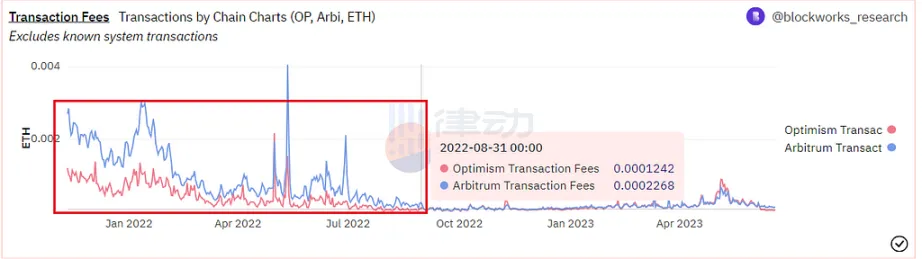
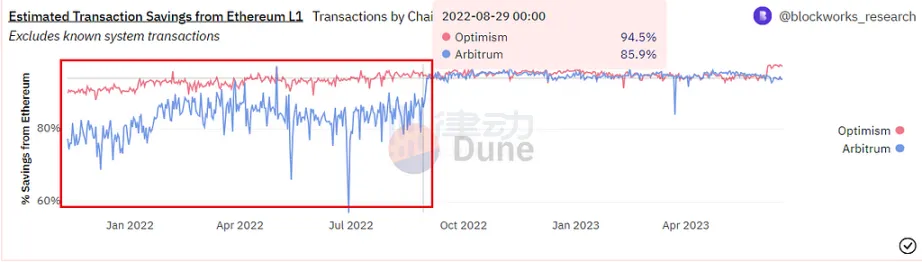
In addition, after the mainnet Bedrock upgrade was completed on June 7th this year, the fees have been reduced by about 50% and the deposit time has been shortened. The average transaction gas fee has decreased by about 75% , making the Optimism mainnet the cheapest Ethereum L2 network for token exchange. Bedrock brings Optimism closer to being a "super chain".
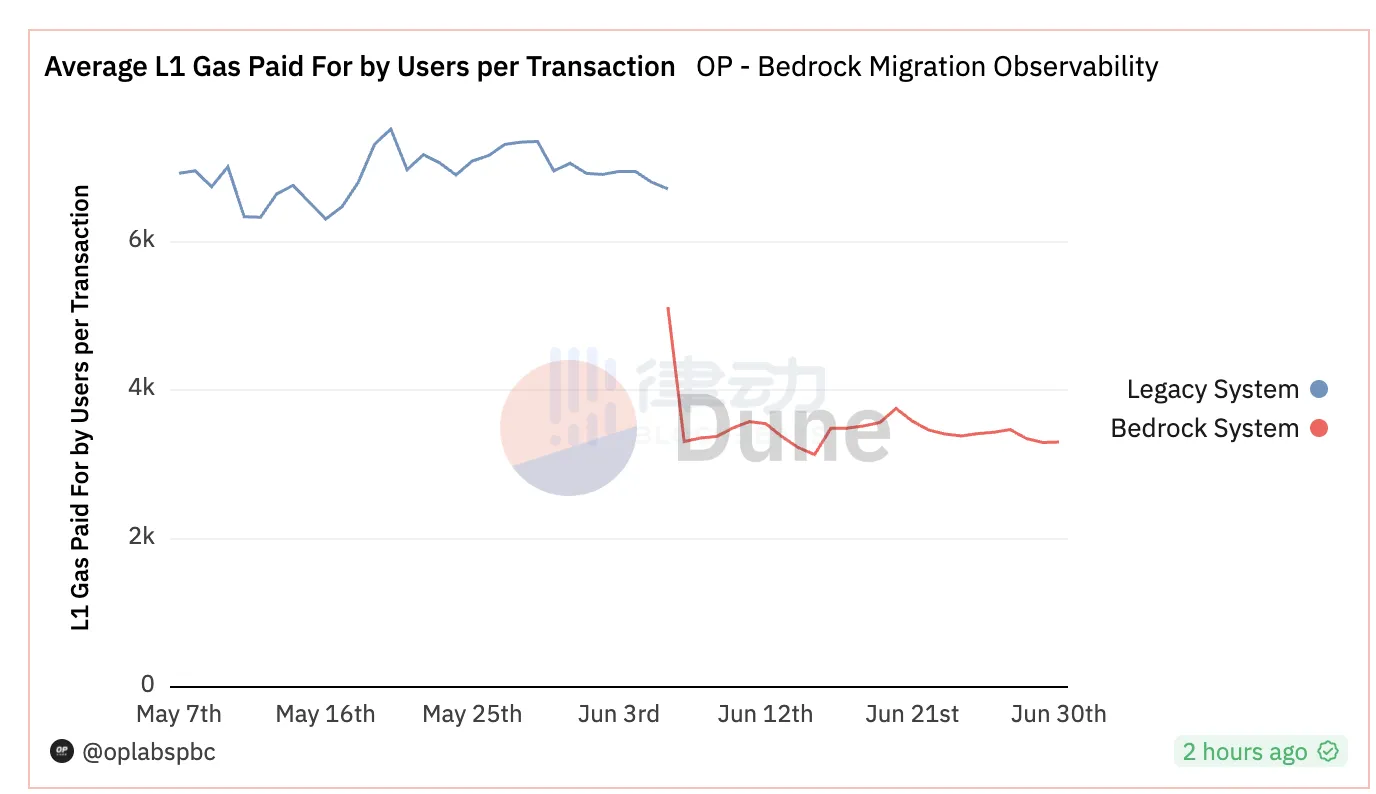
Optimism Bedrock is the architecture for a modular network, and it is the first implementation of the OP Stack. It uses the Ethereum Virtual Machine (EVM) as the execution layer, which is equivalent to the EVM. It also uses Cannon as its interactive fault proof on the settlement layer.
The upgrade of Bedrock makes Optimism more flexible and modular. If Ethereum introduces new transaction types through EIP-4844 in the future, Optimism can also introduce them simultaneously, further reducing transaction fees.
Optimism is gradually establishing itself with the help of OP Stack, which is evident not only in its technical progress but also in the increasing number of projects joining the OP Stack camp.
In addition to Coinbase, who was one of the initial participants (launching their own L2 - Base based on OP Stack), more and more projects are joining the superchain ranks and launching their own application chains using OP Stack components. This includes top-tier venture capital firm a16z developing a Rollup client based on OP Stack components, Sam Altman, the founder of ChatGPT, migrating Worldcoin from Polygon to Optimism, Zora launching the Zora Network, a Layer 2 NFT minting platform for creators, brands, and collectors, with 35 partner integrations, and even public chains like BNBCHAIN using OP Stack to build their own application chain - opBNB.
Which projects are using OP Stack?
OP Stack is not the only option on the market that offers one-click publishing. In fact, projects like Worldcoin, Coinbase, and BNB Chain have all considered building their own public chains or using other frameworks to construct layer 2 chains. However, in the end, none of them chose OP Stack. What are the reasons behind this decision? Additionally, what strategic significance does the application chain based on OP Stack have for each project?
Zora and its 35 ecological partners
Zora Network has launched a layer 2 NFT minting platform based on OP Stack, targeting NFT creators, brands, and collectors. It provides a range of tools for NFT creators and can reduce minting costs to below $3.
Around the creators and collectors, Zora aims to create the best user experience by offering faster speeds, lower costs, and a better on-chain experience.
As mentioned in a tweet by Zora Engineering, "An interesting fact is that the combined cost of 'bridging' to L2 and 'minting' on OP Stack is lower than the cost of minting on the mainnet."
Zora Network will seamlessly integrate with the existing infrastructure of Zora Marketplace. This means that the existing artists, brands, and collector users on the platform will seamlessly join the new layer 2 network, including 35 Web3 project entities such as the music NFT platform Sound.XYZ, the wallet application Rainbow Wallet, the Web 3.0 innovation incubator Seed Club, and PleasrDAO, as well as the existing 130,000 users.
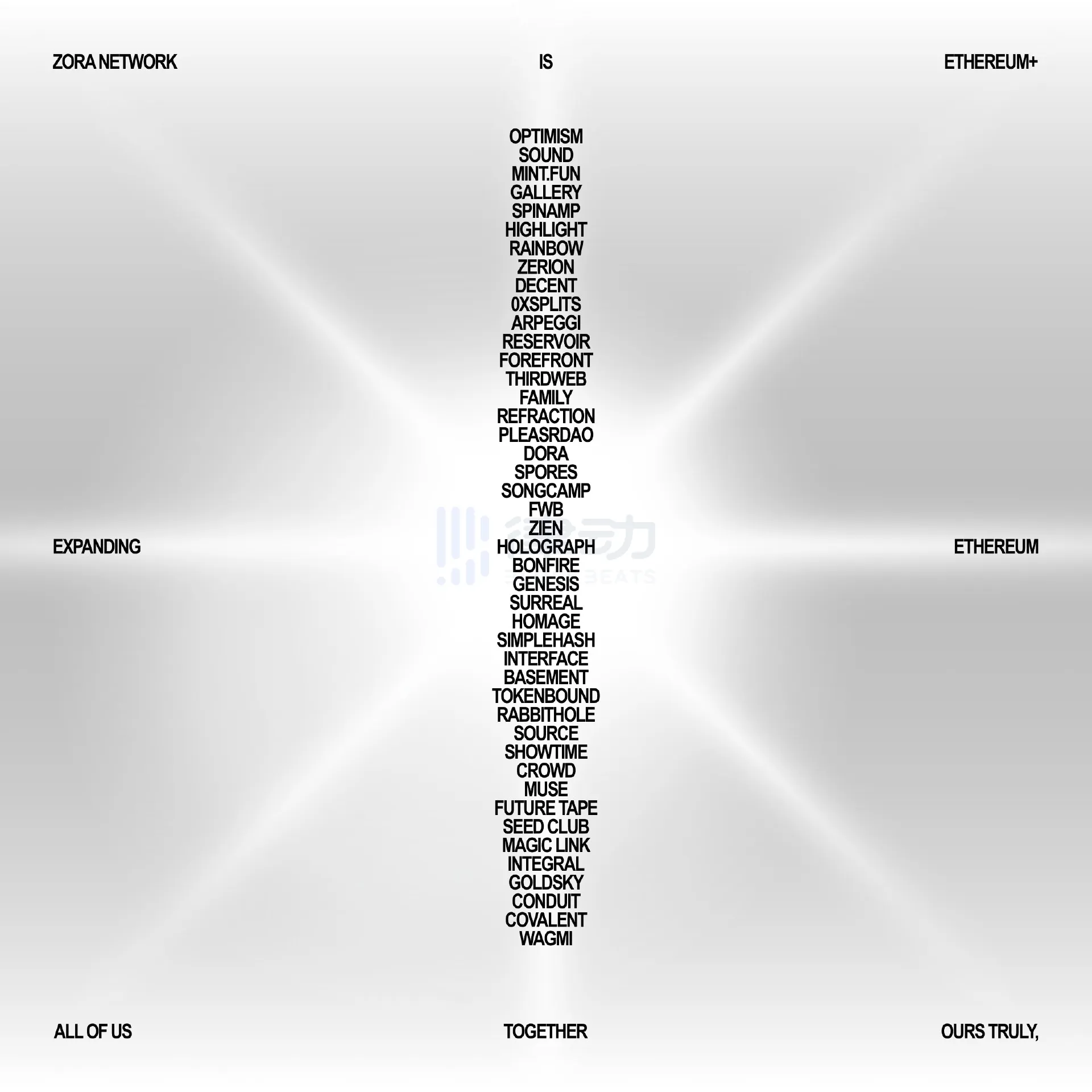
"OP Stack is used to develop application chains, hoping to minimize the cost for creators and make Zora a thriving place for on-chain media and culture."
To commemorate this release, Zora has issued an open version NFT called Energy, which fans can mint within the next 10 days.
Data from Dune shows that since its launch on the 21st, Zora Network has reached over 38,012 bridged addresses and a TVL of 375 ETH, equivalent to around $700,000.
BNB Chain Application Chain opBNB
L2 is not exclusive to Ethereum. With OP Stack, new public chains can also join the Ethereum L2 game. For example, opBNB, a layer 2 application chain built on OP Stack.
On June 19th, BNB Chain launched the Layer 2 testnet based on Optimism OP Stack (expected to launch the mainnet in Q3 2023). By using OP Stack Rollup, opBNB can move computation and state storage off-chain, alleviating congestion and reducing transaction costs.
opBNB can further improve processing speed, with performance superior to BNB Chain.
According to official descriptions, opBNB has a block time of 1 second, transfer gas fee as low as $0.005, and a transaction volume per second (TPS) exceeding 4,000 (compared to the current 2,000 transactions per second of layer 1 BNB Smart Chain). The average cost per transaction is approximately $0.109, almost twice the speed of BNB Chain mainnet and significantly reduced costs.
opBNB is a layer 2 network (Layer 2) built on OP Stack on BSC (Binance Smart Chain). Similar to Optimism Rollup, opBNB computes transaction data off-chain and submits it to Layer 1 for network performance improvement, achieving high TPS, low gas fees, and the same level of security as Layer 1.
So why does opBNB use the OP Stack to build its own application chain?
In fact, L2 is not unique to Ethereum. With the surge in transaction volume in GameFi and other areas, even high-performance public chains like BNB Chain face the problems of network congestion and high gas fees. The original design and architecture can no longer meet the needs of new scalability requirements, which is where opBNB comes in.
As early as September of last year, BNB Chain launched the zkBNB testnet (a Layer 2 network that uses zero-knowledge proofs). However, because zkBNB is not compatible with EVM (incompatibility with EVM means it cannot interact with applications on Ethereum), this prompted BNB Chain to develop a new Layer 2 solution called "opBNB".
opBNB introduces improved data availability, batch transactions, and a gas limit of up to 100 M for the BNB ecosystem. Additionally, the EVM-compatible OP Stack simplifies the process of migrating Ethereum Virtual Machine (EVM) code from Ethereum to BNB Chain, allowing developers to create open ecosystems faster and easier, thus expanding the user base.
Unlike Optimism and Coinbase's Layer 2 scaling solution Base, opBNB is built on BSC (rather than Ethereum). BSC's performance itself is superior to Ethereum, and opBNB further enhances that performance, surpassing not only BSC but also other scaling solutions like Optimism.
Most importantly, adopting the OP Stack to build a Layer 2 application chain on BNB Chain has strategic significance.
For the public chain BNB Chain, building an application chain using the OP Stack not only allows it to benefit from the high security of the Ethereum Layer 1, but also enables the use of BNB as the token for gas fee payment. This means that as more use cases emerge in the future, the application scenarios for BNB can be greatly expanded, and these benefits can be captured by BNB. In the long run, BNB Chain may even become a strong competitor to Ethereum's continuously developing Layer 2 ecosystem.
Base Developed and Incubated by Coinbase
Base (@BuildOnBase), launched in February this year, is one of the earliest application chains to adopt the OP Stack. Developed and incubated by Coinbase, it is an application chain that joined the Optimism rollup ecosystem early on, aside from Optimism's own projects.
In addition, the Base development team is also a core contributor to the OP Stack codebase and has been deeply involved in and promoting EIP-4844. It can be said that the Base team is the biggest driving force behind the research and development of OP Stack.
Base, as an application chain that focuses on financial services, has the characteristics of security, low cost, developer-friendly, and easy deployment of dApps. So why did Coinbase, as the largest and compliant centralized cryptocurrency exchange in the United States, choose to develop the Layer 2 network Base?
Developing Base, an application chain, during this stage aligns with Coinbase's future roadmap.
In fact, after the previous phased goal of "developing and investing in a large number of decentralized applications to provide users with convenient application layer access to cryptocurrencies" took shape, it is time to practice Coinbase's ultimate goal of "creating a global open financial system and reshaping the current financial system."
However, building an open financial system requires the support of a public chain and its ecosystem. Previously, Coinbase had the idea of building its own public chain, but it was eventually abandoned due to cost, difficulty, regulation, and strategic considerations.
Choosing OP Stack to build Base not only allows for the reuse of existing Optimism development achievements, but also enables "one-click chain launch." Its modular framework supports high openness and composability, including the execution layer of the chain (which virtual machine to choose), the method of proof (fraud proof or ZK), data availability (DA) layer, settlement layer, and so on. It truly adopts a modular Lego-like approach.
Most importantly, becoming OP Chain means that Coinbase joins the Ethereum lineup and can handle Ethereum's traffic in the future. In addition, Base will also be a member of the "Super Chain," which means that it can exchange resources with other OP Chains in the ecosystem and contribute to the future "Super Chain" system that may reach Internet-scale. With Coinbase's existing user base (in Q3 2022, Coinbase has nearly 110 million users and over 8 million monthly active users), seamlessly connecting customers to the financial services protocols hosted on Base and using Base as an entry point to access Ethereum L1, other L2s, and other L1 ecosystems greatly increases the probability of Base's success in the future.
With the powerful resources behind Coinbase, even in the early stages, Base has attracted nearly 60 projects as ecosystem partners, including infrastructure and tools such as Chainlink, Nansen, Dune Analytics, The Graph, as well as well-known projects originally deployed on Ethereum, such as Sushiswap, Balancer, PoolTogether.
According to the development plan, Base will not directly serve C-side users in the future, but will introduce more decentralized applications to provide services for C-side users. Therefore, since its inception, Base has jointly held multiple hackathons and developer contests around the world with Upside DAO, Developer DAO, GenTwo, thirdweb, QuickNode, Google, Blockdaemon, and other developer communities and organizations to attract more developers.
Worldcoin and Its On-Chain Identity System
In May of this year, the Worldcoin Foundation and Tools for Humanity (TFH), early protocol contributors, announced their support for the Optimism Collective and jointly build a scalable blockchain ecosystem based on OP Stack.
As the first step in joining the Optimism Collective, Worldcoin's decentralized privacy identity protocol, World ID, will go live on the OP mainnet, and its native wallet, World App, will be migrated to the OP mainnet in the future.
In fact, as early as 2020, Worldcoin had independently developed and launched an Optimistic Rollup application chain called Hubble, which was specifically designed for simple payments. They also released a test version of the World App. However, after the release, the team found that the test results were not ideal and that user demands went beyond simple payment functionality, which exceeded Hubble's capacity. As a result, it was migrated to Polygon PoS.
Now, Worldcoin has decided to rebuild the application chain using OP Stack. However, the focus of this cooperation will be on building the on-chain identity system.
For Optimism, a decentralized on-chain identity system is key to achieving its self-growth economy, unlocking democratic governance and innovation, and empowering individuals to better control their finances and participate in the global economy in their own way.
To this end, Optimism has deployed the identity primitive AttestationStation, an experimental identity system that allows anyone to attest to other addresses, thus assigning a trust score to a specific on-chain address to measure its real social relationships (influence).
For Worldcoin, the identity system is equally important, as it aims to distribute digital currency to 7.9 billion people worldwide for free and achieve fair wealth distribution. This requires a method to determine users' identities and prevent individuals from claiming tokens multiple times using different identities. To address this, the team has developed World ID as the underlying identity protocol for Worldcoin. It ensures that each person can register only one account with their iris. Additionally, the team has developed a set of biometric devices to verify a person's uniqueness through iris scans while preserving the privacy of the verified individual through zero-knowledge proofs.
Currently, Worldcoin has over 1.6 million registered users in its test version and over 500,000 monthly active World App users. This means that Worldcoin, as part of the Superchain ecosystem, will bring a massive user base to the OP ecosystem. In the long run, considering Worldcoin's leading position in the research and investment of identity systems, this will enhance the governance capabilities of the key component "OP Citizens' House" in the Optimism ecosystem and drive the progress of the on-chain reputation system AttestationStation, ultimately expanding the Web3 identity system in the Optimism network and laying the foundation for decentralized governance.
Worldcoin team has not yet announced the development progress of its application chain. However, Twitter user Spreek tweeted that someone has deployed a large number of gnosis safes accounts on the Optimism network. According to statistics, there are approximately 300,000 gnosis safes accounts deployed on the Optimism network, with each account generating approximately 10,000-15,000 transactions within a week. Worldcoin core developer Tiago Sada claimed this "achievement" and told BlockBeats, "These Safe contract operations are related to the migration of World App accounts to the Optimism rollup mainnet. Currently, Worldcoin is in the first phase of migrating to the super chain."
a16z's Rollup Client Magi
Magi is a layer 2 Rollup client solution launched in April of this year by a16z Crypto. It is written in Rust and builds on the OP Stack, serving as a consensus client in Ethereum's traditional execution/consensus splitting, providing new blocks to the execution client to facilitate on-chain transactions. Magi shares the core functionality with the reference implementation (op-node) and works together with execution nodes (such as op-geth) to synchronize with any OP Stack chain.
The goal of Magi is to be an independently developed alternative to the op-node, increasing the diversity of Rollup clients.
A16z hopes to build a new client based on Rust that will encourage a more secure and active OP Stack and bring more contributors to the ecosystem.
As one of the most well-known investors in the encryption field, A16z has over $7.6 billion (approximately RMB 50 billion) in funds for investment in this field (as of last May). As an investor in the Ethereum scalability project Optimism, A16z Crypto is leading the development of the Magi client on OP Stack, not only as an investor but also as a developer. This is also a16z's first step into Optimism Collective.
On-chain games: OPCraft, Keystone, and Loot
On-chain games usually have scenarios with high-frequency interactions, which means they have extremely high requirements for speed and cost. This means that on-chain games need customized blockchain infrastructure, and many scalability solutions have launched scalability solutions for on-chain games.
OP Stack is one of the most popular infrastructures for on-chain games. One of the most representative on-chain game experiments, OPcraft , is built on Op stack.
OPCraft is an on-chain virtual world where every river, every blade of grass, and every patch of snow on top of a mountain exists on the chain, and every action that takes place is a transaction on Ethereum. Like most pixel-style games, you can explore procedurally generated landscapes, mine ores, place materials, and craft new items in OPCraft. Players can build magnificent structures, erect monuments, and transform the land alone or together with other players.
OPCraft, built on OP Stack, achieves higher throughput and shorter block times with simple debugging.
Keystone is another chain made with OP Stack. It uses custom pre-compilation to embed game ticks and ECS in the chain, increasing the speed of on-chain games by 100 times and providing a more powerful gaming experience.
In addition, the Loot ecosystem project Adventure Gold DAO recently announced that it will adopt OP Stack to build a new Ethereum L2 network called Loot Chain for the Loot community, in order to reduce gas fees and use its native token AGLD as a gas token. The chain also uses Polygon as the data availability layer, significantly reducing the costs of building, deploying, and operating the Loot Chain.
Conclusion
"One-click chain deployment + modularity" is not something new, however, relying on the OP Stack within the Ethereum ecosystem has attracted a large number of ecosystem partners due to its high degree of openness and composability. After all, joining the OP Stack ecosystem means the ability to share resources with Ethereum in parallel, enjoy the high security of Ethereum, and still have the option to use their own native token as a gas token. Who can resist such a good opportunity?


