






Analysis of BTC Stamps: a new outlet for Bitcoin NFT


There is a new trend in the world of Bitcoin NFTs.
A new implementation of Bitcoin NFTs called BTC Stamps (Bitcoin "stamps") has been born, and in its first 20 days, the number of NFTs minted through this method far exceeds that of the more familiar Ordinals data at the start. (About Ordinals, please refer to "image description》)
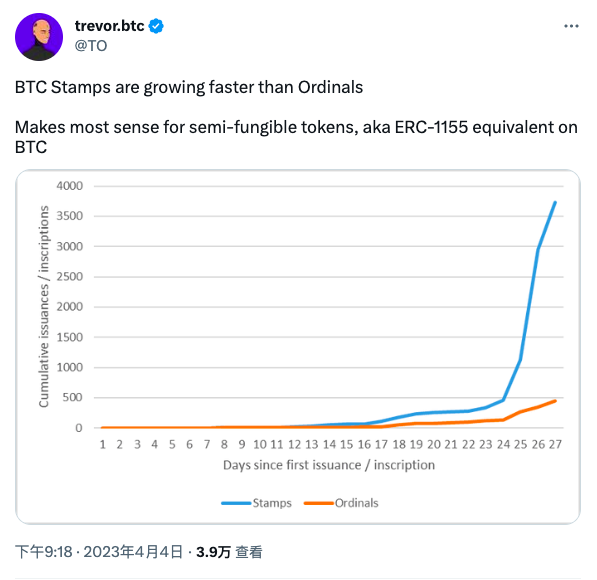
Image source: trevor.btc, partner of Bitcoin Frontier Fund
BTC Stamps was created by anonymous developer Mike In Space! According to the Github information he submitted,The implementation mechanism of BTC Stamps is to embed the image data in base 64 format into the transaction output on the Bitcoin chain, so as to permanently save the corresponding image data on the Bitcoin chain.
Specifically, the user needs to first encode the binary content of the image into a string in base 64 format (the base 64 encoding of the image means that a pair of image data can be encoded into a string of strings, and then use the string instead of the image address) , and then add the prefix "Stamps:" before the string, and then use the Counterparty protocol to broadcast the entire text content to the Bitcoin chain. The content will be segmented but numbered one by one, so as to facilitate reverse decoding by upper-layer applications to the original picture content.
There is a concept involved here -Counterparty protocol. The Counterparty protocol was actually born as early as 2014, and "Rare Pepes", who is now regarded as the pioneer of NFT (the word NFT didn't even exist at the time), used the protocol.ThatThe feature is that data can be written in the blank space of the Bitcoin data block, so as to embed the data into the original Bitcoin transaction.
It is worth mentioning that 99% of Counterparty transactions generally use the OP_RETURN data encoding method, but the data embedded based on this method can be "deleted" by the full Bitcoin node, so it is not suitable for the NFT direction that emphasizes permanent storage . But in the case of BTC Stamps, due to the uniform length of the base 64 string, the corresponding Counterparty transaction will default to the P 2 SH type. This type of transaction needs to split and embed the data into multiple transaction outputs (the larger the content, the The more outputs are created), and cannot be "deleted" by the Bitcoin full node, thus realizing the permanent storage of the image data.
As for the C-end experience of BTC Stamps, there are two points that need special attention.
One is from the perspective of the cost of data on-chain, Mike In Space! in the Github databaseIt is recommended that users choose the image format of "24 x 24 pixels, PNG or GIF with 8 color depth", which is also the native resolution of the head project CryptoPunks.
two isAll BTC Stamps NFTs will be numbered according to the transaction timestamp(so the most important thing is probably not the picture content, but the number), the numbering starts at 0 and will continue indefinitely, but transactions with embedded base 64 strings that are invalid or illegible will not be recognized.
StampchainThe data shows that as of 1:30 on April 6th, Beijing time, 8,220 BTC Stamps NFTs have been minted, and most of the pictures are directly copied from the original pictures of CryptoPunks.
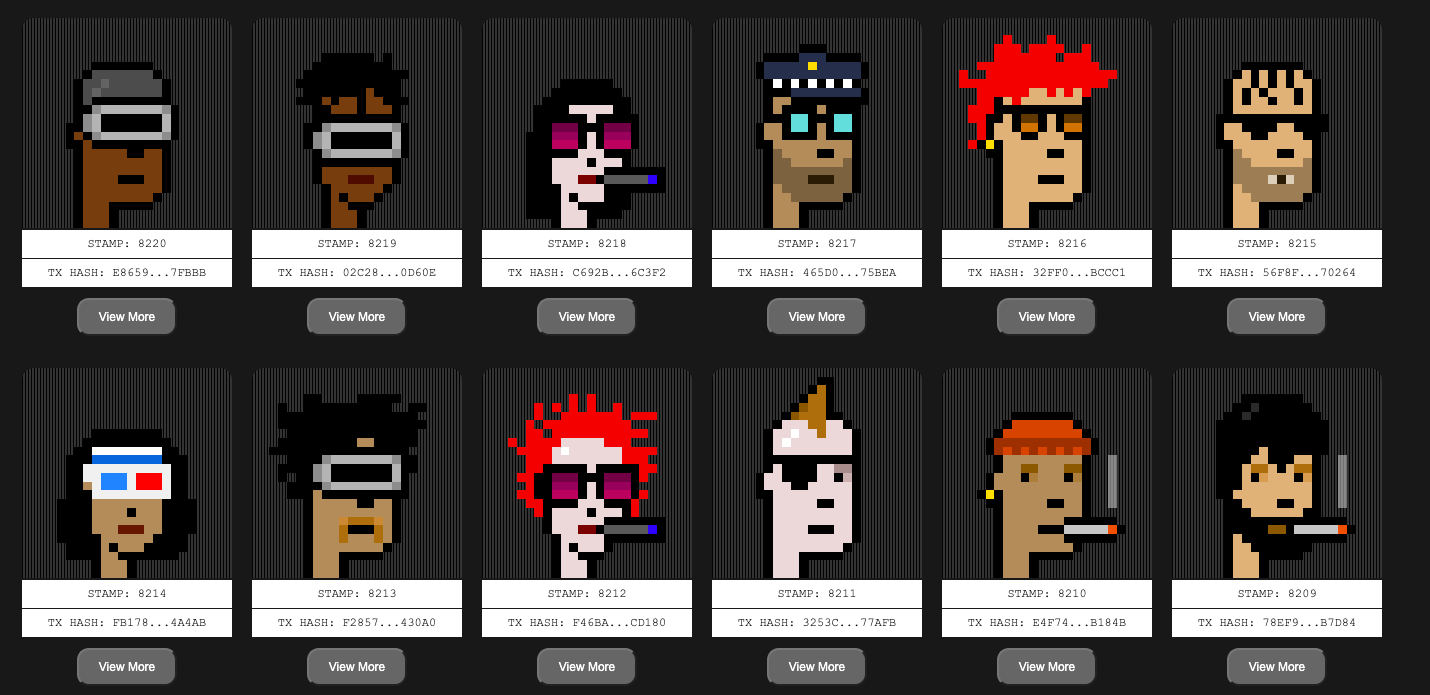
On the whole, BTC Stamps provides a brand-new implementation form for all players interested in Bitcoin NFT. Compared with Ordinals, there are also some obvious differences.
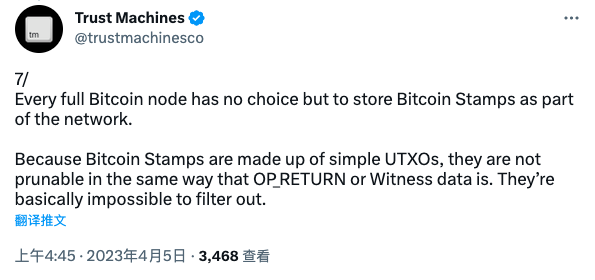
According to the analysis of the Bitcoin ecological development team Trust Machines, the biggest advantage of BTC Stamps over Ordinals is that,Its data storage is based on the simplest transaction output, so Bitcoin full nodes have "no choice" but to save BTC Stamps, while OP_RETURN and "witness data" (the scheme adopted by Ordinals) may be "deleted" by the full node.
However, BTC Stamps also have obvious disadvantages compared to Ordinals.The most important point is that the cost of BTC Stamps is higher than that of Ordinals, which also leads to BTC Stamps can only limit the specifications of the original image in order to limit the cost; in addition, Ordinals also supports other file types besides images, such as text, audio, video and even applications, etc., as long as the size does not exceed 4 MB The block limit is enough, which is temporarily impossible for BTC Stamps.
The development of Bitcoin NFT is still in a very early stage. Both BTC Stamps and Ordinals are not mature enough for the time being. Whether the two can be distinguished in the end, or whether they will go to different application directions according to different characteristics will depend on It has become a key point of view for the future development of Bitcoin NFT. Odaily will also continue to accompany you and keep track of the development trend of this segmented track.


