In-depth interpretation of the Filecoin virtual machine: working principle, unlocked use cases and its importance



Original source:Filecoin Network
overview
text
Original source:
first level title
overview
This blog post explains the basics of the Filecoin Virtual Machine (FVM) and why it is so important. In addition, it describes how to evaluate and prioritize the opportunities it will unlock.
Second, we introduce a framework to categorize potential use cases for FVM virtual machines by their relevant opportunity areas. This session discusses the specific opportunities unlocked by FVM virtual machines, and how VCs, developers, storage providers, and other stakeholders can evaluate and prioritize these opportunities.
In the third section, we will explore how the FVM virtual machine can commoditize cloud services, allowing anyone to create and monetize data-related products and services, thereby fully unlocking and enhancing the full potential of this trillion-dollar open data economy .
Finally, we discussed what drives hundreds of teams to build applications on top of FVM, and where to stay informed about the latest news on FVM.
Note that this blog post builds on the results of previous posts exploring the role of the Filecoin Virtual Machine in the broader Filecoin roadmap (https://medium.com/tldrfilecoin/state-and- direction-of-filecoin-summarized-4b90c59e3cca), its potential impact on the Filecoin economy (https://medium.com/tldrfilecoin/filecoin-tokenomics-understanding-an-advancing-economy-ef319632ffa8 ), and its role in unlocking open The potential for new use cases in the data-as-a-service economy (https://medium.com/tldrfilecoin/business-models-on-the-fvm-23cd71fdd3f1). You may find these articles useful for exploring related topics in depth.
first level title
1. FVM enables Filecoin to achieve user programmability, becoming a watershed for innovation
Filecoin's expansive roadmap (https://medium.com/tldrfilecoin/state-and-direction-of-filecoin-summarized-4b90c59e3cca) aims to transform cloud services into a permissionless marketplace where any provider can provide services . The FVM virtual machine smart contract (called actors on Filecoin), released on March 14, 2023, is a key part of this broader vision because it allows user programmability for key services of the Filecoin network: large-scale storage, retrieval and data calculation.
What’s exciting about the FVM virtual machine is that it allows any developer¹ to deploy smart contracts on the network. An analogy can be drawn to what happened with the advent of programmability in mobile phones: the ability to write apps and install them on phones dramatically increased the things people could do on their phones, making phones more functional than the original pre-installed software. become stronger. That was a watershed moment for innovation.
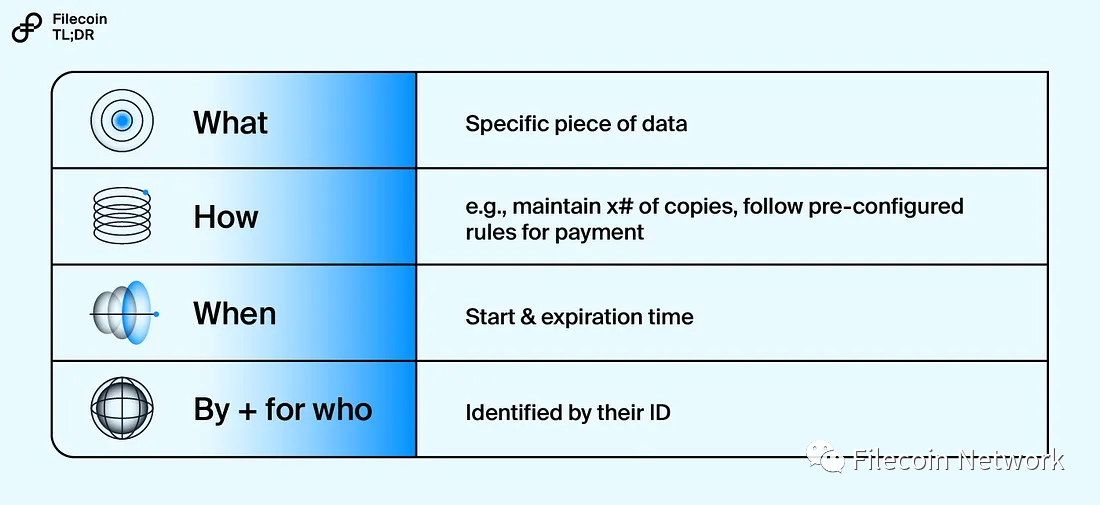
FVM is a state machine that enables any user to program around the state of the Filecoin blockchain.
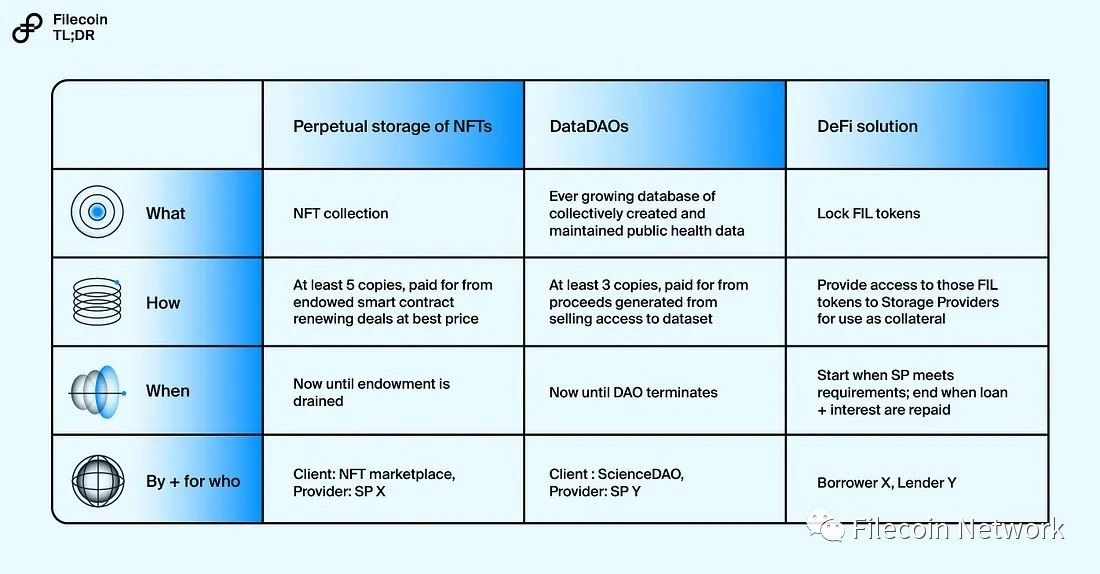
Although the FVM virtual machine will not directly deal with the data on the Filecoin network (but only its metadata), it can realize the automation of storage and related services (off-chain data indexing and oracle) and value settlement. Such automation will unlock many new use cases. The figure below shows the new opportunities (persistent storage, DataDAOs, Filecoin staking, etc.) created by the combination of FVM virtual machine open functions.
FVM virtual machine supports value settlement and building smart contracts. These contracts can interact with metadata based on Filecoin blockchain services such as storage.
These scenes can be combined endlessly with each other and with other components such as developer tools, end user interface, etc. In addition, they may eventually leverage other components of the Filecoin economy that either anchor data into the same blockspace (such as retrieval and computation of content-addressed data) or connect to other economies (such as through cross-chain bridges and oracles). These combinations ultimately lead to more powerful applications.first level title
2. How do we view the use case of FVM virtual machine unlockingUse cases for FVM virtual machine unlocking can be simply categorized into the following opportunity areas:
Data upload and management:Proposals to automate storage transactions could unlock use cases such as persistent storage.
Data Collection and Monetization:Such as assisting the creation, collection and monetization of valuable data sets.
Distributed finance:For example, issuing collateral for thousands of storage providers on this network can also create opportunities for token holders to actively participate in the Filecoin economy.
Network actor discovery and analysis:
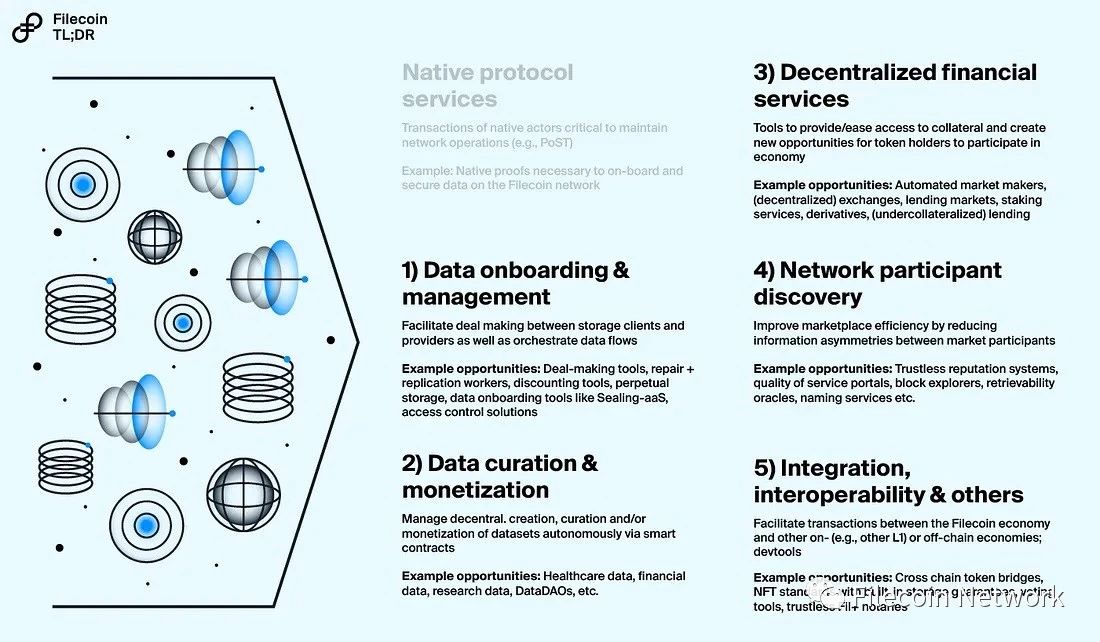
This creates opportunities for differentiation, such as storage provider reputation services or data retrievability oracles, and also improves stability for users of this distributed cloud service.
Integration, interoperability and other services:
Such as cross-chain bridges to other economies, NFT standards with built-in storage guarantees, and developer tools.
It is worth noting that some businesses may straddle these opportunity areas due to FVM virtual machine use cases and the composability of Web 3.
The use cases of FVM virtual machine unlocking can be simply divided into five opportunity areas, corresponding to several large market opportunities.
One of the unique advantages of FVM-based virtual machine services is the ability to access a large number of storage providers - all of whom want to increase profitability. In February 2023, Filecoin network storage providers locked a total of 130 million FIL (https://filfox.info/en) as collateral to ensure their commitment to network and customer data security.
In addition, storage providers have invested millions of dollars to support the operation of several data centers, providing huge storage space. Partly due to the lack of DeFi solutions, they currently have little access to collateral and other funding opportunities². Therefore, if there is a service that can reduce these costs for storage providers, reduce the complexity of related processes, and unlock new revenue streams, it represents a large-scale market opportunity. This advantage will also make Filecoin a unique L 1 protocol.
Services based on FVM virtual machines can also support data access or encryption solutions such as Medusa (https://medusanet.xyz/), Fission (https://fission.codes/), Lit (https://litprotocol.com /) or Lighthouse (https://www.lighthouse.storage/)), thereby increasing the revenue of the storage provider. In this way, Filecoin solutions can have a new source of customers - by bringing more differentiated schemes to storage providers (such as through reputation assessment or compliance certification tools), lengthen the cycle of storage transaction proposals (perhaps even permanently) , to more efficiently allocate the datacap data quota of the Fil+ plan.
Cross-chain bridges and information mechanisms connecting other Web 3 ecosystems can help the service input and output in the Filecoin economy, and also represent a large growth opportunity - to increase the utility of the Filecoin network (block space demand) And the usability of Web 3 plays a big role. In the short term, developers can also take advantage of the opportunities brought about by the development of tools related to the above fields.
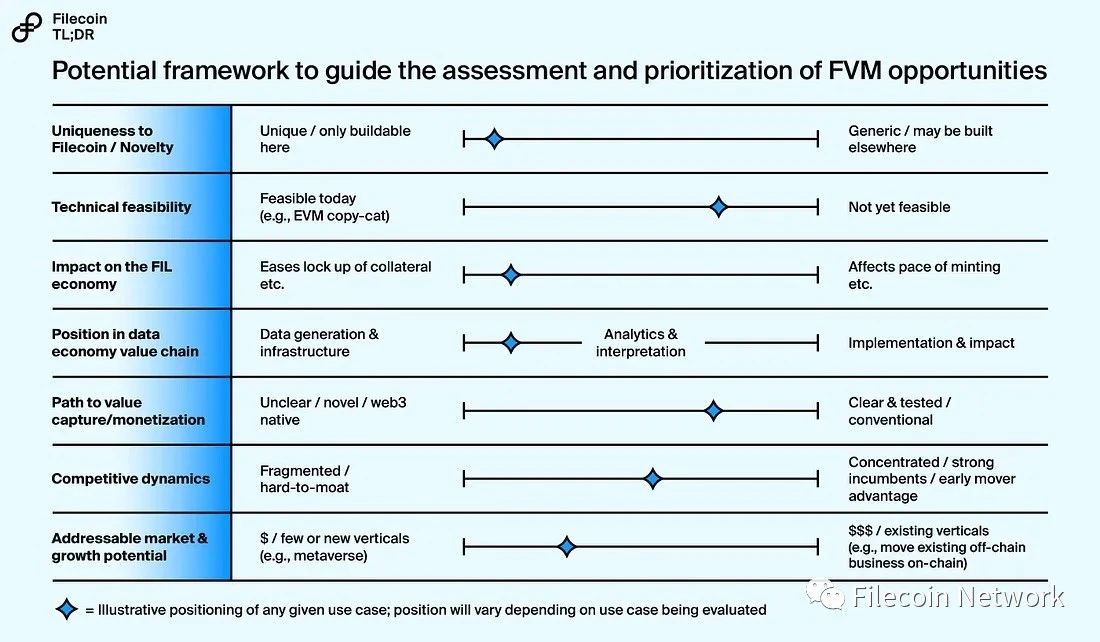
Taken together, these opportunities represent some markets with revenue potential in the hundreds of millions of dollars. Different considerations will help stakeholders to prioritize the development of different opportunity areas. In addition, stakeholders can strategically prioritize the development of different opportunity areas to maximize impact. The following overview framework provides a dimension for evaluating the unlocking opportunities of FVM virtual machines, which you can refer to.
Various considerations, such as those provided on this continuously updated list, will help stakeholders determine the priority of use cases in different opportunity areas.
first level title
3. Empower more people, create and capture data value, and release the full potential of the open data economy
Web 3 and Filecoin (especially the FVM virtual machine) will continue to promote the commoditization of cloud services and bring better contribution attribution mechanisms to the data economy. This section explains why commoditization is needed, how it opens the door to the data economy, and how it enhances the process of value creation, capture, and fair sharing.
A broad definition of the data economy can be given: it can cover data analysis and transformation businesses (such as encryption software, transcoding software, etc.), data access and monetization (such as on-demand streaming services), financial services in market transactions, and Sales of the hardware needed to drive these businesses.
Today, the core pillars supporting the data economy (such as cloud storage and computing, content delivery networks, etc.) are controlled by a few large companies. These institutions have successfully exploited economies of scale to expand their operations. Such control not only creates a single point of failure, it also stifles innovation and drives prices inflated.
Web 3, Filecoin, and the FVM virtual machine have the opportunity to challenge the incumbents: Composability and cryptoeconomic incentives have allowed the Filecoin community to grow rapidly, fostering a network of continuously expanding and price-competitive storage providers. Filecoin's open storage network is already the largest of its kind in the world. Its capacity dwarfs even centralized storage providers (listed companies). As Filecoin further realizes its vision, the infrastructure anchored to the Filecoin network will revolve around content distribution (such as through Filecoin Saturn (https://strn.network/)) and data computing (such as Bacalhau (https://www. bacalhau.org/)) to commoditize its services.
Second, in today's data economy, value creation often comes from collectively created data sets (think: users who create content for a social network and those who have an interest in that content). But in the current data economy, the capture of this value is often monopolized by a few people. This is because the Web 2 era has failed to produce a mechanism that would allow producers of data to directly participate in the process of capturing the value of the datasets they co-create. Instead, it is the advertising industry that has profited the most from the data these collectives create.
By using distributed ledgers, Web 3 technologies are architecturally more capable of tracking and giving back to contributors (even data of little value). Specifically, by using the FVM virtual machine, any unrelated participants can use the Filecoin token (or the L2 layer abstract protocol based on the FVM virtual machine) to form a collective with an incentive mechanism, in an unprecedented way, jointly Create, preserve and monetize data.
Alternatively, researchers could sell access to a database of bacterial pathogens (which could be used to discover antibiotics or improve drug discovery efforts), with the proceeds used to fund the database's ongoing data collection and maintenance efforts.
Or a growing encyclopedia could directly reward its most active contributors, rather than letting value flow through an intermediary.
With such projects, the ability to capture value will be tied to access to proprietary data sets. In addition, the openness and composability of such services gives users the freedom to opt out of data services, maintain their loyalty, or express their opinions. This degree of freedom will force organizations to think deeply about data set privacy and sharing issues, not just a "trust us" and it's over. It may also allow data holders to enjoy a greater share of returns.
In general, FVM virtual machine and Filecoin-driven storage commoditization and a more complete value attribution mechanism will not only bring more intense competition and pressure in various fields of the data economy, but also consolidate Filecoin as a driver of the open data economy The unique position of the L1 layer blockchain.
first level title
Conclusion: FVM virtual machine has become a fertile ground for the accelerated growth of the Filecoin ecosystem
FVM promises to unlock the growth of a class of applications, marketplaces, and organizations that would dwarf centralized cloud service providers in scale and breadth.
This potential has greatly encouraged the community: In the weeks before the FVM virtual machine was officially launched, hundreds of teams were building related applications on the FVM virtual machine on the test chain. Additionally, FVM virtual machine hackathons (such as Spacewarp) held prior to the FVM virtual machine launch saw the highest number of registrations for a Filecoin-only hackathon (https://twitter.com/Filecoin/status/1627385553027997697).
The Filecoin community will continue to foster a highly composable ecosystem that accelerates the best ideas. The FVM virtual machine is highly compatible and thus can catalyze the adoption of Web 3 technologies and develop hand in hand with other ecosystems and L1 blockchains.
It's a bit like a computer that can support multiple operating systems. Filecoin virtual machines support multiple runtimes. The first runtime to be released will be the Filecoin Ethereum Virtual Machine (FEVM). This will make it easier for EVM developers to get started by importing existing EVM smart contracts using the proven developer tools infrastructure.
There are many good reasons why you should build your application with FVM. If you want to see which teams are working on this, you can check out this continuously updated list (http://ecosystem.filecoin.io/?filters=enabled&tags=FVM). In addition, you can also review the Space Warp program (http://spacewarp.fvm.dev/) to learn about some activities before the release of the FVM virtual machine, including FVM hackathons, sponsorship programs, community leader boards and accelerator programs, etc. . To understand the technical details of the FVM virtual machine, you can visit fvm.filecoin.io (https://fvm.filecoin.io/) or watch related videos (https://youtu.be/Cj 9 r 3 pKI 2 L 8 ).