Decentralized social protocols: Nostr to the left, Farcaster to the right


Original author: 0xOrange
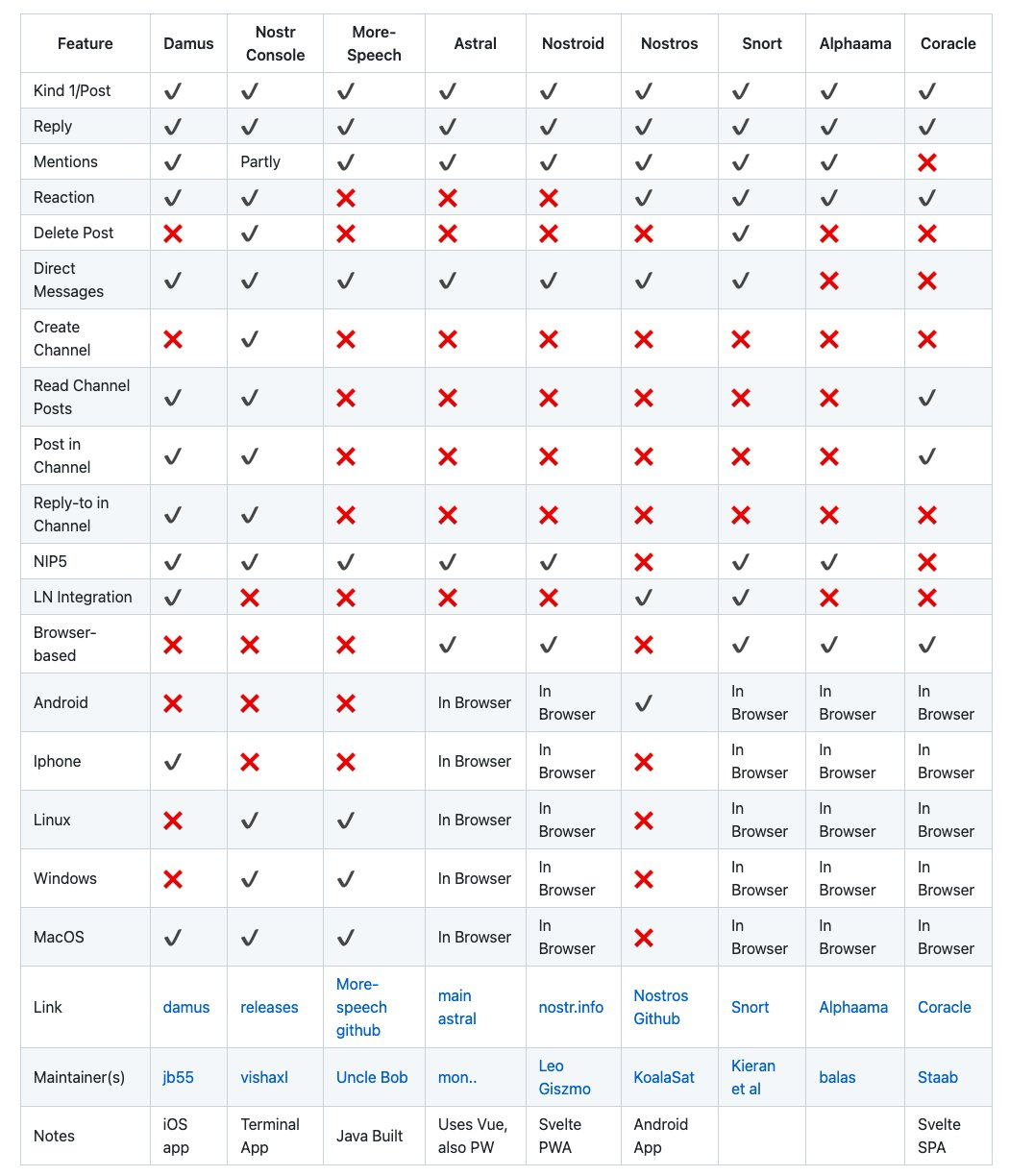
At the same time, everyone will inevitably compare it with classic WEB2 social products like Twitter, but some people will make a wrong match in the comparison process, such as comparing Twitter with Nostr, or equating Damus with Nostr, here The misunderstanding is thatThe essence of Nostr is a protocol, and Damus is a third-party application developed according to the protocol.There are many other applications similar to Damus. The following is a comparison of different client implementations of Nostr.
Nostr is a minimal protocol dedicated to creating a censorship-resistant global "social" network. This vision reflects the current social dilemma:Social networks are censored, not free.
The most talked about example is of course Twitter, but,Did Twitter do it wrong?
I don't think so, because it is a private company registered in the United States (it used to be a listed company), which is destined to be subject to supervision, to be responsible to shareholders, and to have a profitable business model...It is a commercial company, not a defender of free speech.
As a company, he has the right to set his own censorship boundaries. For example, when various child pornography, vendetta, and racial hatred flood the platform, it will inevitably lead to bad money driving out good money, which will affect the demand of advertisers. In addition, the government, Public opinion and even internal employee opinions can become pressures that affect censorship.
Who will defend the freedom of social networks? I think that companies or applications should not be fully responsible, but should be handed over to protocols like Nostr and Farcaster,Code guarantees freedom.
Using the most common metaphor, Nostr and Farcaster are the Layer 1 of social networking, providing a truly free "public" space. Other developers and private companies can build applications based on this public square. In theory, classic WEB2 applications such as Twitter can also It can be built on the basis of Nostr. In the social layer 2, the competition is UI\UX, curation, operation... Each application may have different speech review standards, but this does not affect the existence of "source information", even if some information is in If an application is blocked, it can still be displayed in another application, which also allows everyone to freely choose their favorite application.
Nostr and Farcaster are more representative social protocol layers. In addition, there are Lens Protocol, and DeSo,They have the same goal, but the technical route and even the "protocol character" are different.
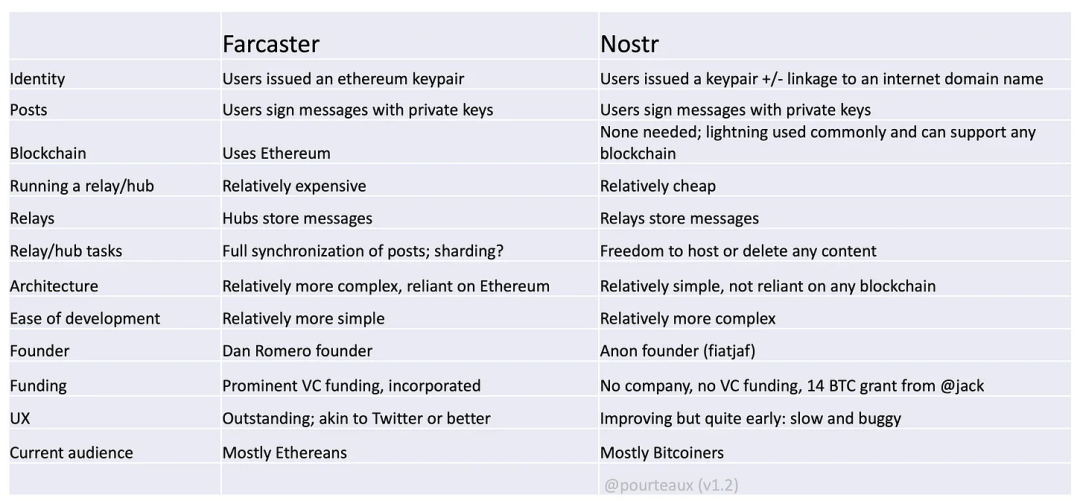
Comprehensive comparison, Nostr and Farcaster, a simple conclusion is:Nostr is more like Bitcoin, Farcaster is more like Ethereum.
In essence, Farcaster is still a VC-backed company, established by former Coinbase executive Dan Romero, and received $30 million in financing in July 2022, led by a16z.
Farcaster’s early invited users are mainly VCs, project founders, and Ethereum community users.
In terms of design, Farcaster uses the Ethereum architecture. Creating a personal profile on Farcaster will generate mnemonic words and an identity on the Ethereum Goerli testnet. Farcaster chooses to host user identity information on the chain, which is the global data registry.
Because storing information on the chain itself is expensive, Farcaster’s choice is to store a person’s identity information and the ability to read and write data on the chain, while other data information (such as sent private messages, etc.) will be stored off the chain Server Farcaster Hubs, so as to ensure that users can fully control their identity, social relationship and data information.
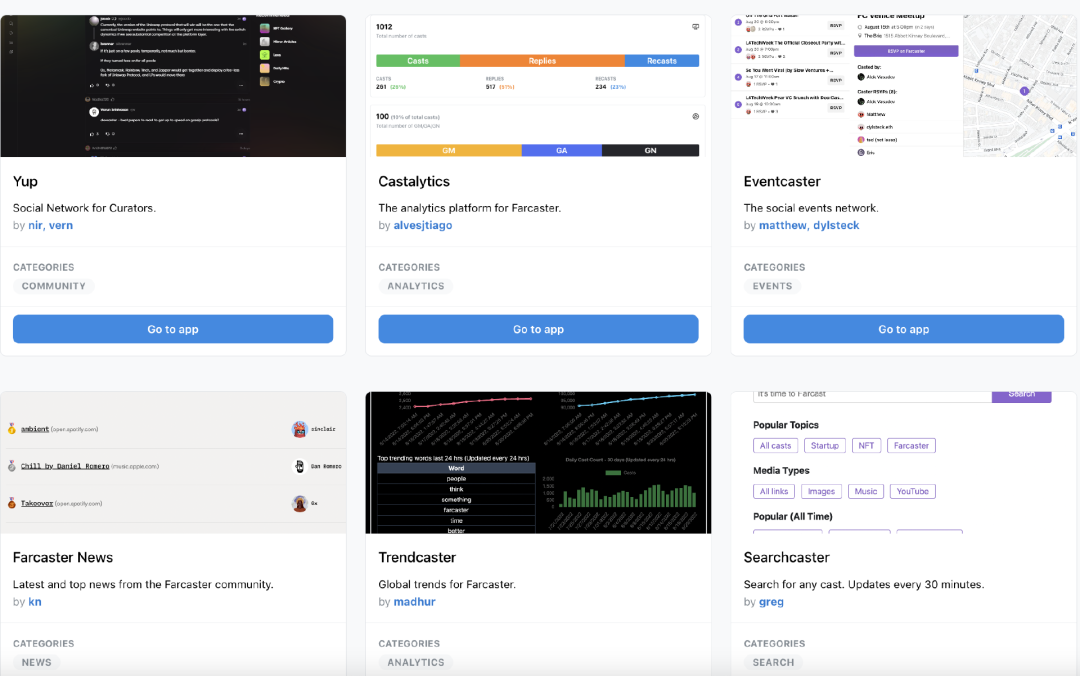
Currently, there are more than 30 applications built on the Farcaster protocol.
Compared with Farcaster’s tens of millions of dollars in financing, Nostr looks shabby. It was established by a group of anonymous developers without external financing. Later, it received a donation of 14 BTC from Twitter founder Jack Dorsey, which is the only external funding. .
In the early days, Nostr's supporters were mainly Bitcoin enthusiasts headed by Jack, including Martti Malmi, the core developer who first set up a Bitcoin forum for Satoshi Nakamoto, developed the client iris.to based on the Nostr protocol.
Like Bitcoin, Nostr pursues "simplicity". The identity information of each user is the public key, and the core is two components, the client and the repeater (also called a transponder).
Everyone runs a client, and when you want to publish something, you sign it with your key and send it to multiple relayers (servers hosted by other people or yourself), from To get updates from other people, you can ask multiple repeaters if they know about those other people.
Anyone can run a relayer, we don't need to trust the relayer, the signature is verified on the client side.
To sum it up in a sentence from BTCStudy Ajian,Nostr is a public key-based, minimalist, censorship-resistant messaging protocol.
In addition to Nostr and Farcaster, the hottest social protocol is Lens Protocol, a decentralized social media protocol built on Polygon by Stani Kulechov, founder of DeFi lending project Aave.
The core of Lens Protocol is to make full use of the potential of NFT and build a social graph based on NFT.
For example, when you create a Lens profile, an NFT is minted in your Ethereum wallet; when you follow someone on Lenster, you mint a "fan" NFT (Follow NFT) on the chain and each NFT Each has a unique number, which records the order of creation/following.
Therefore, under the Lens Protocol, social relations are not only a kind of data, but also an asset that can be transferred and traded.
From the perspective of ecological development, Lens Protocol should be the hottest social protocol at present, which is partly due to the modular design of its components.
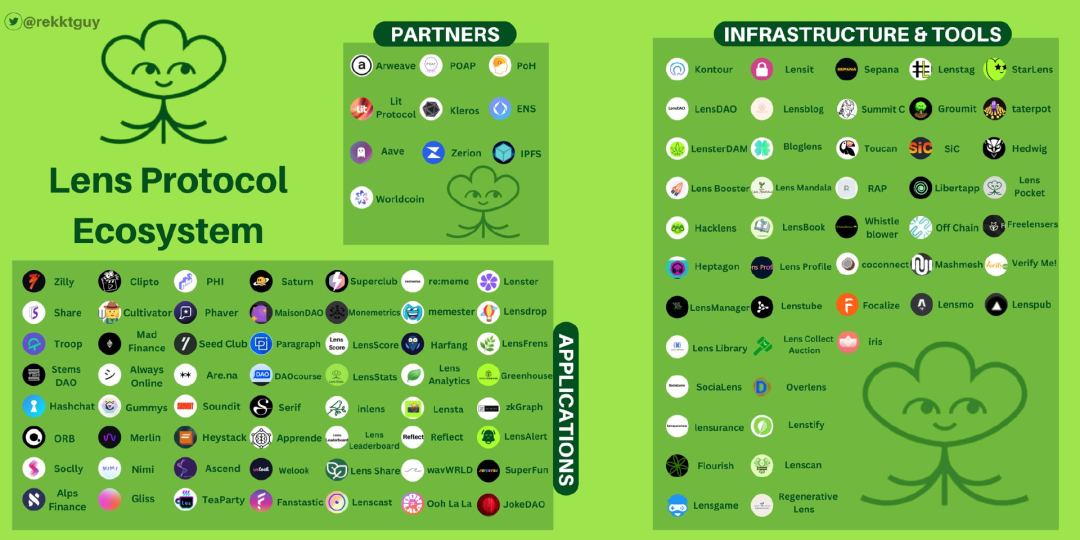
Lens Protocol is extremely developer-friendly, allowing developers to use modular components to build their own social applications on Lens, including a large number of Web3 and Web2 tools, or on-chain and off-chain data, all of which are bound together by LensAPI. For example, for data hosting, applications can choose decentralized storage methods such as IPFS and Arweave, or traditional methods such as AWS; they can choose XMTP or Dialect for direct messaging, and Push or Notify for sending notifications.
In the traditional Internet field, social networking is the pearl, because of its strong network effect, the oligopoly effect brought by the social graph is particularly obvious. For example, the social terminal of most social applications, including Tantan and Momo, is actually WeChat. It is difficult to leave the social relationship accumulated on WeChat.
Regardless of whether decentralized social networking can subvert traditional social relationships and graphs, one of the questions to be asked here is,Does decentralized social networking still have network effects? Who will be the winner?
The network effects and monopoly advantages of traditional Internet social platforms largely come from being closed and licensed, and building their own back garden. After a period of time, users will be very expensive to quit these platforms, because they cannot take away their social relationships and graphs.
But in a decentralized social network, where there is no permission, and users control their own social relationships (provided they really control it), the cost of user exit is low, making it harder for network effects to accumulate.
In other words, decentralized protocols can accumulate some network effects, but it is difficult for applications to accumulate network effects.
This may be a kind of encryption freedom.
Only throwing bricks to attract jade, discuss with you.