






Cold thinking under the heat of DID: isolated islands of information, single scene, how to break the situation?


In November 2021, the encryption unicorn Amber Group published a research report "Decentralized Identity DID: Web3 Passport", which systematically introduced the DID concept and ecosystem.
At that time, few people would have expected that the Web3 track would make great strides in the following year, frequently obtaining huge financing, and various DID projects came one after another, allowing more and more C-end users to have decentralized identities. Flying into the homes of ordinary people".
However, behind the DID boom, more and more islands of information have emerged. These projects are backed by different public chains and do not communicate with each other; even DID projects on the same chain do not support information sharing and transmission.
Over time, users have more and more DID identities, but management becomes more and more difficult. This is obviously not what Web3 should look like. So, can many DIDs be aggregated to meet various application needs of users in one stop?
Objectively speaking, the current answer is no. However, there are already projects that try to solve this problem. Take the Web3 collaboration platform Dmail as an example. The platform recently launched a DaaS service (DID/Decentralized-as-a-Service), starting from the DID account of a Web3 user, and providing encrypted information transmission services based on DID Name.
Simply understood, Dmail supports the aggregation service of multi-chain domain names, provides various types of encrypted information transmission services based on DID Name, and supports users to send and receive emails with various DID identities in one background.
first level title
Cold thinking under the heat of DID
Last August, decentralized identity protocol .bit announced a $13 million funding round led by CMB International, HashKey Capital, QingSong Fund, GSR Ventures, GGV Capital and SNZ.
Financing in a bear market is inherently difficult, but a DID project can complete a high amount of financing, which shows the market's expectations for the DID track. As far as VC is concerned, this is the current outlet, and even Binance cannot stay out of it.
Following .bit, Space ID completed its seed round of financing, led by Binance Labs. The ensuing domain name registration triggered Fomo in the market, and some users made a lot of money by trading whitelisted OAT and domain names.
For a while, whitelisting and squatting domain names became a profitable business, and the popularity of the DID track can be seen.
In fact, the domain name is only part of the DID. According to different application scenarios, DID can also be divided into the following four categories: off-chain identity authentication (such as BrightID), on-chain identity aggregation (such as CyberConnect), on-chain credit scoring (such as ARCx), and on-chain behavior authentication (like Project Galaxy).
Since 2022, various DID projects have attracted a large number of Web3 users. Taking CyberConnect as an example, this project is a rising star with a user scale of more than 100,000. Although Lens has not yet fully opened for registration in the same period, the number of accounts has exceeded 100,000.
Behind the prosperity, the DID track also exposed many problems: financial hype is prevalent, which deviates from the original intention of DID; different projects are fighting on their own, and the problem of information islands is serious;
To give a simple example, different public chains have different domain name projects. Although users hold a bunch of domain names, they cannot share identity information. It seems difficult to find a second application scenario other than using domain names to transfer money.
If you turn a blind eye to these problems, the DID track is likely to be short-lived, and the development of Web3 is even more empty talk.
At present, although some projects are trying to cross-chain, they still cannot tear down the walls between different DIDs, and some projects are trying to aggregate identities, but there are often no products directly oriented to users, and the landing scenarios are even more lackluster.
first level title
New Try: DaaS
The Dmail I recently came into contact with provides a new way of thinking: start with specific needs and aggregate different DIDs.
The project started from a decentralized mailbox and has now developed into a Web3 collaboration platform, which has received investment from more than 20 VCs including Hashkey. In order to solve the problem of breaking the information barrier between DID projects, Dmail launched a DaaS service (DID/Decentralized-as-a-Service).
Starting from the DID account of Web3 users, this service provides various types of information transmission services based on DID Name. Any form of information (text, pictures, links, etc.) can be spread in the Web3 world through Dmail's DaaS.
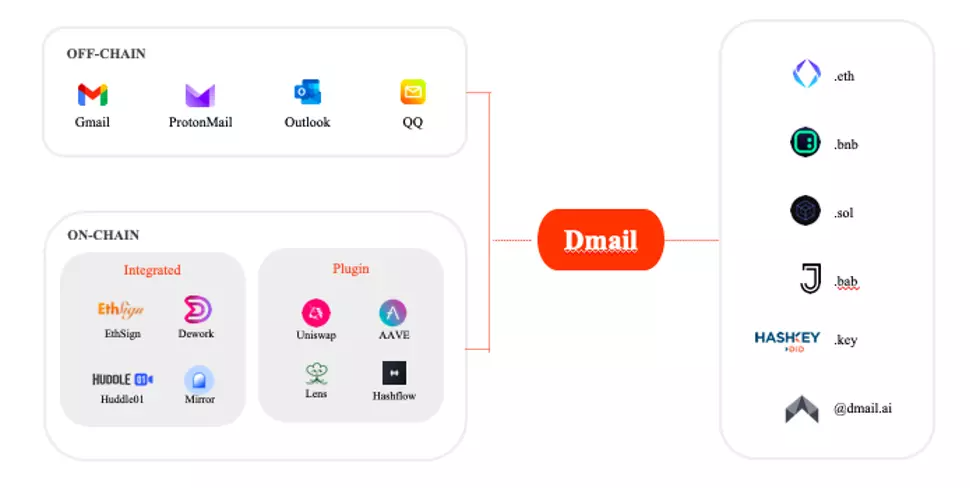
In terms of specific applications, Dmail's DaaS supports aggregation services for multi-chain domain names. The DID projects of the current mainstream public chains can be aggregated to the Dmail platform to realize the multi-platform integration of user DID domain names.
In addition, Dmail also supports domain name resolution of mainstream public chains. After users log in to Dmail with their own DID, their original DID domain name (such as dmail.eth) can be displayed on Dmail, and this domain name can also be used as the address for sending and receiving Web3 mail.
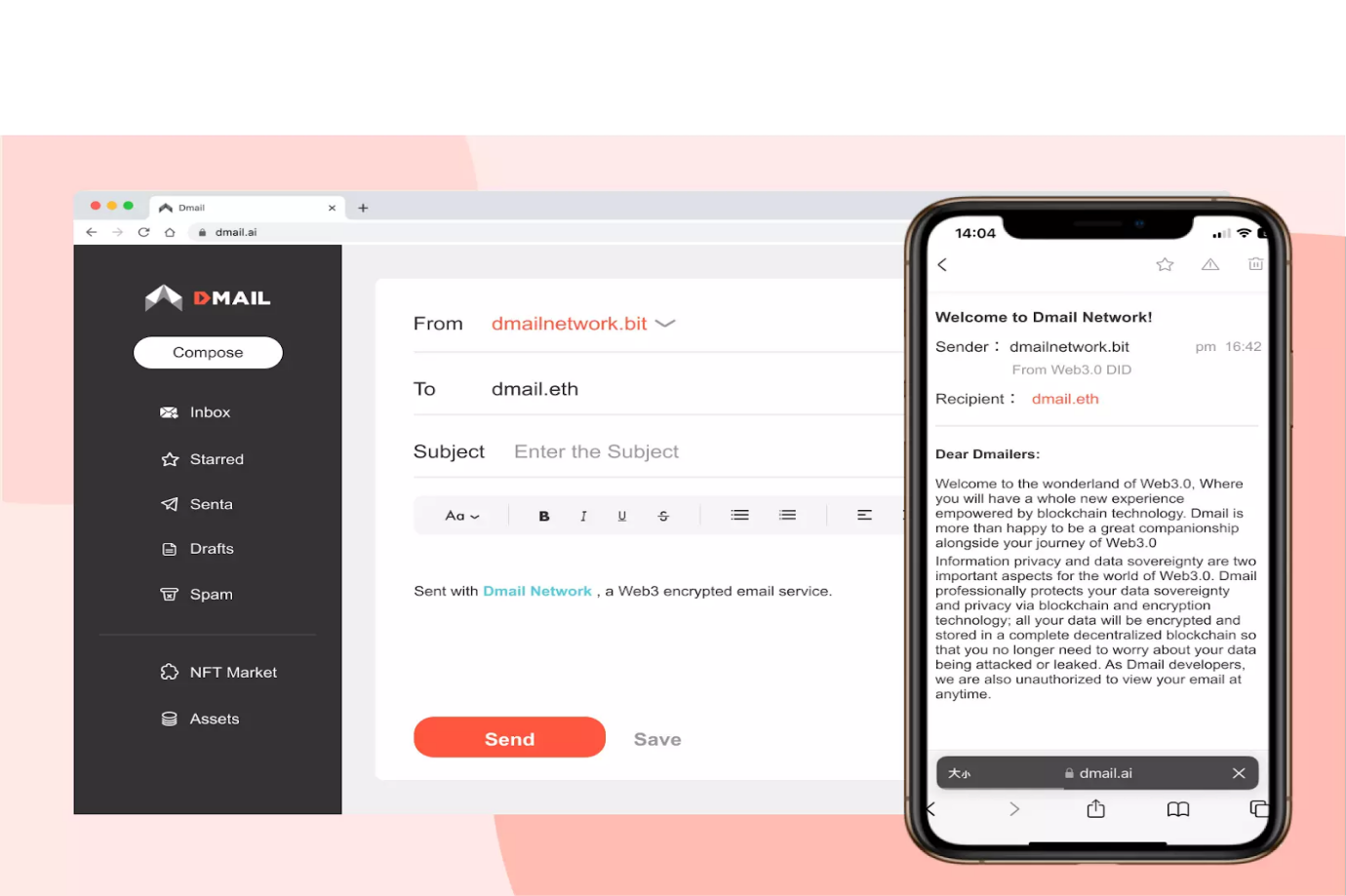
In Dmail, users with any DID account can mint a Dmail NFT domain name account for free when they log in to Dmail. After logging in to the account, the user can view all DID Names held on the Setting Page, and at the same time can set and bind any DID Name for sending and receiving emails.
If the DID Name bound to the user is transferred or sold, the user does not need to worry about the loss of email information, because all email information is associated with the login wallet address. At this time, only need to switch to the new DID Name to view the historical email.
When other users send emails to users who have switched/sold the commonly used DID Name, they will also receive a reminder of the recipient's DID Name binding transfer, thereby terminating the information transmission and avoiding the leakage of important information.
It is worth noting that Dmail not only supports Web3 mail transmission, but also supports traditional mailboxes such as Gmail, ProtonMail, and Outlook, which is conducive to the integration of Web2 and Web3.
It is reported that Dmail already supports DID login and use such as ENS, SpaceID, JazDID, HashkeyID, Unstoppable and .Bit. In the future, Dmail will cooperate with more DID projects to provide private information services, including but not limited to NextID, Unipass, BNS, PolygonID, Bonfida, etc.
In general, Dmail starts from the information transmission scene and meets the mail sending and receiving needs of different DID users in one stop. Although the function is relatively simple, it shows its innovation to break the information barrier.
Looking Ahead: "PLAN B" in the Web3 Era
In 2017, Wall Street financial tycoon Jim Rogers said frankly in an interview: "In the next 10 or 20 years, only one identity is dangerous, because there will be many problems in the world that we need to face, financial, political, military... …so there has to be a PLAN B, because having a second identity gives you a chance of survival."
In the era of Web3.0, DID is exactly the PLAN B we need. It returns data and identity control rights to users, helps users create unique "on-chain ID cards", records on-chain activities and creates value, and opens up a broader application and narrative space.
Right now, DID is in the stage of barbaric growth, and there is still a long way to go from concept popularization to application landing. In this context, Dmail launched DaaS service, becoming the first Web3 DApp integrating DaaS service in the field of decentralized mailboxes in one fell swoop, which is expected to bring some positive value:
①For the DID industry: Aggregate mainstream DID and break the information barrier; provide reference for the development of the industry. In the future, it is not ruled out that more projects will start from specific scenarios to truly meet the diverse needs of DID users;
②For DID projects: expand existing application scenarios and fill user information transmission needs; Dmail is sending cooperation invitations to all DID projects to jointly provide users with 100% decentralized mail and collaborative office solutions, and expand more for DID application scenarios;
③For Web3 users: one-stop aggregation of DID accounts + mail sending and receiving, which can not only enrich the identity on the DID chain, but also "eat more with one fish", ambush various DID projects and Dmail airdrops. (Note: Dmail will airdrop 5% of the total amount of tokens to NFT mailbox holders. It is currently implementing a points reward plan. Users can earn points for completing tasks such as invitation registration and sending emails, which can be exchanged for various rights and even tokens in the future airdrop)
However, Dmail's ambitions don't stop there. According to insiders, the project also plans to launch asset management functions based on DID in the future, and will open up more social attribute functions of DID Name, such as adding social graphs.
In short, the Web3 era has come, and DID has great potential. We look forward to the continuous innovation of "Dmails" to make DID a real Web3 passport.





