






Inventory of the encryption projects that will die in the encryption industry in 2022: the DeFi track accounts for the highest proportion


Finishing: Cookies, Chain Catchers
The encryption market in 2022 is full of bad news - Terra collapsed in May, and encryption giants such as Three Arrows Capital and Voyager were hit by thunder one after another. At the end of the year, the exchange giant FTX collapsed again, driving the entire market into a bleak bear market, directly or indirectly causing a large number of encryption projects to cease operations.
ReportReport, a total of 951 cryptocurrencies entered the state of death from January to November this year. Fraudsters deployed more than 117,000 scam tokens on-chain from Jan. 1 to Dec. 1, 2022, up from all of 2021, according to a report from blockchain risk monitoring firm Solidus Labs. 41%. Of course, this includes many so-called "Dogcoins" and "altcoins", which are not consistent with the conventionally understood encryption entrepreneurial projects.
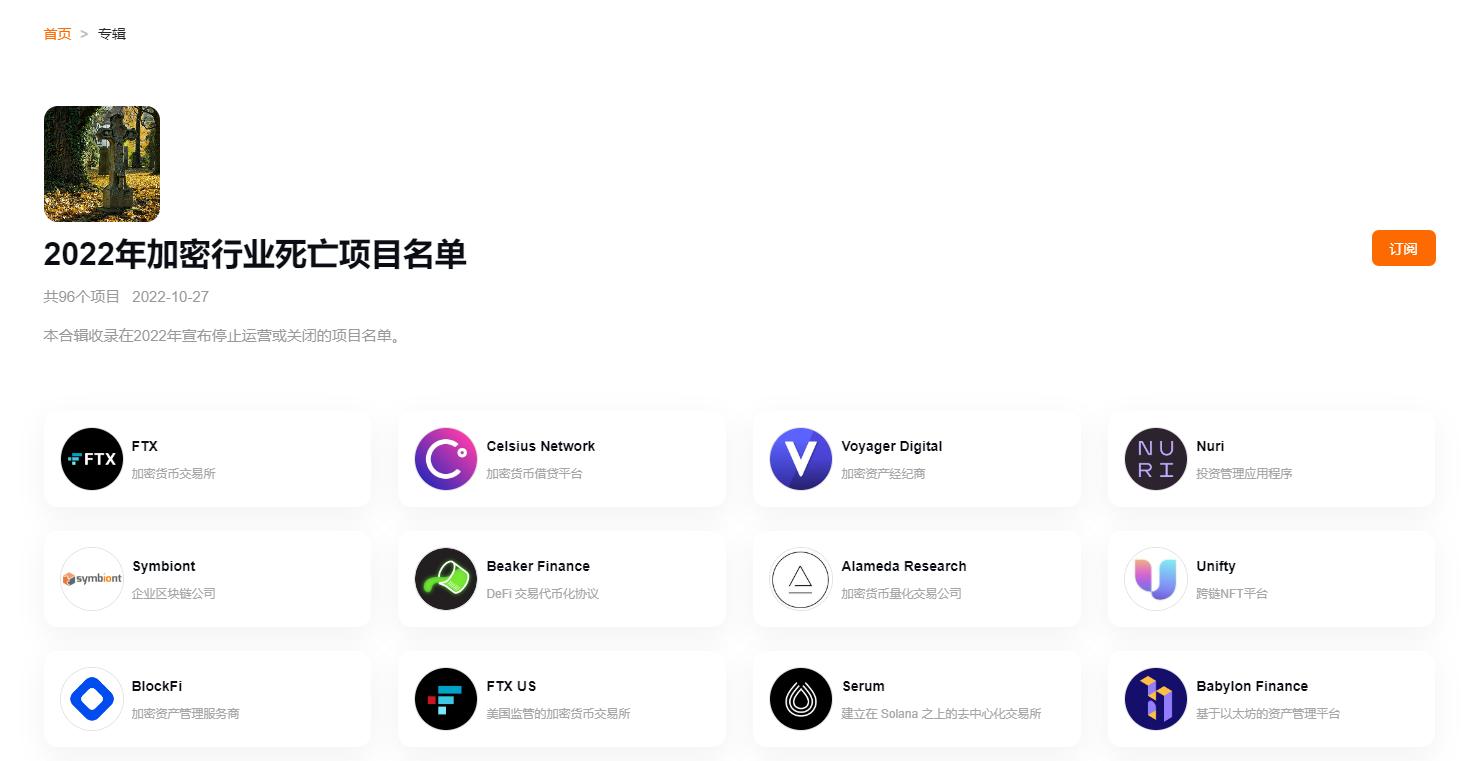
Recently, the encrypted data website RootData also released the project compilation "List of Dead Crypto Projects in 2022", which included 96 encryption projects that died this year, all of which had specific products but ceased operations due to various reasons. This list can reflect the development status of the encryption industry to a certain extent.
From the perspective of the track, DeFi, CeFi, and NFT are the tracks with the highest proportion of dead projects, accounting for 42%, 16%, and 13% respectively.
At the same time, 28 of these projects have received financing, with a total financing amount of US$3.605 billion, mainly contributed by projects such as FTX, Voyager Digital, Celsius Network, BlockFi, and FTX US. From the perspective of investment institutions, Alameda Research, Galaxy Digital, Arrington Capital, Paradigm, X 21 Digital, Pantera Capital, Coinbase Ventures and other institutions have three or more invested projects that have ceased operations.
Among them, the death of the vast majority of encrypted projects was affected by the collapse of Terra and FTX. The projects that were only affected by Terra and ceased operations include Anchor Protocol, Mirror Protocol, Proteus Finance, LoTerra, Nebula, Steak, Alice, Terra Name Service, Terranova.
In addition, several projects have announced that they will stop operations due to market demand, internal governance and funding issues, including Babylon Finance, Porta Network, Rentable, Skynet Labs, mistX, PandaDAO, Magnety, etc.
These bloody cases are worth pondering by the industry. How should start-up encryption projects be alert to the ubiquitous risks and formulate corresponding risk management strategies. This article will take stock of these crypto projects that will die in 2022.
CeFi
Cryptocurrency exchange FTX began to stop processing user withdrawals on November 9, and then entered bankruptcy proceedings. On December 13, FTX founder SBF was arrested in Panama and will be extradited back to the United States to face multiple charges. According to Chainalysis statistics, the FTX crash caused a loss of $9 billion. FTX damaged users may need to wait for the completion of bankruptcy reorganization before they can get part of the compensation. About 130 affiliates of FTX Group filed for bankruptcy together, including its independent US platformFTX.US。
Alameda Research founder Sam Bankman-Fried started Alameda in 2017 to take advantage of cryptocurrency arbitrage opportunities, then hired Caroline Ellison in 2018 and Sam Trabucco as co-CEO of Alameda Research a year later. Trabucco resigned on Aug. 25 but continued as a consultant. SBF tweeted on Nov. 10 to announce that the company is winding down operations. Caroline Ellison, who pleaded guilty to seven charges following the collapse of Alameda Research, carrying a maximum sentence of 110 years, said she was cooperating with prosecutors in the criminal case against SBF.
Encrypted asset management service provider BlockFi filed for bankruptcy on November 28. According to the company’s filings with the U.S. Bankruptcy Court, the top ten creditors are owed nearly $1.2 billion in debt. In July, the company was bailed out by FTX after suffering losses on a loan to bankrupt crypto hedge fund Three Arrows Capital. But the FTX collapse prompted BlockFi to suspend lending and client withdrawals. At the time of the bankruptcy filing, BlockFi had $257 million in cash that it will use to continue certain operations through the bankruptcy process.
The cryptocurrency lending platform Celsius Network entered bankruptcy proceedings on July 14. The platform has been promoting its income products with an annual return rate of nearly 19% to users. It has attracted 1.7 million users in 4 years and managed 30 billion US dollars in assets at the peak.
Voyager Digital, an encrypted asset brokerage, filed for bankruptcy on July 5. The platform not only provides retail customers with cryptocurrency trading services, but also attracts cryptocurrency holders to deposit assets at an interest rate of up to 12%, and then lends them out. Voyager suffered a loss of up to US$600 million due to Three Arrows Capital. According to Voyager's estimates, they have more than 100,000 creditors and debt assets between US$1 billion and US$10 billion. In the end, Binance.US bid about $1.022 billion to acquire its business.
German cryptocurrency exchange Nuri filed for bankruptcy on Aug. 10 amid a sell-off in the crypto market and the collapse of Celsius. The platform claims that the bankruptcy proceedings will not affect users' funds. Its trading services will end on November 30, and users must withdraw all assets before December 18.
Blocknom, an encrypted income platform for Southeast Asia, is a platform that provides users with a safe way to manage money. It cooperates with the encrypted infrastructure company Fireblocks to allow users to obtain stable and high-yield interest of up to 13% per year.
Coinsuper
Coinsuper, a virtual asset trading platform, has been reported by many users that they cannot withdraw funds since January, and the official website of the platform can no longer be accessed. Coinsuper has received financing from Pantera Capital, Cloud Nine Capital, Matrix Partners and other institutions.
Genesis Block, an over-the-counter trading center for digital assets, suspended trading on November 18, and closed the OTC trading website on December 10. The closure of Genesis Block was affected by the FTX incident.
Spanish cryptocurrency platform 2 gether notified users on July 6 that it would close all user accounts due to lack of resources.
Bitfront, a cryptocurrency exchange, stopped new user registration on November 28 and gradually stopped operating wealth management products in December. User withdrawal will be closed on March 31, 2023, Beijing time. Bitfront explained that the measure was made in the best interest of the LINE blockchain ecosystem and has nothing to do with issues related to certain exchanges that have been accused of misconduct recently.
ZeFi allows users to deposit cash and convert it into USDC/USDT, and lend it to borrowers who use digital assets such as BTC and ETH as collateral to obtain interest income. Nianhua APY is as high as 10%. ZeFi has suspended new user registrations, discontinued
All income services.
DeFi
Beaker Finance, a DeFi transaction tokenization protocol, is a smart contract that pools assets to execute specific smart contract transactions, and shares the ownership of assets held by Beaker after the transaction is executed.
On August 31, Ramon Recuero, the founder of Babylon, issued a document stating that the operation was officially suspended in mid-November, mainly because the hacker attack on the Rari/FEI lending pool in April this year brought irreparable losses to the team. After the news is published, users will not be able to create new investment strategies or investment groups. On September 6, the remaining assets in the treasury will be liquidated and distributed to BABL and hBABL holders in full. For details, please refer to "Babylon Founder's Meditation: My DeFi Project Shut Down》
Cryptolocally is a decentralized P2P encrypted trading platform, which has been invested by IOSG Ventures.
Serum is a decentralized exchange built on top of Solana. The Serum Community Foundation completed a token financing of 75 million US dollars at a 15% market discount, and Tiger Global and others participated in the investment. The project ceased operations due to the FTX incident. Serum developers then plan to fork to create a new protocol that is not controlled by FTX private keys.
MistX, a decentralized exchange using Flashbots technology, shut down its services at the end of June because the incubation accelerator Alchemist decided to terminate mistX's incubation agreement, and the functions of mistX became redundant after the general use of EIP-1559.
KAKI is a decentralized options protocol based on Arbitrum and BNB Chain. With DeFi as the core and Game as the outerwear, it is committed to creating options DEX for retail users.
Mirror Protocol, a decentralized synthetic asset protocol, allows users to create synthetic assets and trade them. The project ceased operations due to the crash of Terra.
AnnounceAnnounceDue to external factors as well as Swim's internal trajectory and traction, Swim will be shutting down on May 1, 2023. Users can withdraw their liquidity and the smart contract will be available indefinitely after the protocol is closed.
Ardana
Ardana tweeted on Nov. 24 that it would stop developing dUSD due to uncertainty about funding and project timelines. Ardana will continue to open source code, and the remaining funds and treasury balance will be held by Ardana Labs. When there are teams with development capabilities in the community, Ardana will continue to work.
Decentralized money marketplace Anchor Protocol offers a steady 20% APY yield to UST (Terra’s USD-pegged stablecoin) savers. The project ceased operations due to the Terra crash.
Arco Protocol
After the IDO failure of the Aptos ecological decentralized lending platform Arco Protocol on October 29, partners such as Wormhole and Celer Network announced the cessation of cooperation, and then the agreement voted for users to decide whether to refund.
Qubit
Decentralized money market platform Qubit had 206,809 BNB stolen on Jan. 28, worth more than $80 million at the time.
BNB Chain ecological income aggregator Blur Finance deleted Twitter feed and Discord channel on August 11, the team took away more than 600,000 US dollars, BLR tokens fell 99%
Level01 is a DeFi platform that provides artificial intelligence-guided derivatives trading services in the financial, commodity and digital asset markets.
DeFi hedge fund ForceDAO announced on March 6 that the protocol failed to recover after the vulnerability was exploited and would officially end operations, recommending users to withdraw all remaining funds. Prior to April 2021, the ForceDAO contract vulnerability was exploited, resulting in a large number of additional tokens being issued.
The cryptocurrency derivatives trading platform Bexplus announced on July 18 that it decided to stop providing services, and users can withdraw 100% of their assets in Bexplus.
Crypto earning platform Freeway offers up to 43% annualized rewards to users of its “Supercharger” denominated in cryptocurrencies and fiat currencies. The platform announced the suspension of services on October 24, involving over $100 million in assets. Two days later, the platform said it was halting operations due to unprecedented dollar gains and cryptocurrency volatility, and attempted to run multiple recovery plans.
The revenue aggregation protocol Starstream on Metis was affected by a vulnerability in its distributor treasury contract and stolen more than 500 million STARS in the early morning of April 8, and then the attacker mortgaged STARS to the lending protocol Agora DeFi and lent USDC, METIS and other assets, a total of Caused Agora DeFi to lose about 8.2 million US dollars.
Proteus Finance is a yield farming aggregator based on the Terra Classic network, its AI algorithm maximizes yield by automatically proposing portfolio allocations and providing automated DeFi strategies.
Aleph Finance
Aleph Finance, the hybrid passive income agreement of the Avalanche ecosystem, announced its disbandment on June 21, mainly due to the poor market environment, the node niche being "destroyed" by Strongblock's mismanagement, and the public's sentiment towards locking and staking products.
Mensa Protocol, a decentralized lending platform based on the Fantom chain, aims to provide a decentralized and secure market for platform users to obtain loans and earn interest.
LoTerra is a self-executing smart contract based on the Terra Classic network. Affected by the Terra crash, the team announced on May 15 that it would prepare a statement, but there was no news after that.
Mushrooms Finance, a cryptocurrency income vault, issued a farewell statement on May 17. The website will be inaccessible in June, and the remaining funds in the vault will be converted into USDC in the Polygon network and distributed to token holders in proportion. Users need to withdraw assets as soon as possible.
Scranton.Finance is a community- and relationship-focused yield farm on the Fantom network.
The multi-chain platform Gaj Finance announced on November 25 that it will no longer provide support for further services due to the risks in the underlying DeFi protocol.
Nebula is a Terra-based passive asset management protocol that was snapshotted on May 25th at block 7780000 in preparation for the restart.
KSwap is an AMM-based token exchange protocol for the OKExChain ecosystem.
The Levin Ecosystem, an automated market-making DEX project, announced that from January 4, 2023, "levinswap.org" will no longer be valid. But after that date, the smart contract is still valid and secure.
Parrot DeFi is a decentralized yield farming and NFTs multi-chain platform that currently supports Arbitrum, Harmony, Polygon, IoTeX networks.
Bagels Finance, a cross-chain leveraged income farming agreement, had problems last year due to node downtime. The agreement was launched on January 18. V1 users have established a solution. Users who cannot close positions need to contact the community administrator.
Magnety, an asset management protocol based on StarkNet, announced the suspension of operations on September 11. The official explanation is that asset management on the chain is very complicated and involves many legal issues, so a lot of legal fees are required. At present, Magnety has refunded all investors, and the code has also been made public.
Steak is a liquidity staking protocol on the Terra network.
Goblin FTM is a DeFi yield mining protocol on Fantom.
BTC yield aggregator ACoconut has no news since announcing on January 3 that it will launch the v3 version, and the TVL of its v1 and v2 versions has been reduced to 0.
1 Swap is a stablecoin exchange protocol based on Moonriver, and its official website and Twitter have ceased operations.
NFT
The cross-chain NFT platform Unifty announced its acquisition on March 18. The new team is drafting a new white paper and updated token economics. 1 million Unifty team tokens and 350,000 liquidity incentive tokens have been destroyed.
Dropp GG
Social NFT minting platform Dropp GG is a platform that aims to bring the metaverse into the real world. The platform launched a geographic-based NFT version.
The multi-platform metaverse The Kingdom provides users with various digital experiences such as stores, housing, and public buildings.
AnnounceAnnounceStopped operations due to strategic mistakes and too slow decision-making, as well as various external unfavorable factors in the NFT and gaming communities, which prevented the platform from finding products suitable for the market.
The NFT rental agreement Rentable enables any dApp to provide rental services to its users without integration, and its official website and Twitter have ceased operations. For specific causes of death, seeThe founder's self-reported three "failure lessons" from the closure of the NFT rental agreement Rentable》
SudoRare
SudoRare is an NFT platform forked from SudoSwap. The project deleted its official website and Twitter on August 23, taking away 519 ET from users, worth about $810,000 at the time.
NeoNexus
Jack, the founder of NeoNexus, the metaverse project of the Solana ecosystem, tweeted on March 22 that the team will no longer develop the project and hopes to hand it over to the community for development. The reason was low market conditions and a significant drop in the price of the SOL token. Additionally, NeoNexus was unable to raise enough new rounds of funding.
OmArt is an NFT platform based on the original oNFT and infinite scrolling auction model, and its official website has ceased operation.
Stratos, an NFT marketplace for discovering, collecting and selling digital goods on Arbitrum, has indicated that its official website is no longer available.
Polygram is an NFT marketplace built on top of DeSo.
CherryTrader is an NFT liquidity solution, and its official website has been discontinued.
Blin Metaverse is an NFT infrastructure of the BNB Chain ecology, which simulates reshaping the NFT infrastructure through IP, virtual social network, NFT asset casting, rights confirmation and circulation on the value chain.
Solvent is a platform that provides index funds for NFTs on Solana. Any NFT holder who wants to obtain liquidity from NFTs can deposit their NFT assets into their specific NFT collection in exchange for minting fungible tokens of specific NFT projects.
Beat Foundry hopes to use NFT to provide an alternative to the traditional music distribution model. Funding projects through NFT instead of traditional record companies can bring more creative freedom.
infrastructure
Alice is a non-custodial wallet based on Terra. Its vision is to build an easy-to-use non-custodial wallet for everyday commerce, and use UST for real-world payments in the wider Terra community.
Porta Network, a Substrate-based proof-of-stake blockchain, announced on March 26 that it had ceased operations because about 600,000 USDT was stolen from the project in November last year. The founder Shane is the only person who controls the company's funds and wallets. Withdrew all liquidity in the process and was accused of fraud.
Terra Name Service (TNS) is an IBC chain-based name service that creates easy-to-remember names for Terra addresses.
Novi (formerly Calibra) is a digital wallet test project of Internet giant Meta, aiming to provide wallet services for projects such as Meta Universe. Beginning July 21, users could no longer top up their accounts, and the program officially ceased service on September 1.
Terranova is an Ethereum Virtual Machine (EVM) project that aims to connect the TerraUSD stablecoin ecosystem to Ethereum.
Raze Network is an EVM-compatible privacy protocol. It is built as a native privacy layer that can provide end-to-end anonymity for the entire DeFi and Web3.0 stack. The project has received financing from OKX Ventures, Signum Capital, CMS Holdings and other institutions.
Hypernet Labs, a technology company developing blockchain-based payment and identity solutions, has ceased operations on its Twitter account.
Symbiont is an enterprise blockchain platform designed to solve real problems in financial services. Its Assembly™ is designed for institutions to issue, track and manage financial instruments such as data, loans and securities.
Games & Metaverse
Business Age of Empires is a P2E game built on the BSC platform. The project had completed $3 million in financing in January.
Survival Game Online is a survival simulation game. The official Telegram channel has ceased operation, and a large number of users reported that the project has engaged in fraudulent activities.
I WORLD GAME is an NFT live-action role-playing game, and its official website has ceased operation.
KaraStar is a P2E game based on BNB Chian. Players can constantly explore the core gameplay of the game, master their own game skills, and collect more and more resources in the game. The game received investment from Kucoin Ventures last December.
Endless Battlefield is a military strategy and exploration sandbox virtual world based on UE engine. The game has received investment from LD Capital, EVG and other institutions.
NASH Metaverse is a decentralized metaverse with the background of space science fiction. The project has been invested by Fundamental Labs and Huofeng Capital.
DAO
PandaDAO is a decentralized data development organization, aiming to develop more Web2 Internet products and liberate more Web2 human resources. In less than a year since its launch, it has developed a programmable data reference platform Pansight, a mutual fragmentation protocol for NFT collections to ERC 20, etc. In September 2022, the project announced its dissolution after a community vote due to governance structure issues and DAO management issues.
The Spice DAO announced its dissolution on July 29, with plans to return ETH to Spice token holders. Spice DAO had previously raised 2,608 ETH through juicebox, worth nearly $8.7 million at the time. In January of this year, Spice DAO successfully bid for the unpublished manuscript of the film "Dune" by Alejandro Jodorowosky for approximately US$3.03 million.
The Reputation DAO strives to be the reputation layer for the open blockchain economy. The project is an Aave grant recipient and has also received $4.74 million in investments from Framework Ventures and others. Currently, the official website of Reputation DAO has ceased operation.
NinjaDAOs
other
other
Ethereum Gas Limit is a solution that can help reveal the best transfer limit (Gas Limit) in the usage market. Currently, its official website shows that it has ceased operations. All ETH pledged during Genesis will be returned to Genesis participants, including ETH pledged by users. Coinlist.
Polystarter
Polystarter is a native launchpad built for Polygon ecological projects, and its investors include Huobi Ventures.
Solstarter is an IDO platform on Solana that helps launchpad projects increase liquidity in a fair and decentralized manner. Investors in the project include Gate Labs.
Bihu is a Chinese blockchain community platform. On March 21, Bihu announced that it would cease operations due to policy reasons.
Skynet Labs, the developer of the decentralized storage and hosting platform Skynet, announced on Aug. 13 that it was shutting down after failing to secure new financing.


