






The cleaning of the encryption industry in 2022 will bring about a more stable industry development


Original title: The State of Crypto Funding in 2022
Original compilation: Leo, BlockBeats
Original compilation: Leo, BlockBeats
There are too many major events happening in the encryption industry in 2022, so I won’t go into detail here. The repeated failures and crashes will only increase the industry’s doubts about the future prospects of crypto and reduce people’s confidence in crypto. But in the same way, looking back at the process of the Internet as an emerging technology, it has just started, developed, and prospered. Part of the elimination can usher in a more stable industry, and the pain during the period is enough to exchange for future satisfaction.
For crypto, the sprouts growing out of the ruins may be the towering trees that will cover the wind and rain in the future. BlockBeats compiled Steve LR Kamer's article on "Current M&A and venture capital, and how the current market shapes the future of the industry" as follows:
Let’s face it, the crypto and blockchain industry in 2022 is in a dangerous dilemma. Although part of this crisis is caused by industry characteristics and various internal chaos, there are also greater external forces at work. Geopolitics, persistently high inflation, and prolonged trade disruptions are cooling the global economy, reducing risk appetite for assets like crypto.
In such difficult times, we have seen the difference between the strong and the weak. The winner is crowned and the loser is retired. The concept is actually very simple, this is the survival of the fittest.
secondary title
take out the money
Buying When the Market Bleeds - Warren Buffett
You don’t need to be a market expert to realize this: crypto and blockchain have had a fraught year so far, from regulatory uncertainty to rampant hacking; the failure of massive crypto empires like FTX and Luna; The loss of management and legal problems have not only brought cryptocurrency prices to multi-year lows, but also eliminated most of the trust that the blockchain industry has worked hard to build over the years.
You can think I'm wrong, but many failed projects have internally created problems, they are driven by greed and unwillingness to face risks properly, many projects often start from shaky foundations, in other words, the blockchain The industry is full of self-proclaimed gurus, ruthless hurt and short-sighted investors who only pay attention to their own every move and never think from the perspective of the industry.
secondary title
Dot-com bubble and Web3 relationship
One gets a sense of nostalgia every once in a while, history is often the best teacher, and I have to draw a parallel to the Dot-com bubble of the early 2000s.
Looking back at that time, the Internet was at a similar stage to cypto and blockchain. In the late 1990s, the Internet was still an abstract concept. Some technologists claimed that it would change the world, and many companies had almost no regulations. The final result was The industry is fragmented, with no prominent players dominating the market, many startups overpromising and underdelivering, and regulators struggling to rein in the situation.
Since the mid-1990s, relatively stable interest rates and "cheap" funding have meant that startups have been amply funded, valued in the millions before even launching a product or service, and some companies (don't want to name them) You can even get listed on the American Stock Exchange with just a business plan!
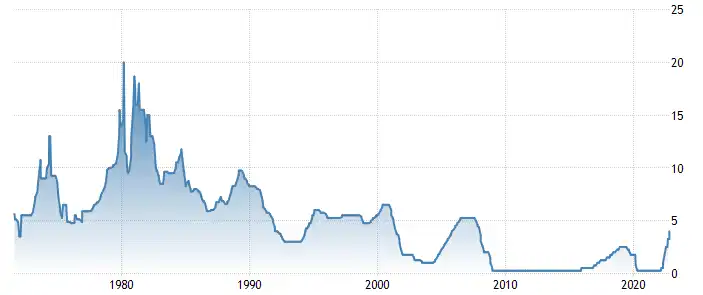
Then, in the late 1990s, the Federal Reserve began raising interest rates amid fears the economy was overheating, and company valuations soared, and money began to dry up. Lacking a sustainable revenue stream, or simply having nothing to sell, many companies went bankrupt, leaving behind frustrated investors, lawsuits, and most importantly - a loss of trust in the industry.
The heightened risk also meant that investors began to withdraw funds and protect interests, and began to sell technology stocks frantically, which soon spread to other risk assets, eventually leading to a "tech winter" and what analysts later called a "mild recession". ".
"The Internet bubble is also related to the Nasdaq. From January 1995 to March 2000, the Nasdaq Composite Index rose from 751.49 to 5132.52, an increase of 582%. From March 2000 to October 2002, the Nasdaq Composite Index The index is down 75%, erasing most of its gains since the dawn of the dot-com bubble.” ——Institute of Corporate Finance
This was a true tech frenzy that nearly wiped out an entire industry, so what is ultimately behind this bubble?
The company is overvalued
well capitalized
media frenzy
secondary title
history seems to repeat itself
Despite the tech industry’s desperation, not all is doomed, and the dot-com bubble has spawned a flurry of new regulations designed to level the playing field, protect investors, and offer better prospects for solid, stable projects.
It quickly became clear that the dot-com bust was not due to flaws in the underlying technology, but because of the projects and frameworks built on top of it.
The internet has always been there: the only question is in what form and state, if I were to picture it as nature, the internet would be a forest fire, destructive but purifying, feeding the forest with fresh and fertile It may take a few years for the soil and the space to re-grow to make it stronger and more diverse than before, but time is a relative concept, and ten years is just a flash in the pan in a macro-industry development process.
Another interesting fact is that not all trees will disappear in the fire, the weak and weak ones will perish, the strong ones will still persist and live with their scars, and they will bring new life to the whole forest .
Ironically, startups are often victims of the so-called "burn rate." The burn rate defines the rate at which a company burns through the available capital, and as you may have guessed, operating on hopes, seed money, and VC funding alone is not a sustainable business plan, and this may continue for a while, but if the industry climate becomes Worse and funding dried up, eventual failure was inevitable.
survival of the fittest
In my opinion, the crypto winter is eerily similar to the dot-com bubble, and while many agree that distributed ledger technology has great potential, the industry is still in its infancy, going through similar boom and bust periods as the internet did two decades ago .
While financing is getting more expensive and harder to find, the “glossy coat” of the blockchain industry is starting to crack, and before we assess how this will affect companies and their future financing, let’s take a look at the aforementioned Some of the problems faced by the blockchain industry.
executive exit
We have seen reports of many high profile executives leaving the crypto industry, or at least temporarily. CoinDesk once published an article:Why So Many Crypto Executives Are Leaving? The article also reveals some key issues:
Why do captains abandon ships that appear to be intact?
What does their departure mean for the companies, employees and stakeholders left behind?
Were all these projects illegal from the start, just to fill the wallets of a few crooked businessmen behind the scenes?
Especially with the start-up industry, where the growth of a company is dependent on executive management and leadership skills rather than the actual success of the underlying business, when raising funds, having a strong executive reputation is often the difference between success and failure, maybe you have the best project in the world or idea, but without a well-known leader to drive it and make it a reality, you will find that the fundraising stage is already difficult to move forward.
A company without a leader can also face opposition from new and existing investors, making it difficult to attract new capital, or in the worst case leading to the loss of funds.
lack of transparency
This is debatable, but the most interesting, especially blockchain and cypto, self-proclaimed to provide crystal clear transparency, however, many projects today fail precisely because of the lack of transparency.
What good is transparent underlying technology when neither the project nor the project gatekeepers are transparent? TradFi experienced the Lehman Brothers fiasco in 2008, why would a FTX-sized bankruptcy be needed to prompt crypto exchanges to publish their security procedures and proof of reserves? Haven't you learned from past fiascos?
On the other hand, we still see "investors" throwing their money at any project that promises a quick profit, I hate to beat you, but if it sounds too good to be true, it probably is.
Opaque business practices, combined with general risk aversion, could affect financing and acquisitions. Looking again at FTX, Binance originally intended to acquire it to maintain the integrity of the market. However, Binance withdrew a few days later, claiming that the complexities of FTX’s problems were unsolvable and could end up hurting their own business, causing a bigger ripple effect.
lack of regulation
Again, opinions differ widely on this issue, here is my opinion: while too much regulation can stifle innovation and make markets exclusive, no regulation can lead to anarchy that hurts everyone except ruthless businessmen .
Yes, I keep bringing up this topic in many of my articles, as meaningful regulation is critical to future blockchain adoption and crypto survival.
From a venture capital perspective, an unregulated market is difficult to navigate, it reduces the quantifiability of risk and hinders the ability to properly evaluate investments. Regulatory uncertainty can mean that a potentially profitable investment fails without warning.
capital cost
If you want to start a business, capital is one of the most basic requirements. Over the past ten years, this is an easy task. Apart from some temporary declines, the global economy has been steadily rising driven by cheap funds. Applying for loans or Seeking capital was easy and required little capital, but soon enough the abundance of funds changed and people put their money into anything that paid off, no matter how risky it was.
We could go into detail about how companies are valued and the implications, but that's beyond the scope of this article.
In short, cheap money (i.e. low interest rates) means lower discount rates and higher company valuations. When central banks suddenly start raising rates aggressively, say to fight inflation, company valuations based on discounted cash flows start to fall. (If you're not familiar with discount rates and the cost of capital,click the link )
The conclusion is that rapidly changing company valuations greatly affect their ability to obtain funding, maintain operations and growth prospects.
secondary title
integration effect
Looking back at history again, some companies were well capitalized and structured enough to survive despite the relentless burst of the dot-com bubble. In the early 2000s, people started dipping into earmarks, frantically looking for talent and affordable, promising projects. Google, Amazon, Priceline, Microsoft, Apple, or something else?
The result has been a rapid consolidation of the tech industry away from a few monopolies and the birth of the age of tech unicorns, some of which have become so powerful that they continue to dominate our daily lives, raising a whole new set of questions .
But the lessons learned from the dot-com bust have also refined the new rules and regulations that until now have prevented a repeat of the past for Web 2, which has finally come of age, although there are still some issues.
text
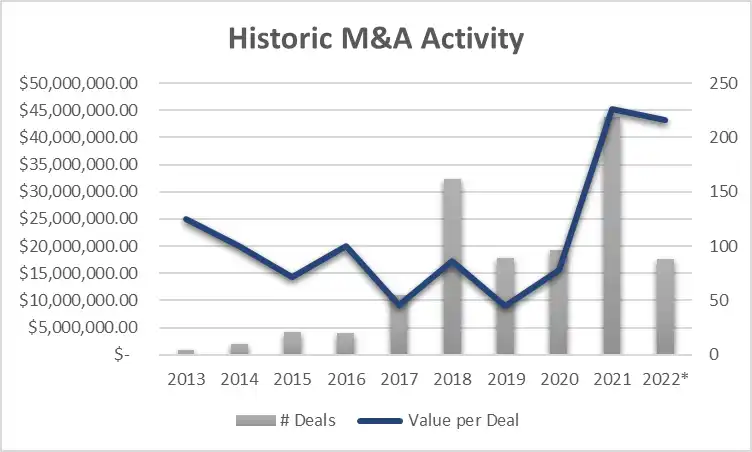
M&A activity 2013-2022
While M&A deal activity appears to have peaked in 2021, the average value per deal remains at an all-time high. Between 2016 and 2020, the average deal size was about $20 million, while in 2021 this figure increased by about 100% year-on-year, but 2022 does not seem to have dropped significantly, and one explanation is that buyers are still willing to put up large sums , but what they buy is more specific; another explanation is that due to the decline in the crypto industry, more projects are prone to failure, resulting in fewer buying opportunities in the market, assuming that demand from buyers exceeds supply, we can conclude that higher competition, thereby providing higher acquisition prices for high-quality transactions.
M&A Activity Outlook
The jury is still out on whether the trend of rising average prices will continue. The recent uncertainties in the global economy and strict regulatory requirements for the crypto and blockchain industries may hinder the completion of transactions in the short term; on the other hand, as well-known companies seek to vertically or horizontally integrate their business ) requirements, further scrutiny and demands for transparency are likely to accelerate M&A activity in the medium term.
TokenData previousa reportSupporting this thesis, the report shows a stark divergence between strategic and financial M&A activity, although the market in 2018 and 2021 will be largely driven by financial M&A, the momentum has shifted towards the more strategic In an era of high financing costs, uncertainty and demand for low-risk assets, this seems logical.
With strategic acquisitions aimed at improving operations, reducing supply chain costs and strengthening existing businesses, large players with strong balance sheets will seek to integrate competitors and potential disruptors to gain an advantage. A good example is the acquisition of companies such as TradFi, which is trying to integrate crypto and blockchain providers to enter the market. ,, from a strategic standpoint, the chances of finding a better deal are greater in a high-demand environment.
Financial acquisitions, on the other hand, are more like bets on a company’s future success, buyers’ interest is often a purely financial and speculative bet, and uncertain industry prospects reduce prospects for future returns, thereby reducing financial M&A deals.
Strategic M&A: Companies that decide to make acquisitions to further strengthen their brand or eliminate competitors through vertical/horizontal integration;
Financial M&A: Acquisitions by financial firms such as private equity firms and SPACs.
As such, we are likely to see consolidation in the blockchain industry, with many smaller companies being consolidated into larger, more dominant players, another driver of consolidation is the increased cost of financing making it difficult for small projects to rely on Borrowed assets to survive, some projects will have to obtain lifecycle funding at steep valuation discounts or risk bankruptcy.
The question remains whether the consolidation underway in the Web 3 space will be like what we have seen in Web 2, where the few control the many. More importantly, what does this mean for the decentralization of blockchain technology?
secondary title
Briefly talk about the status quo of VC
After a highly active 2020 and 2021, this year is undoubtedly different in venture capital. Over the past few years, the blockchain industry's "getting better" has attracted investors large and small. However, I've seen more and more changes, and if your assumptions are correct, venture capital is the most profitable risk game. The fragmented and increasingly complex environment of blockchain and crypto favors VCs, who have significant resources to evaluate investment opportunities and quantify associated risks.
To secure funding, blockchain companies must deliver quality, deliver on promises, and provide transparency. Going forward, funds will flow to projects that solve real problems and bring added value to consumers.
Finally, VCs are constantly on the lookout for better deals, and the current industry turmoil has a cleansing effect that will hopefully remove more and more bad actors from the market, so VCs will find the right opportunities more easily.
If you're on the money-raising side, ask yourself how to attract money, here are some ideas on how to position yourself:
- Ensure business operations are transparent and understandable;
- Take responsibility, i.e. stakeholders must be able to solve problems and someone needs to be held accountable for the project;
- Don't raise too much money for the project at the beginning, excessive company valuation will also bring higher expectations to investors and stakeholders;
- Provide a solution to a real problem and highlight the benefits of that solution, don't use crypto or blockchain as the main driver of the project, focus on the added value of the solution and how Web 3 can support this.
- Start small, focus on a specific problem, make it work, and then focus on scaling.
secondary title
Risks and Opportunities of Decentralization
The definition of decentralization is at the heart of the entire blockchain debate, and as mentioned earlier, I support the notion of not letting one entity control too much. On the other hand, I'm happy to partially delegate some responsibilities in exchange for comfort and ease of use, but that's a personal preference.
risk
The original purpose of the Internet was to simplify the transfer of knowledge and improve global communication, but information is a powerful tool, and whoever holds the control comes with enormous responsibility. It is clear that after consolidation in the early 2000s, the main disadvantage of Web 2 is the transparency and centralization of data control, so the idea of introducing blockchain technology seems attractive, but we have to be careful that we don't just promise them Will do better than before while blindly following a new messiah (savior).
opportunity
in conclusion
in conclusion
There is no doubt that the status quo of the blockchain is very complicated, but it also provides a huge opportunity. The current encryption industry is going against the wind, but what will eventually change is the appearance of the industry today.
Greater popularity and greater adoption will continue to attract capital as players seek discounted entry. Increased strategic M&As may lead to more consolidation as companies integrate vertically and horizontally. Crucially, blockchain is essential Transparency provides technology that keeps these "big players" under tight control, no matter how much data you control, if anyone can see what you do with it, and you can be held accountable for wrongdoing, the potential for abuse of power sex will be greatly reduced.
Going back to Buffett, who wouldn't want to buy a solid Web 3 project at a deep discount?


