






An article to understand the ecological construction of the modular blockchain Celestia


On October 20, after Celestia announced a new round of financing led by Bain Capital Crypto and Polychain Capital, the modular public chain once again became one of the hot topics of discussion. This article takes readers through the projects being built in the Celestia ecosystem: Cevmos, Fuel, dYmension, Eclipse.
What is a modular solution?
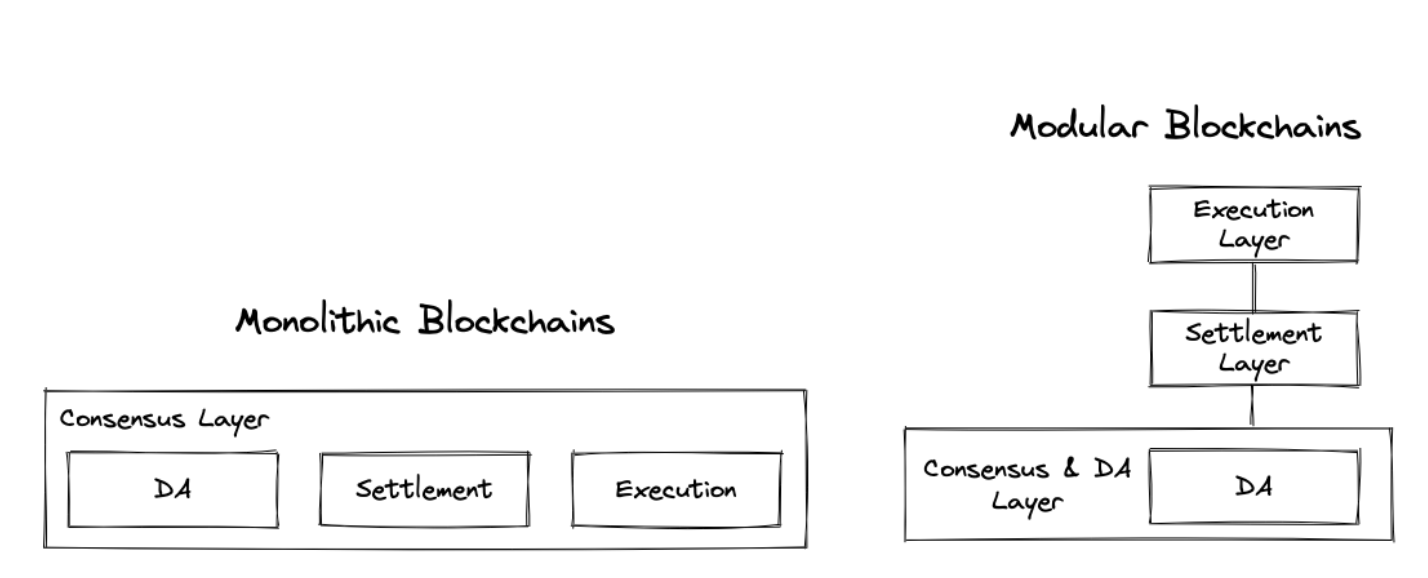
In short, the modular solution is to modularize the function stack of the single block chain function. The specific functions can be roughly divided into:
Execute: handle state changes;
Settlement: verify the status of the execution layer and resolve disputes, and be responsible for the bridge of assets cross-chain;
Consensus: All nodes reach a consensus on the validity of state transitions, in short, nodes at least agree on transactions and their ordering;
Data Availability (DA): Ensure that data is storable, verifiable, and available, that is, to ensure that the transaction data behind the rollup block header has been published and available so that anyone can recreate the state.
Why separate the individual modules?
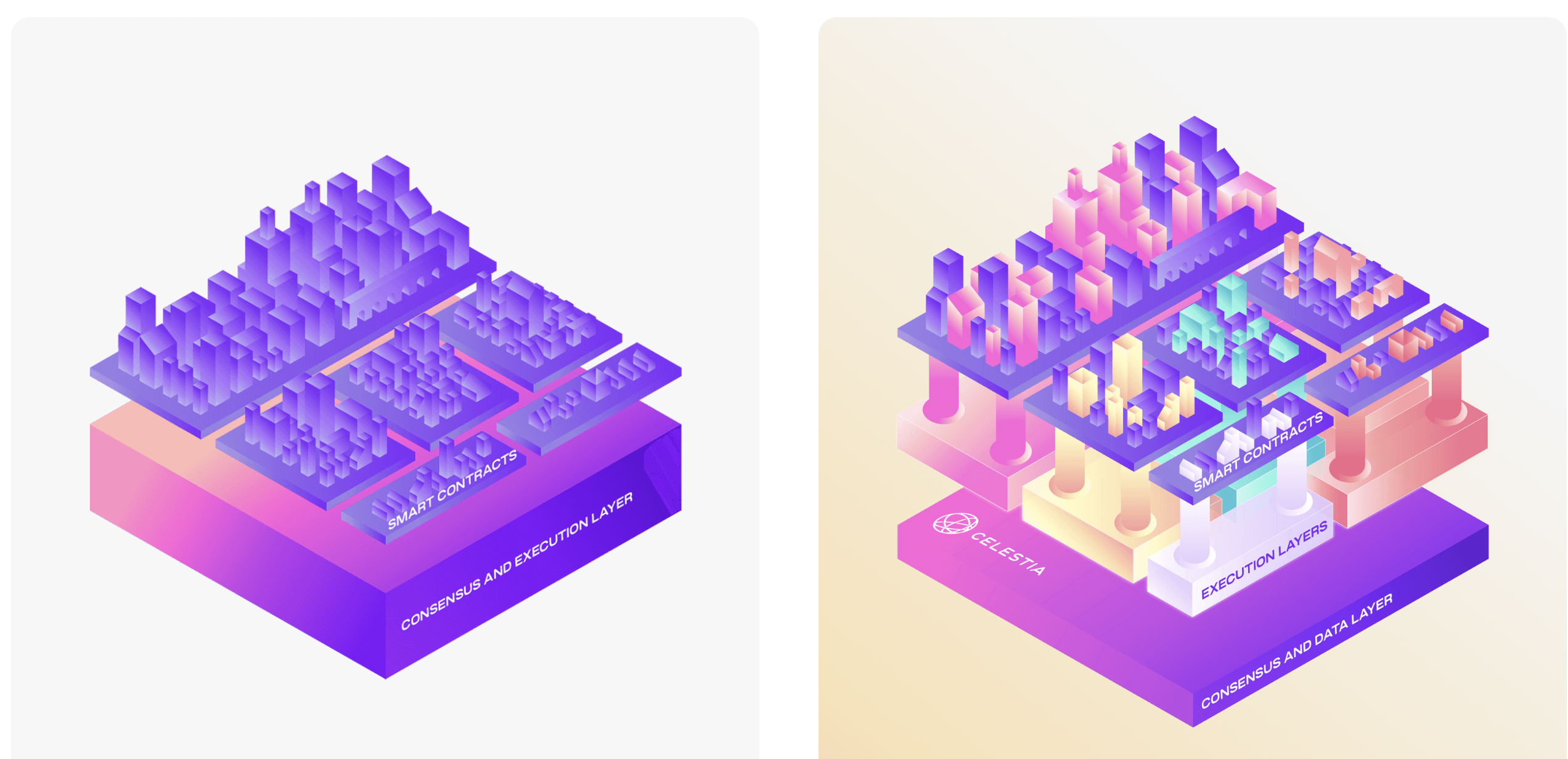
Because the single block chain cannot maintain the trustless and decentralization of the network by breaking the correlation between the calculation and verification costs at the same time under the premise of ensuring sufficient throughput, this bottleneck is also called "the bottleneck of the block chain". Impossible Triangle".
Why do you need a modular public chain with rollup?
first level title
Celestia
Celestia's predecessor, LazyLedger, is a pluggable consensus and data availability layer that only verifies data availability and transaction ordering, providing great flexibility for the entire blockchain network modular architecture. Why is Celestia inseparable from rollup? Before modularization, the proposal of rollup has made how to verify the DA of Layer2 transaction data a big problem.
 Specifically, when a block producer publishes a valid block header, but deliberately hides or tampers with transaction data, light nodes can only rely on the block header for verification, and thus are easily deceived and accept invalid blocks. However, full nodes cannot generate DA and fraud proofs for light nodes, which means that light nodes have to verify DA themselves or assume that most data is trustworthy. So, that's why most nodes have to download full transaction data and verify block data availability. Doing so, however, introduces scalability constraints and problems to network extension solutions.
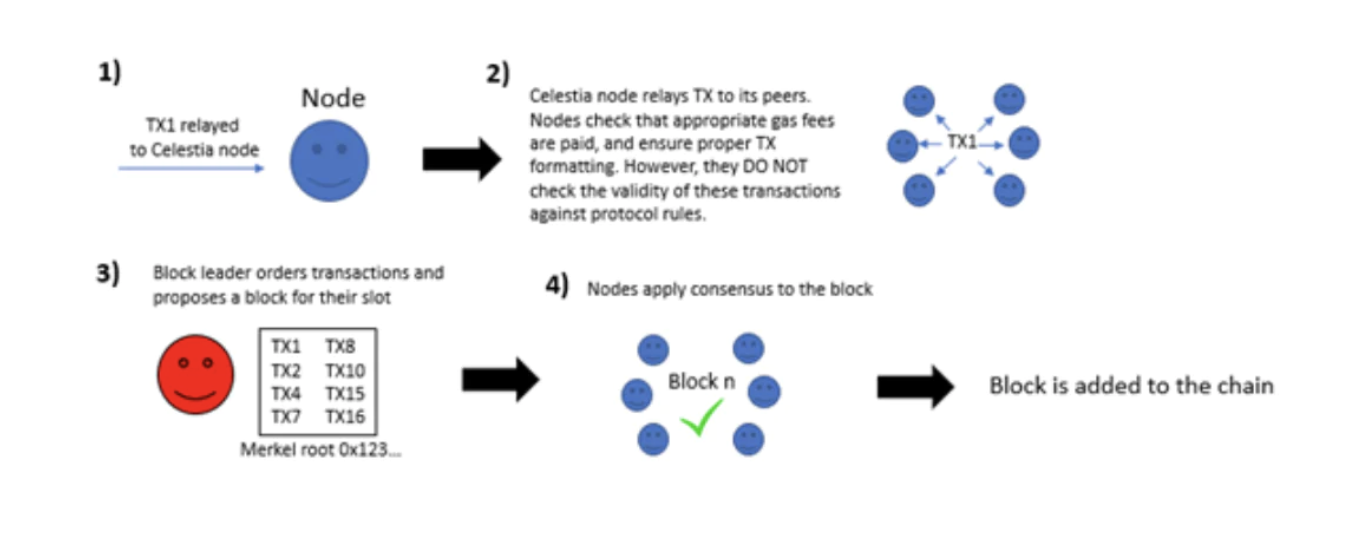
Celestia uses an off-chain method to implement DA, that is, through Reed-Solomon erasure codes and a special Namespaced Merkle Trees structure to ensure data availability, making DA cheaper and more efficient. The specific Celestia DA works as follows:
Nodes receive transactions submitted by rollup
Nodes ensure proper fees are paid
Nodes sort transactions
Collectively verify data integrity
Divide the data according to the DNS mapping corresponding to the specific rollup inserted into Celestia
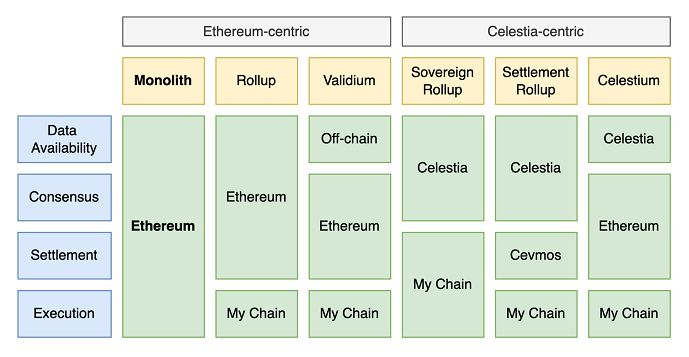
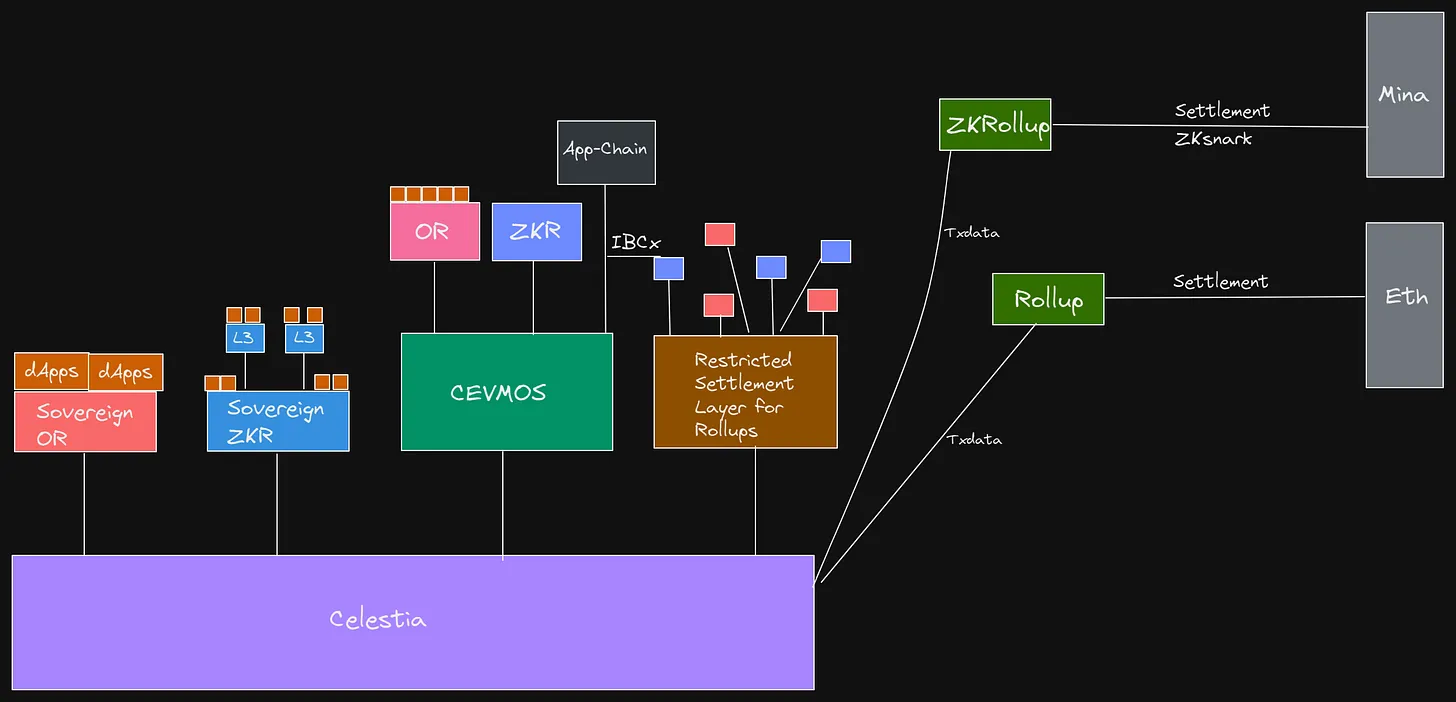
Of course, Celestia's core competitiveness lies not only in its DA and consensus functions, but also in its use of rollups to provide diverse options for the execution layer. Of course, Celestia's core competitiveness lies not only in its DA and consensus functions, but also in its use of rollups to provide diverse options for the execution layer.Celestia also divides rollup into Ethereum native and Celestia native. Celestia native rollup can be inserted into Celestia in two ways:
Sovereign rollups
Forced settlement rollup (Settlement Enforced rollups like Cevmos, Celestiums, etc)
first level title
Cevmos
Cevmos is a rollup stack jointly developed by Cosmos EVM application chain Evmos and Celestia, aiming to become the best settlement layer based on EVM rollup on Celestia. And Cevmos is the abbreviation of Celestia, Evmos and Cosmos.
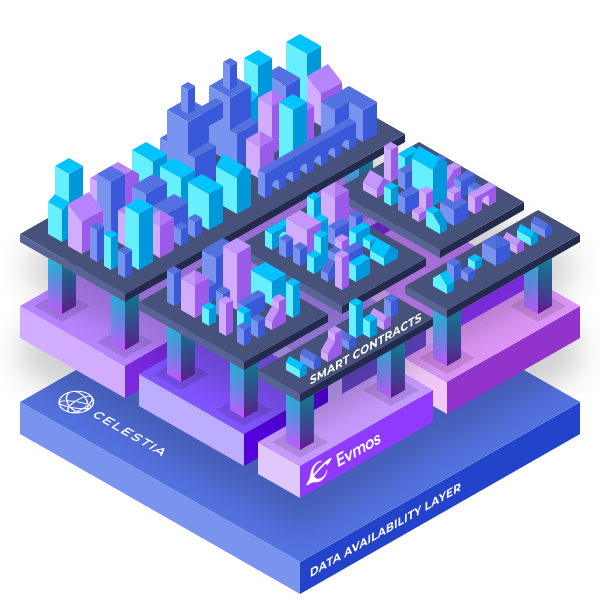
As one of the mandatory settlement rollup schemes, Cevmos tries to reduce costs and improve efficiency (limited EVM) by providing a dedicated settlement layer for rollup. Specifically, in this stack, Cevmos will serve as a settlement layer, which will be based on Evmos, and the recursive rollup of EVM (rollup in rollup) will be built on top of it.
Cevmos useOptimint(Optimistic Tendermint) instead of the Tendermint Core consensus engine used on the existing Cosmos to build Celestia rollup. Optimint is a Tendermint BFT replacement that enables developers to deploy rollups using existing consensus and DAs such as Celestia.
Since the Cevmos settlement layer itself is a rollup, the rollups built on top of it are collectively referred to as settlement rollups. Each built rollup will have a two-way trust-minimized bridge with Cevmos rollup, which can redeploy existing rollup contracts and applications on Ethereum to reduce the workload of migration. This also means that all rollups built will use calldata on Cevmos rollups, while Cevmos uses Optimint to batch the data and publish it to Celestia.
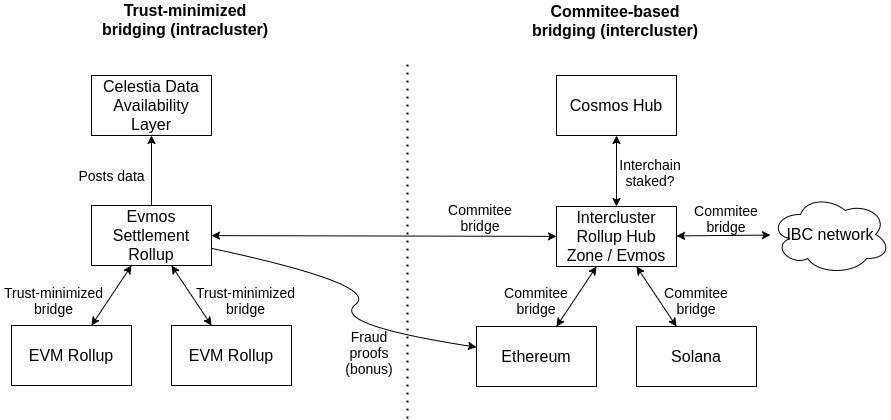
Since Cevmos rollups themselves are restricted EVM environments, they will also attempt to complete the challenging setup with a single round of fraud proofs.
first level title
Fuel
Fuel and Celestia are twin sisters. The difference is that Celestia is optimized for DA and sorting and only deals with data availability and consensus, while Fuel is positioned as a modular execution layer.
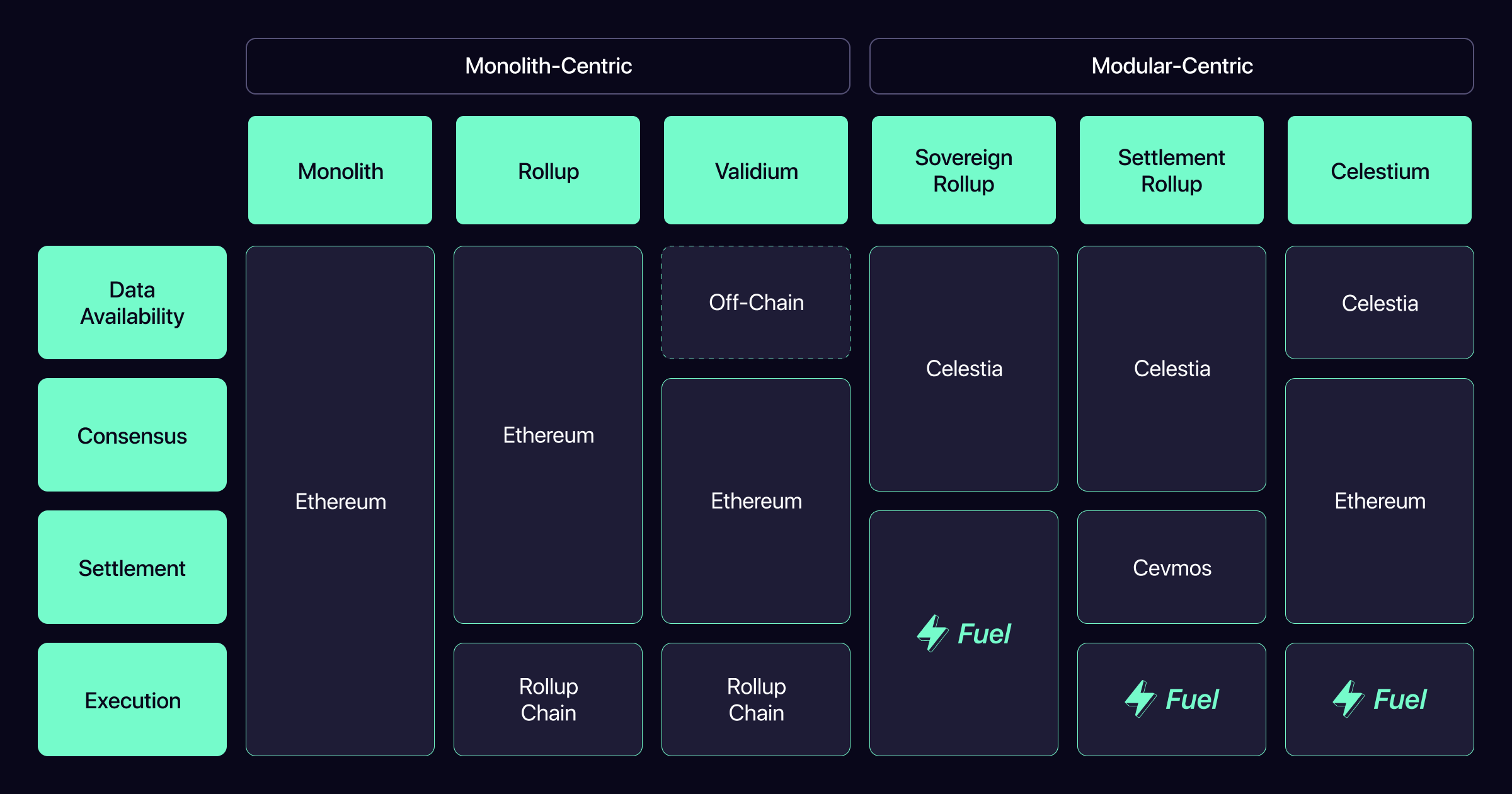
The biggest difference from today's Optimistic rollups is that Fuel runs a brand new virtual machine architecture, namely FuelVM and its toolchain and Sway language.
Fuel VM is a custom virtual machine built entirely for smart contract execution, processing transactions in parallel. Fuel VM was designed from the ground up to be easily fraud-resistant and can be used by the transaction execution layer of Optimistic rollup.
first level title
dYmension
dYmension is a sovereign rollup built on Cosmos, aiming to make the development of rollApp (custom application-focused rollup) extremely convenient through dYmension Chain (settlement layer), RDK (RollApp Development Kit), and IRC (inter-rollup communication).
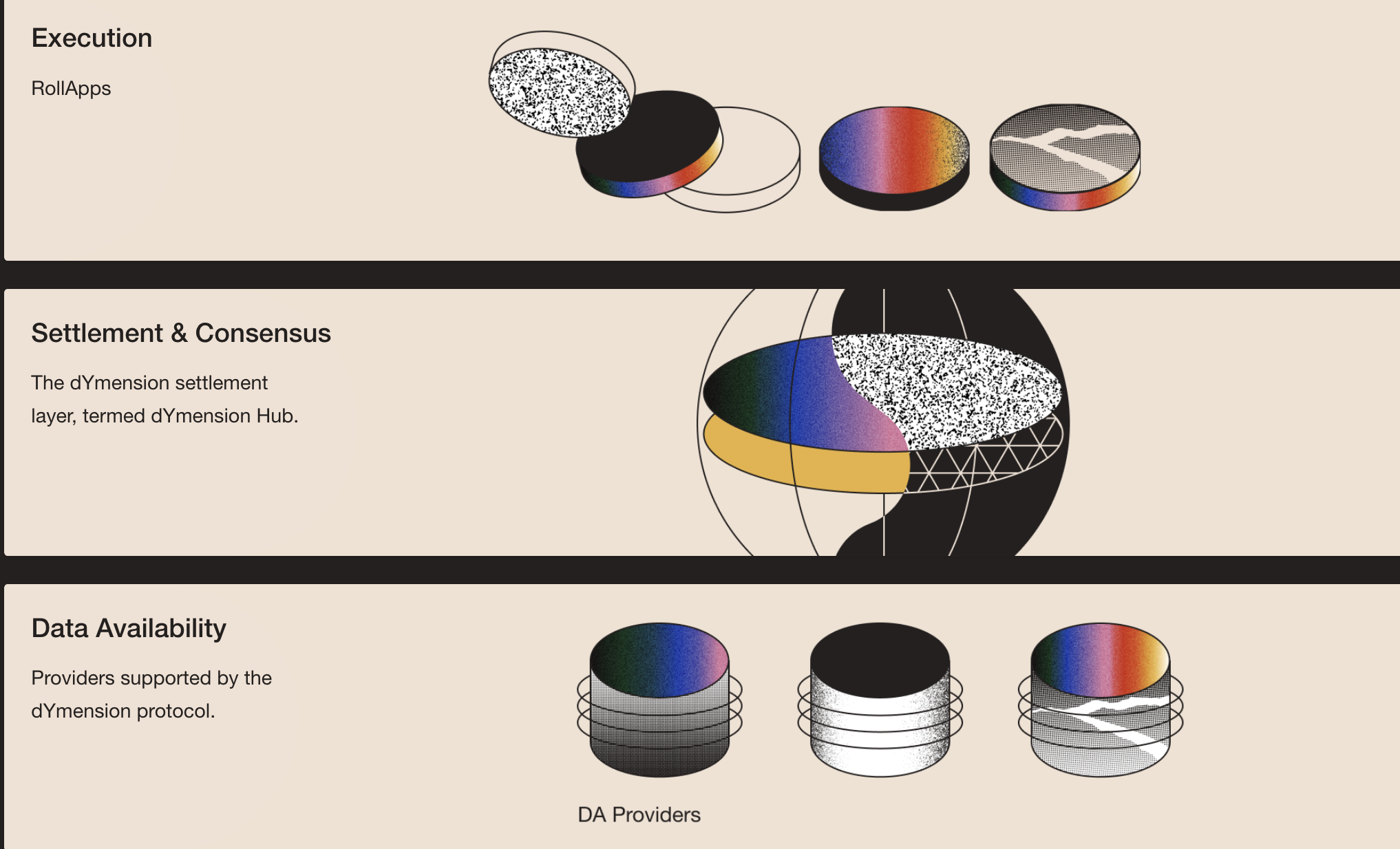
The settlement layer built by dYmension is called dYmension hub, which is a PoS chain with Tendermint Core state replication model for networking and consensus. The RollApp built on the basis of dYmension hub inherits the security of the hub, and the RDK and the dedicated module group supported by the hub guarantee mutual communication.
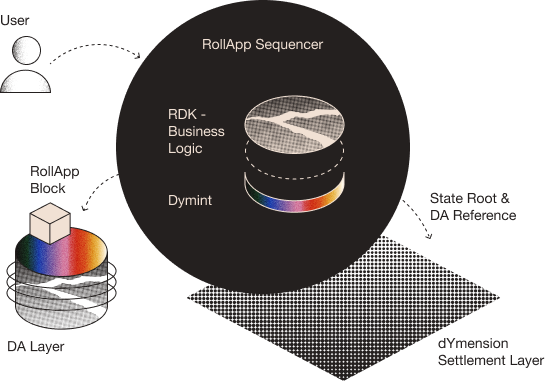
RollApps consists of two cores: client and server. The server is the application terminal designated for the RollApp deployment program, and is used to implement custom business logic and build prepackaged modules of the RollApp development kit RDK. The client component, called dymint, derived from Celestia's Optimint, is a direct replacement for Tendermint and is responsible for block production, peer-to-peer message propagation, and interlayer communication. Since RollApp itself has no consensus tasks, dymint can provide the low latency requirements required by modern applications.
first level title
Eclipse
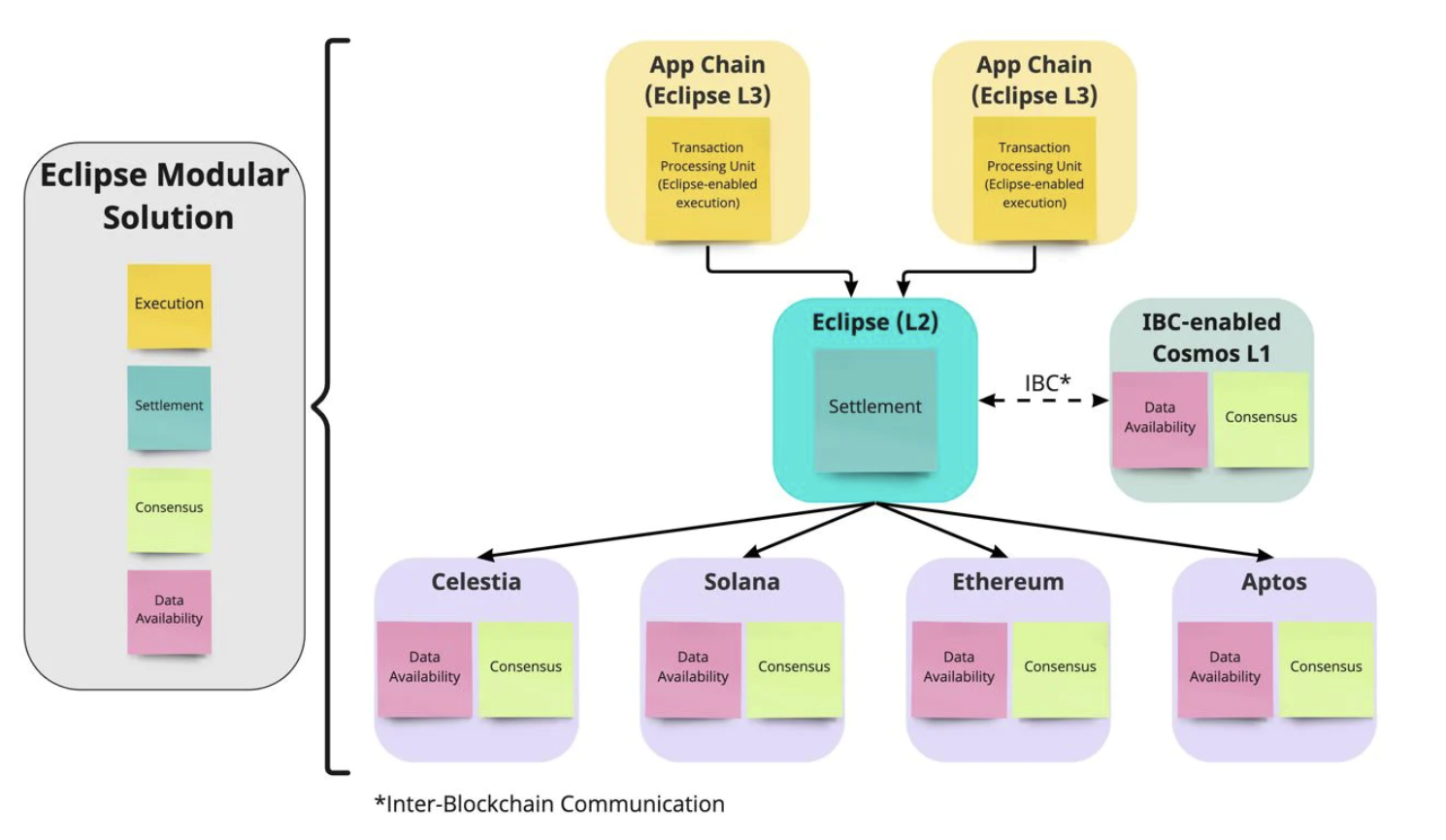
Eclipse is also a sovereign rollup based on the Cosmos ecosystem, allowing Solana VM to be used on any chain to build a customizable, modular rollup settlement layer.
In the early stage of Eclipse, Celestia will be used as the consensus layer and DA, and Solana VM will be used as the settlement and execution environment, and its ultimate vision is to build a customizable rollup execution layer for any Layer1 heterogeneous blockchain, and to integrate all blockchains through connected in a modular fashion. In addition, the settlement layer rollup based on Solana VM will also be iterated into Optimistic rollup and zk rollup in the future.
It is worth noting that the construction of the above modular schemes all use Celestia to provide data and Cosmos IBC to ensure inter-chain communication. Just like the free ecology of Ethereum, a modular ecology based on Cosmos has been built, and the interoperability usage scenarios of Cosmos will also usher in an explosion.
disclaimer
Reference:
https://docs.celestia.org/concepts/how-celestia-works/data-availability-layer
https://forum.celestia.org/t/an-open-modular-stack-for-evm-based-applications-using-celestia-evmos-and-cosmos/89
https://fuel-labs.ghost.io/beyond-monolithic-the-modular-blockchain-paradigm/
https://medium.com/alliancedao/the-case-for-parallel-processing-chains-90bac38a6ba4
https://docs.dymension.xyz/learn/dymension-hub
https://mirror.xyz/neelsalami.eth/rvhK5mEcFTOjyu_DFsqS2cYR7U6Fjvbw3nf8tI-pr-Q?ref=twitter
https://polygon.technology/solutions/polygon-avail/
https://rainandcoffee.substack.com/p/the-modular-world
disclaimer
More information
Copyright Notice
Without the authorization of DODO Research Institute, no one may use without authorization (including but not limited to copy, disseminate, display, mirror, upload, download, reprint, excerpt, etc.) or allow others to use the above intellectual property rights. If the work has been authorized to be used, it shall be used within the scope of authorization, and the source of the author shall be indicated. Otherwise, its legal responsibility will be investigated according to law.
about Us
"DODO Research Institute" led by the dean "Dr.DODO" led a group of DODO researchers to dive into the Web 3.0 world, doing reliable and in-depth research, aiming at decoding the encrypted world, outputting clear opinions, and discovering the future value of the encrypted world. "DODO" is a decentralized trading platform driven by the Proactive Market Maker (PMM) algorithm, which aims to provide efficient on-chain liquidity for Web3 assets, allowing everyone to issue and trade easily.
More information
Official Website: https://dodoex.io/
GitHub: https://github.com/DODOEX
Telegram: t.me/dodoex_official
Discord: https://discord.gg/tyKReUK
Twitter: https://twitter.com/DodoResearch
Notion: https://dodotopia.notion.site/Dr-DODO-is-Researching-6c18bbca8ea0465ab94a61ff5d2d7682
Mirror:https://mirror.xyz/0x70562F91075eea0f87728733b4bbe00F7e779788
Finally, please pay attention to DODO's latest recruitment information:https://twitter.com/DodoResearch/status/1587274217082404864?s=20&t=bDwaDZ5m5WdnmzQ9q6gthw





