Galxe's launch of Passport draws controversy, discussing the future development trend of SBT


Original Author: wesely
Original Author: wesely
Original source: The Way of Defi
When a Web3 project starts to roll out services that require KYC, the results can be imagined.
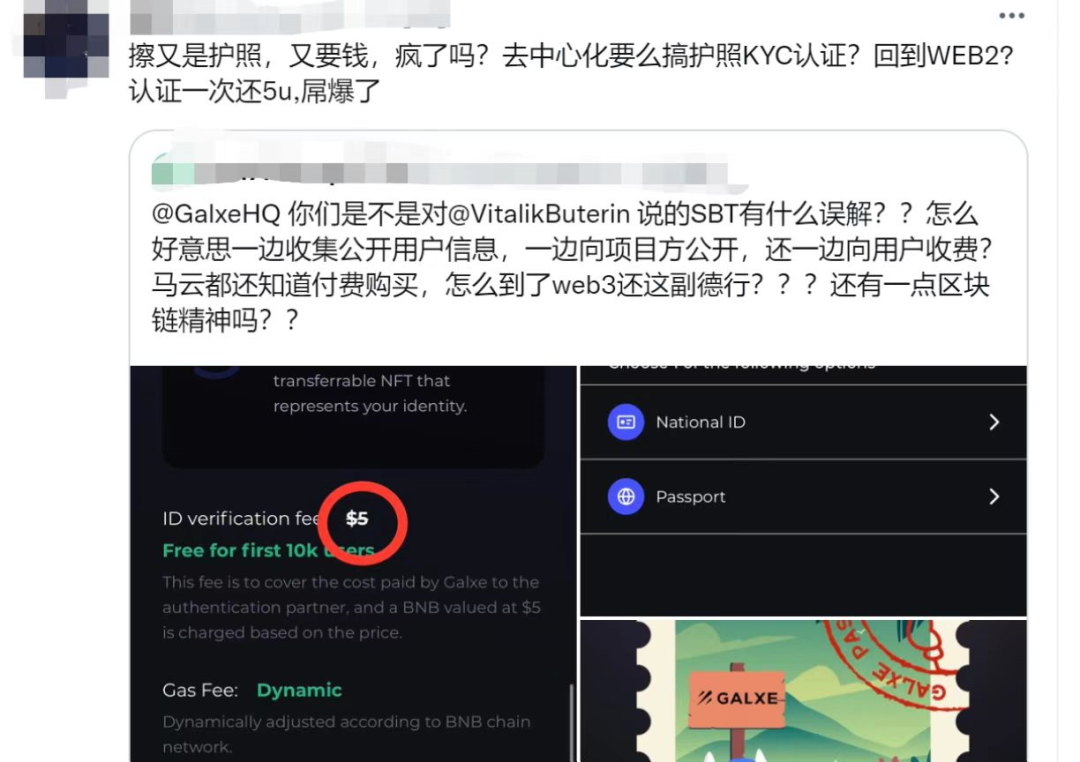
Galxe, a well-known Web3 credential data network project, has been criticized after launching its own Passport, because it needs the user's identity and face information. Although it has repeatedly emphasized its encrypted storage and security, it is still difficult to make Web3 users pay for the perverse approach. , At the same time, the Soul Binding Token SBT was once again pushed into the spotlight.
When I heard the term soul binding for the first time, I thought the name was too metaphysical and unreliable, like a name given by a fortune teller. After reading the paper "Decentralized Society: Finding the Soul of Web3" co-authored by Vitalik Buterin, E. Glen Weyl, Puja Ohlhaver and many related articles, some ideas began to emerge, both good and bad, and finally in a kind of The following is done in a sense of paradox.
The article mainly briefly introduces some trends in the future development of soul-bound tokens in my opinion and the problems it may face in the development process. It is just my opinion. Welcome to discuss and learn with me.
How to understand Soul Binding Token?I see it as a proof of affiliation or more simply a label, a label that is non-transferable when it is attached. This label can be a certain identity, a certain certificate, a certain activity, or a certain For example, Nansen labels different wallets such as "rare NFT collectors" and "elite DEX traders". If these labels are SBT, they are essentially soul-bound tokens, representing Some kind of special wallet owner, through these SBT tags, can construct a native digital identity portrait, which can be associated with the real world, or choose not to be associated with the real world, but in the digital world,
The collection of various SBTs can create an independent digital person identity portrait on the chain.
In fact, this is from the perspective of the chain. The record book of activities on the chain is a manifestation of SBT, and SBT only makes the activities on the chain explicit. If it is considered from an off-chain perspective, SBT will be strongly related to the issuer. The industry and application positioning of the issuer determine the use and influence of this SBT. For example, the BAB issued by Binance this time represents a A real user who has passed KYC, so the SBT of BAB is essentially an ID card on the chain, which proves that the wallet with this SBT is an independent and unique user. Naturally, it is easy to understand why SBT-based airdrops may be a future Trend, because this can achieve Token dispersion very simply, and also avoid Sybil attacks to a large extent.
When it comes to the usage scenarios of Soul Binding Token, it can be roughly summarized into the following categories:
Digital ID or Membership
Proof of achievement, such as employment history, education, verification of event attendance, reputation, etc.
unsecured loan
social recovery wallet
soul drop
DAO Governance Defense
Four Development Trends of SBT
If we understand the sentence "a collection of various SBTs can create an independent identity portrait of a digital person on the chain", we can easily understand the above application scenarios and development trends. They all revolve around the "identity " This key word expands.
DID and on-chain identity
If building a digital society similar to the real world, what will be the first elements?
Of course, it is human beings, only people can call it a society, so how to define a digital person on the chain? Through on-chain data? Yes, but this is time-consuming and labor-intensive. At present, the development of DIDs on chains such as BrightID and Proof of Humanity has been struggling in the quagmire. The high cost and slow growth rate cannot make DIDs have the influence they deserve, and even through SBT The way of tagging also needs to gather enough tags to have a complete portrait. The easiest way is to get through real-world KYC, such as Binance’s BAB, which is simple and direct in one step. Therefore, the combination of SBT and DID on the chain will be a future trend, especially for companies with a large amount of real KYC data in traditional industries, which will have a natural advantage in this regard.
DID is a very big track, both in terms of development potential and application scenarios are very rich, some Web3 companies also hope to seize the first-mover advantage, whether it is Passport bundled with traditional social accounts launched by Gitcoin, or Galxe Passports that need KYC all want to build their own DID system, and these data are more valuable than the data on the chain.
On-chain credit investigation and on-chain data analysis
Unsecured lending seems to be an ideal for all Crypto people, and the premise of unsecured lending is the perfection of the identity and credit system. Identity is a complete digital person on the chain, including various information such as digital personality, behavior habits, etc.; credit The construction of the chain needs to build a credit system on the chain through the behavior on the chain, and perform credit ratings on different objects. For example, in the future, there will be a credit rating agency on the chain. Analyze and present the credit rating of relevant wallet holders in the form of SBT. Of course, this requires enough information to fully display the real credit rating. Only the half of the cross-chain association with SBT in the following text is cited. , this cannot be accomplished overnight.
And this kind of rating agency needs to have strong processing capabilities for on-chain data, so projects based on on-chain data analysis, such as on-chain data analysis platforms such as Nansen, Token Terminal, Dune Analytics, Skew, etc., may show a greater value and influence.
Dynamic SBT+cross-chain
Real users are all multi-chain users, so SBT that supports cross-chain association must be a future development direction. In single-chain mode, there will be many restrictions on building user portraits through SBT, which is relatively one-sided. If it can be used between different public chains By connecting all the SBTs in series, through the classification and summarization of data on different chains and different types of SBTs, the real user characteristics can be summarized more quickly and completely, and the role of different SBTs can also be maximized.
In addition, because the essence of SBT is an NFT that cannot be transferred, and the dynamization of NFT is the trend of NFT becoming intelligent in the future. For example, the NFT named "Proof of Merge" made by consensys to celebrate the merger of Ethereum is essentially a dynamic SBT, while dynamic SBT will reflect digital human activities on the chain in a more flexible and intelligent way, and will show more fun in the fields of games and social interaction.
The current Crypto industry is a super-financialized industry. All applications are bound to finance, whether it is social networking or DAO governance. However, hyper-financialization is by no means the whole of an industry, and speculation should not be the core of Crypto. There is a bigger market and imagination to explore. A connection to the existing physical world can connect traditional businesses to the chain in a more reasonable way. The dynamic SBT+ cross-chain method will make it easier to connect to the physical society. Create more potential application scenarios.
SBT: A New Perspective for Web2 Enterprises Entering Crypto
At present, looking at the Crypto industry from the global perspective of traditional Web2 companies, Crypto is still a product in a legally ambiguous area. Out of risk considerations, Web2 companies often participate in a prudent manner and want to penetrate this industry deeply. , Token and NFT will have potential hidden dangers, and the non-tradable attribute of SBT gives them a new perspective.
Whether it is SBT under the membership system or connecting offline KYC to the chain in the form of SBT, the risk will be smaller. At the same time, creating multi-dimensional SBT through Web2 will accelerate the decentralization to a certain extent. The construction and improvement of the identity on the chain in the social DeSoc may appear in the future as a physical organization with this as the main business. In fact, if the recent Starbucks NFT activities can be combined with SBT, it may be a good attempt. In the future, SBT The issuer of the SBT will probably be more important than the SBT itself.
But from this perspective, it will be limited by the business scope and attributes of Web2 enterprises. It is not as easy to use as the panacea style of NFT. At the same time, because the financial attributes of SBT are eliminated, some projects that focus on profit The party has no motivation to participate, which makes the construction of SBT infrastructure and other application scenarios relatively slow.
After introducing the advantages of SBT, let's take a look at its disadvantages.
secondary title
The first is the issue of privacy and security
On the one hand, there is the privacy issue of SBT, which SBT can be disclosed, which ones are not suitable for disclosure, whether it can achieve custom scope and conditional disclosure, etc. These are still to be resolved. To solve this problem, technologies such as zero-knowledge proof may need to be introduced to balance privacy and open relationship. Especially for SBT bound with real KYC, security will be more important.
In the future, with the launch of different SBT types, the credibility of the issuer will be a core consideration, so it will be very important to be able to verify the issuer. SBT needs to rely on the issuer, and the issuer’s fraud or Doing evil cannot be measured and judged, so the centralization of the issuer will be a factor restricting the development of SBT.
secondary title
SBT’s On-Chain Discrimination
When someone sends a malicious SBT, it will have a negative impact on the identity of the address, especially for discrimination against different SBTs. It will also become easier to launch Web2-style operations such as price discrimination, service restrictions, and access thresholds. In addition, "account maintenance" may become an industry, especially after adding the special identity on the chain to create a high-quality identity on the chain, and then in the financial society on the chain at a lower cost, or even Carrying out financial activities at no cost, but the real morality and identity of the digital people behind them are false, which will become a financial mine that can be detonated at any time.
The above-mentioned on-chain discrimination will introduce too many negative factors into the decentralized society DeSoc. In the DeSoc society, it may not be enough to rely solely on on-chain credit, and authoritative institutions may still be needed to support it.