






Merged MEV: A new source of income for staking ETH


Original title: "Who's Gonna Protect You from MEV after the Merge?"
Original source: Integral official website
Original compilation: 0x711, BlockBeats
Original compilation: 0x711, BlockBeats
Everyone is looking forward to the Ethereum merger event, which is expected to happen on September 15th.

There is a cliché: MEV (Maximum Extractable Value), from sandwich attacks to exploiting NFT sellers. This time, the core of the topic is MEV and Merge,Is there a future for extractable value in the coming PoS era.
In the PoS mechanism, it is the stakers, not the miners, who have the ability to withdraw MEV. While some stakers may be unimpressed, research shows thatimage description
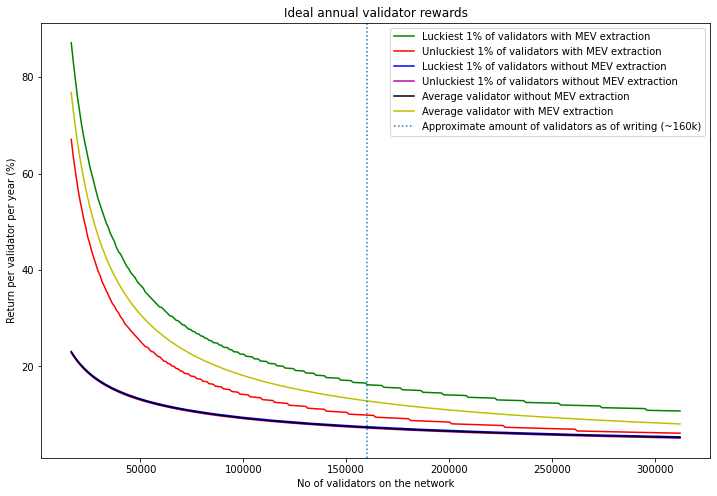
MEV rewards can give you a 2-3x return on your ETH stake
This means that any stakers who do not do so are at a loss for money, and it could dilute their stake in the network. In order to make it easier for stakers to obtain MEV rewards,FlashbotsThe team released software called mev-boost. Just like the current Flashbots system, mev-boost feeds MEV transactions to block packers, but with some key differences.
Most importantly, mev-boost only provides complete blocks. Flashbots have stated that this is to prevent frontrunning transactions or preventing block packers from being stolen by searchers. (Searchers refer to participants who are looking for opportunities to pack potentially profitable MEV opportunities into blocks) So Flashbots don't want block packers to read block content. They can recreate and submit blocks themselves, but they don't give the searchers a cut. So the case for obfuscation is sound, but it also brings controversy.
On the one hand, mev-boost has centralization risks. It works a bit like a bazaar. Seekers put together transactions and submit complete blocks to an API relay run by Flashbot. The relay then does some checks on the block and passes it on to the block packer. Block packers (who will become stakers when merged) extract full blocks and add them to the blockchain.Post-merger, there may only be relays that are OFAC compliant and review transactions。
This leads to an ongoing problem with the Ethereum network. For example, why does the network basically hand over block packaging to a centralized entity that may exclude sensitive transactions due to political risk? These questions were brought up at a recent ethereum developer conference.
Ethereum core developer Tim Berko alsoresponded to this. Some have proposed to exclude mev-boost, and some have even suggested to postpone the merge.
To its credit,The Flashbots team responded by open sourcing mev-boost. But that may not be enough. Running relays and finding MEV opportunities is hard work. There is a high demand for Ethereum staking service providers to run the above software.
Regardless, we hope stakers will take advantage of the MEV opportunity, with or without the help of Flashbot. The rewards obtained are quite generous. Furthermore, MEV will only increase the yield of staking ETH.
Original link


