






Messari: Observations on the Optimism Governance Fund


Original Author: Raho
Original Title: Governance Fund Observations
This article comes from the radical observation of OP governance by Raho and Tnorm, two analysts of the Messari Governor[1] team. OP adopts the delegated voting governance model. This article has certain reference significance for understanding delegated voting and its loopholes.
entrust
entrust
The distribution of governance power remains a controversial topic in DAO governance. Many DAOs believe that it is better to have a central group of individuals making decisions than a distributed group of large numbers of individuals who may not be involved in the decision making. Regardless, participation becomes critical if voting rights are to be distributed to delegates. The graph below is the distribution of voting participation for the top fifty delegates so far, and the voting participation for each address.
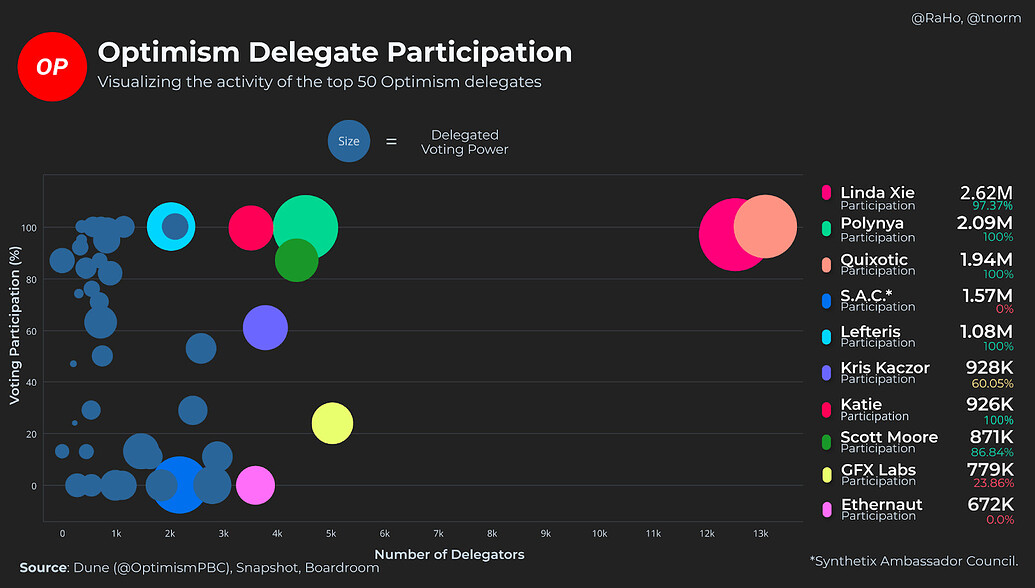
While there were outliers, many top delegates actively participated in the majority of the vote. Linda Xie, Polynya, Quixotic, and Lefteris all participated as role models, the most anticipated outstanding representatives of our community. For those who failed to participate, some behaviors were explained by the fact that they may have technical issues that require Gnosis Safe and Snapshot support [1].
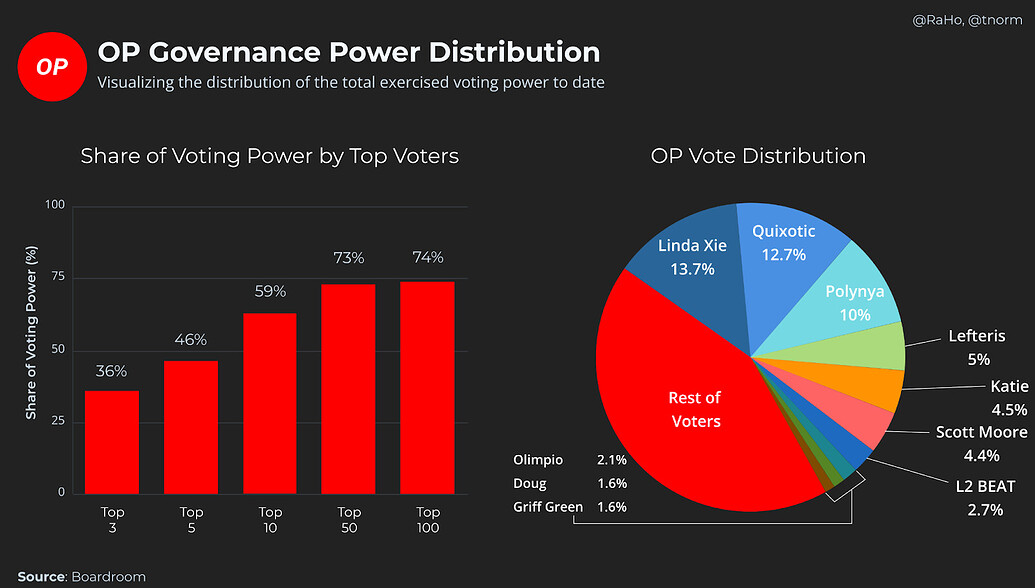
Linda Xie and Quixotic (two of the DAO's largest representatives) represent such a large group of delegates, which is also an encouraging sign in decentralization. Going forward, we hope to see more participation from top-level representatives who did not participate. With greater consistency and visibility in reporting, we expect to see smaller, more active delegates absorb some of the voting power from apathetic delegates.
first level title
Scope of Governance Fund
There are examples of projects applying for governance funds and partner funds in multiple scenarios (Aave[2], Velodrome[3]). Since the current case of governance funds and partnership funds are both used for liquidity mining incentives, it is necessary to define the scope of governance and partnership funds. An alternative to publicly listing the recipients of partner funding (including the amount) is to immediately blacklist the project to ensure that the project cannot receive funding from both sources. The community should work with the Optimism Foundation to develop appropriate guidelines for this issue.
In addition to addressing the overlap of partners and governance funding, the community also needs to have a solid understanding of the scope of governance funding. Due to the complexity of calculating liquidity mining incentives, more than one application lacked a specific timeline.
Possible solutions:
Develop clear guidelines for governance funds and partner funds.
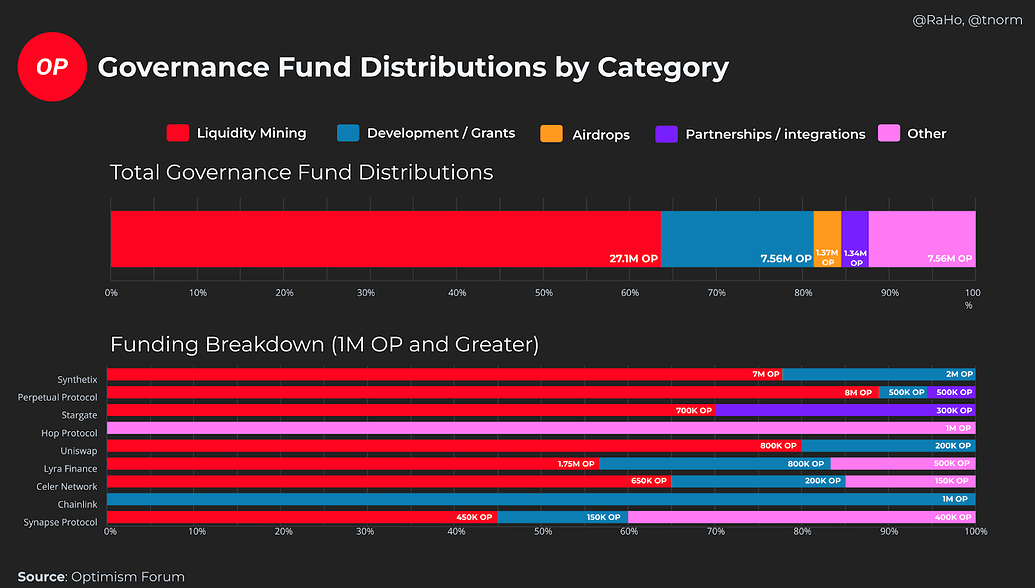
Optimism’s document roughly explains that liquidity mining activities are better suited within the confines of a Partner Fund than a Governance Fund. Since liquidity mining activities have consumed 63% (27M OP sources [4]) of governance funds, it would be helpful to develop a more precise outline of funding goals and determine whether liquidity mining falls under these goals Effective.
Partner Fund:
“5.4% of OP tokens will be allocated to a fund dedicated to partners. These funds will be allocated strategically by the Optimism Foundation to foster the growth of the Optimism ecosystem for the benefit of the collective.”
Governance Fund:
"5.4% of OP tokens will be dedicated to the first governance fund. All projects demonstrating the use of Optimism can apply for tokens from the fund at gov.optimism.io[5]."first level title
Potential Vulnerabilities of Governance Funds
The primary use of OP tokens is governance rights to fund projects and initiatives. Therefore, it is clear that the current model does not highlight the potential of its exploitation.
After Airdrop#1, the way to earn OP tokens is by accepting funding or participating (already funded through the Governance Fund or Partner Fund) in project-hosted (minority) liquidity mining events. Due to the limited ability to obtain OPs, the Optimism community believes that when voting for or against governance funding proposals, the votes of delegates will be in the best interest of users and support the long-term development of the Optimism collective. While we support Optimism in funding projects and setting goals within its native ecosystem, [the lack of accountability for the use of funds after they are distributed has concerned some community members (https://gov.optimism.io /t/perpetual-protocol-optimism-governances-first-failure/3029).
To emphasize the importance of these votes, we would like to provide an example of an exploit of a potential vulnerability which luckily has not yet occurred. In Phase 0 of governance funding, two separate protocols (Perpetual Protocol and Synthetix) were funded with 9,000,000 OP.
Hypothetically, with that amount of OP, it is easy to self-delegate OPs and vote on behalf of future self-funded proposals. With this amount of OP, any proposal we see in governance funding phase 0 or phase 1 will easily reach the minimum quorum.
Minimum quorum:
10%"Can vote for OP":25,751,126 OP * 0.1 = 2,575,112.6 OP
(Source: Dune[7])
The average number of votes per proposal is 17,974,761.68 OP. Adding the 9 million OPs to the total number of votes available would give a total of 34,751,126 votes and a minimum quorum of 3,475,112.6 OPs. Assuming the same average number of OPs used for voting, adding 9 million OPs would give a malicious project nearly 35% of the voting power.
((9,000,000 OP / (17,974,761.68 OP + 9,000,000 OP))*100 = 33.36452091%)
As far as we know, there are no failsafes that prevent projects that have already received funding from self-delegating their OPs and voting on behalf of future self-funding.
Potential Risk Mitigation:
This topic is already covered in Grant Proposal Template V2 [8], but ideally there would be a clear path to accountability.
Grant Proposal Template V2
Our expectation is that token grants will not be self-delegated for governance purposes. The main purpose of these token grants is to incentivize sustainable usage and growth of the Optimism ecosystem. Applicants should disclose whether they plan to increase their voting power by delegating a portion of the vested tokens to themselves or a closely related party.
As a community, there are ways to mitigate this risk and ensure that funds remain in the hands of projects contributing to Optimism collectively.
Increase quorum (and/or approval threshold):
The current quorum does not reflect the amount of distribution allocated to the Governance Fund and Partner Fund, opening up room for governance manipulation.
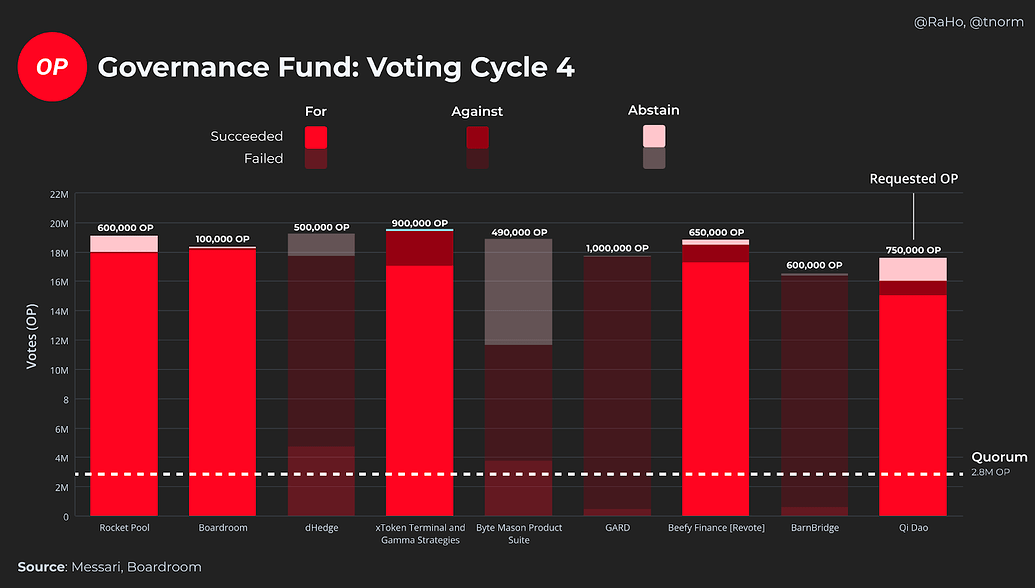
The current voting OP quorum is about 1.1% of the total circulating supply. Relatively speaking, this threshold is significantly lower than many DeFi DAOs with higher TVL - namely Uniswap (4%) or Compound (5.5%). Looking at the results of Voting Cycle 4, it is clear that, based on current delegate participation, increasing the quorum increases governance security without risking stifling progress on future governance proposals. Every vote so far has far exceeded the quorum.
Delegates ensure accountability by:
Projects receiving governance funds accept a 3/4 multisig (two delegates and two project team members). Using this model, representatives are directly accountable to recipients of funds.
Accountability Committee:
Following the model introduced by the Optimism Foundation [9], an accountability committee is formed to ensure that recipients of funds abide by the uses of funds proposed in their original proposals.
Open source funding map:
The model entails the development of an open-source dashboard that maps the token’s trail, but allows the community to self-police and stop funding projects that don’t abide by their proposed use of funds.
Summarize
Summarize
refer to
refer to
https://messari.io/governor/overview
https://gov.optimism.io/t/gfx-labs-delegate-communication-thread/2728/12
https://twitter.com/AaveAave/status/1555230478394966018?s=20&t=DDOZTVpenl1IFg7SwwBHUg
https://twitter.com/VelodromeFi/status/1545434763951017986?s=20&t=By9CVeuOw-AVOu9lgauDng
https://docs.google.com/spreadsheets/d/1VZp7x8YdNTY1dYHOu-u8zmu5_YQL_tHP1bYw7mTults/edit?usp=sharing
http://gov.optimism.io/
https://community.optimism.io/docs/governance/allocations/#ecosystem-fund
https://dune.com/queries/872016/1521063
https://gov.optimism.io/t/grant-proposal-template-v2/3233
https://gov.optimism.io/t/introducing-governance-committees/3238





