






Nansen: What enlightenment does Shudu NFT casting have on the market?


Original source: Nansen
Original source: Nansen
Summarize
Summarize
Insights shared before Chainalysis, observed that 20% of NFT minters realized profits from purchased NFTs during the Mint phase. While their report established the dominance of NFT minters, it prompted us to dig deeper into NFT minter behavior. Using data from the Nansen dashboard, we explore trends related to NFT minting. Our analysis shows that the behavior of NFT minters can serve as a signal for short-term market trends, just as we observe the behavior of miners as a proxy for Bitcoin price.
Data from the Nansen NFT Index and Market Trends panel captures the recent downtrend in the market, which is also reflected in the behavior of NFT miners. Our findings revealed such a phenomenon: One-third of minted NFTs were sold above the floor price and minting cost. Likewise, one in three NFTs ended up as illiquid collectibles with little trading activity after minting.
Understanding the NFT Market Through NFT Minter Behavior
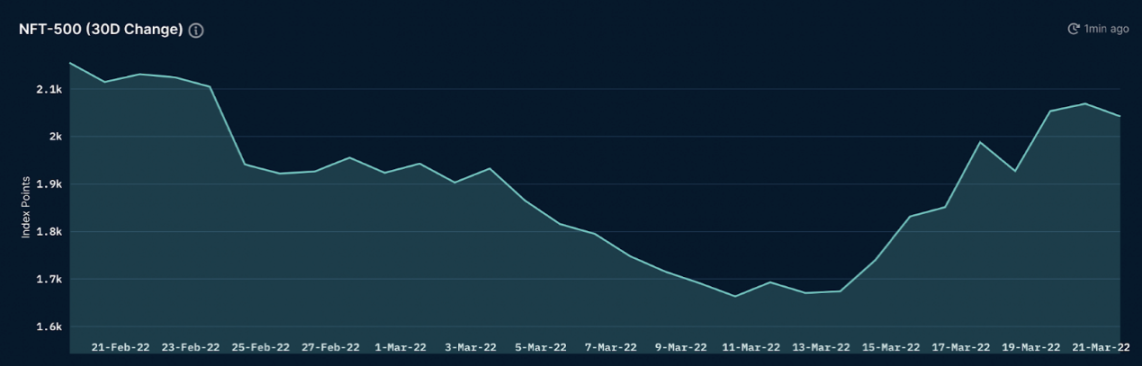
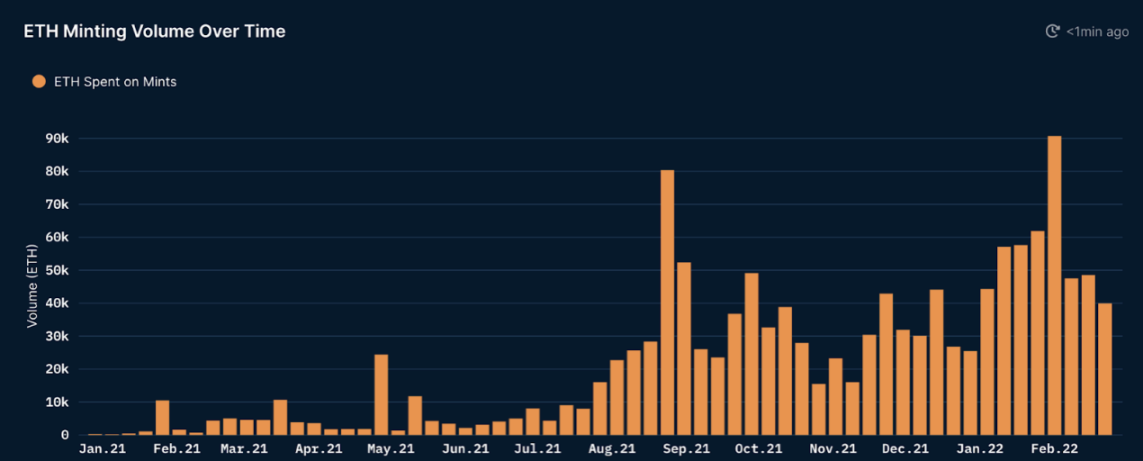
Over the past 30 days, we have seen the NFT market decline slightly, with the Nansen NFT-500 (ETH) Index down -5.23% in ETH terms and -0.89% in USD terms. Such a move is in line with the broader market, where sentiment is dominated by "risk aversion" amid expectations of rate hikes and a war between Russia and Ukraine. Such sentiment is also reflected in minted sales, which have declined over the past 30 days. While the Nansen NFT-500 Index reflects this market sentiment, we can also observe this trend through the behavior of NFT minters.
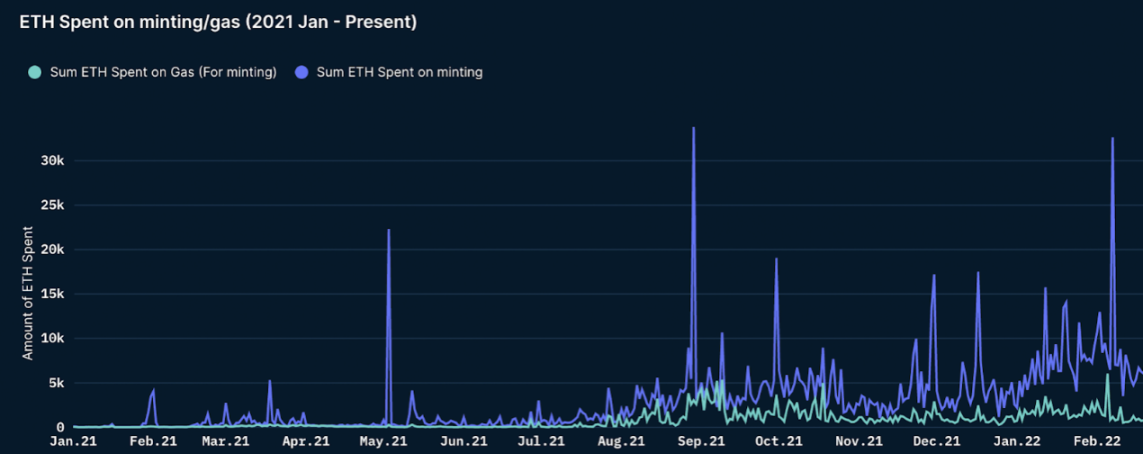
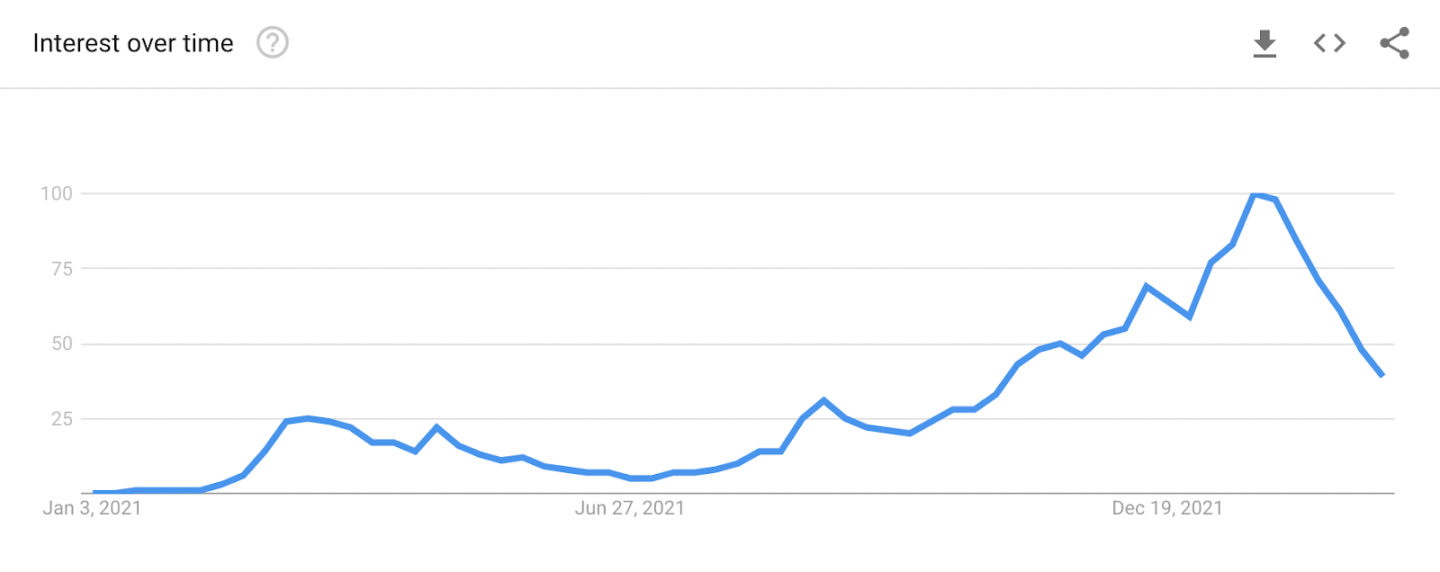
Beginning in 2022, the amount of ETH used for minting will gradually decrease. When checking this trend against Google Trends, searches for NFT themes have declined, suggesting that interest in NFT themes may be slowing down in the short term.
However, if compared to 2021, NFT minters spent more ETH in both minting and transaction fees in 2022. Some notable NFT minting projects during this period include MAYC, Pixelmon, Meebit, and Lost Poets.
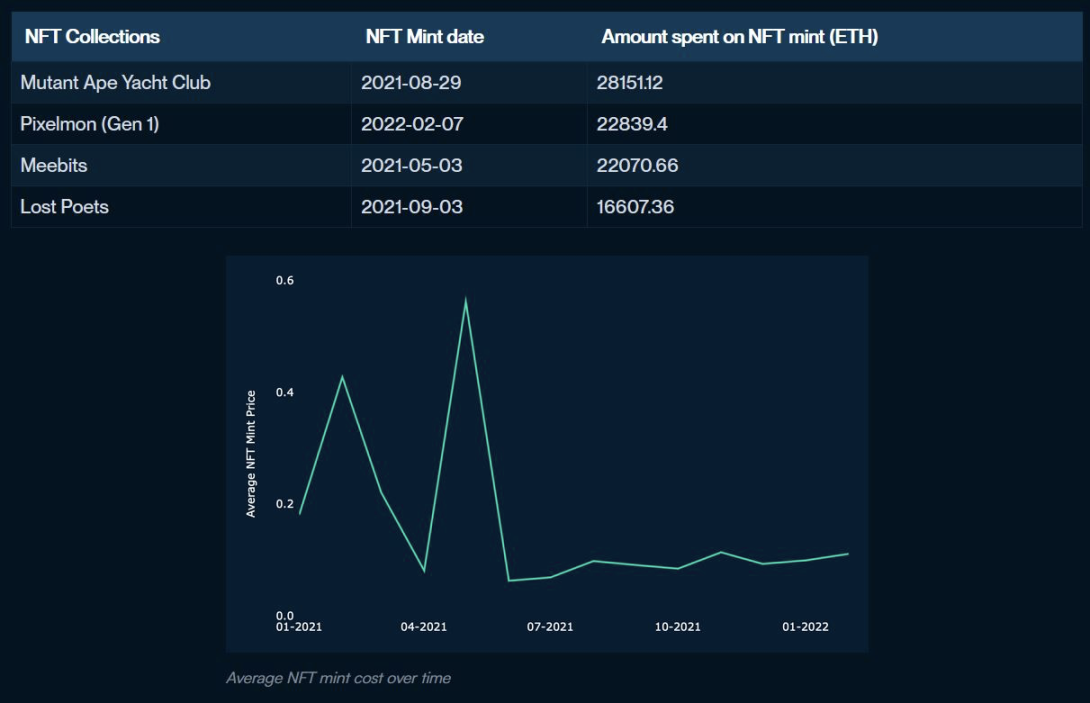
A closer look at the data shows that the average minting cost peaked in May 2021 at 0.56 ETH, but fell to a low of 0.06 ETH in June 2021. Since July 2021, the average minting cost of NFT has been between 0.07ETH and 0.1ETH. We hypothesize that a possible explanation for this phenomenon is that as more items are introduced into the market, NFT minting becomes more competitive, driving down the average minting cost. Between January 2021 and February 2022, we saw the number of minted collectibles increase by over 4800%, from 39802 collectibles to 197086.
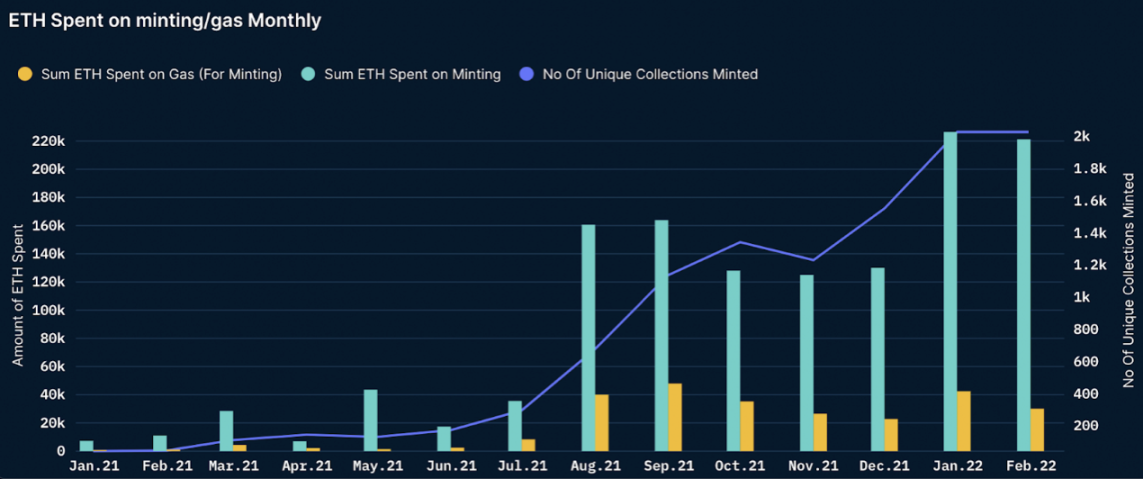
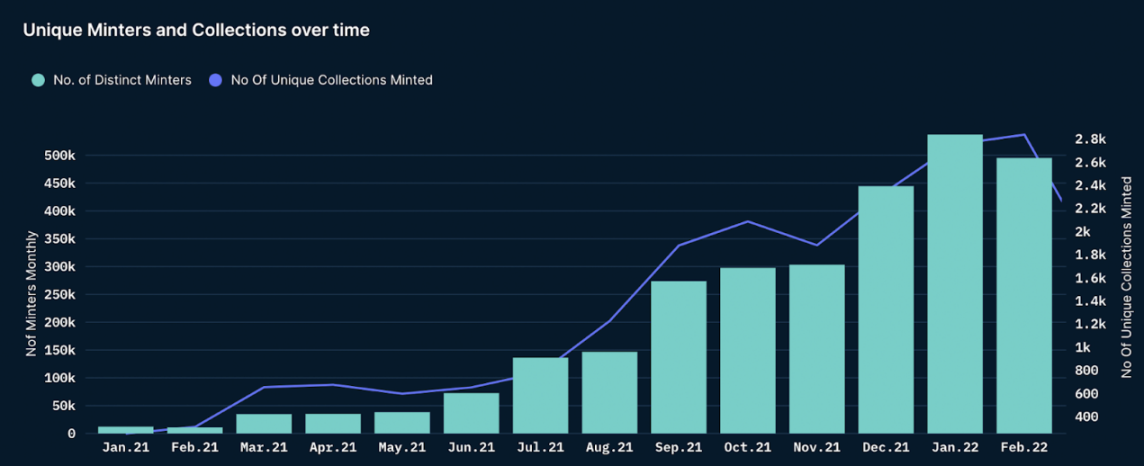
The cumulative increase in total NFT minting and transaction fee payouts is likely due to the increase in new NFT newcomers participating in the marketplace over time.
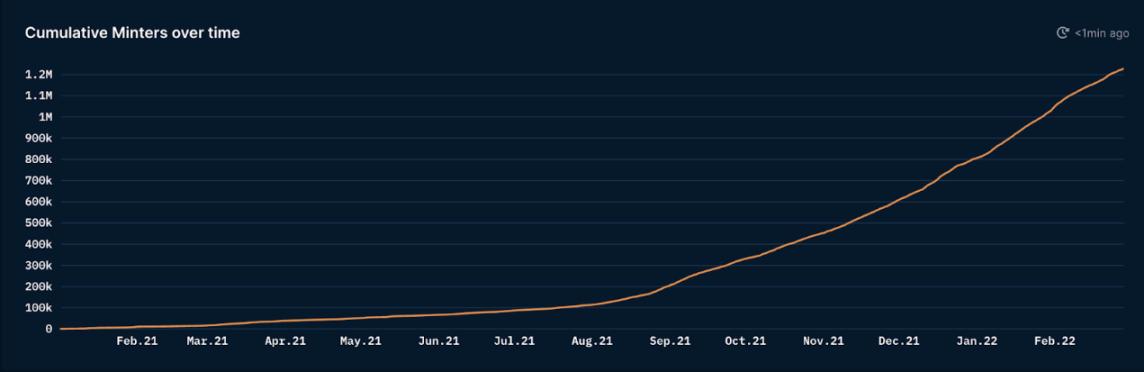
Between 2021 and 2022, we observe a 2,000-fold increase in cumulative NFT minting issuance projects in the NFT market, from approximately 500 NFT project parties in early 2021 to 1.2 million NFT project parties by the end of February 2022.
Profiles of NFT minters
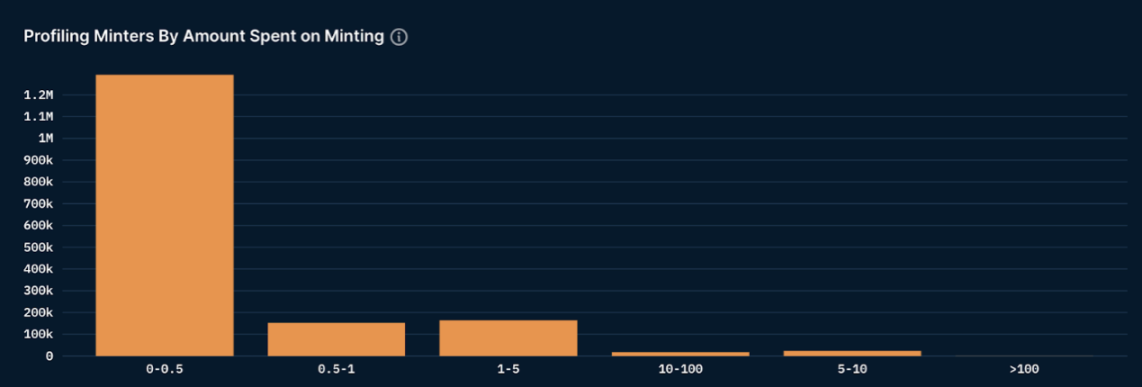
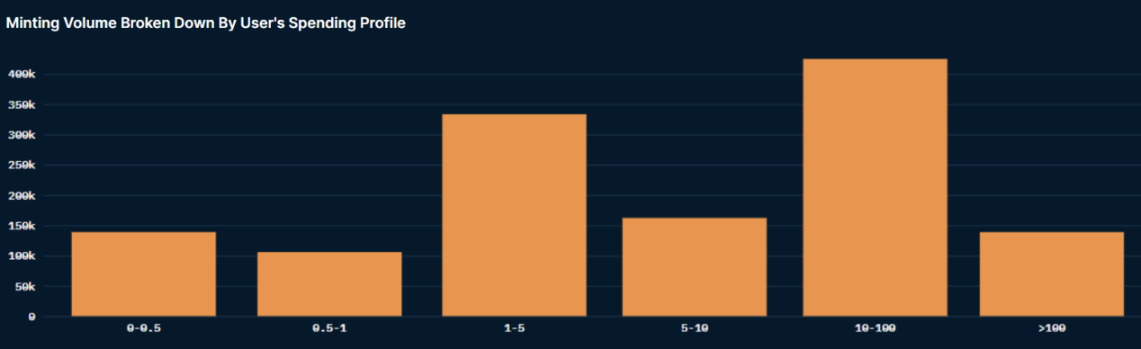
As a snapshot, we can see that most NFT minters spent up to 0.5 ETH for their minting. These minters who spent no more than 0.5 ETH accounted for about 10.7% of the NFT minting volume.
The NFT minters that dominate the minting volume are those spending between 10 and 100 ETH, they account for about a third (32.6%) of the total minting volume.
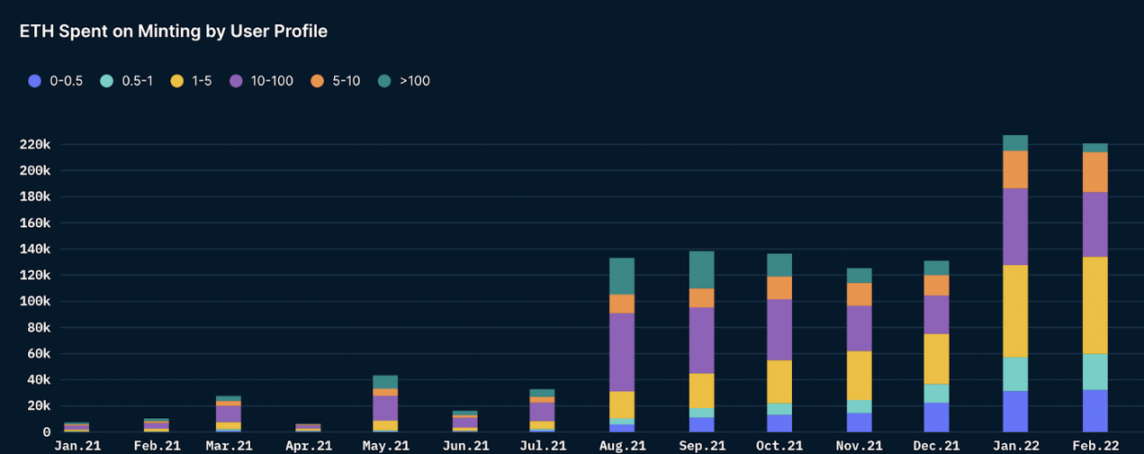
When analyzing the data of NFT Minters per month, we observed that before 2022, the group of NFT Minters who spend between 10 and 100 ETH is the largest group of NFT Minters. However, since December 2021, the trend has reversed, with NFT Minters costing 1 to 5 ETH being the most representative. On the other hand, there seems to be a slight decrease in "whale" NFT minters spending more than 100ETH.
Minting does not mean profit
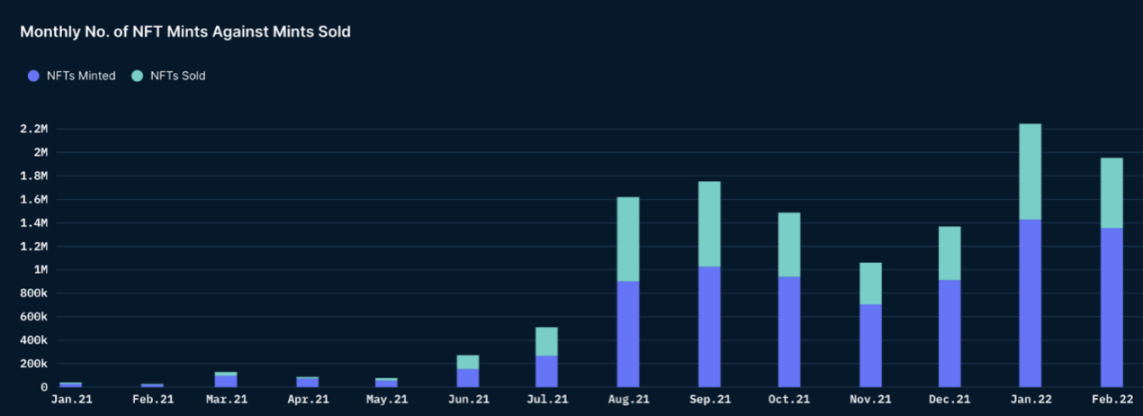
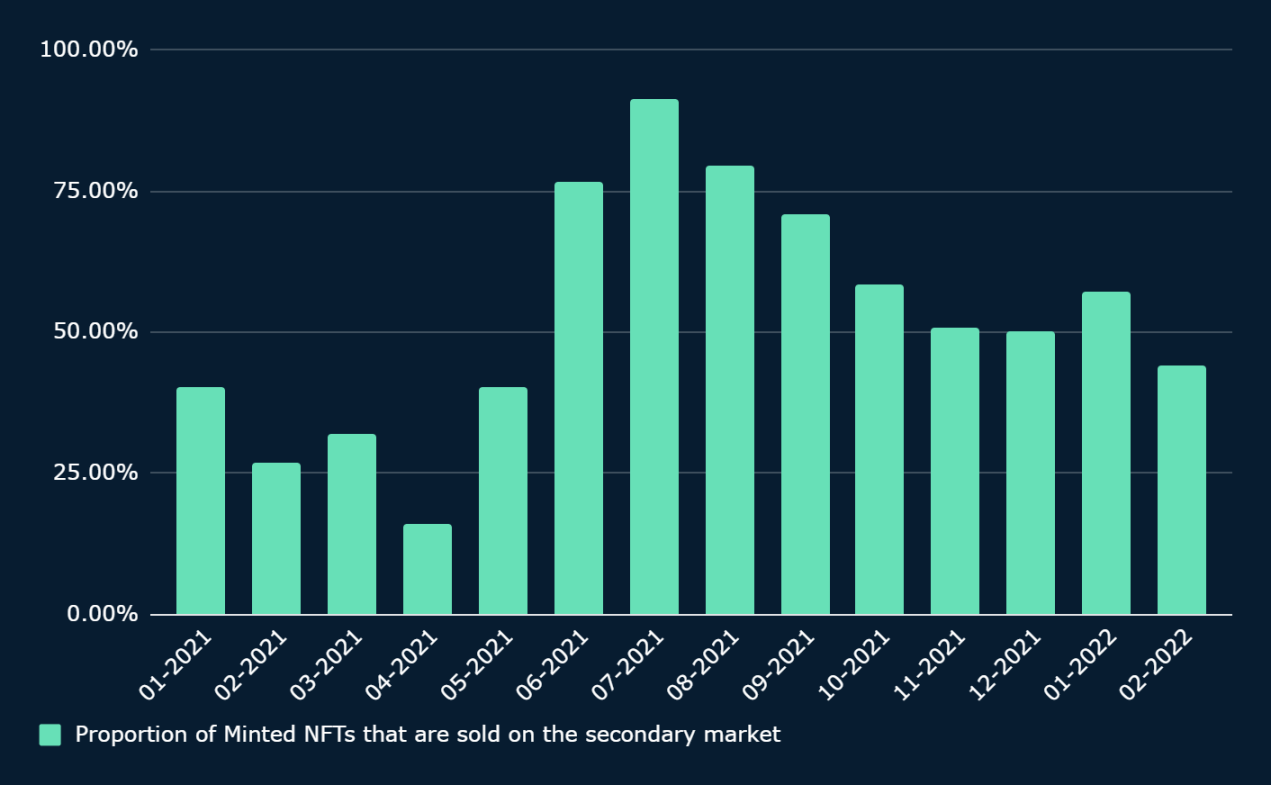
We are curious what percentage of minted NFTs are recirculated and traded on the secondary market. Our data shows that from January 2021 to February 2022, an average of 44.8% of minted NFTs were resold on the secondary market each month. However, since July 2021, the proportion of minted NFTs sold on the secondary market appears to be gradually decreasing.
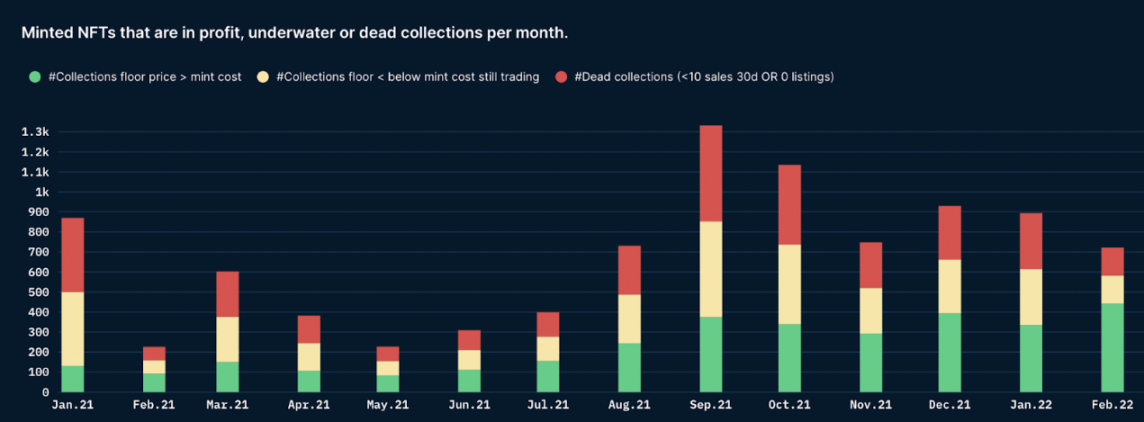
When analyzing the profitability of minted NFTs, it shows that 1 in 3 minted new NFTs will not be traded again. On average, the selling price of one-third of NFTs is also lower than the cost of coinage, and the reserve price of one-third of NFTs is higher than the cost of coinage. However, when analyzing this trend, we see that the proportion of minted NFTs that are in profit is increasing over time, while the proportion of NFTs that are dead collectibles is gradually decreasing.
When analyzing the monthly profits of the top minted collectibles, we see a minimum average profit of around 4ETH with a peak of 115 ETH. As the graph above shows, the profits of top minted collectibles follow a volatile trajectory.
Finally, should I also mint NFTs?
Early access to NFTs by participating in minting should be carefully considered. When deciding whether to participate in NFT Mint, you should consider your own risk appetite. Thorough due diligence must be done on potential projects such as the research community, its roadmap and the history of the founding team. For a more evidence-based approach, one can use Nansen's NFT God Mode Insights to examine transaction data for specific items.
People can also leverage Nansen's Mint Master to glean insights into what renowned NFT minting masters are doing and track smart money operations and actions on projects. While NFT Mint minting may seem like a micro-level activity, it is crucial to understand the macro outlook of the NFT market. You can get it from Nansenmarket trend dataOriginal link


