






Cryptocurrency Trojan Horse? What if USDC/USDT leaves Ethereum


Original Author: Emiri
Original compilation: Block unicorn
Original Author: Emiri
Original compilation: Block unicorn
and"here"
If you have read my previous articles, then you may be asking,
Yes, the problem is its success. In my opinion, by far the most useful thing about crypto is stablecoins, and USDC/USDT is the best use case for cryptocurrencies right now. They make it easy to move dollars around the world, they simplify the transaction experience, and they prove to be a better payment system, especially for international transfers.
But stablecoins completely defeat the original vision and purpose of crypto. Think about it, we are building an alternative financial system, free from any constraints of the traditional financial world, but the best product to emerge from it, is a synthetic fiat currency (USDC/USDT).
first level title
USDC hegemony
Everyone knows about the rise of USDC and how it started to become a very close competitor to Tether (USDT parent company) USDT. In fact, most people have come to like USDC and seem to believe that it will outperform Tether due to constant rumors of shady dealings behind Tether. I mean, USDC is starting to become so popular that there is a twitter account surrounding USDC bullish: @USDCbull1.
As we have seen, many decentralized stablecoins have collapsed over the past few months. For the little fat guy in USDC, it's all going well. Undisturbed on their track, nourished to grow, focus on their track and thrive, there doesn't seem to be any problem on the horizon. Circle is constantly updating the status of their USDC reserves and even announced a Euro stablecoin, all good.
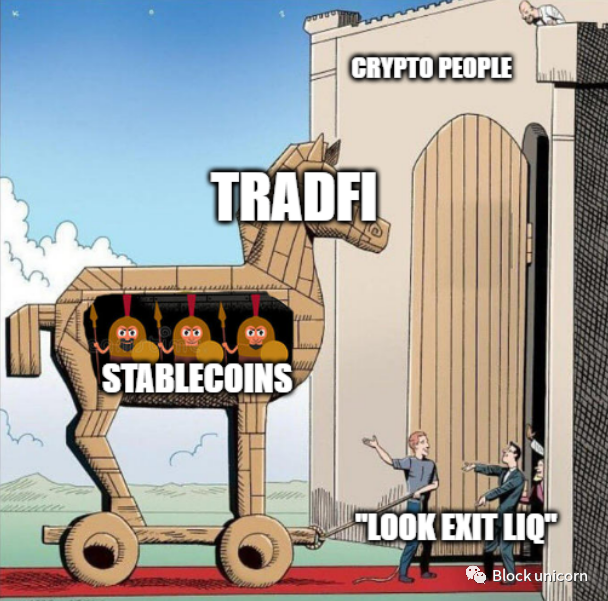
However, recent developments have shown that the Trojan horse has begun to reveal its true self. After OFAC sanctioned Tornado Cash (Tornado), Circle (USDC parent company) complied and blacklisted addresses associated with Tornado Cash. Many users and protocols that have had any interaction with Tornado Cash now have a significant portion of their funds frozen. This is just a small example of the power these centralized stablecoins wield. They can blacklist addresses at any time, meaning that relying on them poses an existential risk to the crypto ecosystem.
USDC started out as a small tumor ignored by most and has transformed into a potentially dangerous cancer plaguing every part of the cryptoeconomy, and all we can do now is watch these events unfold.
first level title
Where is the cancer now?
Let’s start with the most important Dapp in this scene, Curve Finance. The most important pool on Curve (CRV) is 3pool, which at the time of writing has a TVL of $991 million and a trading volume of $95 million. Other large fund pools, such as Frax fund pool, sUSD fund pool and USDT fund pool are all related to 3Pool. In the 3crv fund pool, USDC accounts for 40% of the fund pool, which is about $400 million at the time of writing this article.
Let's look at Uniswap, 4 of the top 5 pools by TVL have USDC. These top 5 pools collectively account for $2.5 billion in TVL, with a combined weekly trading volume of $5 billion. Therefore, a major part of Uniswap activity is dependent on USDC.
On the AAVE lending protocol, USDC is the second most active currency after ETH. AAVE has a total of $1.4 billion in USDC supply and $470 million in borrowing. On Compound, USDC is the second most liquid after ETH, with a total of $700 million in liquidity.
When MakerDAO moved to a multi-asset collateral model, the amount of ETH they held as collateral dropped dramatically, while the amount of USDC in reserves increased dramatically. Currently, 60% of DAI collateral is provided by USDC. 47% of the $10 billion DAI TVL is provided by USDC. As such, the leading decentralized stablecoins in DeFi rely heavily on centralized stablecoins.
I could go on and on, but I think you'll get the idea. USDC is deeply rooted in all basic protocol parts of DeFi. The total TVL of DeFi is 65 billion U.S. dollars. The top five agreements in TVL are MakerDAO, Lido, AAVE, Uniswap and Curve. Among the 65 billion U.S. dollars in TVL, USDC accumulatively accounts for 36 billion U.S. dollars, which is only slightly more than half. Most of the TVL of four of the protocols is composed of USDC.
Doctor: I dare not say, it looks like stage 3 cancer.
first level title
What does the oncologist recommend?
(Any suggestions for USDT/USDC)
"Diversity is needed to solve the over-concentration problem bro" seems to be a common solution proposed on Twitter. All treasuries and protocols should move away from supporting USDC and start looking for more decentralized, censorship-resistant alternatives.This is of course something that everyone loves to do, but only if it is this easy. We need to think about what decentralization from these centralized stablecoins actually looks like for DeFi.
People love to talk about the Lego-like structure of DeFi. However, if you look at those underlying protocols mentioned above, you will find that the DeFi ecosystem depends on them (USDC/USDT) to some extent.
They either build on top of these underlying protocols, execute strategies on them, or hold large amounts of native tokens within their treasury. Therefore, the knock-on effect of moving away from USDC could be catastrophic, with the collapse of the foundation causing the entire building to collapse at once. Unfortunately, many new protocols with real potential will have to close early, as will many existing protocols that are growing steadily.
In my opinion, if you want to get rid of USDC, there are two options. One is protocol diversification into other stablecoins and the other is diversification into a basket of other cryptoassets.
When it comes to diversifying into other stablecoins, let's say you diversify into other decentralized stablecoins. At this point, the best options are DAI and FRAX, but as we saw before, they both rely heavily on USDC right now. So diversifying away from USDC could cause some wild swings in DAI and FRAX itself. When it comes to other options, they prove to be very dangerous as most of them are not sufficiently stress tested. We know that stablecoins are prone to crashes, which is why relying on newer stablecoins is not a good move.
Even a truly decentralized stablecoin with no peg like RAI. This seems like the optimal solution, but the problem is user adoption. Mentally, it's hard to get people to accept such a stablecoin and start pricing it with RAI, plus it's poorly integrated with the rest of DeFi.
Another way is to diversify from USDC into a basket of crypto assets. While this makes sense from a "decentralized" perspective, it doesn't make sense from a business perspective. This would result in a situation similar to the pre-stablecoin era, where each protocol reserve and each protocol treasury would hold high-risk and highly volatile crypto assets that could cause most protocols to shut down under adverse market conditions .
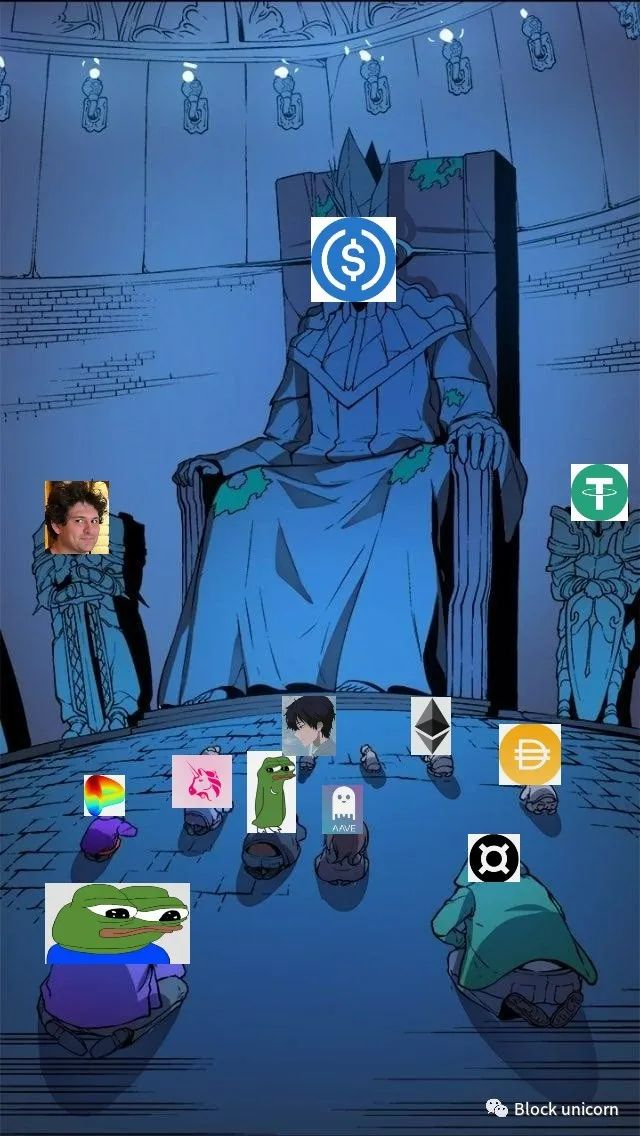
So what should we do? Will the developer offer a breakthrough solution? Or we just get on our knees.
first level title
Do we really need stablecoins?
All this talk about stablecoins raises the question of whether stablecoins are really necessary. There have been many experiments with decentralization, but they were either not truly decentralized or ended up imploding. For centralized stablecoins, there is not yet, or is likely to be, meaningful competition.In short, stablecoins have 3 main benefits. Transactions, payments and access. 2/3 of that can be resolved, but any unprecedented access to dollars (or other currencies) will only work with fiat-pegged stablecoins.
One way to look at stablecoins is to look at it over a very long time frame. In this case, they are only a temporary solution, acting as a bridge between fiat and cryptocurrencies. Once a significant portion of global liquidity is incorporated into cryptocurrencies, then something like ETH or whatever is popular at the time can start to be the base currency, simply because all cryptocurrencies will be traded against them.
final thoughts
first level title
final thoughts
This isn't the only insider in our system, the oracles on which nearly all protocols rely are often centralized, and key infrastructure players like Infura (infrastructure development toolkit and API, the decentralized protocol unicorn development, such as UNI, COMP, Metamask, etc.), are also centralized, and with trust being placed in so many different cancer spaces (centralized spaces), the more likely outcome is a complete abandonment of decentralization, censorship resistance, and Licensing transactions.
We wish there was a way to move our reliance on these centralized entities to something more in the spirit of the original crypto. If we are successful in this task, we may experience extreme pain in the medium term given how deeply entrenched these entities are. As painful as it is, I am sure that encryption is not dead, it has proven its resilience time and time again, and the same thing will likely happen again.


