Why did dYdX choose to "escape" from Ethereum and embrace Cosmos?


Original author: fyj, 0x711, BlockBeats
On June 23, dYdX announced that it will transfer to the Cosmos ecosystem, develop a custom application chain based on the Cosmos SDK, and implement the migration in the upcoming dYdX V4 version. This may be the first time that a well-known Ethereum-native DeFi application in the industry chose to flee.
The founder Antonio's words are meaningful: "When choosing a chain, I think people should not think about what kind of users there are on this chain, but should think about what kind of product experience the chain can achieve."
The application layer has been suffering for Ethereum for a long time. As early as November last year, Antonio, the founder of dYdX, tweetedPublicly Questioning Ethereum’s Efficiency Improvement, the speech has revealed that it is considering transferring dYdX to other chains.
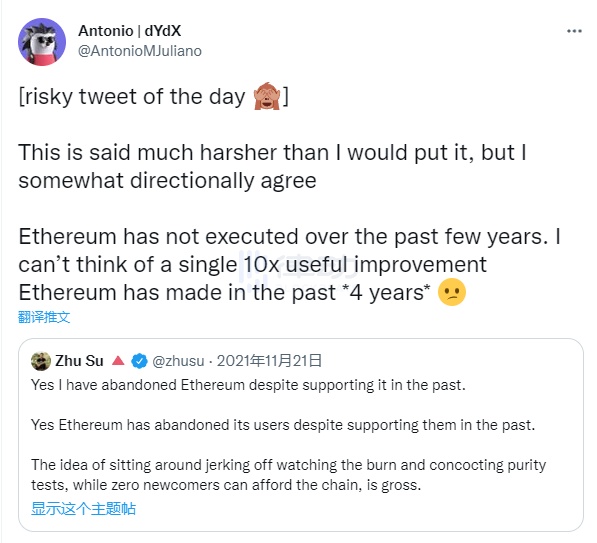
Antonio believes that over the years, Ethereum has been lacking in technology implementation, and dYdX aims to become a DEX that is "ten times the current scale and can compete with centralized trading platforms in terms of experience".
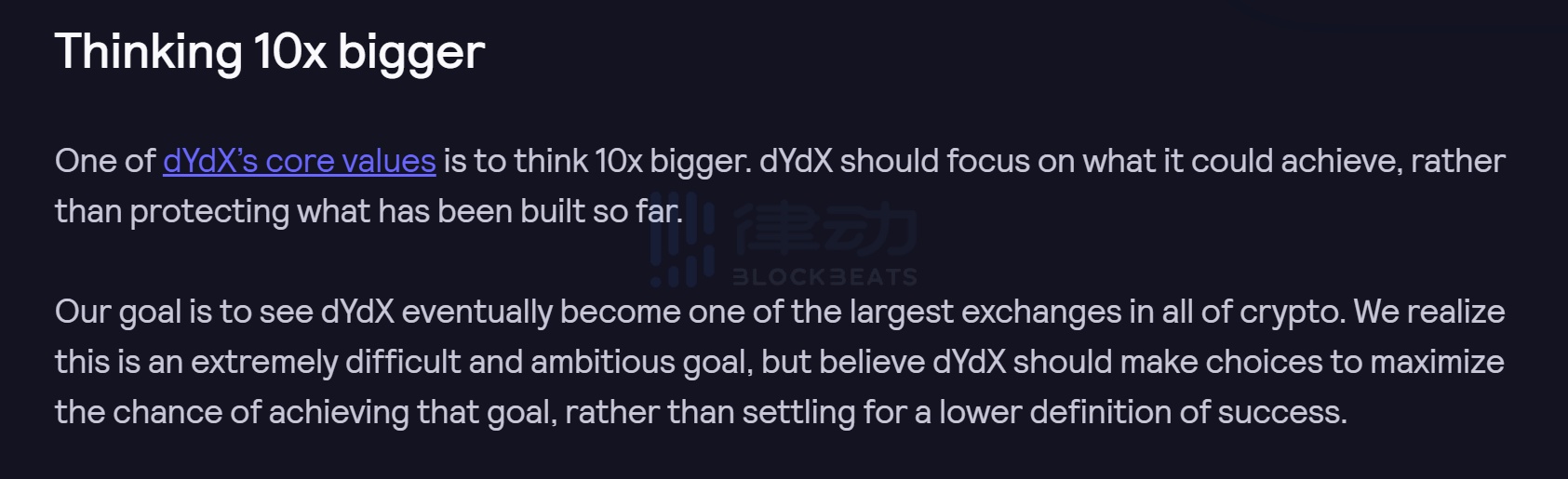
Antonio has always been a product manager in the industry. As one of the earliest DeFi projects, dYdX has long been committed to developing mobile applications and trying to bring decentralized applications (Dapps) into the mass market. In the migration announcement, dYdX mentioned that the team is not satisfied with the current transaction speed of 10 transactions per second and the order/cancellation performance of 1000 transactions per second, and expansion needs to build a centralized off-chain order matching system, which is different from dYdX's decentralized The positioning of the chemical transaction does not match. Therefore, in V4, dYdX will build a decentralized off-chain order system, taking into account both performance and concept.
But is it just because the Ethereum ecosystem really cannot meet the needs of dYdX? The community believes that the reasons behind Antonio's decision may be more complex and multifaceted.
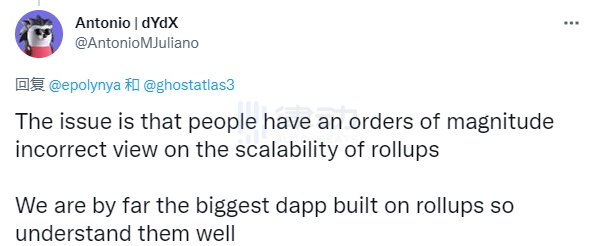
Encrypted KOL polynya said, technically speaking, Rollups can achieve the required chain performance of dYdX V4. Therefore, it may make this decision out of chain sovereignty and timing considerations. First, the rollup technology was too late to be ready for primetime; second, there wasn't enough demand in the industry to demand a rollup. In addition, using dYdX as an ecological token may have chain security and sustainability issues.
In this regard, Antonio responded that the migration does have chain sovereignty considerations, and dYdX monopolizing a chain will make it easier for the protocol to recover from loopholes (fork). In terms of security, the initial stage of the new chain will control the number of nodes to ensure security.
For rollup technology,Antonio saysI am pessimistic about the future expansion of rollup, "dYdX is the largest dapp on rollup, and I know rollup very well."
Crypto analyst @EffortCapital said the impact of dYdX's choice of Cosmos as a DeFi OG should not be underestimated. Other crypto KOLs are not optimistic about this decision because they do not understand the Cosmos ecology.
In addition, Chainlink community ambassador @ChainLinkGod and Cosomos ecosystem developer Zaki welcomed and looked forward to the migration.
Solidity developer 0xTomoyo made an in-depth analysis of the migration reasons from a technical perspective. The current dYdX order book is run on an off-chain centralized server, and L2 is only used to settle matching trades. In theory they could build an in-memory order book on L2, but currently no such tool exists. Therefore, dYdX chose to build a new chain on Cosmos, with each validator running an in-memory order book. This further realizes the decentralization of the protocol.
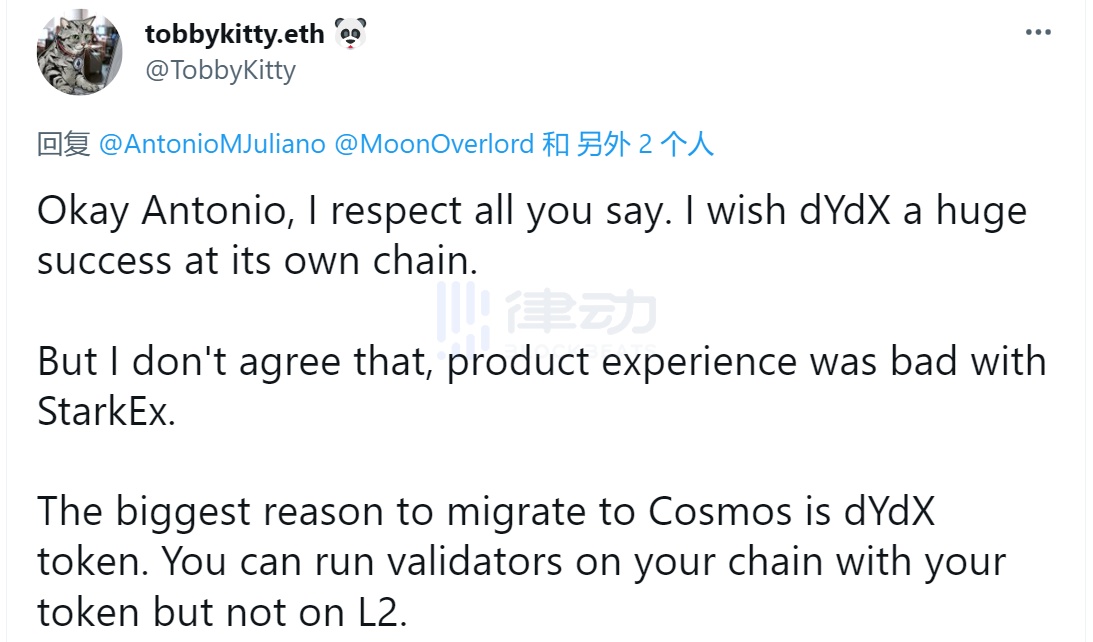
StarkNet co-founder @TobbyKitty speaks out, the biggest reason for migrating to Cosmos is to allow dYdX Token to run verification nodes on the new chain and lock the value of the protocol, but it will not work on L2.
Finally, whether this decision should be voted on by the dYdX DAO, which is widely questioned by the community,Antonio responds, “The DAO will vote on the decision. It’s just software that the company is developing, and the protocol can choose to use it or not.”
The protocol layer pushes the developer-friendly workload to Layer2. Next to Layer2, there are a large number of API providers and node service providers such as Infura and InfStones. After years of ecological accumulation, the development work has become easier and easier , or is it getting harder? It is not difficult to feel that Antonio is tired of following the rhythm of Ethereum again and again.
Whether the ecology breeds the application or the application feeds the ecology is not a matter of the east wind overwhelming the west wind. Different aspects of contradictions in different periods lead the development of things.
It's just that dYdX tells us that at the moment, rather than arguing who is the boss of Layer2, maybe we should listen to the voices of product managers.