






In-depth analysis of the multi-layer structure and expansion methods of DAO


Original Author: MIDDLE.X
Original Author: MIDDLE.X
Original source: PAKA Labs
Last year, we saw an explosion in DAO activity, with dozens of fold increases in both funds under management and participating members. At present, the total amount of funds managed in the form of DAO is 9.8 billion US dollars, and there are 80 DAO organizations with management funds of more than 1 million US dollars (DeepDAO, 2022).
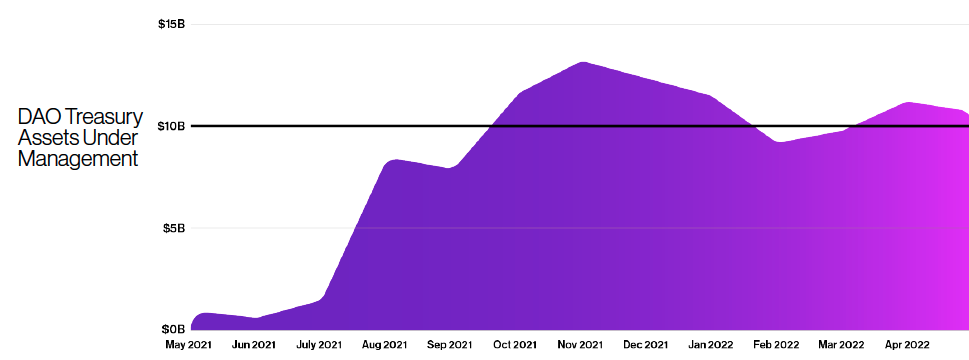
image description
(Source: https://deepdao.io/organizations)
However, over time, the development of DAOs began to face scalability issues:
First, DAO takes democratic participation as the most basic principle, but when there are more and more participants in DAO and more and more affairs, it will fall into the dilemma of "everyone must decide everything together". Many DAO members became overwhelmed with various voting decisions and did not have enough background information to make informed decisions, ultimately resulting in low participation rates and a tendency toward centralization.
Therefore, with the help of some governance frameworks, DAO evolved a multi-layer model to meet the challenges. Governance frameworks that support the multi-tier model include Moloch V2 and Orca.
first level title
DAO-Pod structure
Moloch V2 and Orca both chose to build a sub-group for DAO. A DAO delegates a portion of funds and a specific set of powers to a small, trusted team to act with relative autonomy. Such a trusted small team is called Minion in Moloch V2 and Pod in Orca. Although they are called differently, they all take the form of a multi-signature wallet. The multisig wallet is funded by DAO members voting and appointing a multisig committee. It is collectively referred to as Pod in this article.
DAO itself is also a multi-signature wallet, but DAO has its own complete governance layer, and independently completes the governance process through its own governance certificate and governance rules, while Pod does not have a governance certificate, and its governance relies on multi-signature committees and relatively simple weight and threshold rules. Most importantly, Pod governance is subject to the parent DAO.
We refine the relationship between DAO and Pod as "binding delegation".
Pod is entrusted by the parent DAO and becomes a relatively independent financial entity, which can perform the following operations
Independently manage and operate the funds in the Pod, which can be used for external investment, donation, Swap, service procurement, etc.;
Launch a Coodinape round (a DAO tool for distributing remuneration), or otherwise distribute internal remuneration to contributors;
The Pod treasury can also be used to receive money, but the money received is integrated with the treasury deposit and still belongs to the parent DAO.
At the same time, Pods are subject to a series of constraints from the parent DAO, including:
The ownership of the Pod treasury belongs to the parent DAO, and the multi-signature committee is only the authorized manager;
Pod cannot arbitrarily change the members of the multi-signature committee and their respective multi-signature weights, nor can they change the multi-signature rules, and these powers belong to the parent DAO;
The parent DAO has the right to withdraw the pod's funds and cancel the pod;
The parent DAO may set certain restrictions on the payment of Pod funds to reduce financial risks, such as single transaction limit, daily limit, payment black and white list, etc.
In the constrained delegation structure, both constraints and delegation are indispensable. Delegation refers to the full authorization for Pods, and constraints define the boundaries of authorization. This structure allows DAO to break out of the aforementioned two dilemmas of "everyone must decide everything" and "everyone must decide everything". Its advantages include:
By authorizing Pod, DAO's governance pressure is greatly reduced, allowing DAO members to concentrate on core key issues;
By appointing a multi-signature committee, professional people can decide professional matters, create Pods, and entrust not only the right to manage funds, but the right to decide on affairs within a certain range;
By dividing the Pods, each small-scale and well-coordinated team can master part of the resources of the DAO, so as to achieve rapid decision-making and rapid action, so that the grassroots of the DAO can obtain execution power comparable to that of a centralized organization;
By depositing funds into Pod, it is convenient for DAO to carry out budget management;
By establishing a temporary Pod and electing an administrator, it is convenient for DAO to perform time-sensitive actions, such as external asset exchange and asset bidding.
At the same time, creating a Pod and depositing assets is equivalent to creating a new asset package. DAO can use Pod directly as an asset for external exchange, transfer, mortgage and other operations.
first level title
From double layer to multilayer
So far, what we have talked about is the two-layer structure of DAO and Pod organization. In fact, both DAO and Pod can be multi-layered, and the two constitute an infinite multi-layer system.
Most DAOs are a kind of state-like entity, not subordinate to any jurisdiction, and have their own independent "sovereignty" to some extent, and have the final decision on all internal affairs. But if one DAO holds most or even all of the governance tokens of another DAO and has decisive influence in the governance vote, then there will be de facto affiliation.
The Pod directly created by the parent DAO is not the smallest unit in the DAO. Pods can also create and manage their own Pods. Technically, infinite layers of Pods can be realized. This is like the "sand paradox". You can find the smallest grain of sand in the world, but you can always break it into more and smaller sand. For Pod, there is no Planck scale.Therefore, a multi-level DAO system may look like this:
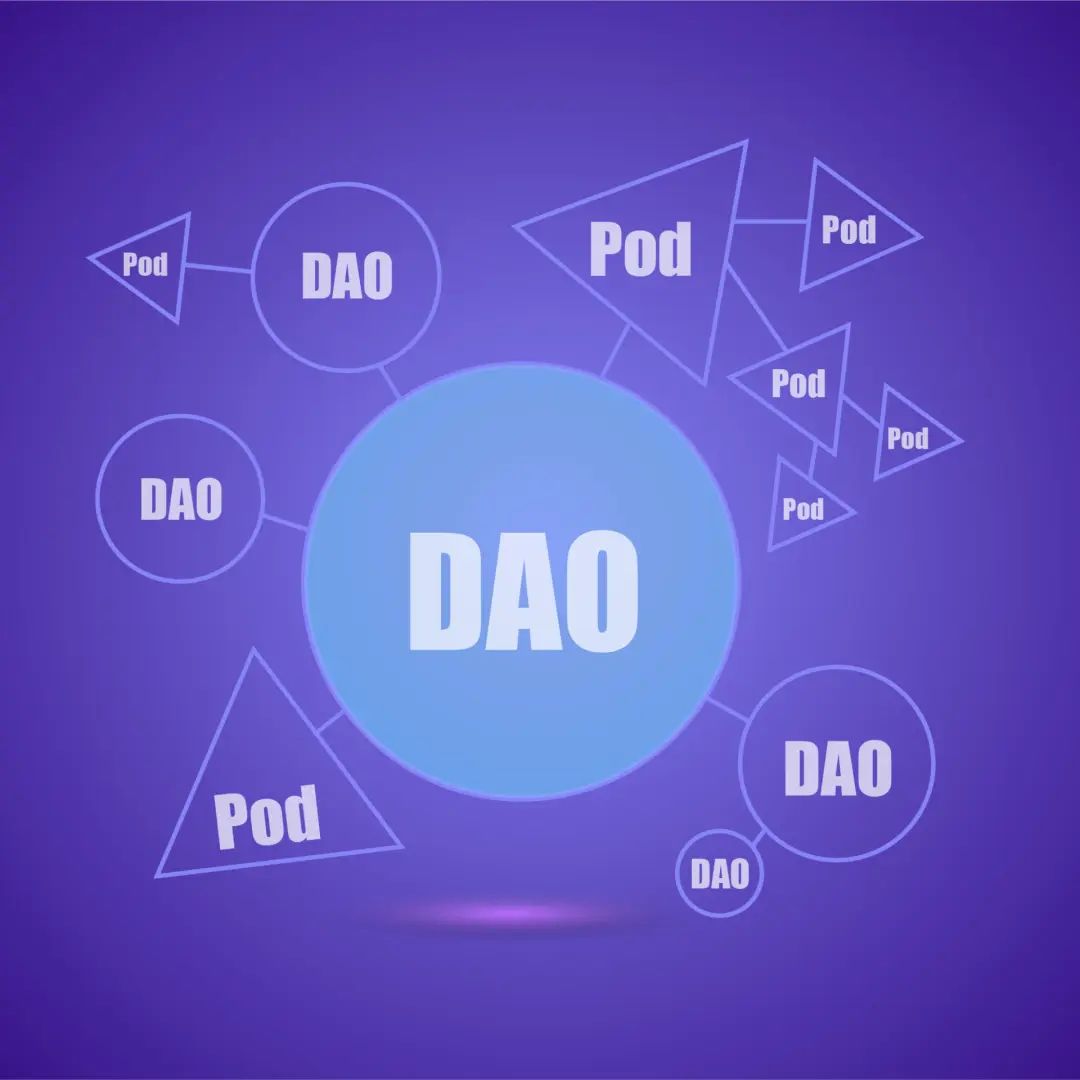 There are DAOs in DAOs, and Pods in Pods.
Formally, the only difference between Pod and DAO is that Pod does not have its own governance token. If the Pod is authorized by the parent DAO to issue its own governance token, then the Pod will no longer be a Pod, but will have its own independent "sovereignty" and become a DAO. Correspondingly, the subordination relationship of the Pod to the parent DAO has evolved into an investment relationship of one DAO to another DAO. In this case, we can understand the mother DAO as an incubator, and the Pod is equivalent to the incubated project. When the incubation matures, the Pod can "stand on its own" and become a new DAO. For example, indiGG, the Indian branch of YGG DAO, developed much faster than other branches, so indiGG began to operate independently, issued its own Token, and formed an investment relationship with YGG DAO, becoming a structure similar to a "subsidiary".
first level title
Independent Pod
In the above, it seems that there is an assumption that Pod must be created by DAO and must belong to a certain DAO, but we believe that the concept of Pod should not be limited to this. The essence of Pod is a multi-signature wallet. We Conversely, it can also be considered that a multi-signature wallet is a Pod. If you create a multi-signature wallet with Gnosis Safe, it can be understood that you have created a Pod. In fact, the pod vault in Orca is built using Gnosis Safe as the core.
We found that the prototype of DAO is often a group chat + a multi-signature address. Several members thought something was cool, and then created a multi-signature address, sent a vision, and started raising funds. In the embryonic stage of DAO, the founding members often do not want to do too much, and creating a complex governance layer is not a top priority. A multi-signature address can often solve the problem. Some well-known DAOs, such as Constitution DAO, FreeDAO, and PleasrDAO, all started from a simple initiative, using multi-signature addresses to raise funds, and then evolved into DAOs. DAO trendsetters who have been honed by Internet thinking like to travel light and run in small steps.
As the practice progresses, the project may fall silent due to failure, or it may attract more participants due to success. If the project is successful, at some point, multi-signature wallets can no longer coordinate many participants, and it becomes necessary to build a complete governance layer. Benefiting from the composability of encrypted products, you don’t need to create a new DAO and transfer funds there, but you can directly upgrade a Gnosis Safe multi-signature address to a DAO, that is to say, you put an independent Pod Upgrade to DAO.
Multi-layer structure: making DAO organization more like life
The multi-layer structure composed of Pod and DAO will always evolve according to business needs, just like life evolves with changes in the environment. In a DAO, Pods that cannot effectively achieve business goals will be revoked, while successful Pods will be retained, and even further evolve into a multi-layer Pod structure until it can break away from the parent body and become a new DAO, and the new DAO will gradually develop independently , or combined with the original parent DAO to form a larger organism - we can call it a DAO community.
Different from the rigid level setting of the bureaucracy, the multi-layer structure of DAO is always in flux, and the evolution is bottom-up. The hierarchical structure emerges and dissipates according to the situation, self-organizing and self-adaptive. In the bureaucratic system, the lower level is responsible to the higher level, and the first level is responsible to the first level. In DAO, the upper level authorizes the lower level, and the first level authorizes the first level. The bureaucracy is a control system, and DAO is an authorization system. In the authorization system, each level has full autonomy, and the layer-by-layer control management structure is replaced by distributed authority and collective wisdom.
The significance of the multi-layer structure is not only to give DAO scalability, but also to enable DAO to achieve better decentralization. If DAO needs to decide many transactions through governance voting, then too many governance transactions will lead to a decline in participation, because participants cannot invest enough time in governance transactions. By authorizing Pod, DAO will take those high-frequency The daily decision-making is separated, which saves the thinking bandwidth of governance participants and allows them to participate more actively in the governance of DAO's core affairs.
first level title
We found that in social cooperation, the most basic unit of cooperation is often not an individual or a large organization with a complex structure, but a relatively flat and closely coordinated small team. Such a team has its size limit, not the Dunbar number, but a smaller size, which is considered to be within 12 people in the "Squad Theory", which is equivalent to the size of a football team.
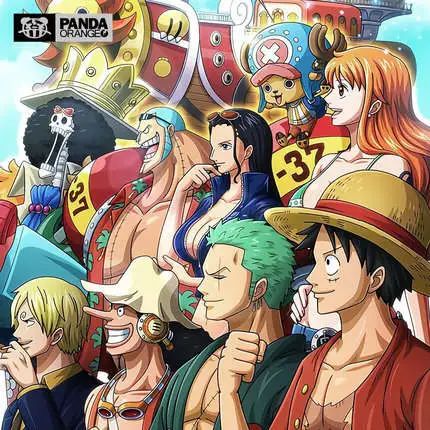
image description
The straw hat gang in the anime "One Piece" has 9 members
Imagine the ideal size for a brainstorm, or a meeting where everyone can speak freely. If the scale is too small, the potential energy is insufficient, and if the scale is too large, it is easy to divide into multiple groups, or evolve into a one-to-many communication pattern. A scale of more than 12 people means more than one Team Leader's management range, which may require hierarchical management. For a team in DAO, more than 12 people may lead to the failure of the Coordinape-style mutual evaluation system.
Within the team, there is a smooth communication environment, a naturally formed team norm, and a clear collective memory. The team members fully understand each other, and even have a tacit understanding that does not need to communicate. The collaboration within the team is not loose, but tight. A larger organizational network may surround a squad, making its borders blurred and appear larger, but for the core squad there is always an invisible circle that divides the line of intimacy and intimacy.
Pod endows a team with appropriate financial resources and a certain degree of independence, which will further stimulate the creativity and execution of the team. The team will not need to go through layers of approval to apply for resources, so as to find more "entrepreneurship". The team can take care of everyone in the team, so individuals in the team will also feel a greater degree of respect, freedom and sense of belonging, and better invest in value creation.
first level title
Catalytic DAO 2 DAO Collaboration
first level title
summary:
summary:
Above, we have insight into the unique concept of Pod from multiple angles:
From a technical point of view, a Pod is nothing more than a multi-signature wallet, which can belong to a DAO or another Pod, or exist independently. A Pod can be upgraded to a DAO by creating a governance layer;
From an organizational perspective, a Pod is an organizational unit, and a Pod at the grassroots level is often a closely coordinated team in which individuals can give full play to their talents;
From a financial point of view, Pod is a group of packaged assets that can be used for exchange, transfer and mortgage. Packaging assets into Pod simplifies the transaction process of multiple assets and saves Gas costs;
From a business perspective, Pod is a project or business unit under DAO, which may be temporary or long-term.
At the same time, we have seen that the essence of the DAO-Pod relationship is "constrained delegation", and we have seen the infinite extension and natural flow characteristics of the DAO-Pod structure. We found that the DAO-Pod structure not only achieves great scalability for DAO, but also makes DAO truly an evolutionary organization. We believe that the DAO-Pod structure will become a new paradigm of DAO, and the multi-layer, fractal, and rheological structure composed of DAO and Pod will be the future of DAO.
References:
[1] Pods: The DAOnfall of Token Voting
[2] How ENS DAO Brought Working Groups On-Chain
[3] Charting the Path to Unaccredited DAOs with Minion
[4] Squad Wealth


