






Proof of Utility: a solution to quantify NFT rights and interests through the SBT technical framework


Author: Brother Xiaomao, N_0, published by Odaily with authorization
articlearticleput forward the theory of Soulbound Token (SBT) "soul-bound tokens", and mentioned that NFT with social value can try to try soul-bound tokens. The Orange Book is also"Why Soulbound Tokens Are a Good Idea"The article explains this concept in detail and puts forward the idea of "humanity currency" that puts social behavior on the chain. The topic of how to define NFT empowerment has been discussed in this field for a long time, and the NFT community has had some controversial discussions for a long time:
- There is currently no technical standard and on-chain framework for NFT empowerment, and it is not easy to quantify on the blockchain;
- NFT owners cannot choose the utility they want, but passively wait for the airdrop;
- At present, there is no on-chain technical framework for NFT project parties and users to jointly decide and maintain rewards based on on-chain behavior;
secondary title
Not only the NFT itself, can the rights and interests of NFT be bound by the soul?
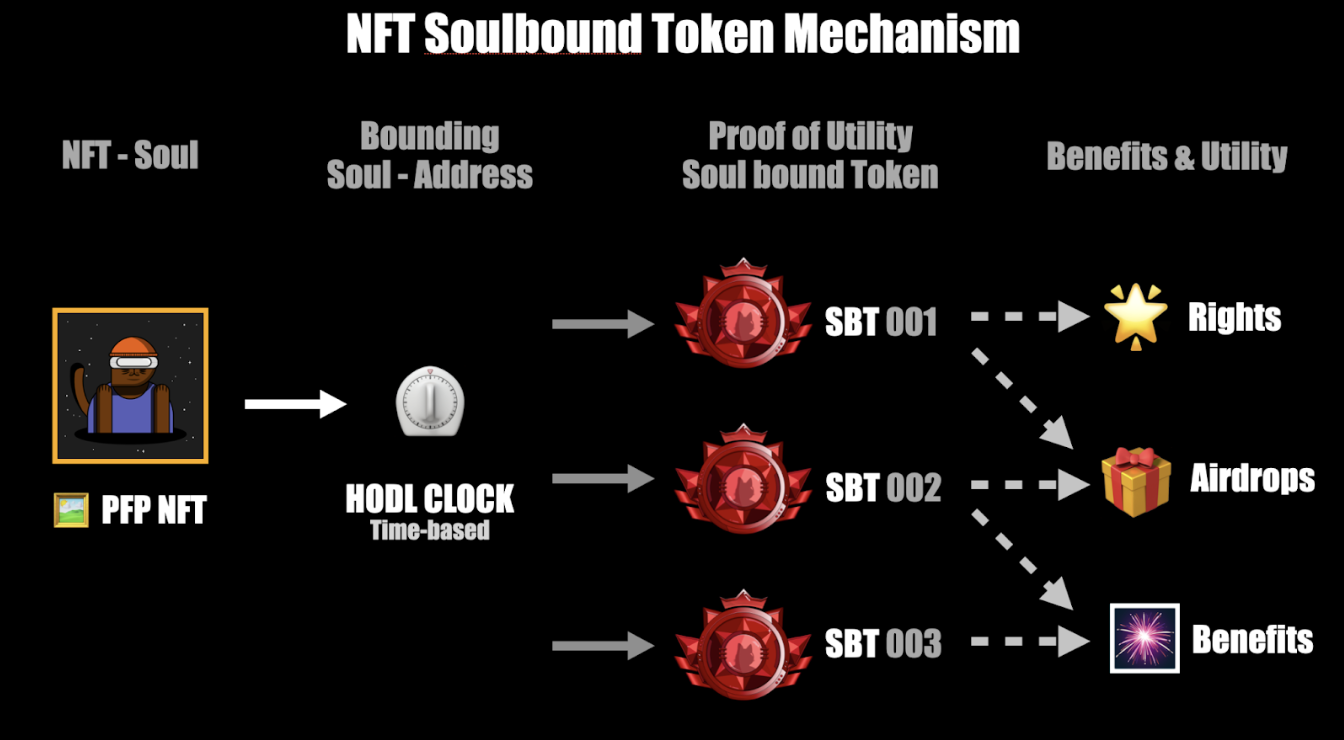
NFT matches the soul of the holder and the behavior on the chain
- The behavior of the holder (hodl or buying and selling) determines how many soul-bound tokens (SBT) can be obtained
NFT Soulbound Token - the rights and interests of the holders of the benchmark
- Soulbound Token (SBT) generated by the soul can be used to unlock the rewards and benefits of the project
One of the clear purposes of this mechanism: NFT holders can actively choose and unlock which benefits to obtain from the project, instead of passively receiving unknown airdrops every time they need to check their wallets.
secondary title
What are NFT soul-bound tokens?
articlearticleExplain the setting of soul-bound tokens: "Soul Bounding Token (soul-bound token), referred to as SBT, SBT is a token that cannot be transferred, just like there is a particularly powerful item in the game. It is bound to your account and cannot be transferred to other accounts. The other is Soul, which is the wallet account holding SBT, and the account holder can be an organization or an individual.”
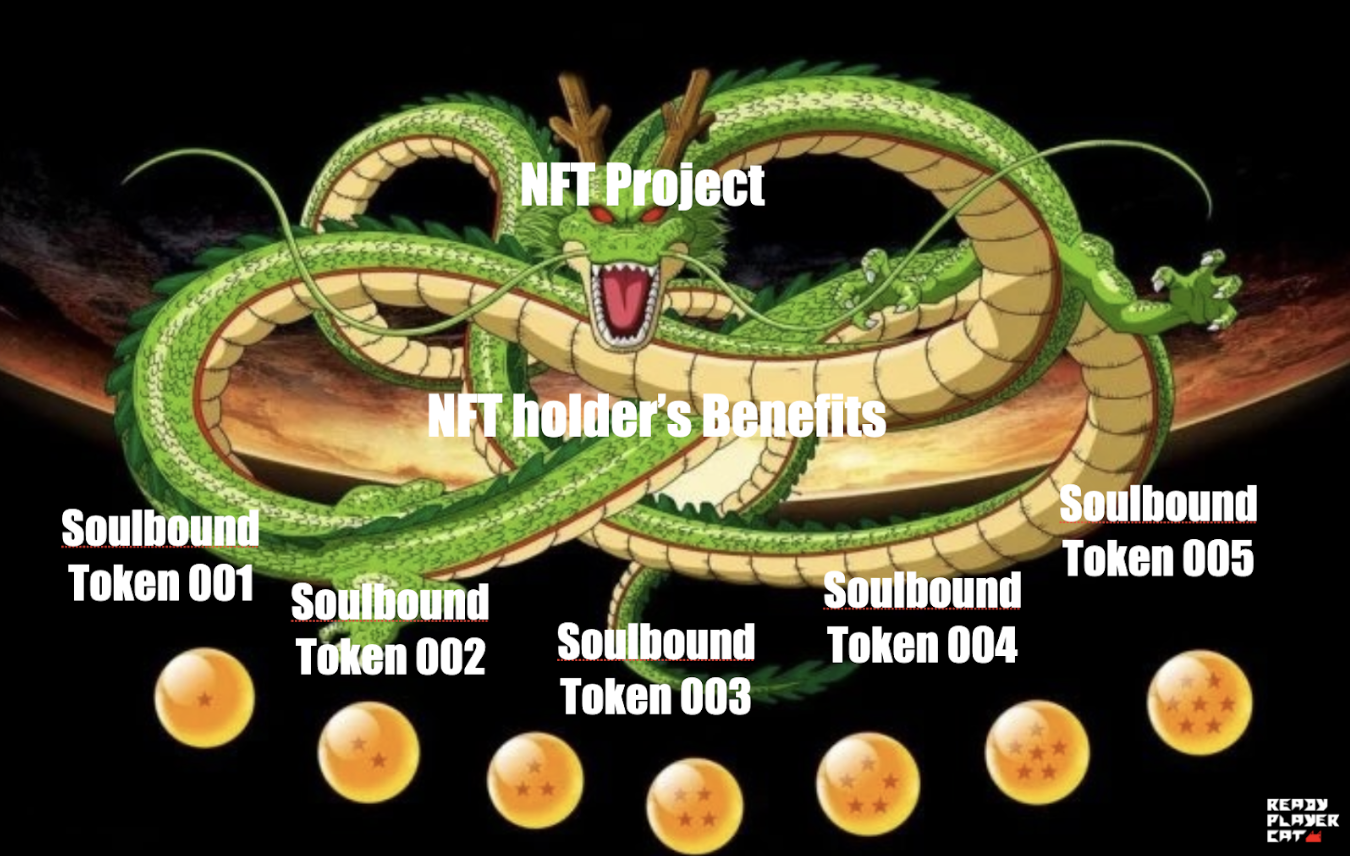
The NFT empowerment envisioned in this article proves the SBT technical framework. You can more vividly understand that SBT is the wish for the dragon in the anime "Dragon Ball". Each "Dragon Ball" represents an SBT token, and will consume a "wish" . The difference is that these "wishes" are the rights and interests that different NFT projects will deliver based on their own resources and roadmaps, and have the following characteristics:
- Non-transferable, bound to address
- The total amount is limited, and the project can be issued additionally
- Can be used to unlock or redeem the income delivered by NFT projects on the chain
- Combined with the on-chain behavior of the NFT owner (including factors such as holding time) to determine the SBT tokens obtained
secondary title
Combined with the technical framework of SBT: a long-term reward mechanism based on on-chain behavior
Since the NFT field is still in its early stages, with the continuous development of the NFT market, early rights and "playing methods" may no longer be popular. In order not to be eliminated by the times, the NFT project team must always find new ways to play NFT.
So, is it possible to develop a long-term technical framework for NFT projects that can adapt to different gameplays? Let's imagine, for example, that NFT project A introduces new gameplay and encoded new resources in its smart contract, we can use the following mechanism template to call the holder's behavior, and formulate and realize all possible future rewards.
(New gameplay) Name of game: Compete for HODL reward
(Participating players) Game members: NFT tokens
(Player's resources) Resources: Clock associated to each NFT token
(On-chain behavior of players) Action space:
Action leads to the modification of resources.
Reward is calculated based on resources that each member holds.
We implement the resource modification function in the smart contract:
token_id.mint ⇒ token_id.clock :=0
token_id.transferByOwner ⇒ token_id.clock += time
token_id.transferByBroker ⇒ token_id.clock :=0
Afterwards, we tune the reward function based on resources:
reward = match token_id.clock with
0 ⇒ “Not royal”
[1..a] ⇒ “Bronze”
[a+1..b] ⇒ “Silver”
others ⇒ “Gold”
end
If the NFT project follows this technical framework, adding a gameplay requires implementing rewards, similar to filling out a new form:
Name of game: #a string describe the rule
Game members: #a set of identities
Resources : #a set of variables stored in the smart contract
Action space: #a set of functions defined in the smart contract
Reward space: #a set of utilities guaranteed to game members
Reward function:
Resource mapping:
f: #Action space ⇒ #Resources
Parameterized reward mapping:
g: #parameter_list * #Resources ⇒ #Reward space
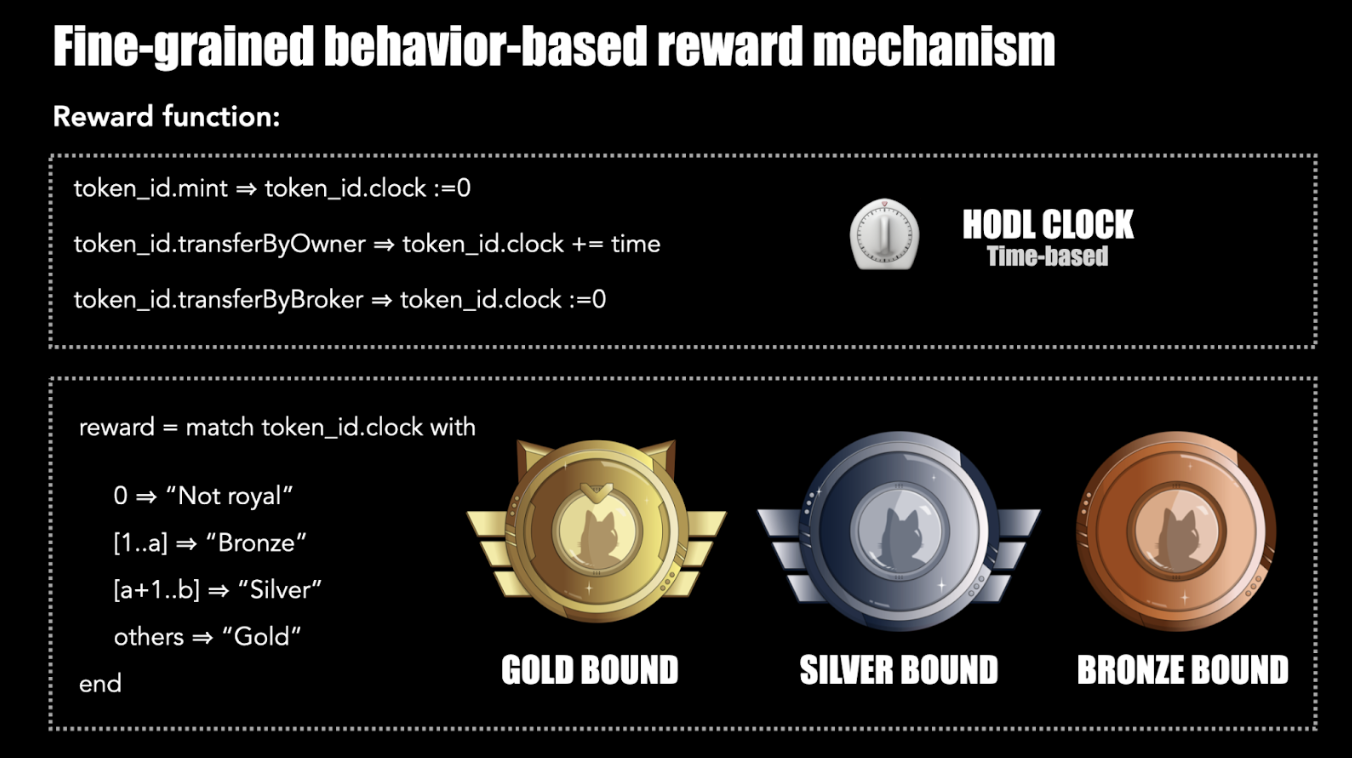
Unlike most of the existing roadmaps and Moonbird's Nesting system, this soul-bound token is nested with the Hodl Clock and the utility function of the technical framework, which has greater freedom.
At the same time, the reward parameters under the SBT technical framework are adjustable. Existing rights and interests can be realized first, and uncertain rights and interests in the future can be bypassed and adjusted in the future. Situations where the rights and interests of the user result in devaluation of the experience. In short, this system is essentially a non-transferable on-chain certificate SBT given to NFT users by the NFT project party, aiming to achieve a fairer on-chain economic reward system, and contains some new innovative ideas that the NFT field wants to achieve:
- Not only the NFT itself, but the way users use the NFT is also recorded on the chain as part of the value of the NFT.
- Develop an on-chain framework between the NFT project party and users on the chain, such as uploading the behavior of NFT users on the chain, calling it as a contract code, and the final result is jointly fed back by the NFT user and the project party.
MaoDAO M³Labs tried to develop the above technology to empower Ready Player Cat holders, and began to try to develop this mechanism into a one-click integrated Protocol for use by more NFT project parties.
Taking Ready Player Cat as an example, we further understand the implementation effect of this SBT technical framework:
Step 1: The user can choose to add the HODL CLOCK clock to the kitten (the timing will be canceled once the trading behavior is carried out in the trading market).
Step 2: After meeting the timing, you will get the corresponding Soulbound Token to freely choose different rights and interests. These rights are closely related to the new projects that MaoDAO M³ Labs is incubating, including the new NFT collection Ready Player Soul, NFT lottery infrastructure toolsNFT LuckboxAnd the Twitter NFT record tracking plug-in BlockTracker, which is still in testing.
secondary title
Reference
Soulbound https://vitalik.ca/general/2022/01/26/soulbound.htmlDecentralized Society:
Finding Web3's Soulhttps://papers.ssrn.com/sol3/papers.cfm?abstract_id=4105763
Why "Soul-Bound Tokens" Are a Good Idea | Weekly Prophet Newspaperhttps://orangexyz.mirror.xyz/dMr6F43Aiz79vuZgO0-d392BgG8elD86osAZ_xhsCRc





