






Detailed explanation of EVM equivalence: promoting the development of L2 open source ecology


Author: David Hoffman
first level title
table of contents and abstract
Understanding EVM equivalence
➤ There is a difference between scaling on Ethereum and scaling Ethereum itself.
➤ The EVM is an emerging construct formed by contributions from thousands of developers.
And forking the EVM limits the ability to access those contributions.
➤ If you want to go fast, go alone; if you want to go far, join the EVM equivalent ecosystem together.
Ecological replication and emergence
Replication and emergenceis a necessary property of a self-reproducing system that wants to cover the globe.
Copy application layer
EVM equivalence allows developers to copy + paste DeFi code between all EVM equivalent rollups. Any valuable new content discovered in one rollup can be immediately replicated in other rollups.
replication protocol layer
EVM equivalence allows an EIP upgrade to be implemented on a separate rollup before being deployed to Ethereum L1. This provides a production testbed for experimental EIPs to be safely implemented on L1.
"Fear Void"
➤ Nature abhors white space. And the crypto world is like nature; it slowly fills in every gap it finds.
➤ The "last mile" problem of encrypted networks, and how we can solve it.
➤ EIP is the new gene. EVM equivalence enables L2 to asynchronously and independently integrate the EIP of its choice. Each L2 will adopt the EIP recommended by its community.
➤ Ethereum will adapt to signals from L2 users; each L2 represents a user's preferred data antenna. The signal sent to Ethereum is:
This is the EIP the community wants
This EIP is safe to deploy
extended public goods
➤ Optimism's retroactive public goods fundraising is a novel social incentive mechanism designed to infuse Silicon Valley-style financial incentives into projects building public goods for L2.
➤ Fund L2 public goods by selling L2 block space for economic benefits
➤ Due to EVM equivalence, public goods research and development on Optimism can be replicated and propagated across the ecosystem
Pushing the organism forward
first level title
Understanding EVM equivalence
EVM equivalence: completely consistent with the specification of Ethereum Virtual Machine (EVM, Ethereum Virtual Machine)
The design philosophy of EVM equivalence is to create an"minimum difference"The optimistic rollup.
EVM equivalence extends the properties of Ethereum into L2,blurred"and"and"EVM-equivalent L2 Debut performance "The line between.
This is the difference between scaling on Ethereum and scaling Ethereum itself.
The optimistic rollup that perfectly clones Ethereum's EVM not only inherits the security of Ethereum;Aspects of its network effects are also shared.
Other L2 design structures do not have all the privileged access to Ethereum network effects and will always be more specialized than other competitors with EVM equivalents.
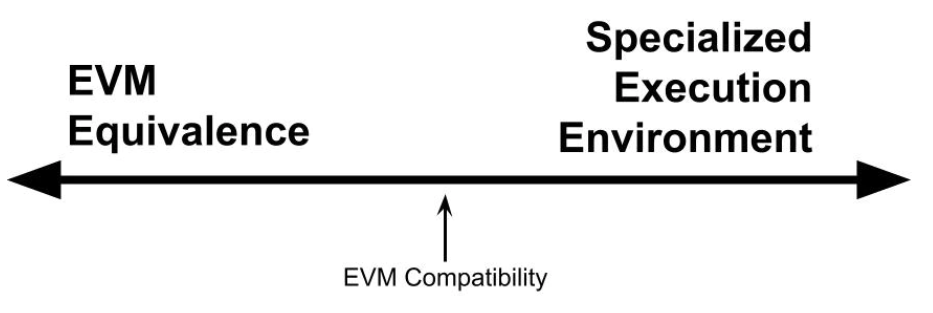
EVM compatibility is dead.VersatilityVersatility(so choose the same criteria as everyone else); or build something completely different, highly optimized for your use case (see ZK-rollups).
In order to fully extend the power of Ethereum into L2, we cannot stop at EVM compatibility.
secondary title
Compatibility and Equivalence
The Optimism team introduced EVM equivalence last year and discussed the technical difference between equivalence and compatibility.
Rollup has been hailed as our scaling savior: "Finally, there is an L2 that can run Uniswap!"
The earliest rollups did this by completely recreating Uniswap, using custom code on custom built rollups.
This is not enough.
The network effects of the EVM go far beyond Solidity itself. A plethora of supporting tools give Ethereum developers superpowers. Because these tools also run on top of the EVM standard,So they are not suitable for custom built rollups.Not to mention the effort required by protocol developers to create something Solidity compatible!
secondary title
EVM is a city
David Mihal (who helped me understand this) gave me this analogy:
"Open source code is like a city. It is created spontaneously from the bottom up by many developers who discover problems and build solutions. Over time, the city gradually optimizes, becomes more robust and efficient.. .
...EVM-compatible chains are like Paris in Las Vegas; they try to artificially replicate something organic. "
Open source software is a public good, maintained and updated by the respective community.
Developers using open source software encounter all kinds of problems; some minor, some critical, and some in between. Some developers took the time to fix these issues, and then lobbied the community for their input. If the community recognizes the value of these things, their contributions will be merged to form a new version. As a result, new standards are created and the utility and robustness of the software are increased.
Like a new city, builders come and produce what the surrounding community needs and values. Shared resources and utilities emerge from this, and since this is formed through code, they never rot. It's a one-way street of incremental value; as long as everyone builds on the same foundation.
secondary title
Geth
Here's Geth's story.
Geth has slowly absorbed meaningful contributions from Ethereum developers over the past few years, and developed a set of software with the most network effects, both inside and outside of Ethereum.
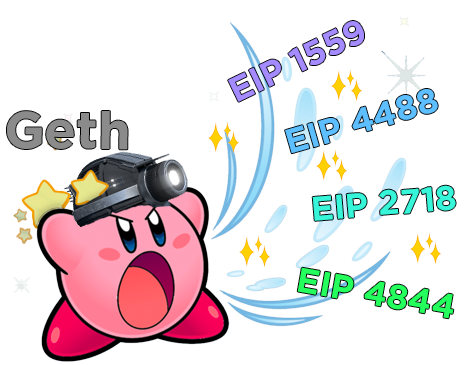
This is why Geth has become a reference point for a large part of the industry. Those who fork Geth and create their own blockchain are still contributing to the same foundation upon which Ethereum rests.
secondary title
EVM fleet (peloton)
Peloton refers to a group or group of road bike riders. Riders in a herd save their energy by following other riders. In this mode, the resistance is significantly reduced; riding in the middle of a growing group, the resistance can be reduced to 5%-10%. Taking advantage of this potential energy-saving approach, there will be a very complex cooperative and competitive interaction between riders and teams in race tactics.
If you want to go fast, go alone; if you want to go far, go together.
The larger the fleet, the higher the efficiency and the faster the speed. Air resistance is distributed over a wider group; as the group size increases, so does the efficiency of the group. In the middle of a car group, the rider basically does not waste energy, because you can use the strength of the entire team to move forward. And the leader of the car group needs to bear all the headwind resistance, and must expend extra power to set the speed of the team, so the leader often has to ride hard.
But when the team leader is tired and the rhythm slows down, there will be many contributors in the team to replace the team leader.
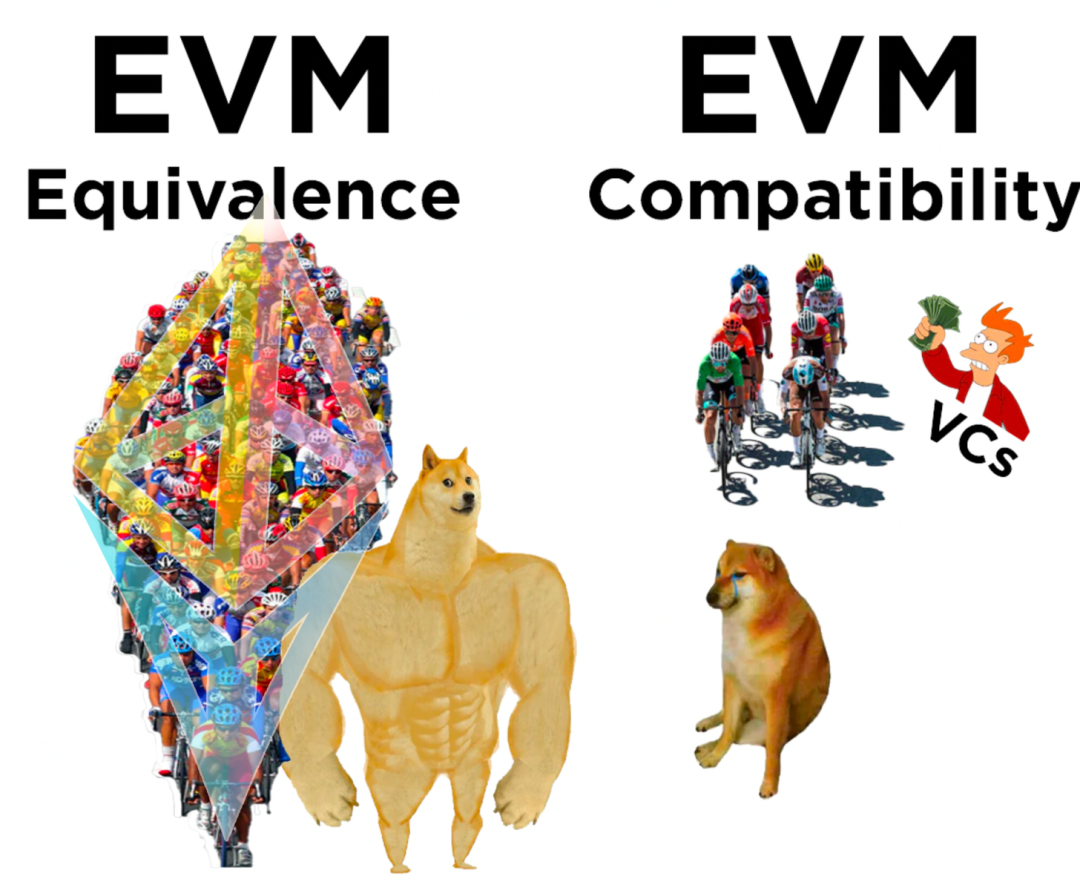
Open source communities will always grow faster than centralized teams. The reason this industry is growing so quickly is because it is like acollaborative flywheel. We build on each other's success, and when one of us keeps going, it carries us all forward - just like these caterpillars.
EVM equivalence is a bottom-up public good that emerges as naturally as a city. EVM compatibility, on the other hand, is a one-time copy of it.
There are countless directions to deviate from the EVM,secondary title。
Copy application layer
Creating an L2 ecosystem with EVM equivalence is critical to maintaining composable and interoperable network effects.
A rollup with EVM equivalence allows developers to instantly copy-paste codebases across chains. This means that development and innovation on a single EVM-equivalent rollup can be seamlessly migrated to any other EVM-equivalent optimistic rollup, as well as Ethereum itself. Since everything is developed on top of EVM standards, L1 network effects are extended into L2, and innovations on L2 reverberate throughout the ecosystem.
When a line of code is deployed on an ORU, it means more than deploying the line of code itself.If you are an open source developer and want your code to be widely used, you will naturally want to use an EVM-equivalent ORU so that your code is immediately compatible with all other EVM-equivalent ORUs.
If you write code once but it works seamlessly across 1000's of EVM compliant chains, the value of the code you create is far greater.
EVM equivalence takes the network effect of EVM to a whole new level.
Non-EVM-equivalent ORUs will not benefit from these shared network effects. Due to the lack of a design philosophy of "minimum differentiation" in non-EVM-equivalent ORUs, the link between the Ethereum network, EVM-equivalent ORUs, and non-EVM-equivalent L2 will be broken.
secondary title
replication protocol layer
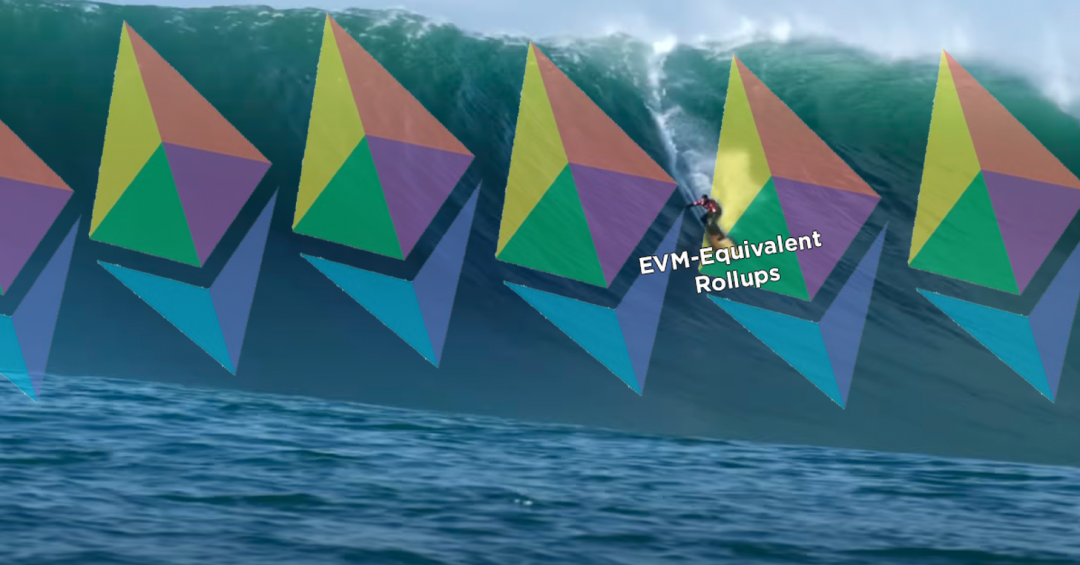
These EVM network effects apply not only to Ethereum’s application layer, but also to the protocol layer itself — which makes things a lot more interesting.
Because EVM-equivalent ORUs have "minimal divergence" from Ethereum, they thus provide a test bed for Ethereum (new EIPs can be tested in a real production environment).
Currently, EIP is being tested on the Ethereum testnet. EIP will be tested multiple times on the test network to ensure that there will be no glitches when it is finally integrated into Ethereum L1.
Doing so is always risky because there is no "minimum difference" between the testnet and Ethereum. There is a difference between implementing an EIP in Goerli or Koven and implementing an EIP in Ethereum. The difference lies in the scale, importance and nature of economic activity on top of Ethereum, which testnets cannot emulate. When implementing new EIPs on Ethereum, there will always be some "unknowns".
EVM equivalence provides a solution.
If an EIP is successfully implemented in an EVM-equivalent ORU, it provides a strong guarantee to the underlying chain that the same EIP can be successfully integrated into it without any vulnerabilities. The EVM-equivalent ORU provides a real production environment for EIP to test, which generates real economic activity and has real capital risk. EIP can be tested at the ORU level without risk of damaging or affecting this system.
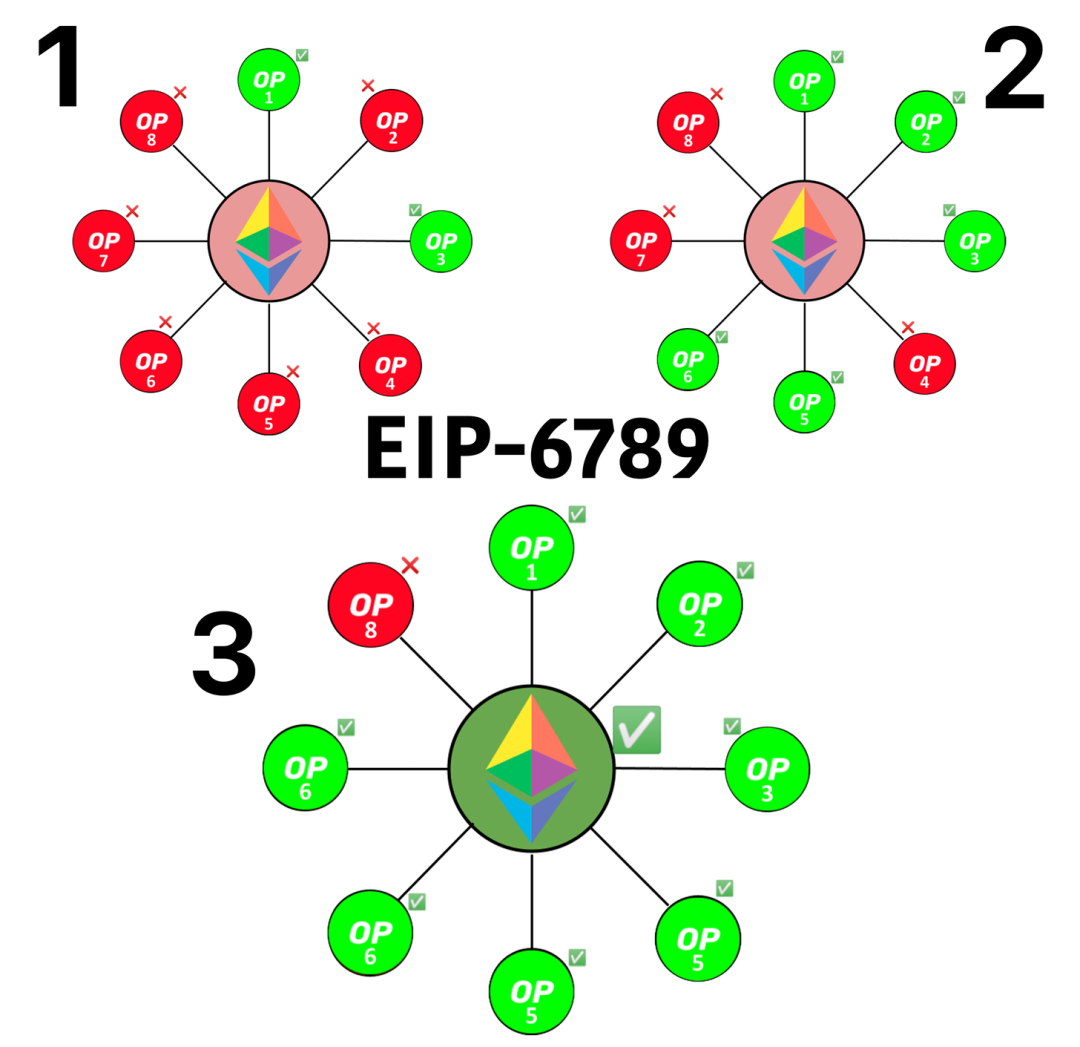
When L2 generally adopts the same EIP, this signals to Ethereum L1 that the community approves of this EIP and that this EIP can be safely integrated into L1.
The EVM-equivalent ORU enables Ethereum to sense the desires of L2 participants, making each L2 an antenna in tune with the needs and desires of users. The "command & control" governance approach of traditional finance (TradFi) and Web2 is transformed into a "sense & respond" paradigm in Web3.
Because each ORU is its own independent economy, it will implement various EIPs independently and asynchronously according to the needs and desires of users, independent of the rest of the ecosystem.
Over time, when more and more independent ORUs recognize the value of the same EIP, the best EIP will dominate the L2 ORU market. If an EIP starts to dominate the entire ORU ecosystem, this will signal to Ethereum L1 that this is a good EIP and that it is safe to implement it at the L1 protocol layer.
secondary title
Summarizing EVM equivalence
Implications of EVM equivalence: Ethereum is freed from the shackles of L1. The characteristics of "Ethereum" can be extended to L2. The dividing line between Ethereum L1 and the EVM-equivalent L2 has become very blurred. There is no longer such a demarcation point: it means that Ethereum L1 is out of the stage of history, and the EVM-equivalent L2 enters the show.
first level title
fear blank
"Nature abhors blank spaces" - Aristotle
image description

secondary title
last mile problem
The last mile refers to the final step of the journey that moves goods and people from a transportation hub to their final destination. The "last mile" problem describes the difficulty of this step. Some of the challenges in "last mile" delivery include minimizing costs, ensuring transparency, improving efficiency and improving infrastructure.
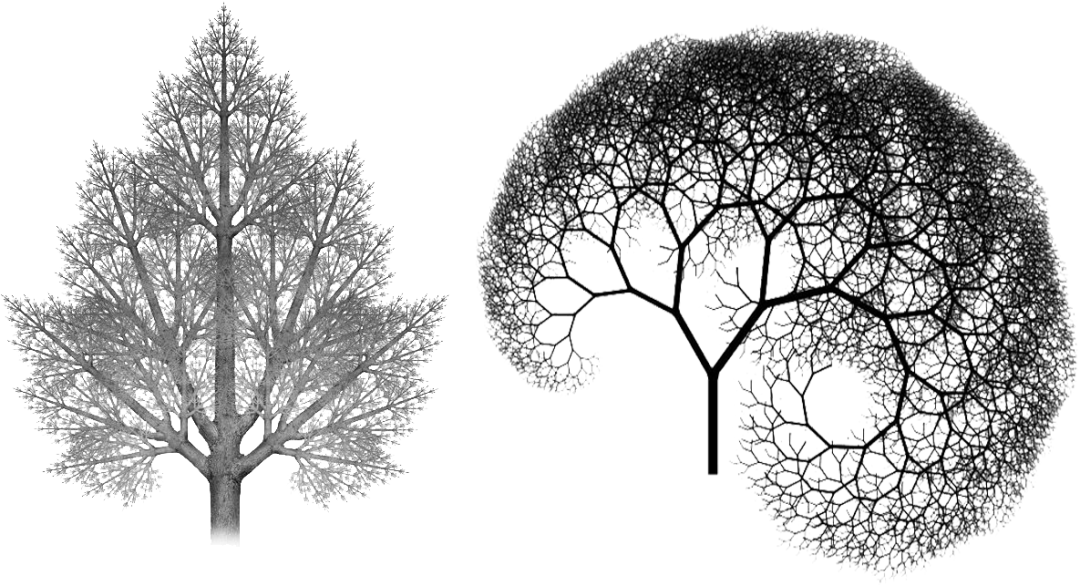
Nature is really good at solving last mile problems. This is a natural consequence of "survival of the fittest"; that is, the organisms best able to reproduce and reproduce will fill the gaps in their living spaces.
Even within a single organism, fractal structures are fundamental patterns for scaling up an organism and increasing its efficiency. The lungs are responsible for capturing oxygen and distributing it to the blood; the circulatory system is responsible for delivering oxygen and other nutrients to the very ends of the organism.
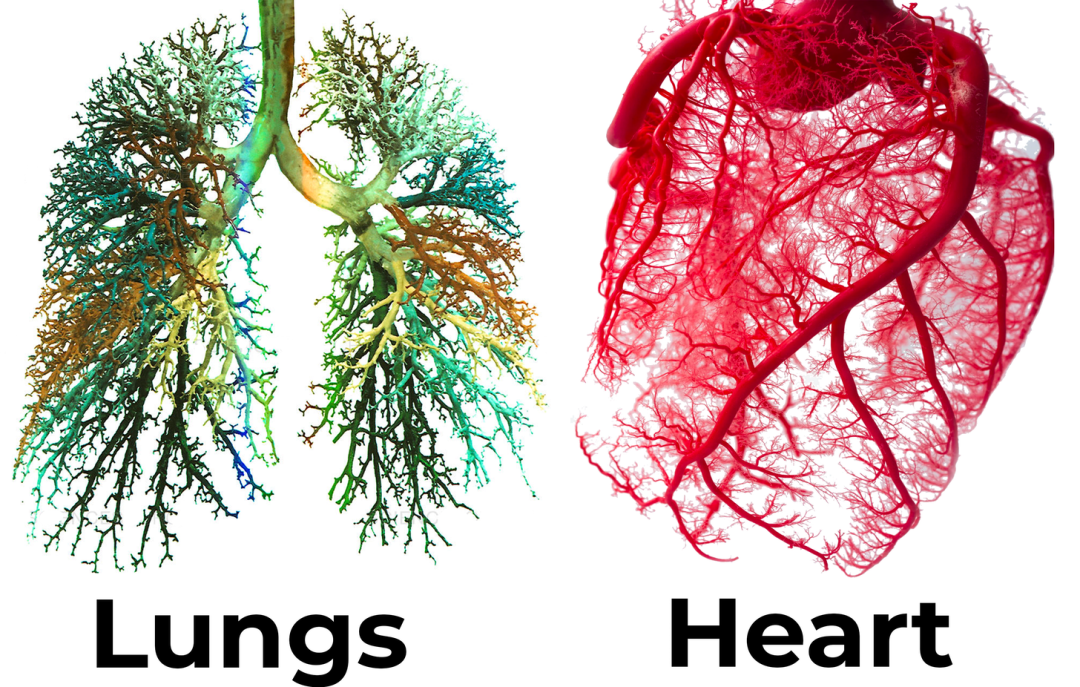
A fractal is a structure in which each substructure has the same properties as the overall structure. A fractal structure can be thought of as a never-ending pattern, and replicability and reproduction are both components of fractals.
Only replicable and reproducible structures can effectively fill the gaps in nature. The encrypted world is a world with a lot of white space;There is still a lot to build on.But to fill all these gaps with new structures, we need systems that can replicate and reproduce.
EVM equivalence builds the foundation needed to generate these features.
In a rollup ecosystem with EVM equivalence, Ethereum can replicate and multiply quickly, focus on user needs, and update code to reflect those needs.
Each L2 can develop in its own unique direction and specialize in whatever it wants. Those successful L2s with lots of users and value will signal to other L2s that it has found something of value. We all know that the crypto industry is really booming, and once something proves useful, it is copied and multiplied.
2013-15 PoW fair release, 2020 DeFi summer liquidity mining and replication frenzy, 2021 L1 Geth fork.
Read more: On Coordination vs Defense
secondary title
EIP is the new gene
Richard Dawkins' book The Selfish Gene discusses how each gene in an organism becomes the smallest unit of life, whose inherent egoism in maintaining and replicating itself provides the basic model on which all life depends.
Good genes survive, bad genes die.
As an organism evolves and adapts, the genes that make it healthy spread across all species through replication and reproduction over time. Beneficial random mutations that occur in an individual organism help it survive and thrive better than other organisms, so the gene goes from being present in only one instance to being present in all possible instances because it is a good gene.
In the modular Ethereum world,EIP is the new gene.
Good EIPs spread in the ecosystem, and bad EIPs gradually die out.
Ethereum is a responsive, adaptive system, and the EVM-equivalent ORU allows new genes to be implemented into organisms at the fringes first, and when the new EIP proves its viability, this EIP is propagated to the remaining in the ORU. If this EIP is good enough, it goes back to the center of Ethereum: L1.
Ethereum becomes an organism capable of responding and adapting to its environment, even as its environment changes over time. Biological organisms have fixed genes since their origin, and Ethereum has the ability to invent and integrate new genes as needed to meet the ever-changing needs of the world.
secondary title
Retroactive Public Goods: Building Infrastructure for Entire Ecosystems
Retroactive Public Goods Funding (RPGF) will transform Ethereum from a system that responds to user needs to one thatproactive system。
Optimism is pioneering a new model of public goods financing, injecting Silicon Valley-style financial incentives into projects that build public goods.
A product that has the potential of a tech startup, but exists as a public good.
Proceeds from L2 blockspace fees flow directly to innovators and founders who create valuable content for Optimism L2. The RPGF promises a grant of funding in the future, assuring public goods builders that if they build valuable public goods, there will be funding waiting for them.
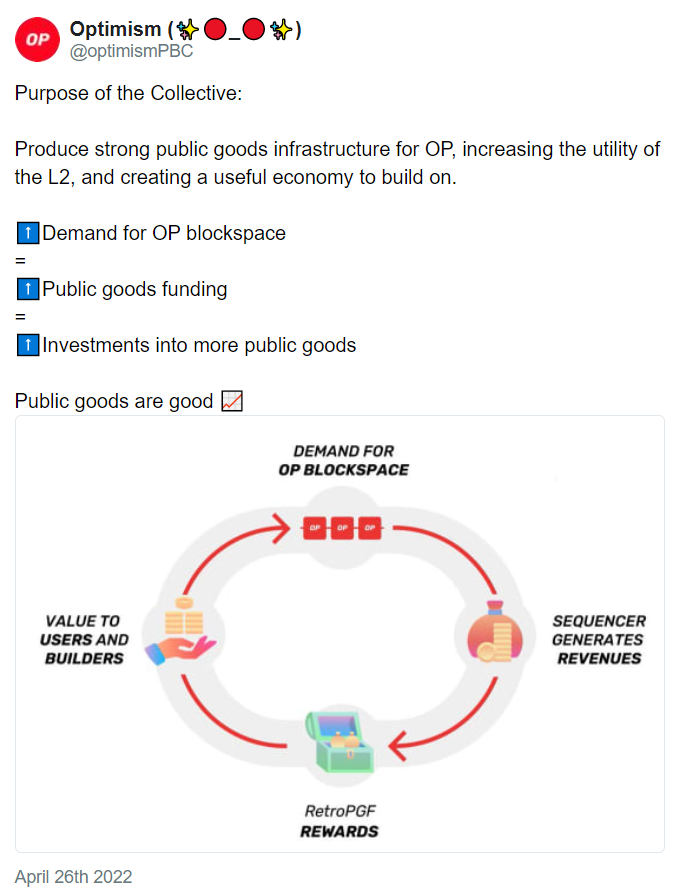
Web2 incentivizes builders and users, whereas Web3 empowers everyone - where impact = revenue.
The combination of RPGF and EVM equivalence means that when Optimism L2 builds something of value, it is immediately available to the entire ecosystem of EVM equivalence.
image description
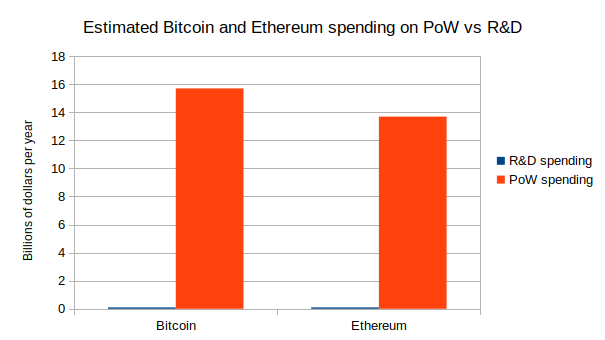
Source: Vitalik
For the first time, the dual effort of RPGF and EVM equivalence provides us with a promising path to solving the tragedy of the commons. Not just for Optimism, L2 ecology, not only for Ethereum, but for the whole blue Odaily.
Step 1: Fundraising for Optimism’s Public Goods
Step 2: Extend these public goods (for free!) to other L2
Step 3: Integrate these public goods on Ethereum
Step 4: Expand the scope of public goods from Ethereum to the world
Step Five: Solving the Global Collaboration Dilemma to Unlock the Future of Star Trek
Original link


