






Comprehensive interpretation of "Ethereum Foundation 2021 Financial Report"


This article comes fromEthereum Foundation, Odaily translator | Moni
, Odaily translator | Moni
Recently, the Ethereum Foundation announced its financial and operational report for the first quarter of 2022. Mr. Odaily (ID: o-daily) summarized the full text as follows:
secondary title
What is the Ethereum Foundation?
The Ethereum Foundation (EF for short) is a non-profit organization that supports the Ethereum ecosystem and is part of a larger community of organizations, individuals, and companies. These organizations, individuals, and companies fund the development of the protocol, working together to grow the community and Ethereum.
In fact, it is difficult to attribute the Ethereum Foundation to a certain type of organization. They are neither technology companies nor "normal" non-profit organizations. Just as new concepts and technologies emerge on Ethereum, the Ethereum Foundation is a new type of organization that supports the long-term development of Ethereum without controlling it.
Overall, the Ethereum Foundation is more of a team community than a traditional organization.
All teams in the Ethereum Foundation community are passionate and committed to a common vision - to participate in Ethereum and make a positive contribution to humanity. Of course, many teams within the Ethereum Foundation can exist independently of each other, with their own processes, goals, budgets, and products. Therefore, such a team community with highly consistent goals and division of labor and cooperation constitutes the current Ethereum Foundation:
1. Some teams are dedicated to the development and maintenance of important parts of the Ethereum technology stack.
3. Some teams are responsible for focusing on the ecosystem itself, going deep into the system, and looking for new challenges and opportunities.
4. There are also teams that focus on the internals of the system to ensure that the resources of the Ethereum Foundation are allocated reasonably, problems are solved correctly, and teams in the community receive the support they need to achieve their goals.
secondary title
What is the philosophy of the Ethereum Foundation?
Since the establishment of the Ethereum Foundation, some key concepts and principles have become the basic guidelines for the decision-making and actions of the Foundation. These core principles guide the decision-making of the Ethereum Foundation's leadership and have an important impact on the entire team.
1. Long-term consideration
The impact of the Ethereum Foundation community on the entire society may be related to the next few decades or even hundreds of years. The continuation of this influence cannot be measured by quarters or fiscal years. Frankly speaking, the life cycle of the Ethereum protocol as a coordination protocol will extend into the future.
This also means that the planning of the Ethereum Foundation will be long-term, not only paying attention to the interests of the current society, but also caring about the future. This is like a gardener, sowing the seeds of hope for future generations.
2. We are all proud
The purpose of the Ethereum Foundation is to resist centralization of power, decentralize opportunity to the community, and push resources to all teams across the ecosystem. The Foundation will be proud that more teams are creating value, because it means that Ethereum is becoming more decentralized and moving towards sustainability.
If the principle of "all prosperity" is not followed, then with the widespread application of Ethereum around the world, the Ethereum Foundation is likely to monopolize all the reputation and influence, but the Ethereum ecosystem should not only be an organization of the Ethereum Foundation .
Based on this idea, the Ethereum Foundation is cooperating with the community as much as possible. When encountering problems, try to consider from the perspective of the entire community and provide as much help as possible, instead of just thinking about yourself.
3. Concept management
The Ethereum community is a community with a soul, and many of its advanced concepts have made Ethereum what it is today. These concepts include open source, decentralization, open access, privacy protection, and more. Of course, the Ethereum Foundation cannot decide the concept of the Ethereum community, they are more concerned about how to cultivate those important teams.
If the Ethereum Foundation is likened to gardeners, then their job is to cultivate the "natural ecosystem" of Ethereum. Like a gardener, the foundation's role is only to cultivate and support, rather than to control or force the development of nature, they will carefully care for the seedlings under their feet.
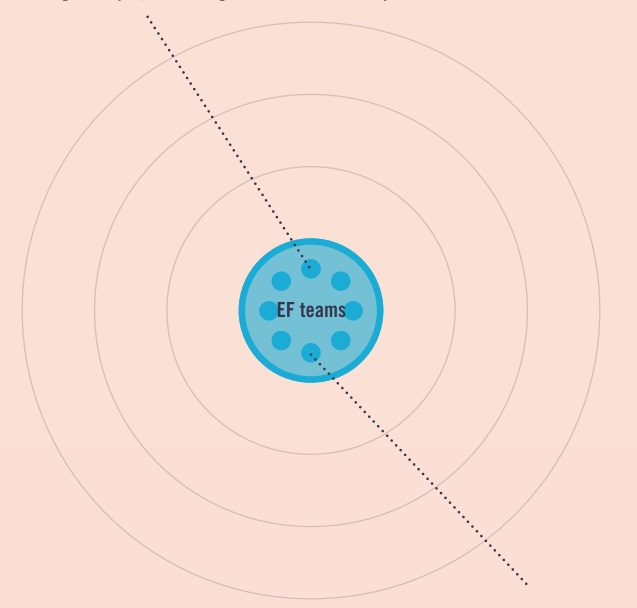
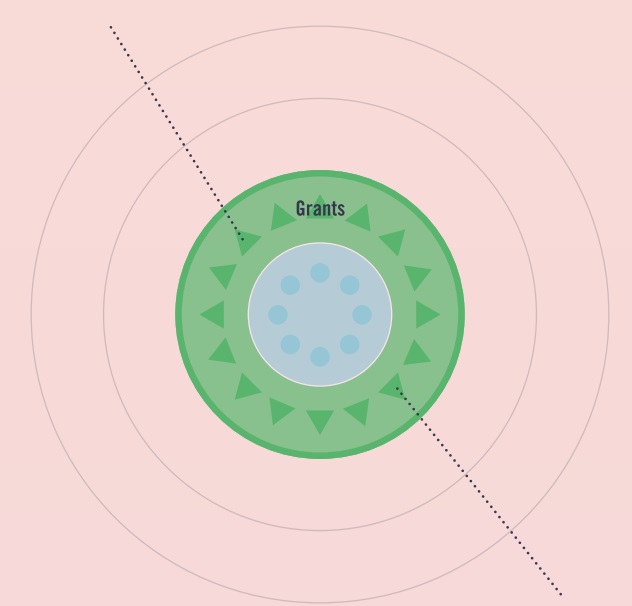
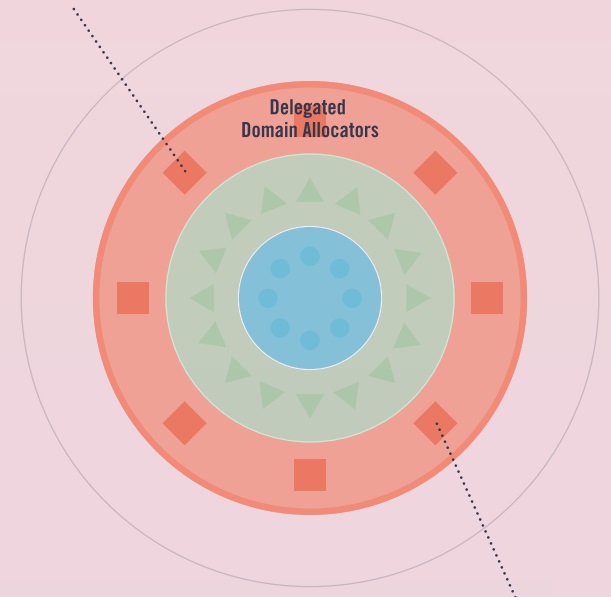
Over the years, the Ethereum Foundation has tried a number of different approaches to supporting the Ethereum ecosystem, and has evolved to a "layered" model in which many different groups can participate in decisions about allocating resources .
The first layer is the Ethereum Foundation team — teams that directly contribute to the ecosystem; the second layer is called “Grants,” which is where teams are funded outside of the Ethereum Foundation; the third layer is called Known as "Delegated Domain Allocators", the Ethereum Foundation works with external groups to jointly decide which teams within a certain scope will provide funds. allocate funds.
secondary title
First layer: Ethereum Foundation team
The Ethereum Foundation is a team-based community. These teams have made their respective contributions to the development of the entire ecosystem. These dazzling star teams include Geth, Solidity, Devcon, etc.
Not only that, but the teams within the community are very diverse in terms of what and how they do their work. Some teams are very independent and like to operate as a unique team; some teams prefer to integrate into the community and work closely with other different Ethereum Foundation teams. Some teams like to be the center of attention of the community; while others prefer to keep a low profile.
1、Devcon
Regardless, the Ethereum Foundation is inclusive, providing funding, operations, and room for growth for a wide variety of teams. Not only that, the Ethereum Foundation sometimes makes dynamic adjustments according to the new needs of the ecosystem, such as creating new teams or reducing support for certain teams.
2、Geth
The Devcon team aims to support the Ethereum ecosystem by hosting various events, including hosting Devcon, the Ethereum developer conference, and launching new initiatives like Devconnect. In addition, the team also supports the activities of the Ethereum community all the year round, and strives to develop the Ethereum community around various activities.
The Geth team is responsible for the development and maintenance of go ethereum (Geth). Users can access the Ethereum blockchain through the geth client and related libraries. Currently, Geth is the most popular Ethereum client and an integral part of the Ethereum ecosystem.
secondary title
The second layer: Grants
In 2021, the Ethereum Foundation will provide a total of 19.6 million yuan in financial sponsorship to teams in the ecosystem. The entire sponsorship process is carried out through an open sponsorship process called the Ecosystem Support Program (ESP). The specific process is: the ESP team receives applications, processes applications, solicits feedback, approves grants, and manages grant relationships. Beyond that, the ESP team is also looking at other non-financial ways to support teams applying for grants.
Not only that, but the Ethereum Foundation team will also receive sponsorship from other teams to achieve their stated goals in the ecosystem through these sponsorship funds.
It is worth mentioning that these sponsorship funds are not only obtained through applications, but also include some "active" sponsorships. Typically, the Ethereum Foundation team has a solid grasp of opportunities to grow and improve the Ethereum ecosystem, engaging in conversations with community members about financial sponsorship.
In many cases, the Ethereum Foundation collaborates with other groups in the Ethereum ecosystem to sponsor joint campaigns. For example, in 2021, the foundation partnered with a group of community donors to raise $1.5 million in funding for the executive client team. However, what the Ethereum Foundation hopes to see most is that the teams do not obtain funds through a single channel, but can directly obtain the source of funds themselves, and successfully achieve their respective goals.
1、Uniswap
Note: The numbers above reflect the 2021 Ethereum Foundation grants. In addition, the Ethereum Foundation also announced the total amount of sponsorship agreements signed in 2021. This amount exceeds previous years because they have committed to sponsoring a large project. Gradually realized over several years.
 Here are some examples of teams that the Ethereum Foundation has sponsored:
2. Consensus (“Eth2”) consensus client
Since 2018, the Ethereum Foundation has sponsored several teams working on consensus clients (formerly "Eth2 clients"). Through the unremitting efforts of the foundation over the years, Ethereum has successfully transitioned to the proof-of-stake consensus mechanism. In the near future, there may be five consensus clients to be integrated.
secondary title
The third layer: Delegated Domain Allocators
For a long time, the Ethereum Foundation has been actively cooperating with experts in the field and empowering them to review and provide sponsorship within a specific scope. At the same time, the Foundation itself has been guided in the allocation of funds.
1、Nomic Labs
Experts who have worked with the Ethereum Foundation have their own areas of expertise, including developing zero-knowledge technology and staking infrastructure, focusing on developer experience improvement and developer onboarding training, and so on. If the Ethereum Foundation fights alone, its power will be limited after all. Therefore, it has to rely on cooperation with a wider community to allocate resources more effectively and provide sponsorship funds for public products in the ecosystem.
2、Devfolio
Cooperation example:
In June 2019, the Ethereum Foundation began to cooperate with Nomic Labs. Initially, the foundation funded Nomic Labs to improve the developer experience on Ethereum. Over time, however, this relationship gradually changed and Nomic Labs was entrusted as a fund distributor. This means that the Ethereum Foundation is working tirelessly to find ways to distribute funds across the ecosystem to improve the developer experience on Ethereum.
Since 2019, the Ethereum Foundation has been working with the Devfolio team, and Devfolio mainly helps guide the Ethereum Foundation's efforts to support the Indian Ethereum ecosystem, provide grants, run scholarship programs, and more.
3. Third-party funding
As the ecosystem matures, the Ethereum Foundation begins to reallocate increasing amounts of funds to independent third-party organizations working together to support the ecosystem and fund public goods. To this end, the Ethereum Foundation partners with organizations such as 0xPARC, Nomic Foundation, ETHGlobal, and uses on-chain applications such as CLR / Quadratic Funding to put power in the hands of the community.
Example 1: CLR / Quadratic Funding
Quadratic Funding is a democratic mechanism for funding public goods, and since 2019 the Ethereum Foundation has partnered with organizations like Gitcoin and CLR.FUND to distribute large sums of money which are then matched with individual donations from the Ethereum community, Ether The Quadratic Foundation will continue to invest in making Quadratic Funding scalable and secure so that the community can use these tools to distribute funds.
Example 2: 0xPARC
Example 3: Nomic Foundation
In 2021, Nomic Labs announced the transition to the Nomic Foundation, a new non-profit foundation dedicated to improving the Ethereum developer platform by building tools and infrastructure. The Ethereum Foundation is providing an $8 million grant to the new organization, with further grants to support its mission.
secondary title
Analysis of the financial situation of the Ethereum Foundation
1. Ethereum Foundation Reserve Fund
As of March 31, 2022, the Ethereum Foundation's reserves are approximately $1.6 billion, with approximately $1.3 billion in cryptocurrencies and $300 million in non-encrypted investments and assets. The vast majority of cryptocurrencies held by the Ethereum Foundation are ETH, accounting for 99.1%, accounting for 0.297% of the total supply of ETH.
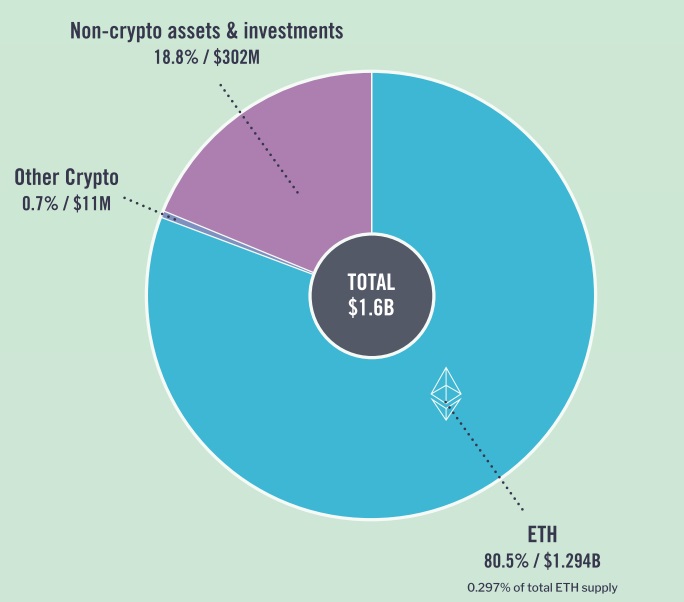
The Ethereum Foundation follows a conservative financial management policy, ensuring that even in the face of a multi-year market downturn, there are sufficient resources to fund the Ethereum Foundation's core goals. As can be seen from the amount of funds held by the Ethereum Foundation, they have a sufficient budget and are basically not affected by ETH price fluctuations.
In order to avoid excessive reliance on ETH, the Ethereum Foundation has also increased non-cryptocurrency reserves, which also provide a greater margin of safety and ensure that non-core but highly leveraged projects continue to provide financial support during market downturns. The reason why most of the funds are "placed" on ETH is because the Ethereum Foundation believes in the potential of Ethereum, and holding ETH also represents confidence in the long-term development of Ethereum. (Note: The ETH held by the Ethereum Foundation includes 39,168 ETHs that have been committed to the client incentive plan, and these ETHs will be distributed to the relevant client development teams according to the previously disclosed schedule.)
Above: Distribution of Ethereum Foundation reserves (as of March 31, 2022)
2. Expenditures of the Ethereum Foundation in 2021
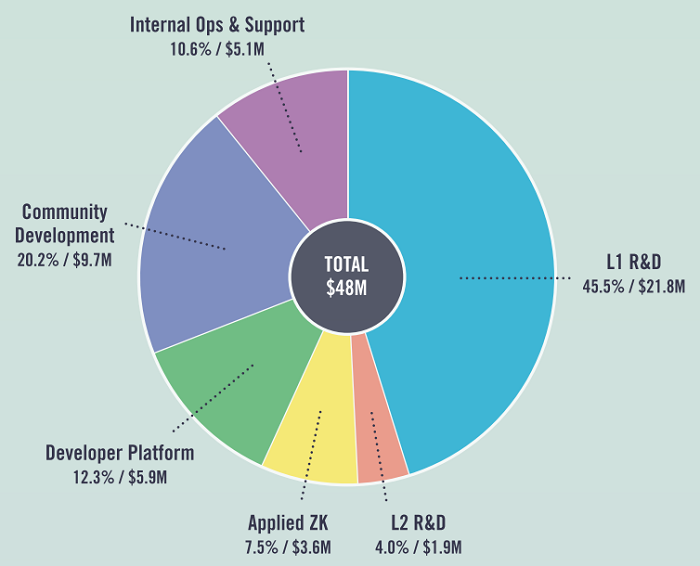
In 2021, the Ethereum Foundation's expenditures reached US$48 million, of which approximately US$20 million was used for external expenditures, mainly including grants, authorized domain name distribution, third-party funding, bounties and sponsorships, and the remaining funds were mainly used for funding Teams and projects within the Ethereum Foundation community, including:
1. Layer 1 research and development - $21.8 million;
2. Layer 2 research and development - $1.9 million;
3. Applied zero-knowledge (ZK) research and development - $3.6 million;
4. Developer Platform - $5.9 million;
5. Community Development - $9.7 million;
6. Internal operations and support - $5.1 million.
1. Layer 1 R&D - $21.8 million
Layer 1 research and development work mainly includes: mainnet upgrade, Geth, internal security research, cryptography research and development, economic modeling and mechanism design, long-term research to realize the roadmap of the Ethereum community, and research and development of external execution and consensus layer clients. This category also includes grant work to external parties, such as network stress testing, external research in specialized cryptography. The client incentive plan funds are not included, and the client team will unlock the funds according to the previously agreed schedule. As of March 31, 2022, there is a total of 39,168 ETH in the client incentive program, worth approximately $132.5 million.
2. Layer 2 R&D - $1.9 million
Layer 2 R&D spending primarily involves those teams contributing to Ethereum Layer 2 R&D, and parties working to improve the Layer 2 ecosystem, including: educational resources, stress testing and monitoring tools, L2 SDK and other developer tools, security reviews of external projects, and more.
3. Applied Zero Knowledge R&D - $3.6 million
This portion of expenditures primarily includes funding for teams working on projects such as MACI, ZKEVM, UniRep, and others, as well as other donations such as ZK Developer Tools, ZK Ritual Design UX, ZK Application Proof of Concept, etc., as well as 2021 October 2021 Monthly grant to 0xPARC Foundation.
4. Developer Platform - $5.9 million
This category includes all work related to improving Ethereum as a developer platform, such as supporting teams such as Solidity, Remix and the Python ecosystem, contributing to Zokrates, and making contributions to third parties such as Nomic Labs. (Note: The $8 million grant to the Nomic Foundation in 2022 is not included)
5. Community Development - $9.7 million
This category includes various efforts to support different parts of the Ethereum community, such as interactions with the core protocol community (such as support for the staking community), Next Billion, Devcon, and Ethereum.org and other educational resources, as well as many grants, Examples include grants to educational campaigns in specific regions such as Honduras and Colombia, and $1 million in pledged community grants announced in November 2021 to advocacy organizations and $1 million in February 2021.


