






Messari Report: Most Web3 infrastructure protocol revenues increased significantly, and Arweave Q1 revenue increased by 49% quarter-on-quarter


Original source: Messari
Compilation of the original text: The Way of DeFi
text
Original source: Messari
text
Compilation of the original text: The Way of DeFi
first level title
key insights
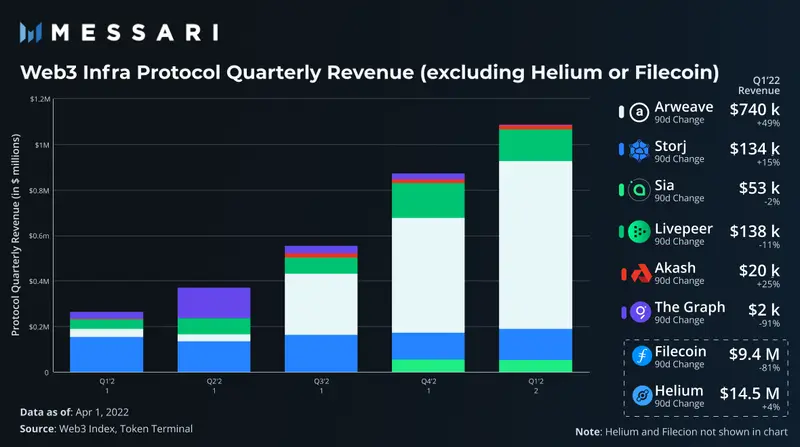
Several Web3 infrastructure protocols are generating significant protocol revenue, including Filecoin, Helium, Arweave, and Livepeer.
Most Web3 protocols have shown significant revenue growth over the past year, with many continuing to experience the aforementioned growth in Q1 2022.
Data from the Web3 Index shows that after years of being built, some Web3 protocols are starting to experience growth in network usage. As a result of this usage, often requiring the protocol's native token to be spent in exchange for the service, these Web3 protocols start generating revenue.
file storage
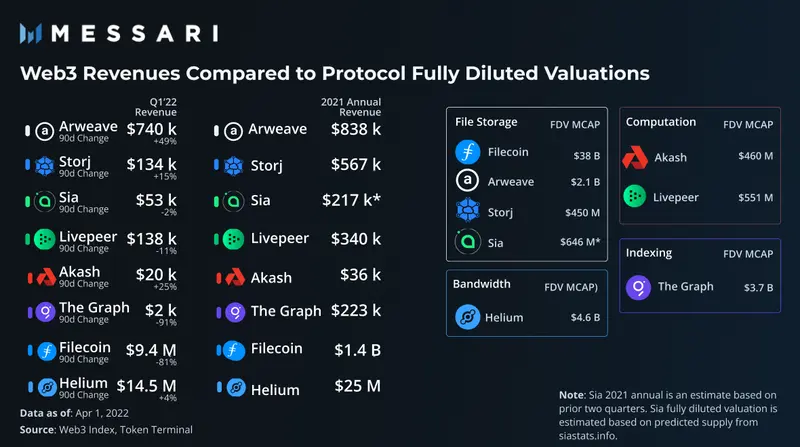
Filecoin and Helium generated significant protocol revenue in 1Q22 — $9.4M and $14.5M respectively — while the remaining selected Web3 infrastructure protocols cumulatively generated over $1M in protocol revenue.
A quick note on methodology and income calculations
It is worth noting that revenue data from Web3 Index, TokenTerminal, and other respective sources are calculated differently (e.g. Web3 index calculates fees based on protocol demand, while Token Terminal tracks demand (protocol revenue) and supply side revenue (participants/supply revenue earned by merchants) services). Having said that, we try to reconcile the data where possible and use the most accurate source of income information.
file storage
calculate
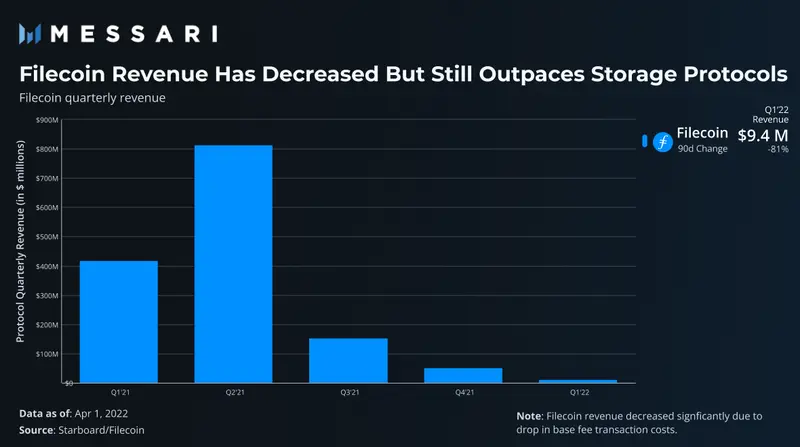
In the file storage protocol space, Filecoin's revenue still stands alone, with revenue exceeding $9 million in the first quarter of 2022. Interestingly, Filecoin's revenue has dropped significantly quarter-over-quarter as the base fee (the main fee for storing data on Filecoin) has declined.
While the exact reason is unclear, the increase in network capacity may have reduced storage costs, as miners are willing to accept lower network storage fees. In addition, Filecoin miners are subsidized through FIL rewards, which means that fees may also decrease as the majority of miner revenue shifts from fee income to token rewards. More analysis is needed to determine the exact reason for the drop in revenue.
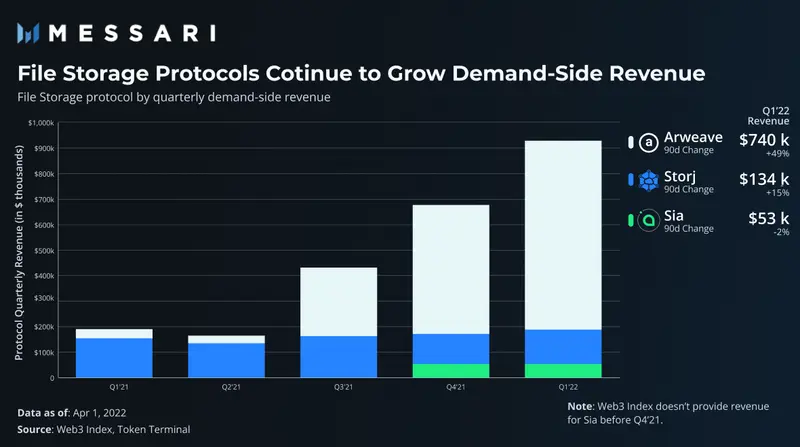
Arweave's revenue was $740,000, an increase of 47% compared to the previous quarter. Data storage on the Arweave network grew 977% year-over-year, thanks in large part to Bundlr, which accounts for more than 70% of Arweave transactions.
Storj's revenue rose 15% in the quarter, while Sia's fell 2%. More recently, Sia integrated Skynet storage capabilities with Polkadot and launched Skynet Kernal, a browser extension that may enable decentralized front-end solutions while still using existing centralized APIs.
calculate
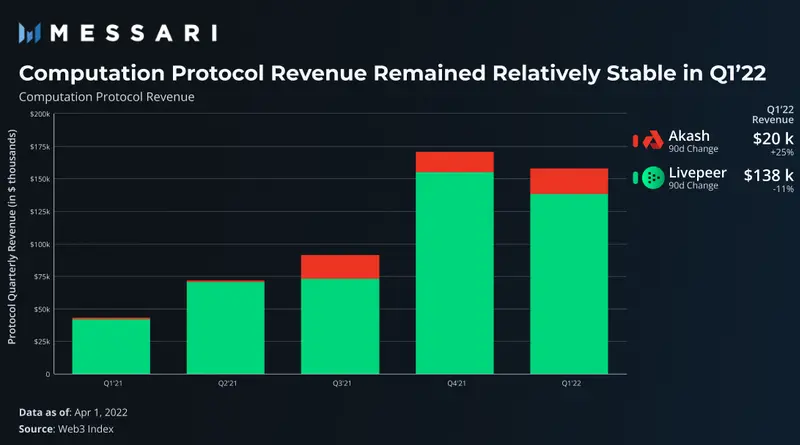
Various applications and services require computing resources. Today, most decentralized computing protocols like Livepeer, Render, and Akash operate on the Airbnb model, where vendors can rent excess CPU and GPU capacity in exchange for a fee. These decentralized protocols are often able to offer better prices than centralized providers due to the protocol’s ability to aggregate supply from various sources.
Computing-centric protocols made strides in 2021, with Livepeer generating $340,000 in protocol fee revenue. Akash's revenue will similarly grow in 2021, hitting an all-time high in the first quarter of 2022.
Data retrieval and indexing
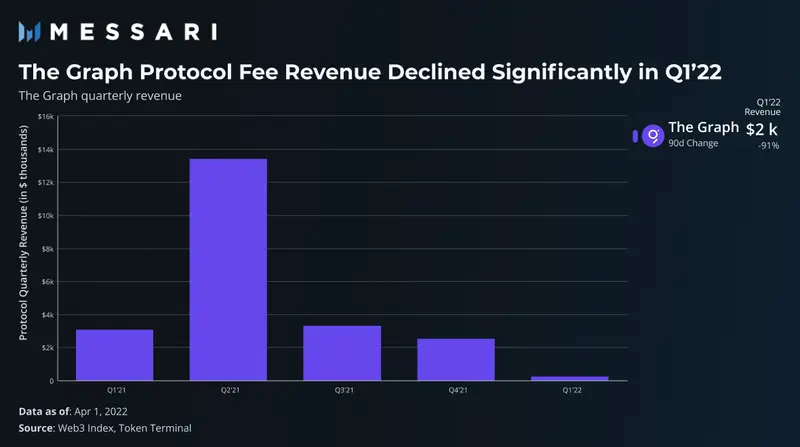
By now, most investors are familiar with The Graph as an indexing protocol that makes it possible to query blockchain data without connecting to it. While The Graph is widely used by various data aggregators, DAOs, and individuals, the fees it generates do not match its adoption. The Graph heavily subsidizes its query services, which drive adoption at the cost of low fee revenue and dilution (in the form of token rewards).
Recently, The Graph community put forward suggestions and roadmaps to improve The Graph performance, user experience, token economy, etc. The most exciting of all these updates is Firehose, a new subgraph structure designed to improve indexing performance by creating a more modular architecture.
Internet connection
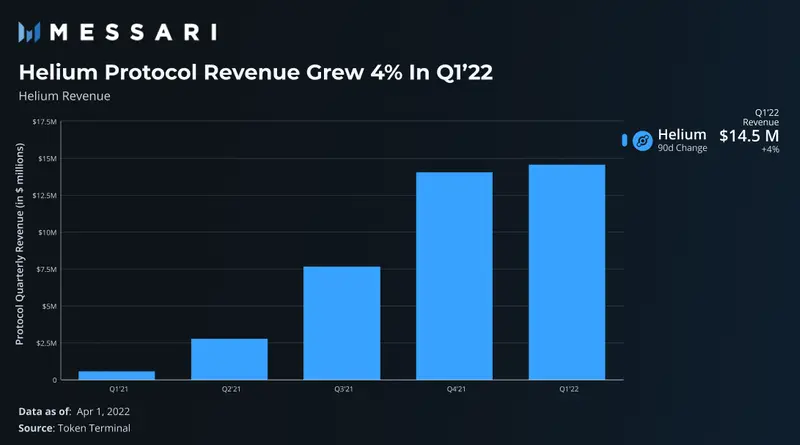
Helium is an open wireless network built on the Helium blockchain, run by a network of hardware devices (nodes) that maintain the network and transmit data. Helium has grown tremendously over the past year, with its most recent funding round in February 2022.


