






Reputation Tokens, Social Cards for a Web3 World?


Translation: PonziCurator
This article is from The SeeDAO.
This article is from The SeeDAO.

Rethink a question:In a community-based decentralized metaverse, how should we better establish reputation mechanisms, recognition mechanisms, and reward mechanisms.
* Translator's note
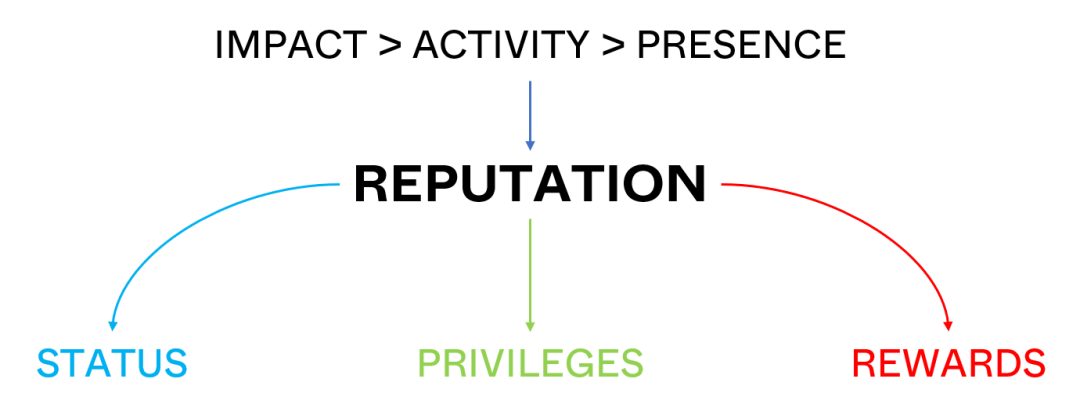
Influence, activity, and participation (in order of priority) constitute the components and metrics of personal reputation; status, privileges, and rewards constitute the positive feedback that personal reputation bestows on individuals.
As "monkeys" living under a hierarchy, humans have a natural tendency to seek a sense of belonging and identity. We both try to fit in and stand out from the crowd. We traveled through various communities and presented ourselves as many distinct identities, and learned how to move flexibly between different hierarchies.
Each community has its own specific hierarchy that dictates how members build reputations, accumulate social capital, and gain community recognition and rewards. In order to help members integrate into the community and have a chance to stand out, the community usually establishes a set of internal norms and sets related"and"and"proof of participation". Under the consensus mechanism (Proof of X), members can show"Proof of ability"、"proof of activity"middle"Proof of X"middle"X"It can be any compliant behavior, or any valuable contribution to the community and its vision.

How to establish the accumulation, recognition and reward mechanism of social capital"How to establish the accumulation, recognition and reward mechanism of social capital"decentralized"decentralized"The consensus mechanism will not be determined by a single centralized platform or middleman. The community can redefine a set of exclusive"Proof-of-X"The consensus mechanism will not be determined by a single centralized platform or middleman. The community can redefine a set of exclusive"Proof-of-X"mechanism. By using tokens and smart contracts, this mechanism can be mapped to different reputation and reward models to ensure the consistency of incentive standards and the maximization of the total value.
It is true that reputation and status are two indicators of social class, but this is not"zero sum game". Admittedly though, there is gamification involved, where people aspire to move up the leaderboards of the community and show off their badges of achievement to other members. In addition, most communities do follow the 1/9/90 rule [1], that is, only a small number of people are making substantial and valuable contributions.
badge"badge". The community recognizes the badge or token as a"social signal", used to characterize a member's specific contribution or achievement. At the same time, they will also be linked to some permissions and privileges. For example, some functions and benefits are only available to members who have reached a certain status or reputation level, and specific governance rights and identities are only open to active members and contributors. This essentially gives their higher status.
reputation token"reputation token"reputation token"reputation token"as a"social signal", also able to function outside of a single community. They are contained in the social map and resume, forming a decentralized and portable identity system unique to the Web3 worldreputation token"reputation token"Define different values and functions.
There is no one-size-fits-all formula for measuring value, but I still try to summarize a template and split the measurement criteria into three sections: participation, activity and influence.After all, the potential social and financial value of any community can be"Community activity"This coordinate system is used for evaluation, the horizontal axis represents the breadth of the community (number of users), and the vertical axis represents the degree of user engagement.
In the initial stage, the members'"active participation"can be counted as a valuable contribution. Usually, the activity of a project or platform is measured by daily activity (DAU) or DAU/MAU (the ratio of daily activity to monthly activity, representing the relative activity of the community). Participation of members - even if only"passive participation"- have communicated their interest and concern to the community and contributed to the overall impact of the community.
However, only stimulating"active participation"In order to maximize the collective power of the community."active participation"There are many forms, but it usually starts with enhancing the connection between members and the community (such as participating in content output and internal communication), and then gradually allowing them to create independently and jointly, and then actively participate in community output to jointly enhance community value.
However, there are differences in the value weights of different activities, thus denoising the signal is required. By establishing the correct formula in the smart contract, a reputation system can be built to autonomously identify valuable and positive feedback activities defined within the community. In other words, the platform will award points based on the value created by members. In such a reputation system, the value weight of influence is greater than activity, and the weight of activity is greater than participation.
In addition to helping members build reputation and earn tokens, the system is more important to maintain incentives for long-term contributors and activists.Depreciation needs to be introduced into any reputation points system, i.e. influence, activity and recency of engagement are key weighting factors in the process of building reputation and assigning value.Therefore, if a member's activity and participation experience a significant decline, they will lose their original status and all associated benefits. This model is similar to a real-life loyalty program: you can only continue to enjoy the privileges as always if you continue to earn rewards.
So, is it possible to untie the non-homogeneous reputation and homogeneous rewards, so that community members can share the created economic value? The dual-token system gives a solution.
In the dual-token system, points and tokens coexist, and social capital can be mapped to financial capital and equity. community by issuing"Tier Tokens"reward tokens"reward tokens"This homogeneous reward, members can exchange them for cash or other things they want, and can also be exchanged for some additional privileges.
reward tokens"reputation token"and"reward tokens"(both are social tokens), members and creators will share in the social capital and utility value they create. Tokenized communities will bridge the existing creator economy and make it a true ownership economy. Community members, consumers and fans can establish direct contact with their favorite idols, creators and brands, and share a piece of the value of collective co-creation.
In the world of Web3, the decentralized identity system will track and record everyone's movements, contributions and achievements (including URL and IRL) in the community, and form an immutable record book, which records"as well as"as well as"our position". This means that our contributions in a community can be aggregated and applied to a wider range of scenarios.

arbitrage"arbitrage". In order to achieve this kind of interactivity, it is necessary to establish a unified standard that allows people to display their own digital identity collection, and can conduct multi-factor analysis on multi-faceted and three-dimensional personal resume and reputation information.
All in all, people care more about your appearance than your race or gender"what have you done". More importantly, here, as long as you make a contribution, you will have the opportunity to receive the recognition and rewards you deserve.

[1] Translator's Note: This hypothesis was proposed by Jakob Nielsen in 2006, which means that in online communities, 90% of the participants only watch the content without participating in the interaction, 9% of the users will participate in the discussion, and only 1% of the users will create content.


