






In-depth analysis of Arweave: Web3.0 storage breaker


Original author:Nicole Cheng (Investment Manager of OFR), Mstone (Analyst of OFR)
Original author:JX (Partner of OFR)
guide:To start the new year, Ryan Selkis atfirst level title
permanent storage
Arweave is a blockchain network whose goal is to achieve decentralized permanent storage for data. One-time payment, lifetime use also solves the cumbersome process of users needing to subscribe continuously. Arweave promises to provide users with storage services for at least 200 years, and with the decline in storage costs every year, this goal becomes clearer and clearer.
secondary title
Why do you need permanent storage?
The Internet that relies on centralized storage is fragile and fragmented. On the one hand, data is growing exponentially, and on the other hand, old data is lost or stolen frequently. Over the past 20 years, 98.4% of web links have suffered from rot, resulting in the familiar "404 Not Found". Looking at the long-term perspective, data permanence on the blockchain will be a new value proposition, and the realization of permanent data storage will be an exciting innovation in the future Internet development and Web3.0 era.
secondary title
Why can Arweave be permanently stored?BlockWeaveThe data structure of SPoRA and the consensus mechanism of SPoRA provide a new solution to the problem of permanent storage. Blockweave's spinning architecture comes withFragmentationFragmentationSPoRAproperties and high scalability, while
The consensus mechanism ensures that miners receive sufficient incentives to store rare data and achieve permanent data storage.
So how do miners achieve permanent storage? The SPoRA mechanism at the consensus level can be understood as a collection of three concepts: 1. PoW 2. PoA 3. Data access speed. The block generation of Arweave requires the participation of a previous random block (recall block). This consensus mechanism is Proof of Access (PoA). In addition, on the basis of PoA, in order to prevent all miners from storing all the data and cannot determine the bookkeeping right, a PoW mechanism is introduced to ensure that the miner who calculates the random number the fastest has the bookkeeping right. However, if a large number of miners will invariably choose low-cost regions to run nodes in order to reduce costs, this geographically centralized storage structure will increase the data access speed of some users. Therefore, data access speed is also a factor in determining miner rewards.
Under the PoA mechanism, another feature that motivates miners to store willingness is also hidden-the probability of recalling blocks is the same. So there is a greater probability for miners who store rare blocks to compete for rewards. This will cause all data to be evenly stored on Arweave.
Although the subjective storage willingness of miners can satisfy permanent storage, will objective data loss affect the feasibility of permanent storage? That is, a certain block happens not to be stored by the miners, resulting in permanent loss.
Taking the above replication rate of 50% and the number of nodes as 100 as an example, we can see that when miners only store half of all data, the probability of losing blocks is already very small. But the actual situation is that the number of nodes in the Arweave network is more than 1000, and the replication rate can reach 90%. It can be said that the probability of permanent loss is very small.
In addition to this, storage cost is also an important factor in maintaining Arweave's permanent storage. We've gotten used to rising prices in almost all areas of our lives, but data storage is one of the few areas that bucks this trend. In the past 50 years. The cost of data storage has dropped by more than 30.5% per year on average. And Arweave's working assumptions for permanent storage to be economically viable are very conservative: Arweave assumes that data storage costs will drop by only 0.5% per year. The initial cost for a user to upload data to the Arweave network covers the first 200 years of storage. If the data storage capacity decreases by more than 0.5% per year, the data storage life will be increased.
image description
source: Ardrive
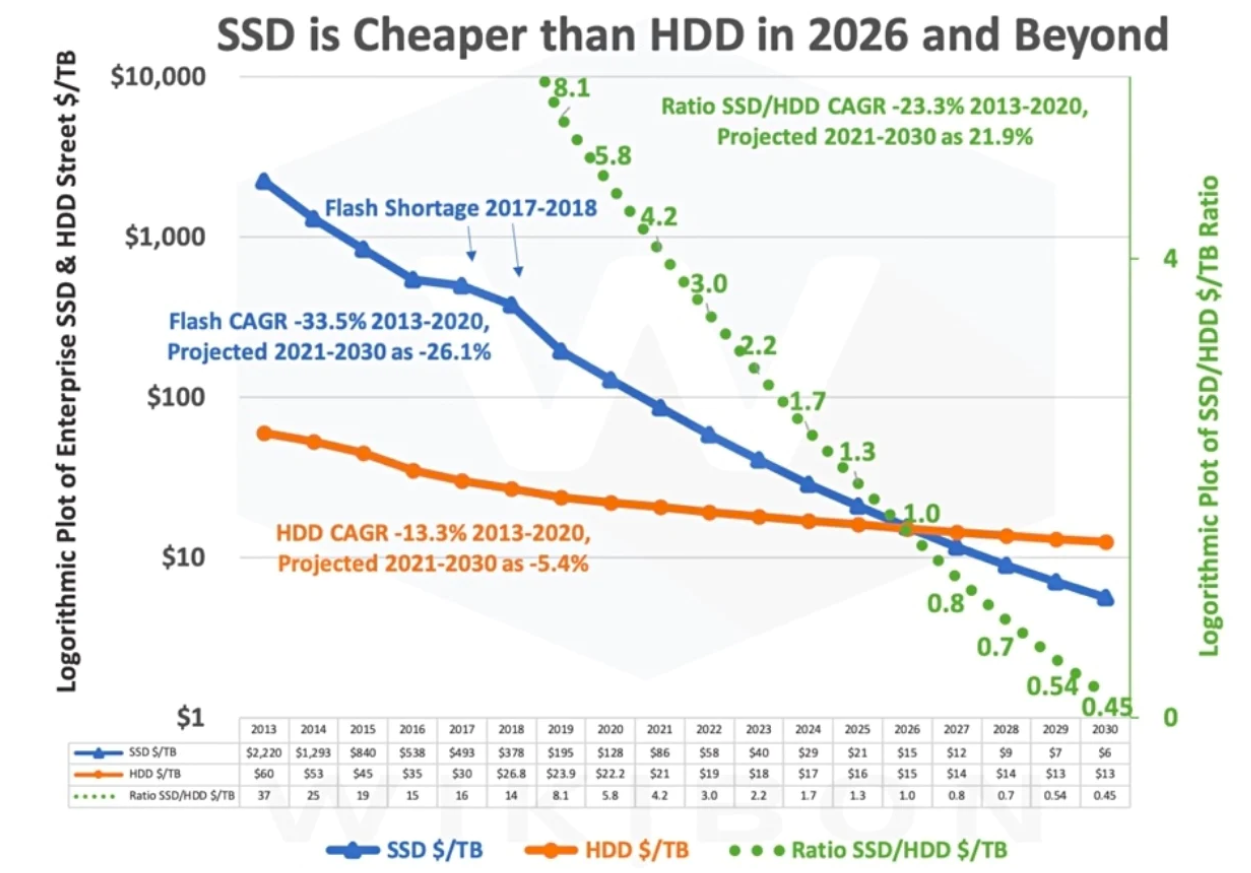
Source: Wikibon, 2021
secondary title
Judging from the data alone, Arweave only had the highest transaction volume of 600M three years after its launch. In contrast, Solana and Avalanche had the same amount of transactions only one year after their launch.

Source: Coin Market Cap
image description
Throughout the history of the development of public chains, it is not difficult to find that the development of public chains is often top-down. The prosperity of the application layer will drive the construction of the underlying infrastructure, and then promote the virtuous circle of the ecological development of the public chain. Uniswap and Opensea, as the two heavyweight applications that burn the most ether, have added a large number of transactions and active addresses to Ethereum, supporting this round of bull market in Ethereum; DEX led by Serum and Raydium has promoted The early development of Solana, the rise of GameFi has driven the activity of BSC, and the distinctive Defi asset agreements such as Anchor and Mirror have brought funds and growth momentum to Terra.
On the other hand, Arweave, although many excellent applications have sprouted, has not yet exploded with the existence of the above-mentioned moat level. The following lists some of the current ecological projects on Arweave according to infrastructure and applications:
When it comes to Bundlr, I have to talk about a new technology of Arweave - Bundles. Bundles adds another dimension to the scalability of Arweave, which can compress any amount of data through L2 into a single block technology that can be processed by L1. Its appearance enables the transaction capacity of Arweave to increase linearly. Users can thus upload a large amount of single data without worrying about the data not being able to be uploaded effectively - it solves a problem that every blockchain has, that is, in the case of transactions submitted by others that reward miners more Circumstances in which it may be rejected.
RedStoneBundlr processed over 10,000,000 transactions in its first month, while Arweave only processed 1,000,000. As Bundlr scales, the network will be able to handle many orders of magnitude more data. According to statistics, 70% of transactions are now bundled data.
(middle layer):
Kyve NetworkOracle solutions on Arweave. At the same time, RedStone aims to become the Chainlink in the Web3 field: upload the verified data to Arweave (staking token), and anyone can get the correct data on it. At the same time, all applications built through SCP are off-chain calculations. When users use the oracle, they can directly read the data on the storage blockchain. And these data will be guaranteed correctness by RedStone's economic mechanism.
(Application Layer/Middle Layer):
Utilizing the storage function of Arweave, KYVE provides structured data storage, verification and access services for different blockchains, helping different chains to complete data cross-chain storage. Data uploaders are responsible for obtaining data from the source and storing it in Arweave, while verifiers ensure the validity and reliability of data on Arweave through a series of incentive and penalty mechanisms, thereby ensuring the availability of the application layer. Once the data is stored, users can retrieve the data using KYVE's query interface, or access it directly in Arweave. Through the verification of KYVE and the permanent storage of Arweave, the integrity of the data provided to downstream users is ensured.
As an excellent front-end application of the Arweave network, ArDrive greatly simplifies the difficulty for users to use the Arweave network. Before ArDrive appeared, users needed to use CLI (command line interface) to interact with the Arweave network to store uploaded content. However, the advent of ArDrive allows users to upload their own content with just a click of the mouse.
everPayAs a product of the same team as ArDrive, AR I/O acts as an information center. Works uploaded to Arweave via Ardrive will first go through AR I/O and then be uploaded to Arweave network, and vice versa. The existence of AR I/O will greatly enhance the user's efficiency and experience with ArDrive.
(middle layer):
PianityBased on the on-chain payment and settlement protocol developed by Arweave, users can realize real-time token transfers between Ethereum and Arweave through everPay without gas fees. everPay's purpose is to provide everyone with a trusted, decentralized payment application, and to provide developers with an SDK that makes it easier to build DEXs.
(application layer):
As an NFT casting and trading platform, Pianity uses a new NFT standard based on Arweave, which fundamentally solves the problem of off-chain storage of NFT metadata. The process of minting NFT is to send a transaction to the NFT contract on Arweave, and save the audio file of the song to the chain while minting a new NFT. While enjoying low-cost on-chain storage, it also further reduces the user's trust cost in the process of trading NFT. Users no longer need to understand complex concepts such as metadata and various storage methods, making the transaction process realize what you see is what you get, and truly achieve trustless transactions.
It is not difficult to see that, as an infrastructure-level protocol, Arweave's narrative, logic, and value support are very different from other public chains. Because of this, unlike the top-down development process of most public chains, the Arweave ecology seems to have spent most of its efforts on the underlying facilities in the past three years, trying to find another way out of its own unique bottom-up development route. So far, there have been more than 400 projects in the ecology, which is nearly double that of the same period last year. Under the narrative of Web3.0, there will be a large number of native blockchain dApps that tend to use on-chain storage. After the underlying infrastructure matures, more application-level projects will emerge, bringing incremental users and funds into the Arweave ecosystem.
Arweave has become the leader in this field with its unique permanent storage in the storage sector. Users realize permanent data storage, one-time payment, and permanent use; at the same time, based on their own storage services, they gradually realize the ecological environment in which the SmartWeave contract and PermaWeb cooperate with each other. But in the exploration of Web3 in the future, the important feature of data ownership is not only reflected through perpetuity, but also requires more empowerment to help Arweave tell the story.
Finally, here are a few application scenarios we are optimistic about for your reference:
1. NFT metadata storage is currently the most widely used use case, and its demand will continue to grow after the rise of audio and video NFT in the future.
2. Similar to the Kyve Network mentioned above, it backs up other public chain data on Arweave, permanently stores the historical data of the public chain, and provides an interface entry for easy retrieval and access, making it Layer 0 of the public chain.
4. A decentralized social platform can carry a large amount of data, and Arweave is naturally highly scalable.


