






A list of the necessary NFT analysis tools for Gaowan


Original Author: Old Yuppie
This article is from the WeChat public account FastDaily.
Original Author: Old Yuppie
This article is from the WeChat public account FastDaily.In the face of these problems, the old yuppie sorted out the most mainstream NFT analysis tools at present, conducted research on its project features and module functions, and compared its advantages and disadvantages through comparative analysis to help everyone better understand and participate in Investment decisions in the NFT market.

In particular, our articles are not intended as investment advice. Readers are invited to think independently. It is still the same sentence: investment should be cautious, and no one should be trusted.
secondary title1. Dune analyticsFounded by Fredrik Haga and Mats Olsen in 2018, Dune analytics is a powerful blockchain data analysis tool and platform that provides users with functions such as data query, extraction, and visualization on the chain. currently available from
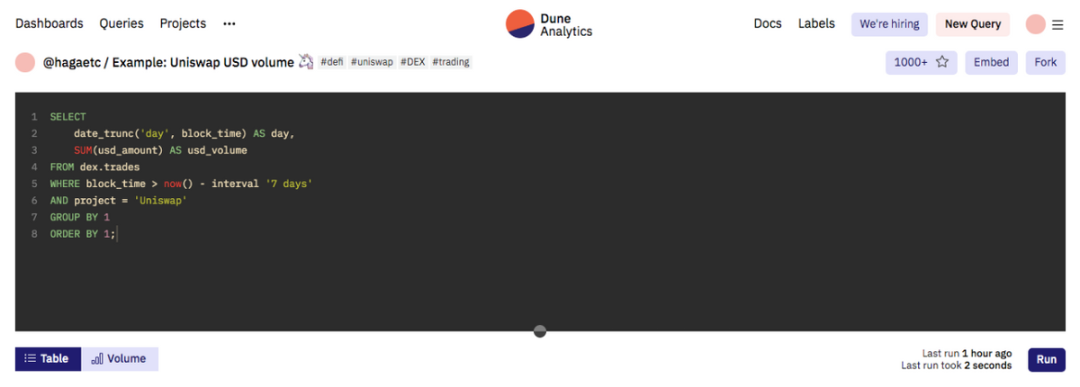
Ethereum, Polygon, BNB Chain, Optimism, and Gnosis Chain query data, and the retrieval method is index retrieval instead of storage
. The project runs on PostgreSQL 12.2, and some SQL development experience is required to convert hard-to-access on-chain data into easy-to-read charts. However, for novices without database experience, Dune has also prepared a lot of practical teaching for everyone to learn.
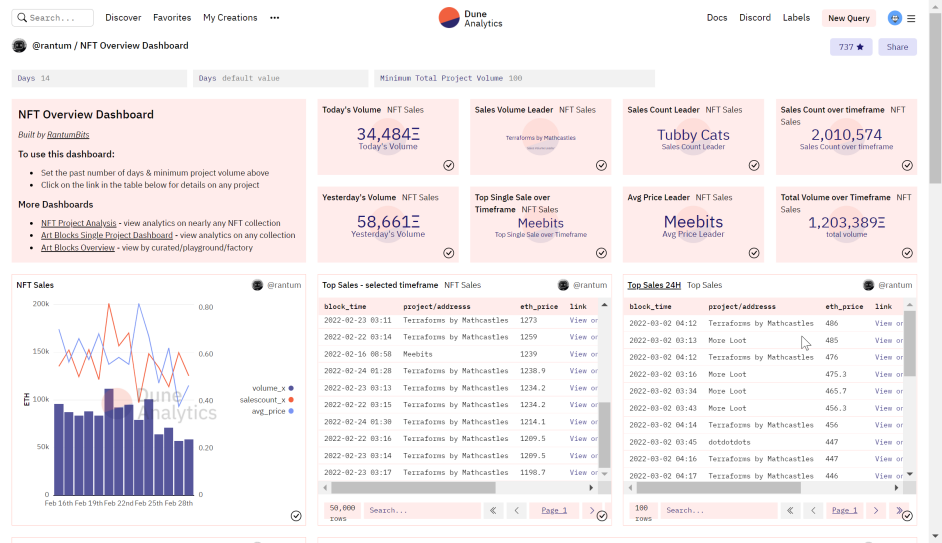
functional module
The main functional modules of Dune analytics are search, favorites, and creation. Among them, the search function can query the project dashboard, data dashboard and user name by keyword. Favorites are used to collect items that users want to focus on. Creation means that players can build the desired data model and convert the data into pie charts, histograms, line charts, and scatter points by using the visualization tools provided by the project party. Figure etc. Users can query all on-chain data such as NFT average price, floor price, number of holders, dispersion degree of holders, sales volume, rarity and price relationship according to their needs. Of course, its functions include but are not limited to the analysis of NFT tracks, and it has a wide range of applications in Defi, GameFi, DAO, Web3, etc.
In addition, the project also has tag query, popularity ranking, creator homepage, payment model (390$ per month), etc., to meet users' needs to track industry hotspots, cultivate creator economy, result export, secondary development, privacy, etc. Various needs.
Project Features
The data is open source. In addition to purchasing paid functions, the dashboards, query results, and editing codes created by users are open to everyone by default;
Strong scalability, the project allows users to build models at will according to their own needs and ideas;
It has a certain threshold and requires certain database query capabilities;
Support creator economy, it is like a social platform for data analysis, allowing users to follow their favorite creators and their accounts on other social platforms;
The unique embedding function can display the data results generated by Dune analytics across platforms;
With a good community atmosphere, players can consult relevant technical issues or submit feedback to community personnel in the community.
Twitter fans 51k, Discord number 12k, the ratio of online people is 1/10, and the discussion content is mainly technical issues such as editing tutorials and code analysis.
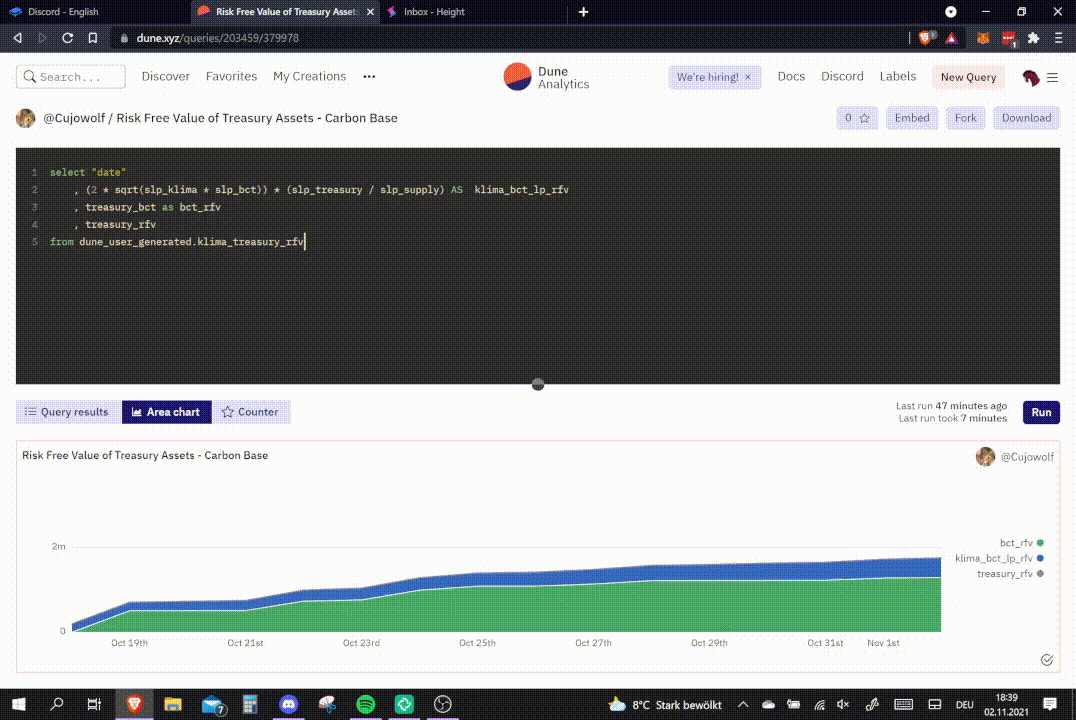
In general, Dune analytics is an on-chain data analysis tool with the most complete data, the most users, and the best user experience. It has strong practical value whether it is in NFT or other tracks, and is highly recommended! (The project has not yet issued coins and NFT, beware of scams!)
secondary title
2. NFT Go
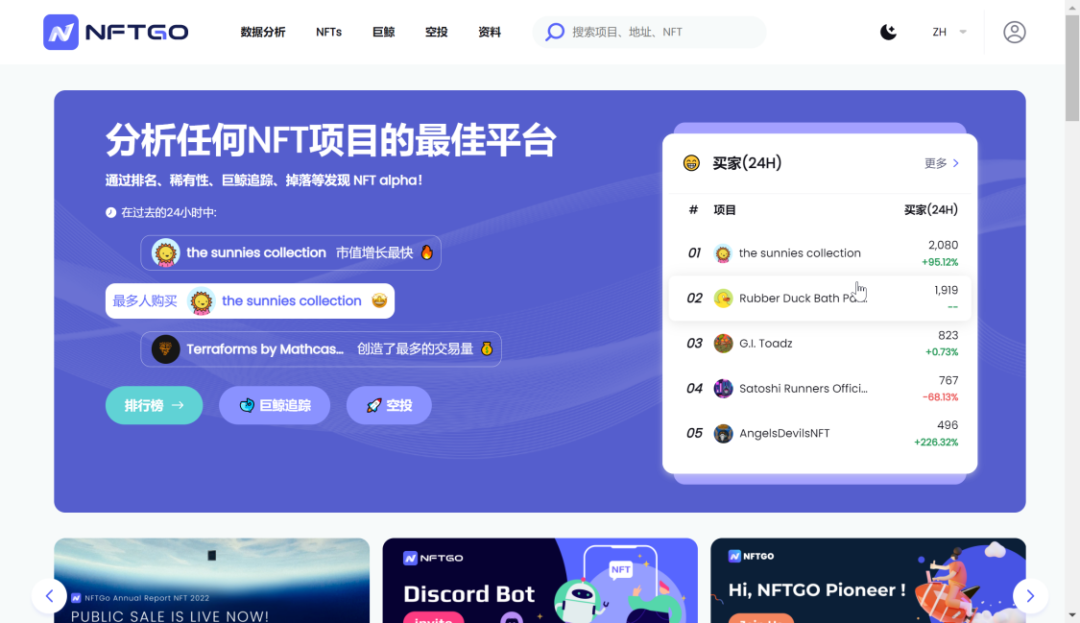
NFTGo is a data aggregation platform for Web3, NFT and gaming communities, aiming to build a portal to the NFT ecosystem. Its creators hope to improve the NFT ecosystem from the perspectives of assessing the value of NFT projects and assets, helping to make informed investment decisions, tracking and identifying high-quality projects, and providing users with various data services to help them gain more in the market Advantage.
Project vision:
Build infrastructure to help users better participate in the creation of NFT;
The main function:
Accelerate your migration from Web2 to Web3 with NFTs.
The main function:
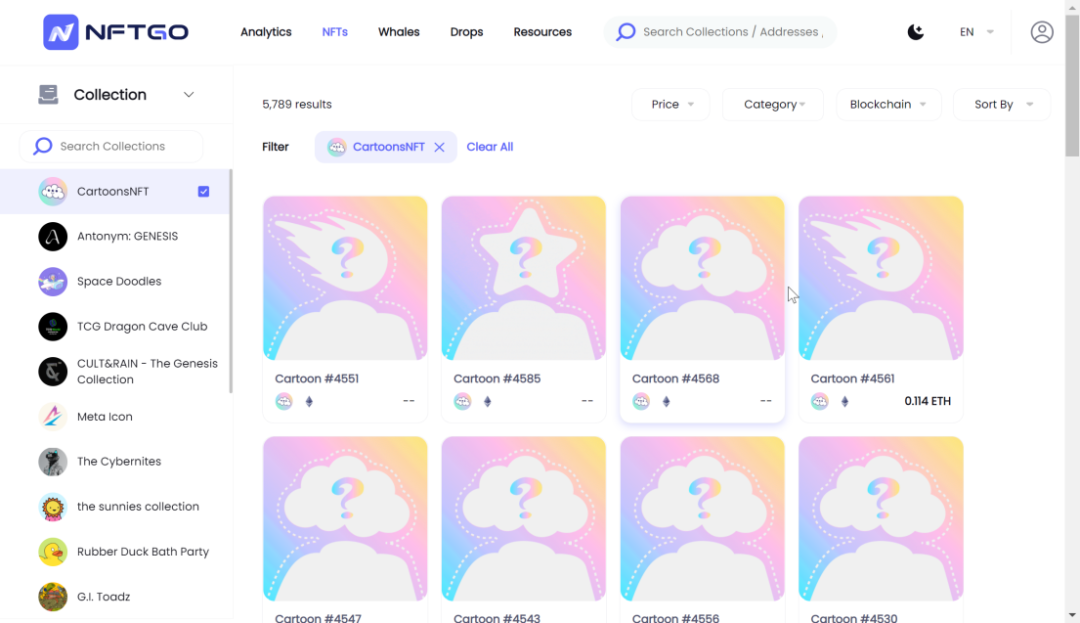
The main functions of NFTGO are data analysis, giant whale wallet monitoring, airdrop information, research reports and classification according to NFT, etc.
NFTGO divides NFT types into social, IP, Metaverse, Defi, games, collectibles, art, PFP, etc., and can perform price screening, multi-label screening, public chain screening and other screening methods to quickly access users interested NFT.
The giant whale function selects 1097 wallets, these wallets hold 3.94B$ of NFT, accounting for 23.15% of the total market value. Provide users with trading decisions by monitoring the whale's mint, transaction, destruction and other behaviors.
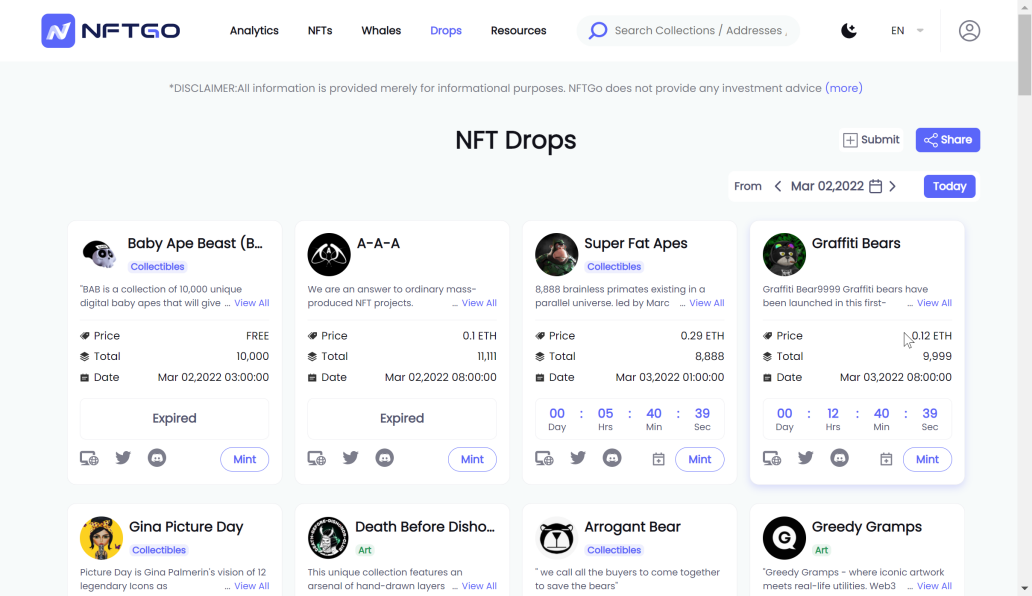
The airdrop function is to collect new information about NFTs in the market, summarize them, focus on the three information of price, quantity, and date, and provide links to web pages, Twitter, and Discord for users to understand by themselves. The airdrop information is arranged according to time, and the target items can be added to the personal Google calendar to remind users in time.
In terms of data analysis, it includes leaderboards, market data, and an evaluator module that has not yet been launched. The former (leaderboard) allows users to understand the hot spots and high-quality projects in the current market, while the latter is from the perspective of the entire NFT market To measure the current overall situation, such as total market capitalization, number of holders, number of projects, transaction volume, trend line, etc.
Program features:
One-stop service, which can help users quickly capture target projects;
Adopting a technical architecture that supports multiple blockchains, theoretically NFT data can be obtained from any blockchain, but currently only supports access to the Ethereum project, and will be extended to multiple chains in the future;
Having an independent listing process for NFT projects ensures that the data provided by NFTGo truly and accurately reflects mainstream NFT market trends;
Provides a multi-dimensional ranking list of NFT-related indicators;
It has an asset search engine and realizes the aggregation of cross-platform transaction information.
There are 22k followers on Twitter, 4.6k on Discord, and 5.7k on Telegram. The community activity is average. Considering that the project is a centralized platform, the activity is understandable.
Generally speaking, this is a general-purpose NFT usage tool. It uniquely quantifies the concept of NFT giant whale addresses, and provides users with investment strategies by monitoring the behavior of giant whales and combining data on the chain. It also includes Airdrops, research reports, and more. Data visualization is excellent, but there is still room for improvement in analysis methods and popularity rankings.
secondary title
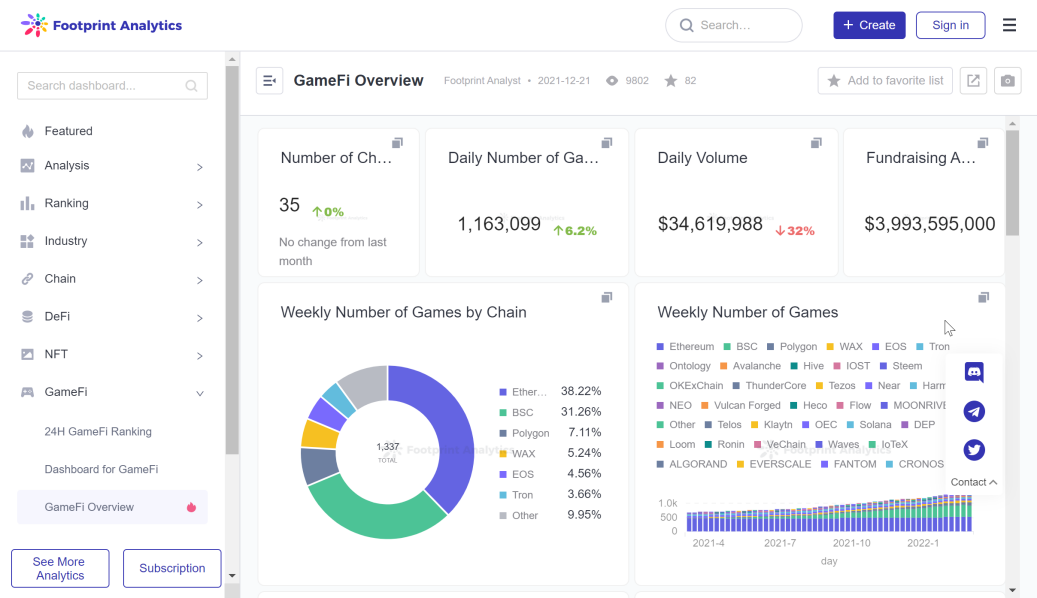
3. Footprint
Similar to Dune analytics, Footprint is a powerful and easy-to-use analysis tool for discovering and visualizing blockchain data. Through Footprint's data integration and collation, users can get more data faster to drive data updates.
Project features and highlights
No coding or technical requirements;
Footprint solves the programming technical problems in the process of collecting blockchain data, provides users with an easy visual operation experience, and does not require SQL queries or coding to analyze blockchain data.
One-click fork query;
Footprint provides a wealth of data analysis templates, supports one-click forking with any open analysis table on the platform, helps users easily create and manage their personalized dashboards, and can also share data sheets and dashboards with friends or social channels, To showcase the unique insights of users.
Advanced Wallet Tab;
Footprint plans to launch a labeling section, which tracks and labels each individual wallet address exchange, meaning users can see which addresses are accumulating or selling specific tokens, as well as their portfolio profits, enabling hyper-targeted research Or unlock macro market trends.
A community powered by DAO;
For data analysis platforms, cryptocurrency transactions involving multiple chains, projects, and wallets are a major challenge for developers and data analysts in terms of data volume and complexity. At the same time, it takes a lot of time and energy to collect and organize standardized data structures, and it takes continuous investment in long-term maintenance. The decentralized organizational structure of the Footprint community allows its users to share insights, inspire and support each other, and actively drive development.
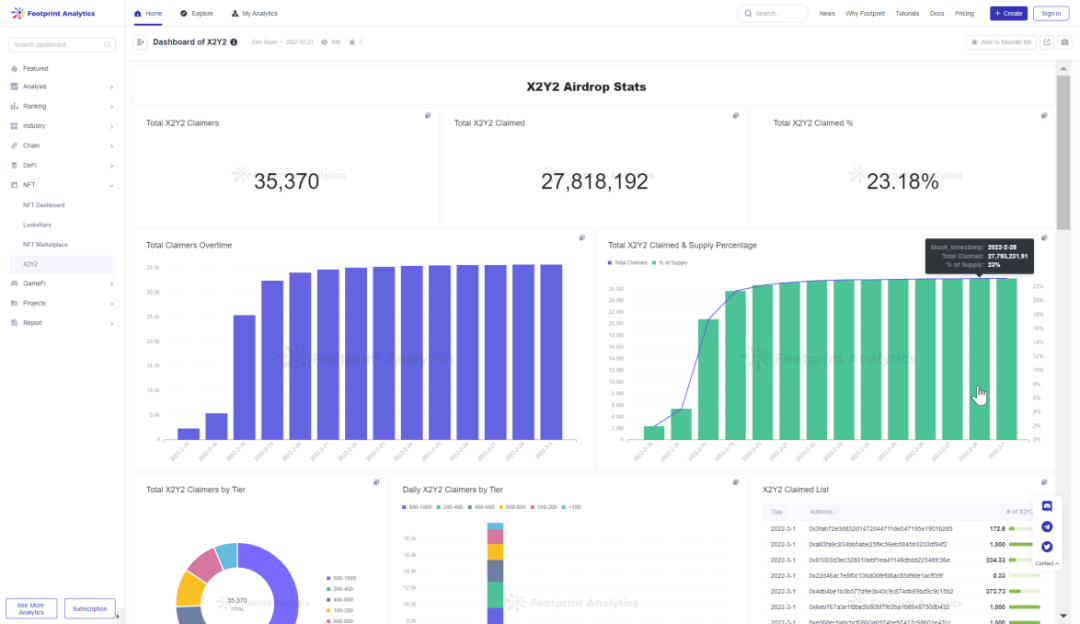
With 5.8k followers on Twitter, 2.9k on Discord, and 2.6k on Telegram, the project is still in its early stages.
It is a competing product with Dune analytics. It is less difficult to get started, and the price is cheaper than the latter ($99 per month for the PRO version), but it provides less support for users to create again, and there is no creator economic system. It is suitable for Completion of data on the chain and more beautiful visual display of the latter.
secondary title
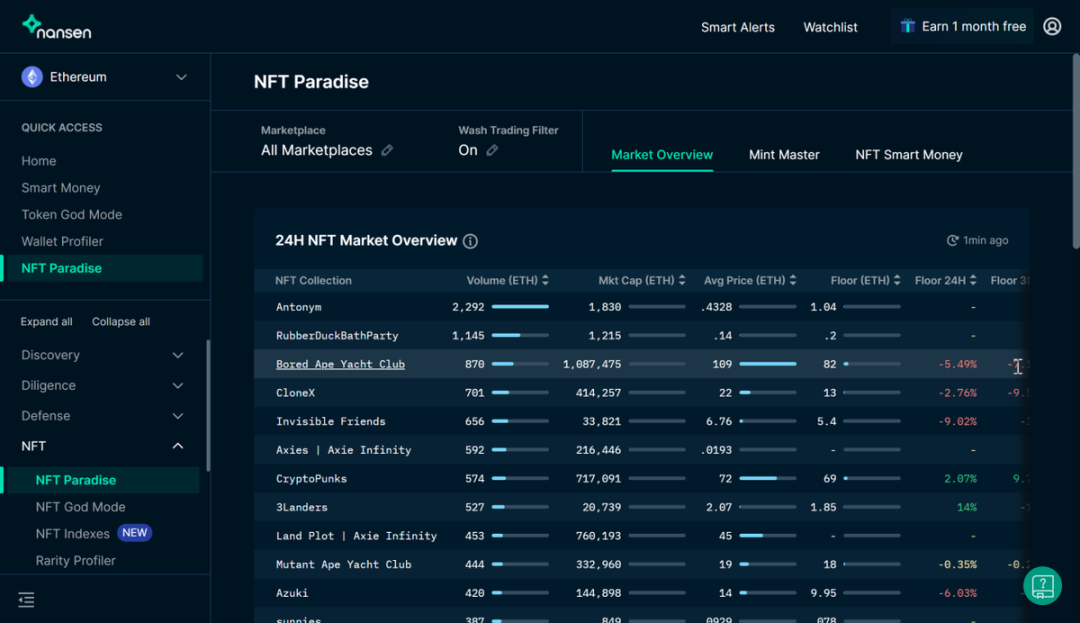
4. Nansen
Nansen is a blockchain analytics platform that combines on-chain data with a massive database containing millions of wallet tags. As a well-known data analysis platform in the encryption market, it currently only has the ETH chain in terms of NFT, which is still in its infancy.
Main modules:
The main modules of its NFT analysis tool are: NFT index, rarity analyzer, item analyzer, GOD mode, NFT Paradise.
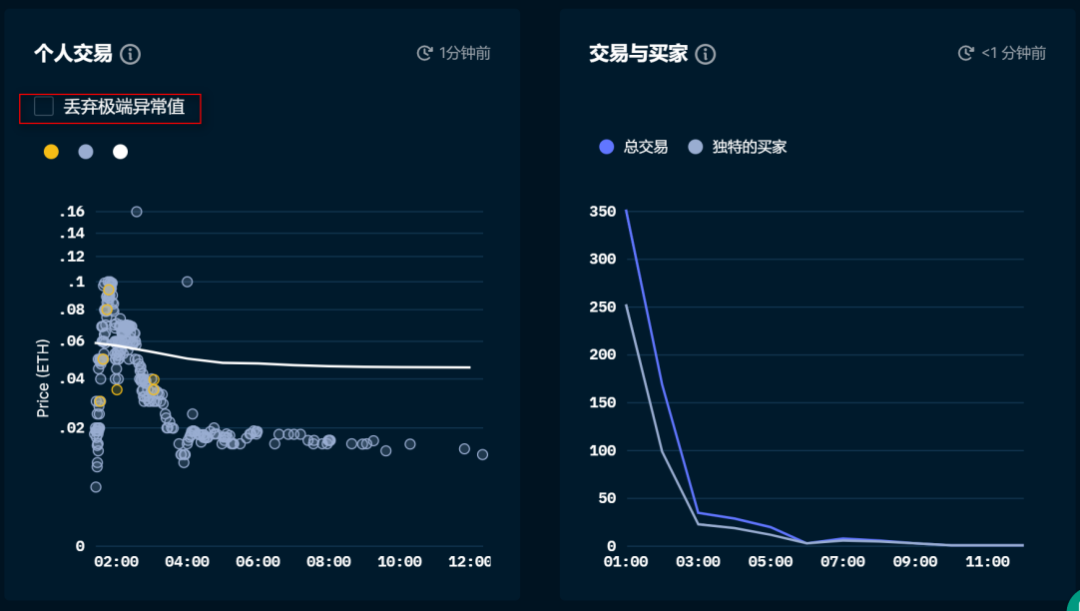
The GOD mode provides us with a more detailed perspective to examine the transaction information and holder data of a specific NFT project, and has the function of discarding extreme outliers, preventing analysts from being disturbed by extreme data and reducing internal transactions. Impact on analytical models.Link。
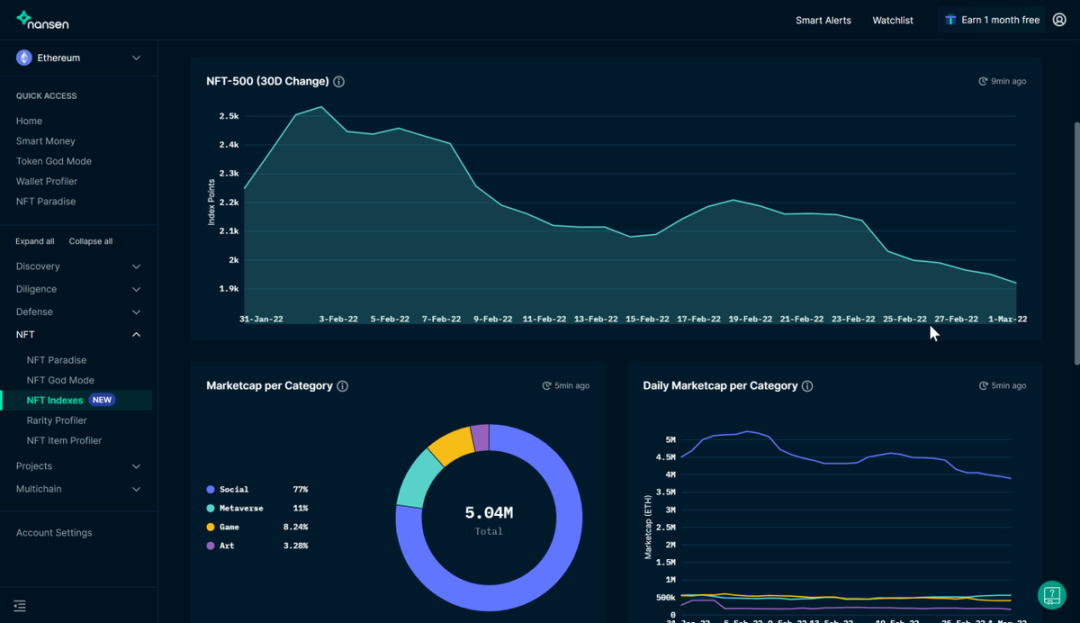
The NFT index function is to propose NSN-NFT500, NSN-BLUECHIP10, NSN-SOCIAL100, NSN-GAME50, NSN-ART20, NSN-META20 and other quantitative indices from the directions of social, games, artwork, metaverse, etc., to analyze the subdivision The overall performance of track NFT, specific selection principles and index calculation methods can be seen
Link
The rarity analyzer and item analyzer select a certain rarity attribute of NFT or a specific NFT to track the price and transaction volume.
Features:
The NFT index module subdivides the track;
The centralized display method cannot allow analysts to obtain a unique perspective of data analysis;
Others
The price is more expensive than other tools;


