DAOrayaki: Discussion on the Punishment Mechanism in DAO Governance



Community is a long-term process. It's one thing to create temporary attention, but it's another to cultivate groups of meaningful relationships and unite an entire community to contribute their time and energy over a period of time.
A large number of relatively clear work goals in the short term may make members feel coercive and resist the community and leave (because of the differences between people, the standards for this are also very different), which is also different from the DAO culture: let Contributors work on tasks they love to deviate from.
Therefore, the choice of identity needs to be subdivided, which is very important. Since DAO lacks the hierarchical system of traditional entity organizations in design, there are only different roles in the community, and there is no distinction between upper and lower. In the context of token networks, roles are roughly divided into two types, pure currency holders and active contributors. By. Pure coin holders may be inactive members of the community. However, due to the high cooperation fluidity and flexibility of DAO, the enthusiasm of active contributors will be hit. The question then arises, what to do or how to deal with less active people or passive participants.
Most of the current complete DAO governance is based on the 8 principles of commons management by Elinor Ostrom. One of them is: graded sanctions for resource occupants who violate community rules. In past experience, no matter who makes the rules, the method of supervising the operation of the rules and their compliance often thinks that they can only rely on an omniscient and omnipotent role outside the rules of the system to enforce them. However, research on common pool resource governance has found that, in most cases, self-implemented (often complex) social programs work well when private and public interests conflict over resource allocation. The operation and guarantee of the rules are not realized by external actors, but the participants weigh the pros and cons to reach a balance. It is a contingency strategy.
A contingency strategy is when the strategic actor recognizes
collective goals will be achieved
When other people follow the rules, he will also follow the rules. Everyone's compliance with the rules depends on others' compliance with the rules. The contingency strategy is the source of long-term stable cooperation outcomes. At this time, everyone is a supervisor.
If no violation is found, the supervisor assumes that others obey the rules, so he will continue to follow the rules.
If a violation is discovered, but the behavior happened by chance on a particular occasion, the discoverer may only impose appropriate sanctions on the violator, in which case a small penalty is enough to remind the violator of the importance of following the rules. In effective common-pool resource governance systems, the initial sanction is often surprisingly light, and the discoverer may find himself in a similar situation in the future, hoping to gain some understanding for himself at that time.
When supervisors see repeated violations that may pose a real threat to the contingency strategy, they increase the intensity of sanctions to deter new violations by those violators and to prevent others from following their example.
Sanctions for occupants who violate the rules range from negligible fines to firing violators depending on the content and severity of their violations. This tiered penalty is far more effective than a uniform standard of consequence, which is a more appropriate sanction given the knowledge of the specific circumstances in which the violation occurred.
Punishment mechanism, the subject of punishment is the individual, and the person affected is the individual. And what is the specific form of punishment? The punished must have tokens pledged in the agreement, so as to damage their income? From the perspective of DAO, if the punishment is reputation, what is linked to reputation is authority. In the DAO community, there will undoubtedly be more opportunities if the reputation is established. Contribution and reputation are not equal, but they complement each other. A high contribution will bring a good reputation, and a good reputation will help make greater contributions. A low contribution can still maintain a good reputation, but damage to the reputation is fatal. People may even use this as a basis to dismiss previous contributions (or have to reassess), as Coopahtroop's troubled early inappropriate remarks about race issues are no doubt the best example.
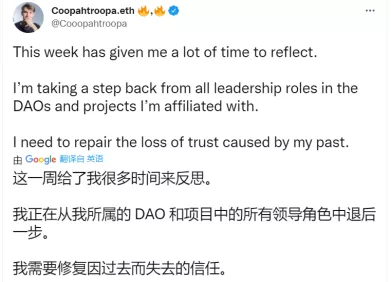
Based on the contingency strategy, in the process of punishment, self-judgment can be used to restore credibility. The decision of whether to punish is made by the community, and the result of punishment is chosen by the punished person, and the result of punishment is chosen by the community. This way of self-consciousness can also better understand the attitude of the punished and restrain oneself better. At the same time, it is also a warning to other people in the community. From the perspective of the punished, the trust of the community can be regained on the basis of reformation. From the perspective of the community, this has also formed a cultural atmosphere, with different roles and everyone is equal, but everyone needs to be vigilant about whether their behavior is wrong. It is causing the tragedy of the commons. After the suicide, the community conducts a reputation vote. The result of the vote not only represents the degree of satisfaction with the result of the suicide, but also reflects the credibility and trust of the member. At that time, credibility was always difficult to measure, but it is well reflected at this time.
Therefore, in DAO governance, the punishment mechanism revolves around personal reputation, which can well restrain the behavior of individuals.
Thanks to DAOctor@DAOrayaki, shawn@DAOrayaki and Tokenbecator.eth, who provided a lot of help in the communication with her (him), and generated a lot of inspiration, thank you.
Hope this article helps you. Thank you for reading.
references:
[1] How to assess new community building hires for token networks
https://medium.com/1kxnetwork/how-to-assess-new-community-building-hires-for-token-networks-a2672c07dd58
[2] Revisiting the Way of Open Community Governance: Eight Principles of Ostrom Commons Governance System Design
https://posts.careerengine.us/p/5f8b4711376f391b21a4c7e8