






About "What is Web3", nine points you need to know


Compilation of this article: 0x13, Kxp, Rhythm BlockBeats
first level title
TL;DR
1. Web3 is a trendy nickname for the decentralized web.
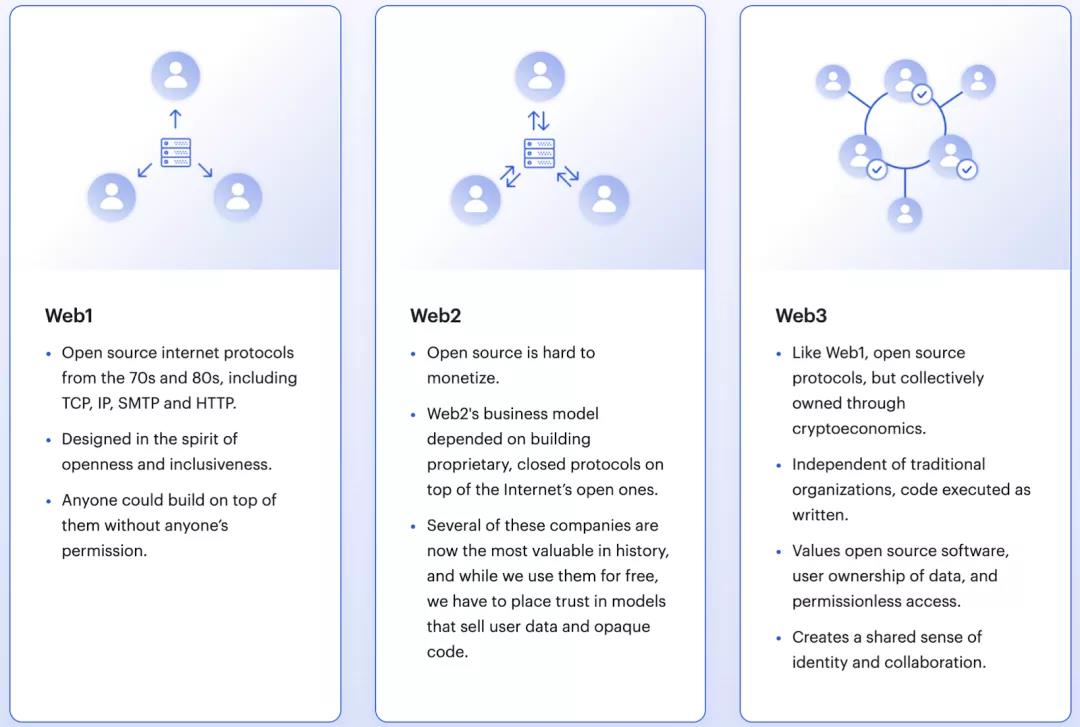
2. Web1 reads only information, Web2 reads + writes information, and Web3 reads, writes, and owns information.
3. Web3 is the currency layer of the internet.
4. Web3 is the identity layer of the internet.
5. Web3 is a reaction to social networks not keeping our data safe and selling user data for profit.
6. Web3 is a way for artists and creators to own not only what they create on the platform, but the platform itself.
7. Web3 is the new incentive model for the Internet.
8. Web3 makes it easy to establish cooperative ownership and governance structures.
secondary title
Web3 is a trendy nickname for the decentralized web
Since 2015, ConsenSys founder and CEO Joseph Lubin has lectured, written articles, and supported teams building Web3 and the decentralized web. The Web3 philosophy has been the "touchstone" guiding all of ConsenSys' early investments and projects.
MetaMask is now the primary way to get people onboarded to use the Ethereum blockchain, with compatibility for more networks on the way. It's a way to securely generate public keys on your phone or computer, but it embodies a new principle of user interaction with the web -- only you have access to your accounts and data, and choose what to share, what to hide. Some people also call MetaMask the Crypto version of the consent manager (customer authorization manager).
When we refer to the decentralized web, we also refer to other stacks beyond decentralized currency and identity. Other aspects of the decentralized web such as decentralized storage are just becoming the infrastructure of the stack for persistent storage (like IPFS and Arweave), decentralized storage (Golem, W3BCloud and others), and decentralized data indexing (Graph Protocol).
secondary title
Web1 read only messages, Web2 read + write messages, Web3 read, write, own messages
When I asked a Web3 developer friend how he would explain Web3, he said: "Web1 is read-only, Web2 is read-write, and Web3 is read-write-own". The original Web was built on open source protocols such as TCP, IP, SMTP, and of course HTTP. A protocol is a standard way for multiple computers to agree to communicate with each other. These underlying protocols govern the information and flow of information on the Internet, and if you want to build an application or service using their rules, you don't have to pay for access.
Web2 is an iterative product built using the Internet's free and open source protocols. Compared with the static, read-only Web1, the major change brought about by Web2 is that individual users can start publishing content to the Internet. It started with likes on Digg message boards, then developed Weibo, and now has more than 2 billion individual users on Facebook. At the same time, another subtle change is quietly taking place. People started thinking that instead of maintaining their own servers to keep their websites up and running, they should leave the trouble to Web2 companies. On the other side of the deal, Web2 has created an island of user data and behavior, a social graph that is valuable to advertisers. In the era of Web2, the individual user is the product.
secondary title
Web3 is the currency layer of the internet
One of the Internet's greatest innovations was the ability to distribute information globally, cheaply, reproducibly, and in great variety. But these labels are opposed to “value,” and by definition anything of value, whether money or an asset, should be scarce and hard to come by. Bitcoin was the first protocol to introduce scarcity to the internet, somewhat solving the "double spending" problem that plagued early digital currency attempts. Double spending means that you can use duplicate digital currency to spend in two or more places at the same time. In traditional finance, banks, credit card companies, and payment processors verify transactions themselves to minimize double spending. For decentralized Crypto, the work of miners or verification nodes is to ensure that accounts will not be double spent. This has profound implications, as verification no longer relies on a trusted central party. Anyone with an internet connection can participate in the peer-to-peer network and check the ledger. Social consensus protects people from malicious actors who try to rollback or censor transactions.
secondary title
Web3 is the identity layer of the internet
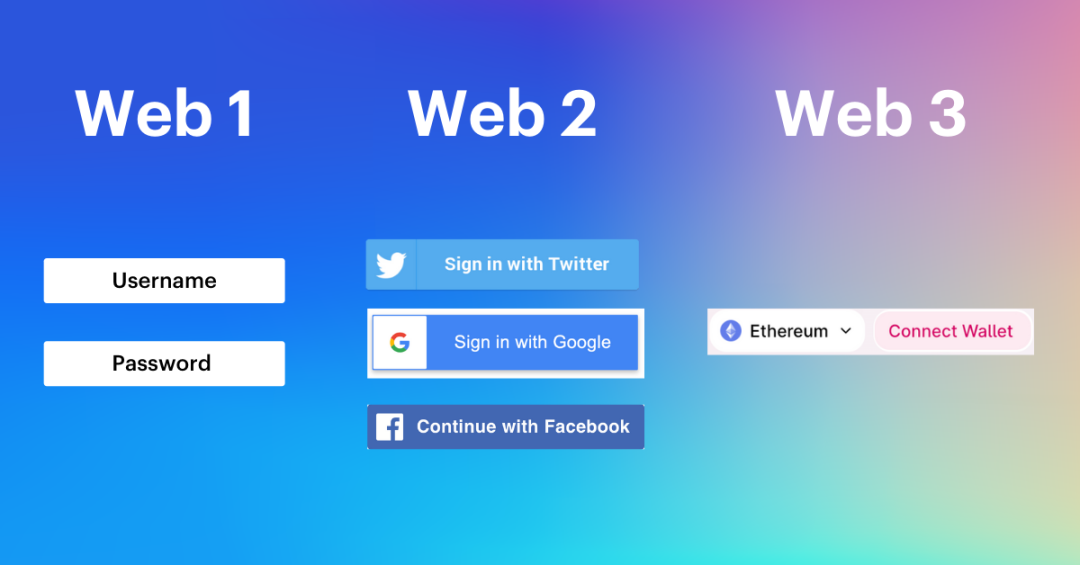
One of the biggest omissions in the early internet protocols was the absence of a public and open-source identity layer. As Web2 evolved, platforms like Facebook and Twitter monopolized this layer as closed-source applications. Whereas Web3's position is that you should own your identity online, and only share some of your information if you want to. In practice, Ethereum's identity system is very basic. You can think of it as a container that allows other projects to be associated with it. For example, when an authority wants to know your date and place of birth, it does not need to know other information that you do not want to provide. Your identity also includes your transaction records, which financial institutions can learn without requiring you to provide your birthday and place of birth. Furthermore, the digital identity you develop on one social network can be ported to other networks.
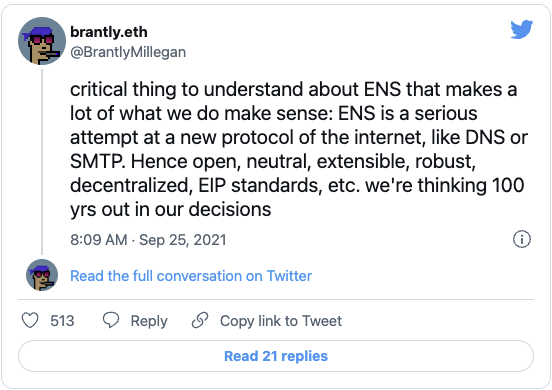
In today's practical scenario, the closest thing the Web3 world has to a common identity layer is the Ethereum Name Service (ENS). Through ENS, you can purchase a unique domain name, which is an NFT using the ERC-721 Token standard, and then you can link it to your Ethereum address. ENS made Ethereum addresses readable, and it has since been used as a more convenient way to airdrop NFTs, show off token holdings or NFT collections, and show what you chose in governance voting. Showing others that you "know" Web3 is actually very attractive, which may be why Paris Hilton, Shaquille O'Neal and others have changed their Twitter usernames to ENS domain names. However, like the early Internet protocols, ENS has no early investors, and the protocol itself is decentralized and given open standards.
secondary title
Web3 is the response to social networks not protecting our data, but profiting from it
Facebook owns most of the data on your social graph, so even if you close the page, the data still exists on Meta's servers. Gavin Wood, who coined the term Web3, said in 2014:"Web 3.0, or the "post-Snowden" network, is a rethinking of various current network activities and introduces a subversive model for all network participants. If we decide that some information needs to be made public, we release it; and if we feel that some information needs to be agreed to reach a consensus, we put it on the to-do list. "The Cambridge Analytica scandal in 2018 revealed that a company had collected the personal information of 87 million people and used it to create voter psychological profiles to influence election results. While it made headlines at the time, these kinds of data breaches have been a regular occurrence, affecting millions of internet users. The reason for all this is simply because we entrust the company to store our data, and when we switch to other platform services later, these permissions have long been irrevocable.
Remember when we described MetaMask as a Crypto version of consent manager (client authorization manager)? Web3 apps are designed on the principle that information is “pushed” by individuals to trusted sources, rather than apps getting it from sources that hold your data. For example, in a Web2 world, when you "sign in with Google," apps could potentially access your personally identifiable data without your consent. The transparency of the data you provide to different applications on the web is one of the reasons why social media networks have gained dominance - your personal information is often very valuable, and in most cases, we agree to the platform's terms of service At the moment it was already handed over.
secondary title
Web3 can allow artists and creators to own not only their work on the platform, but the platform itself
In 2021, it seems like everyone is launching NFTs. According to DappRadar, the total transaction volume of NFT in 2021 will reach more than 23 billion US dollars. For many digital artists, the emergence of NFTs allows them to devote themselves to art work full-time in a true sense for the first time. Since NFT is a common token format, you can mint NFT by deploying your own code or using the NFT marketplace. Unlike Web2 social networks, your Tokens can be purchased on the service platform, sold on the secondary market, or used in other games and applications. In other words, NFT continues the characteristics of Ethereum and is a type of portable and interoperable value.
Some early NFT markets quickly realized that their positioning cannot be just a market, but to build more bridges between creators, users and platforms. In 2021, SuperRare released the RARE Governance Token and created the SuperRare DAO to reward those artists and collectors who joined early, and to encourage the community to participate in its art curation. SuperRare explained: "We hope that Spaces is the future of community art curation. With the support of SuperRare's shared brand and technology, it will become an active ecosystem where curators, artist groups, galleries and community members can hire artists and conduct cooperative auctions. system."
Other applications on Ethereum are now using tokens to reward people for their contributions to network building and decision management. Even Web2 social networks like Reddit are exploring the use of Tokens called "community points" so that active contributors on the subreddit can "own" part of the social network; and DeFi protocols like Uniswap build a A summation mechanism that incentivizes liquidity providers to provide capital for transactions of almost all assets on Ethereum.
secondary title
Web3 is the new patronage model for the Internet
The term "creator economy" is a term used to describe an internet space that aims to help creators monetize in new ways. OnlyFans, Twitch, and other platforms promise that platform users can make money directly from their fans without restrictions, instead of relying on advertising and traffic-centric monetization models. However, unlike the Web3 network, some creators are randomly removed from the network and cannot own the content they share.
The incentive for writers and journalists to earn income directly from their readers has been further intensified by the emergence of platforms such as Substack, Ghost, and Lede in the past year. However, none of these platforms allow writers to leverage ownership to create a direct relationship with their fans. Mirror is a Web3 blog network that allows users to sell their works in the form of NFT, and redefines the mode of creation and sponsorship through "crowdfunding". Crowdfunding allows patrons to fund an idea by depositing ETH in exchange for tokens that certify your sponsorship, which can further be used to join a DAO or receive future rewards from publications. Token is not only useful, it can also prove that you have supported an idea or author, and as more and more people support crowdfunding, the value of Token will become higher and higher. As Kyle Chayka, a New Yorker staff writer who funded Dirt.xyz with Mirror, puts it: “Subscriptions are certainly a sustainable business model for many forms of media, but it’s not necessarily suitable for all forms of content or content. Work, but collectors and patrons are very suitable for this model. NFT can provide support for the relationship between collectors and patrons, and the same is true for various Tokens supported by Mirror, such as ESSAY or Emily Segal's NOVEL. I hope that future Creators can rely on Token and NFT to make money, not just readers or regular payments, and the income from their articles should also be shared by creators and patrons.”
secondary title
Web3 makes it easier to build collaborative governance and ownership structures
If you joined any DAO in 2021, you probably already joined a Telegram or Discord group with other strangers: vote on DeFi governance proposals, make decisions on project funding, get tickets to Erykah Badu concerts; join artists and a developer residency program, collectively buying the sole copy of Wu-Tang Clan's 2015 album Once Upon a Time in Shaolin, and even a joint venture to buy a printed copy of the U.S. Constitution.
A DAO, or "Decentralized Autonomous Organization," is a community-led entity that uses Ethereum smart contracts to establish ground rules and enforce agreed-upon decisions. Some of the largest and earliest DAOs in Ethereum manage ever-growing treasuries for decentralized finance protocols. Currently, the top 20 DAOs have mastered digital assets worth nearly US$10.5 billion.
secondary title
Not every layer of Web3 is decentralized
Any seasoned user of the Web3 ecosystem knows that engineers have been trying to build the most decentralized architecture, easy-to-use applications and scalable infrastructure, and will make various design trade-offs in between. Signal founder Moxie Marlinspike recently blogged about his experiences exploring Web3: "Web1 was built on the premise that everyone on the Internet becomes a publisher and consumer of content, as well as a publisher and consumer of infrastructure. Consumers. We all have our own web server, our own website, our own mail server and our own e-mail. However, this is not really what people want - people don't want to run their own servers (I think This cannot be emphasized enough)".
It shouldn't be too surprising, then, to learn that most of Ethereum's applications call data from trusted API sources, and that the US runs 40% of Ethereum's 5,433 full nodes. MetaMask made a similar design decision in the early years - instead of requiring each user to run a self-hosted Ethereum node, they chose to use Infura to provide data for Ethereum. In this way, developers can focus more on building applications rather than the infrastructure on which the network operates. Dan Finlay, founder of MetaMask, wrote: "This approach makes it easy for users to use our platform without consuming too much power to host nodes. At the same time, it also changes the past in terms of the use and promotion of the platform. The rule, exactly confirms what Moxie said before: "People don't want to host their own servers (because it will take up the entire laptop computer capacity)".
However, this does not mean that the Ethereum and Web3 communities are still considering using decentralized data centers like W3BCloud, or transferring lightweight clients to Eth2 through a series of operations to reduce trust at all levels. Although MetaMask uses Infura as their default server, they have always allowed users to choose their own blockchain connection. In addition, with Snaps, users can choose other options besides using a server to connect to the wallet. Dan Finlay explained, “Snap can help users run lightweight clients, choose alternative runtime systems like zk-STARK chains or new friendly languages, or it can also let users connect to their favorite centralized service platforms.”
While many teams in the Ethereum community are working on improving centralization, the success of some newer, more centralized Crypto networks suggests that users may not care too much about these things. However, we cannot conclude that the Web3 infrastructure will not achieve further development in the future, because more and more people have experienced the advantages of a completely decentralized network.


