AI Industrial Revolution: Where Do We Stand Now


- Core Insight: The current AI landscape remains in the early stage of "installing new machines in an old factory," and the true transformative turning point has yet to arrive. The core challenge for enterprises is not a lack of technical capability, but the need to fundamentally restructure production methods around AI, much like factory owners in the Industrial Revolution moving away from rivers to rebuild power plants. The future core assets lie in deeply embedded industry workflows and unique data, while organizational structures and individual career paths will both be reshaped.
- Key Elements:
- Existing applications are still "replacing water wheels": Most organizations merely attach AI as a chatbot to existing tools, failing to redesign workflows around it, causing saved time to be consumed by old processes. The adoption of AI is stuck between "tool upgrades" and "workshop rebuilding."
- Infrastructure investment risks overheating: Capital expenditure on AI infrastructure is massive (projected to reach $765 billion by 2026), reminiscent of the railway mania of the 1840s. The risk lies in a glut of general-purpose computing power, coupled with a scarcity of specialized capabilities for high-value scenarios (such as financial compliance), where falling API prices could undermine returns on investment.
- Pioneers of organizational change are taking action: Companies like Notion and Y Combinator have begun to "dismantle the factory," restructuring team collaboration through AI Agents (Notion has over 700 Agents) and pushing for "recursive self-improvement" organizational models. Management roles are being replaced by AI, and companies need to become "readable" by AI to form an organizational brain.
- Consulting firms play a critical role as "railway engineers": Anthropic has partnered with KPMG and Accenture to help large enterprises dismantle old processes and rebuild production lines around AI. These giants act as catalysts for organizational change, rather than mere technology users.
- Entry-level positions are under pressure: Data shows that young people aged 22-25 entering AI-exposed occupations have a 14% lower probability of employment compared to their peers, signaling that entry-level roles are being replaced or reshaped by AI. An individual's old "water wheels" (such as degrees and experience) are depreciating.
- New organizational forms are being built around "human-machine collaboration": Future companies operate on a logic of "burning tokens, not headcount." The core value of humans will shift toward offline judgment, novel situations, and emotional decision-making, while AI Agents handle execution and information flow. The old hierarchical structures are being broken down, and individuals must ensure they are "standing along the railway lines."
Original Author: Will Awang
Over the past year, I've attended some industry conferences themed around AI. Guests on stage took turns demonstrating AI's latest tricks, while people in the audience held up their phones to film the screen, posted it on social media, and then went back to scrolling. But back in the office, it was the same weekly meetings, the same approvals, the same weekly reports. Big companies have already written token consumption into their KPIs; some people become model workers just by using scripts to inflate their usage. The people on my social media feed are one day championing Claude's revolution, the next declaring Codex is awesome, and the day after hailing Gemini — are they embracing a revolution, or just rushing to the next hype?
This is all noise, not the answer I'm looking for.
The real question isn't whether AI is powerful enough — the steam engine is already built. The question is who will be the first to tear down the old workshop.
The Industrial Revolution truly began not when Watt improved the steam engine, but when a mill owner in Lancashire decided to move away from the river and rebuild their workshop around the steam engine. The most important moment for AI will be the same — not the day the large model was invented, but the day the first organization decides to dismantle the old workflow and rebuild its production method around AI. That day hasn't arrived yet. But it is on its way.
Two people saw this coming very early. Notion CEO Ivan Zhao wrote an article titled "Steam, Steel, and Infinite Minds" in late 2025, making a cold assessment: we are still in the "water wheel replacement" phase — adding AI chatbots onto existing tools, but no one has redesigned the factory. OpenAI former employee Leopold Aschenbrenner took a different path: he wrote the 165-page "Situational Awareness," then built a fund, growing it from $225 million to $13.68 billion, all betting on AI infrastructure. One looked inward, the other gambled outward.
This article isn't about them. It's about us — where we stand now, and which part of history we are repeating.
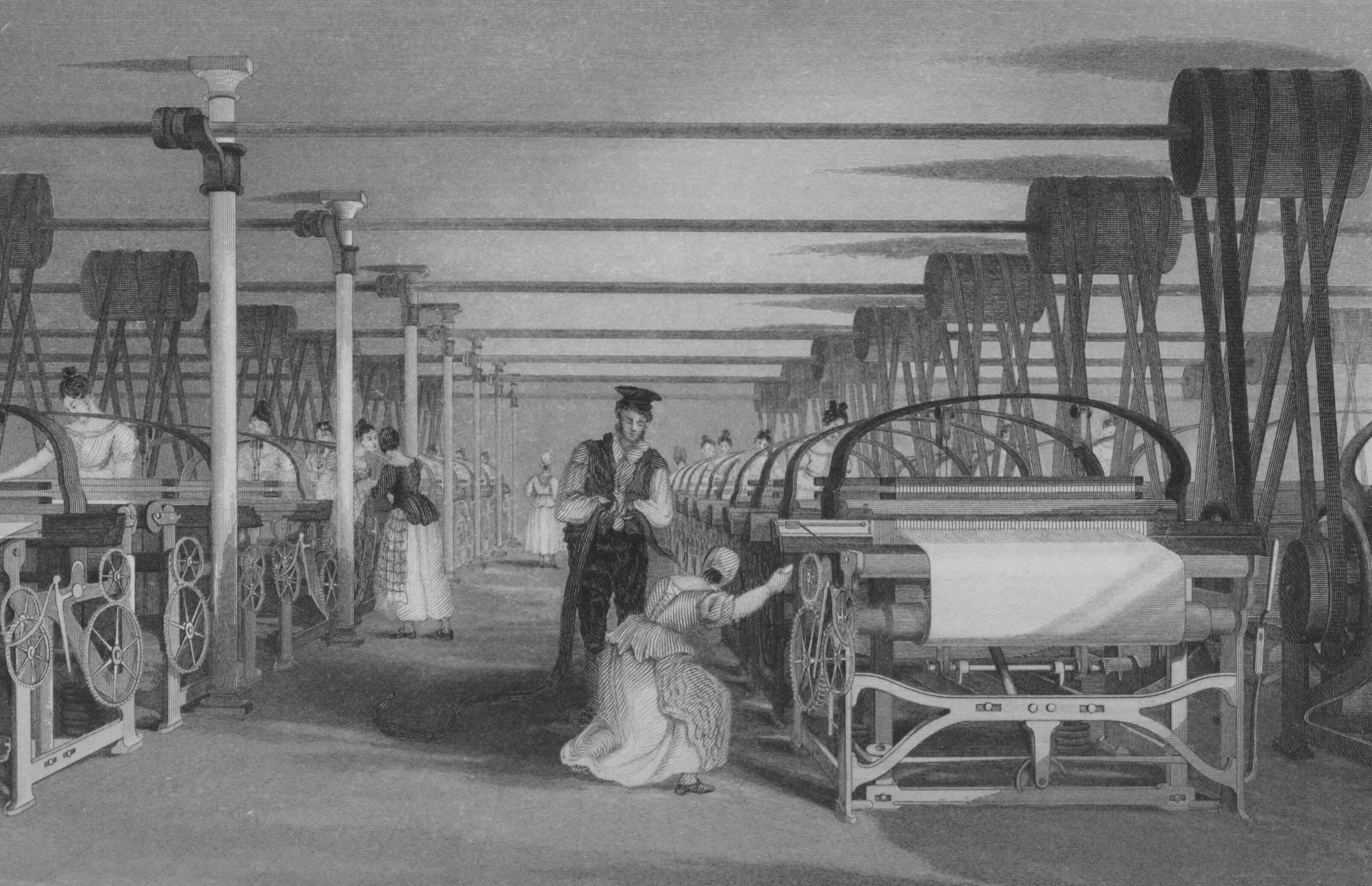
( Power-loom weaving, engraving by J. Tingle after Thomas Allom, 1835 / Wikimedia Commons )
1. The Workshop is Still Old
Most people's day looks like this: use AI to write an email in the morning, saving ten minutes; then spend two hours in a weekly meeting that shouldn't have happened; copy and paste the same set of data between three different tools in the afternoon; post on social media in the evening saying "AI is amazing." The ten minutes saved were neatly consumed by the old workflow.
Similarly, when the steam engine appeared, factory owners initially just replaced water wheels with steam engines, leaving everything else unchanged — the factory was still built by the river, still a multi-story building, still using a central drive shaft to power the entire production line. We put ChatGPT into Slack, add Copilot into Office, embed an AI chat window into the workflow — doing the same thing. The tool was upgraded, but the workshop didn't change.
But replacing the machine isn't the same as replacing the workshop. As McLuhan aptly put it:
We drive into the future using only our rearview mirror. Accommodating new tools with old workflows is like early films merely being recorded stage plays. The real breakthrough comes only when someone frees the steam engine from the river and completely redesigns the production method around the new power source.
Comparing the timeline of the Industrial Revolution with AI can give us a rough idea of where we are on the map.
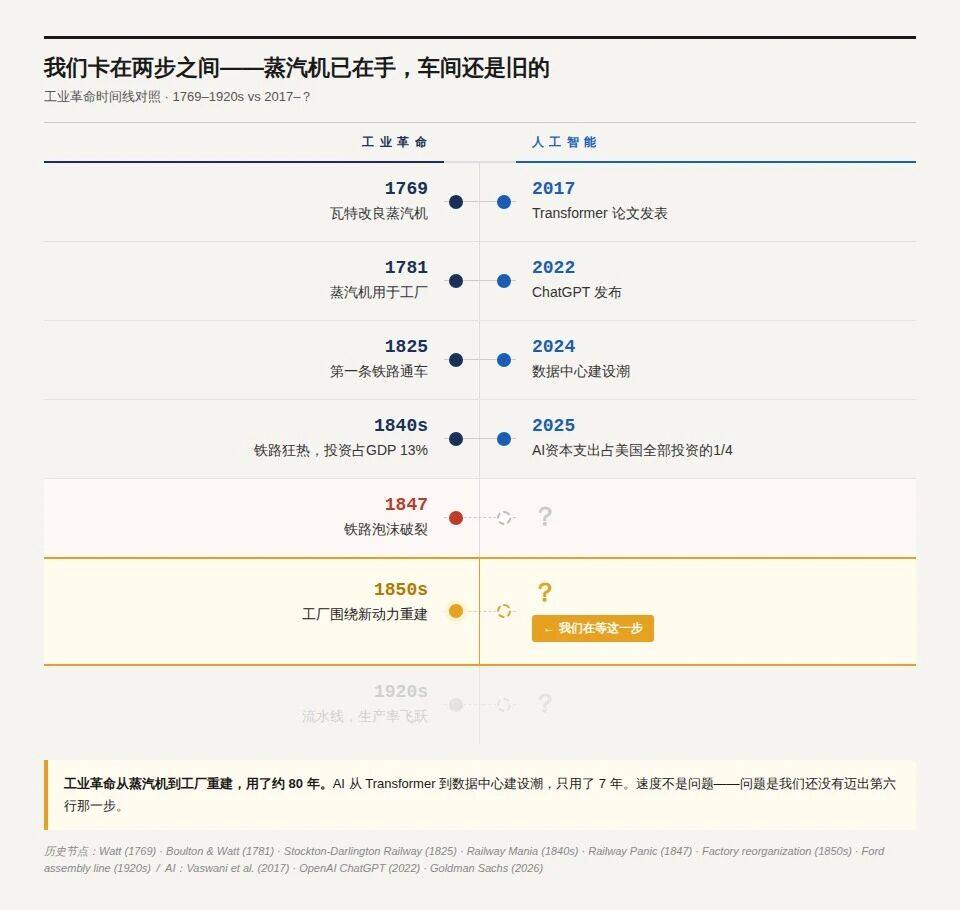
Today's timeline is extremely compressed. The Industrial Revolution took 60 years from the steam engine to the railway mania. AI took only 7 years from the Transformer to the data center construction boom.
Speed isn't the problem; the problem is where we are stuck — the first four rows are all in the "new machine in old workshop" phase. The steam engine is installed, the railways are being laid, but the production method remains unchanged. The sixth row is the true watershed. We are likely stuck between these two steps.
The steam engine is already in hand, but the workshop is still old.
2. The Money is All Piled into the Layer Furthest from the Factory
Infrastructure is always overbuilt. It's the investors who go bankrupt, not the infrastructure.
In 1846, the British Parliament passed 263 railway acts, approving the construction of 9,500 miles of new railway. At its peak, railway investment accounted for 13% of British GDP. Railway shares could be bought with just a 10% down payment, and the middle class flocked in. The bubble burst in 1847. One-third of the approved lines were never built, and countless investors lost everything. Darwin lost 60% on railway stocks, and he was luckier than most.
But the railways remained.
Today's AI infrastructure is following the same path. Goldman Sachs estimates global AI infrastructure capital expenditure to reach $765 billion in 2026, with projections of $1.6 trillion annually by 2031. The capital expenditure of hyperscaler cloud providers as a percentage of operating cash flow has risen from around 40% in 2023 to nearly 70% in 2025. AI-related investments now account for about a quarter of all US investment. Aschenbrenner's $13.68 billion was betting on this layer — not on which application would win, but on the underlying computing power itself.
This capital cycle is isomorphic to real estate development. Building a data center is like building a building: land is electricity, building materials are GPUs and storage, contractors are data center construction firms, developers are cloud providers, tenants are AI application companies, and rent is API revenue. The cloud provider's business model is to pay off the loan with rent — using API revenue to cover data center capital expenditure, waiting for the valuation leap brought by the explosion of AI applications.
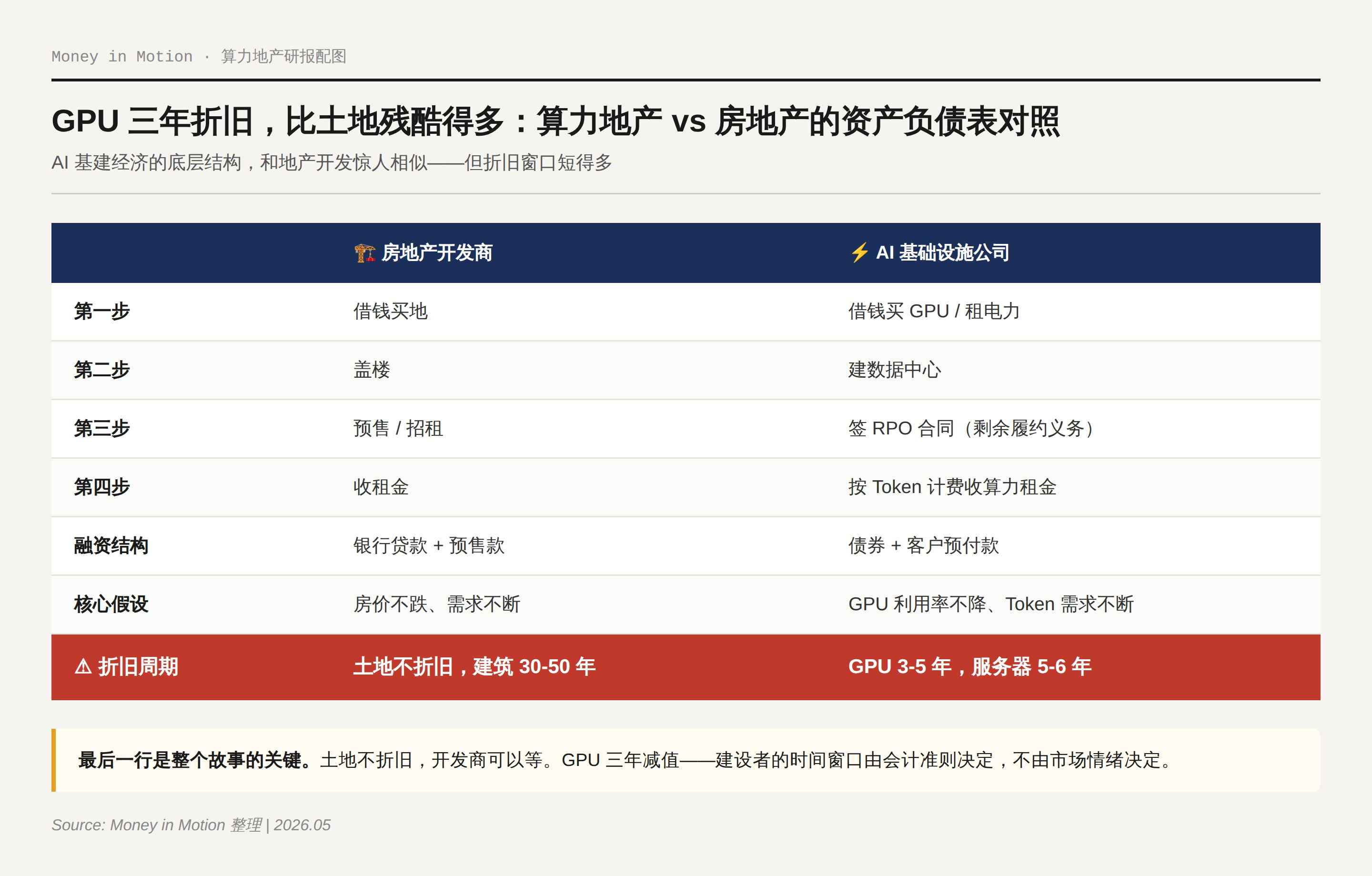
(Computing Power Real Estate: Each generation has its own infrastructure)
The core risk is the same: is the decline in API unit prices being offset by the growth rate of call volume? If rental income falls below the loan repayment line — this is the nightmare most familiar to real estate developers. The lesson from 2008 wasn't that too many houses were built, but that the houses built structurally didn't match the real demand. AI's equivalent risk is: an overabundance of general-purpose computing power, but a scarcity of specialized capabilities for high-value scenarios like financial compliance or medical diagnosis.
Railways, real estate, AI — infrastructure investments across three eras share the same rule: overbuilding is the norm, building material suppliers always lose pricing power, and long-term returns always go to the owners of "prime locations." Look at the Q1 fund holdings on Wall Street — probably 80% is in this infrastructure layer: NVIDIA, data centers, cloud infrastructure. But the railway mania taught us that this isn't the full picture of the AI revolution, nor even the layer with the highest returns.
What is AI's prime location? It's unique industry data and deeply embedded workflows. For individuals, the true "prime location" isn't the stocks they hold, but their own irreplaceable judgment and industry knowledge — provided they have already rebuilt the way they use them around AI.
The real returns are in the next layer. But the transition from infrastructure to value creation isn't seamless. There is a gap in between — historically, this gap swallowed decades.
3. Who is Dismantling the Workshop
People dismantling the workshop and people trying to "improve efficiency with AI" are not doing the same thing.
Zhao Ivan's co-founder, Simon, used to be a "10x programmer." Now he rarely writes code himself — he simultaneously controls three or four AI coding agents, achieving 30x to 40x efficiency. Notion now has 1,000 employees and over 700 AI agents. The gap isn't the tool; it's that Simon dismantled his old workshop, while most people just replaced a water wheel.
600 million Chinese users have used generative AI tools, a 142% year-over-year increase — this is the world's largest AI demand pool. Yet almost no Chinese company has rebuilt its core workflow around AI. The world's largest demand side, paired with a nearly static organizational change on the supply side. This contrast itself is a signal: it's not that the tools are insufficient; it's that the organizations haven't kept up. The context of knowledge work is scattered across dozens of tools and dozens of minds. Output is unverifiable, and no one knows how to judge whether a strategic memo is effective.
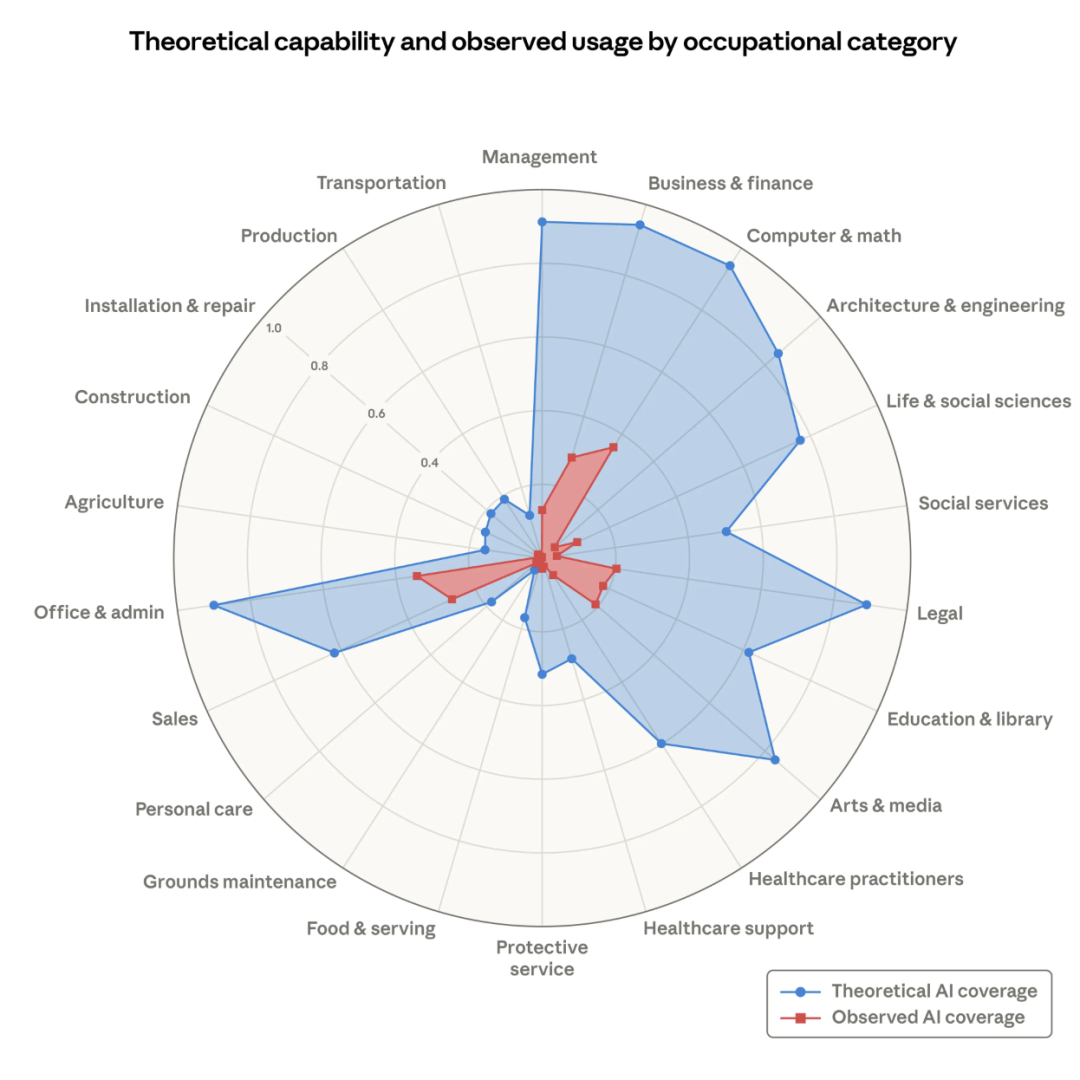
(Labor market impacts of AI: A new measure and early evidence)
Anthropic is already making moves on a larger scale. They released the Economic Index, using real usage data to map which tasks and industries AI is replacing first, and then building according to this map: forming a joint venture with Goldman Sachs, Blackstone, and Hellman & Friedman to create an AI-native enterprise service company; establishing a global alliance with KPMG, integrating 276,000 employees into Claude; Accenture forming a business group training 30,000 people, focusing on finance, life sciences, and healthcare.
These consulting firms are not playing the role of AI users; they are AI's railway engineers. They don't build the steam engine or lay the tracks; they help companies tear down old factories and rebuild production lines around the new power source. Without this role, most factory owners wouldn't know where to start.
The signals are already flashing. The sharpest one comes from the job market.
Young people aged 22-25 entering occupations highly exposed to AI are 14% less likely to find a job compared to their peers entering low-exposure occupations. Entry-level positions are already being squeezed.
If I were a recent graduate, this number would directly impact my job search. If I were a manager, the next batch of entry-level positions I hire for might no longer be filled by people.
Organizations are dismantling. What about individuals? My degrees, my resume, the industry experience accumulated over the years — these are my water wheels. They once drove my entire production line, but the steam engine has arrived. Top university status is no longer a moat; it only proves I once built a decent factory by the river.
The question now is, do we have the ability to leave that river?
Anthropic's data shows that users who have used AI tools for over 6 months have a 10% higher task success rate than new users. Those who started six months early already have a 10% lead, and this gap will compound over time.
But so far, not a single company has gone bankrupt for not using AI. My own law firm, for instance, is still making great strides around AI. The winners haven't been selected by the market yet. The learning curve is real — those who started early are already building an advantage, but most people are still at the starting line.
4. My Next Job Title Doesn't Have a Name Yet
Will my current job title still exist ten years from now? How many of the tools I used daily five years ago are still on my list today? The answer is probably no for both. But I don't know what will replace them — because those things don't exist yet.
This has happened every time in history. New things aren't planned; they grow naturally once old constraints disappear.
Before the railways, Britain was a collection of isolated local economies. The price of cotton cloth in Manchester could differ by 30% from London. Every city had its own local time, and nobody saw a problem with it. Within twenty years of the railways being built, everything changed. A unified national market emerged for the first time, price differences were erased. Standard time was forced into existence by the railways, not invented. Station masters, telegraph operators, travel agents — these jobs didn't exist before the railways.
No one foresaw the department store while laying tracks. No one foresaw standard time while building the steam engine.

(Steam, Steel & AI Infinite Minds)
The history of cities tells the same story. Cities a few hundred years ago were on a human scale — a forty-minute walk across Florence. Steel frames made skyscrapers possible, railways connected cities and their hinterlands, followed by elevators, subways, and highways. Tokyo, Chongqing, Dallas — these aren't just bigger versions of Florence; they are entirely new ways of life.
Knowledge work today is also on a human scale. Teams of a few dozen people, paced by meetings and emails. Systems buckle under more than a few hundred. We are building Florence with stone and wood. AI makes the "Tokyo" possible — organizations composed of thousands of AI agents and people, with workflows running continuously across time zones. The old weekly meetings, quarterly planning, and annual reviews may no longer make sense.
Simon doesn't write code anymore — his job has become "managing AI agents." This position didn't exist two years ago. My next job title probably doesn't have a name yet. But someone is already building that future we can't yet name.
5. What the New Workshop Looks Like
After tearing down the old workshop, what do you build? YC's answer is: let the company improve itself.
Their internal system now rewrites its own code at night. An employee made a query during the day, and it failed. A monitoring agent read the failure, traced the cause, wrote code to fix it, submitted it for review, and deployed it. The next day, the same query worked. The whole thing happened while everyone was asleep.
This isn't AI helping people produce 30% more. This is the system running a complete loop by itself, figuring out how to get better.
YC partner Tom Blomfield, in an internal talk, called this company form a "recursively self-improving AI loop." His assessment was direct: most companies are still Roman legions — orders go down, information goes up, with people acting as conduits for information. AI doesn't just break the efficiency of one link; it breaks the very premise of this entire hierarchical structure.
His new logic is: burn tokens, not heads. The bottleneck is shifting from manpower to computing power. The data YC sees shows that companies in its Demo Day batch have roughly 5 times higher revenue per employee than they did 18 months ago. The role of middle management is being taken over by AI — "coordination" no longer needs people. Everyone should be an IC, a builder, an operator. Every task should have a named owner, not a committee.
There's also a prerequisite: the company must be "readable" by AI. Things not recorded haven't happened in AI's eyes. YC now ingests all partner emails, all Slack messages, and recordings of office hours. One partner used 2,000 hours of recordings accumulated over three months to let AI regenerate a 150-page internal handbook — much better than the old version. This handbook updates automatically each