OpenSea’s Agent Ambition: How ERC-8257 Could Turn NFTs into Passports for AI Agents?


- Core Thesis: OpenSea has released the ERC-8257 draft, aiming to transform NFTs from assets into access credentials for AI Agents through an on-chain tool registry. This move seeks to capture the tool distribution and trading gateway in the Agent economy, opening a new growth path for the NFT market.
- Key Elements:
- ERC-8257 defines an "Agent Tool Registry," allowing developers to register tools and set on-chain access conditions (e.g., holding a specific NFT) via an accessPredicate contract. Agents can discover tools and verify their own permissions.
- This standard does not handle payments, only permission verification. Actual payments are managed by protocols like x402, with pricing information stored in off-chain manifest files, ensuring the standard remains lightweight.
- OpenSea likens ERC-8257 to an HTTP 403 (insufficient permissions), complementing x402 (payment required). The goal is to build a distribution and access infrastructure, not a closed application store.
- Use cases show that Agents could purchase an NFT to obtain discounted call permissions (e.g., reducing a single call fee from $0.05 to $0.01), extending the utility of NFTs as discount cards, membership passes, or subscription credentials.
- A reference implementation has been deployed on the Base mainnet. However, challenges remain, including cross-chain wallet state verification, overlap with other standards, and an inability to guarantee the quality or security of the registered tools.
Original author: KarenZ, Foresight News
This time, OpenSea's narrative focus isn't on NFT trading. It has its sights set on a different entry point: as AI Agents begin to autonomously discover tools, obtain permissions, and pay fees, whoever organizes these tools could claim the starting point of the next wave of on-chain distribution.
OpenSea borrows a metaphor everyone is familiar with: The App Store lets developers publish applications and users discover and pay for them; Agent tools need a similar entry point. The difference is that this time, the entity browsing the store, judging permissions, preparing payments, and invoking services might be an Agent holding a wallet.
OpenSea's Focus: NFTs Transitioning from Assets to Permissions
On the evening of May 26th, OpenSea released "ERC-8257: Agent Tool Registry". In the scenario OpenSea presented, an AI Agent attempts to value an NFT. It gets rejected when calling a professional pricing tool and subsequently discovers that addresses holding a specific NFT can use a discount interface. The Agent then buys that NFT on-chain, resubmits the request, and reduces the single call fee from $0.05 to $0.01.
This example highlights OpenSea's new calculation. In the vision of ERC-8257, NFTs can also serve as access credentials that machines can read and use immediately.
Research data sources, pricing tools, trading signals, and partner APIs can all have on-chain access thresholds set. For example, holding a specific NFT is required to access a discount interface, holding a subscription-type NFT is needed to call premium services, or entry is determined via whitelists, staking balances, or zero-knowledge proofs.
For OpenSea, the change is very concrete. An NFT's utility can extend from avatars, collectibles, and community identity to discount cards, membership certificates, or limited-access tickets when an Agent invokes a service. The objects tradable on the marketplace subsequently expand to include access rights directly executable by software.
OpenSea CTO Chris Maddern subsequently summarized this direction as a more complete on-chain pathway: stablecoins for Agent payments, NFTs for identity and subscriptions, and the Agent Tool Registry driving this concept closer to actual operation.
ERC-8257's Scope is Narrow: Registering Tools, Verifying Eligibility
ERC-8257 was created on April 17, 2026, and is currently marked as Draft in the ethereum/ERCs repository. Its title is Agent Tool Registry, aiming to provide a permissionless on-chain tool registry, not to build a full-fledged app store with review, ranking, and refund mechanisms.
The technical design of ERC-8257 is not overly complex. When a developer registers a tool, several key elements are recorded on-chain: the tool creator's address, a metadataURI pointing to the tool's documentation file, a manifestHash proving the documentation file hasn't been tampered with, and an accessPredicate deciding who can access the tool.
In simpler terms, the on-chain registry acts like a verifiable tool catalog: what the tool does, how to call it, and price hints are stored in an off-chain manifest file; the hash of this file is written on-chain. After pulling the file, the Agent can verify if the content matches. Whether a specific wallet is eligible to call the tool is determined by an independent predicate contract.
If the accessPredicate is a zero address, the tool is open to all callers. If a contract is specified, it can verify conditions like NFT holdings, subscription status, whitelists, staking thresholds, DAO voting results, or zero-knowledge proofs.
It's important to note that ERC-8257 does not handle funds. The proposal explicitly places pricing information in the manifest and delegates actual payments to x402 or other payment protocols. The registry handles discovery and permissions, while settlement is left to external systems. This separation keeps the standard lightweight and means OpenSea is launching more of a distribution and access infrastructure layer rather than a new payment protocol.
This is also why the ERC-8257 author called it "the 403 to x402's 402". In the HTTP context, 402 indicates payment required; 403 indicates insufficient permissions. x402 answers "how to pay for this call", while ERC-8257 aims to handle "whether this address is eligible to enter".
Strictly speaking, 403 is an analogy to help understand the product positioning. The ERC-8257 draft specifies registration and permission determination mechanisms, and does not require all tools to respond to Agents through some fixed HTTP 403 flow.
The So-Called Agent App Store: Competing for the Distribution Starting Point
The "App Store" term easily evokes a closed market governed by platform review, rankings, and control. However, the core design of ERC-8257 leans towards openness: any developer can register tools, Agents can read on-chain registration information, and access conditions can be extended through external contracts.
What OpenSea truly aims for is the scenario of tool discovery and asset trading on top of open protocols. Previously, Agents finding tools relied on documentation, GitHub repos, centralized directories, or manual configuration. ERC-8257 attempts to provide a verifiable on-chain entry point, letting Agents find valuation APIs, research subscriptions, trading signals, or data services, read usage conditions, and then purchase permissions or complete payments based on their wallet state.
On the Ethereum Magicians discussion forum, the proposer stated that a reference implementation has been deployed to the Base mainnet and validated via CLI, SDK, and examples including ERC-721, ERC-1155, subscriptions, and composite predicates.
This opens a broader path for OpenSea than competing in NFT aggregation trading. As long as the Agent economy requires on-chain memberships, tradable seats, or token-gated APIs, OpenSea can continue to play the role of asset discovery and purchase venue. The objects the platform matches can gradually expand from cultural assets to the access credentials needed for machines to execute tasks.
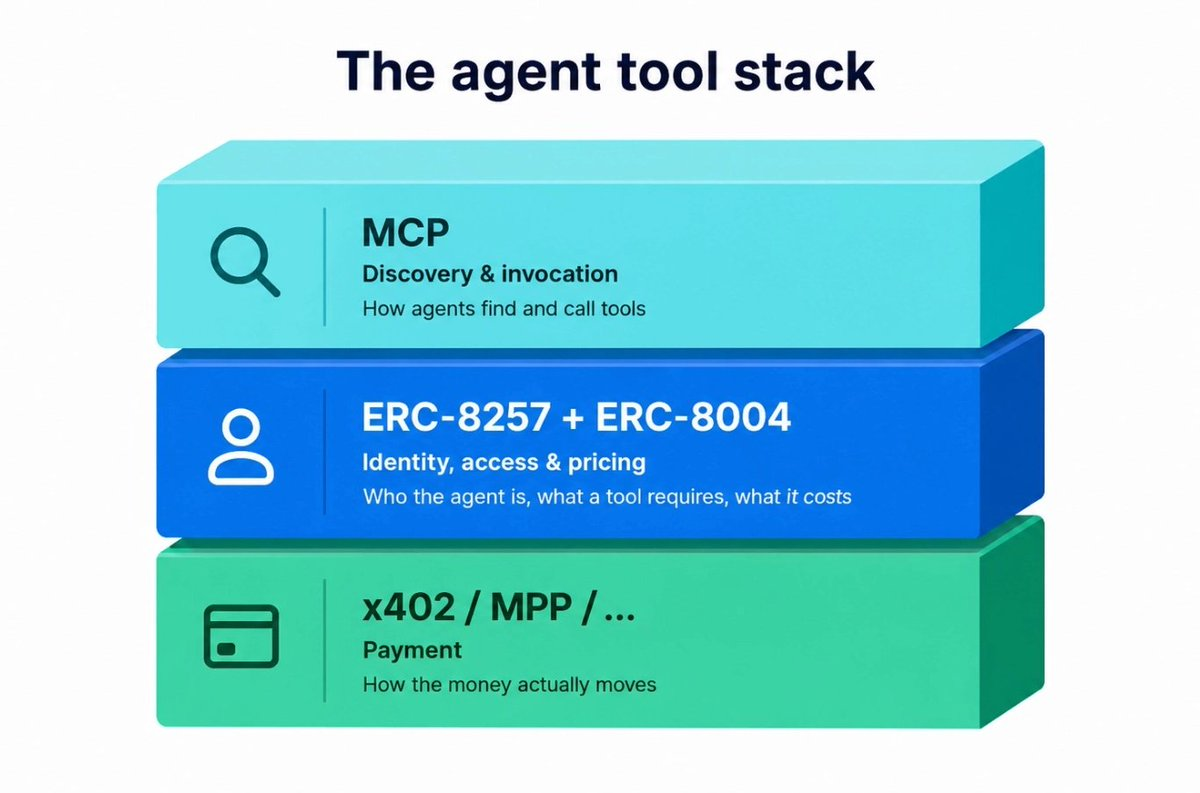
If we break down an Agent calling an on-chain paid tool, the emerging division of protocols generally looks like this:
MCP handles the communication method between tools and AI applications. Servers can expose tools, resources, and prompts; clients discover the capabilities of connected services and initiate calls. It deals with capability descriptions and invocation interfaces but does not inherently provide a public, on-chain, verifiable global tool directory.
ERC-8004 focuses on Agent identity, reputation, and verification records, allowing different entities to identify a specific Agent and its historical behavior clues.
x402 addresses payment, enabling humans or Agents to programmatically pay for APIs and digital content using stablecoins.
ERC-8257 attempts to fill the layer of tool discovery and access: how an Agent finds a tool, verifies the manifest hasn't been tampered with, and determines if its wallet meets the usage conditions.
What Are the Challenges?
ERC-8257 gives Agents a tool catalog and a set of access rules, but it doesn't automatically solve issues of service quality and security.
The on-chain manifest hash only proves the documentation file the Agent reads is consistent with what was registered. It cannot prove the tool's output is reliable, the interface won't leak data, or that the developer will provide long-term service. Predicate contracts can also be misconfigured, become obsolete, or introduce complex risks. An Agent being able to automatically buy a ticket doesn't mean the room it enters is necessarily safe.
Several issues on the Ethereum Magicians discussion forum still require refinement: how to prove cross-chain wallet states; whether ENS is suitable as an additional discovery entry point; whether naming conventions for payment protocols need standardization; and whether there is overlap between ERC-8257 and another proposal, ERC-8239: Agent Skill Registry. The proposal's author also acknowledged in the discussion that integration opportunities still exist between tool definitions, price hints, and different registry approaches.
Therefore, ERC-8257's significance is not that it has already become the unified answer for the Agent tool marketplace. It's more like OpenSea setting up a table early on: Agents come looking for tools, developers come to register capabilities, NFTs assume the role of permissions, payment protocols handle settlement, and OpenSea wants to sit in the spot closest to where the transaction happens.
The most important question for the NFT market used to be: who is willing to bid for an on-chain asset? The new question ERC-8257 opens up is: when a piece of software needs permissions to continue working, what will it buy, and where will it buy it from?