Founder of a16z: How to build a personal productivity system?



In the venture capital ecosystem, we can always see new changes in technology every once in a while, and new business models bring various new forms of startups. In contrast, the venture capital industry seems somewhat "old-fashioned", but from another perspective, it is also because of the great challenges behind the industry's breakthrough in innovation. If we want to make a ranking of the innovation power of the venture capital industry, I believe that A16Z must be among the best. A16Z's unique concept and style of play have always been the vane of new forms in the industry.
In 2011, A16Z co-founder Marc Andreessen published an article titled "Software Is Eating the World" in the Wall Street Journal, which aroused widespread concern. As an investor and a technical expert, he interpreted the general environment of the technology industry and concluded that "software and Internet companies are a great opportunity." In that era, Marc captured Facebook, Groupon, Skype, Twitter , Zynga and other outstanding Internet companies.
In the past two days, Tesla founder Elon Musk, Twitter founder Jack Dorsey, Coinbase founder Brian Armstrong and Marc Andreessen's debate on Web 3.0 has become the most eye-catching topic on Twitter. Before creating A16Z, Marc co-founded Netscape, the originator of browsers. In the era of Internet technology development, Marc Andreessen is undoubtedly one of the most influential and topical superindividuals.
The content shared today comes from an in-depth dialogue between Marc Andreessen and Sriram Krishna, the manager of The Good Time Show (and Sriam is also a partner of A16Z). Marc shared his personal productivity, schedule, reading habits, and learning optimization. latest thinking. I read this content in the second half of last year. After reading it, I feel that this article will not give you an enlightening experience immediately, but after going through it slowly and pondering carefully,You will find that the content in the article is a rational regression that respects common sense. I suggest that you collect it first, and then read it regularly.
At the beginning of this month, I visited an outstanding senior in the investment industry, and asked a question - if the work of investment is to truly go through cycles, what is the competitiveness worth continuing to build? , The answer given to me by my predecessors is that we must always maintain a keen eye for front-line business. Also, as Marc mentioned in this conversation, venture capital is very "close to the actual front line" work. Investors should not think about withdrawing from their daily routine. You need to really understand what's going on. You have to be in close touch with what's going on in the market, know the technologies, know what these entrepreneurs are doing. My admiration for Marc is that since the founding of Netscape, Marc has always been at the forefront of technological innovation and business development in the past 30 years, and behind this is a set of personal productivity systems he built. The input of information and a firm belief in technology as a driving force are inseparable.
In order to give you a better reading experience, some adjustments have been made to this article without affecting the content. At the same time, you can also choose the content you are more interested in to read directly in the dialogue directory.Sincerely hope that you can help share and recommend our content, hoping to bring you inspiration.secondary title
conversation list
personal productivity
The value of open-ended hours and delegation
goals and systems
Process, Outcome, and Stakes
books and reading
Learning and Perspectives
first level title
01
about personal productivity
Sriram: Over ten years ago, you published your famous Pmarca Personal Productivity Guide on your personal blog. So, what does the 2020 edition of The Marc Andreessen Personal Productivity Guide look like?*(Pmarca is Marc Andreessen's personal blog)
Marc:I basically did a big 180° of the guide that was 13-14 years ago. Many of these adjustments are just because A16Z was founded and hopes to continue to grow bigger and stronger. We currently have a large number of companies in our portfolio, and there is a significant amount of investment work going on at any point in time. The A16Z senior partners and I have very high-intensity affairs to deal with, so we need a more structured lifestyle. This guide is by far the most organized I've tried.
A typical day for me is one that follows a strict schedule. I will try my best to complete the "programming calendar" scheduling guidelines.
Sriram: Take me through your day.
Marc:My schedule is more on a weekly basis. The day of the week determines many things. Mondays and Fridays have very specific schedules because we run on the cadence of VCs. Mondays feel like an all-day "marathon" because most of the real teamwork happens on Mondays. Friday's schedule is the same as Monday's. Tuesdays, Wednesdays, Thursdays are much more flexible, usually more outings, board meetings, entrepreneurial consultations, etc. Working on this schedule from Monday to Friday, I now finally understand why people have the concept of weekends. I'm doing my best to allow some down time for Saturday and Sunday.
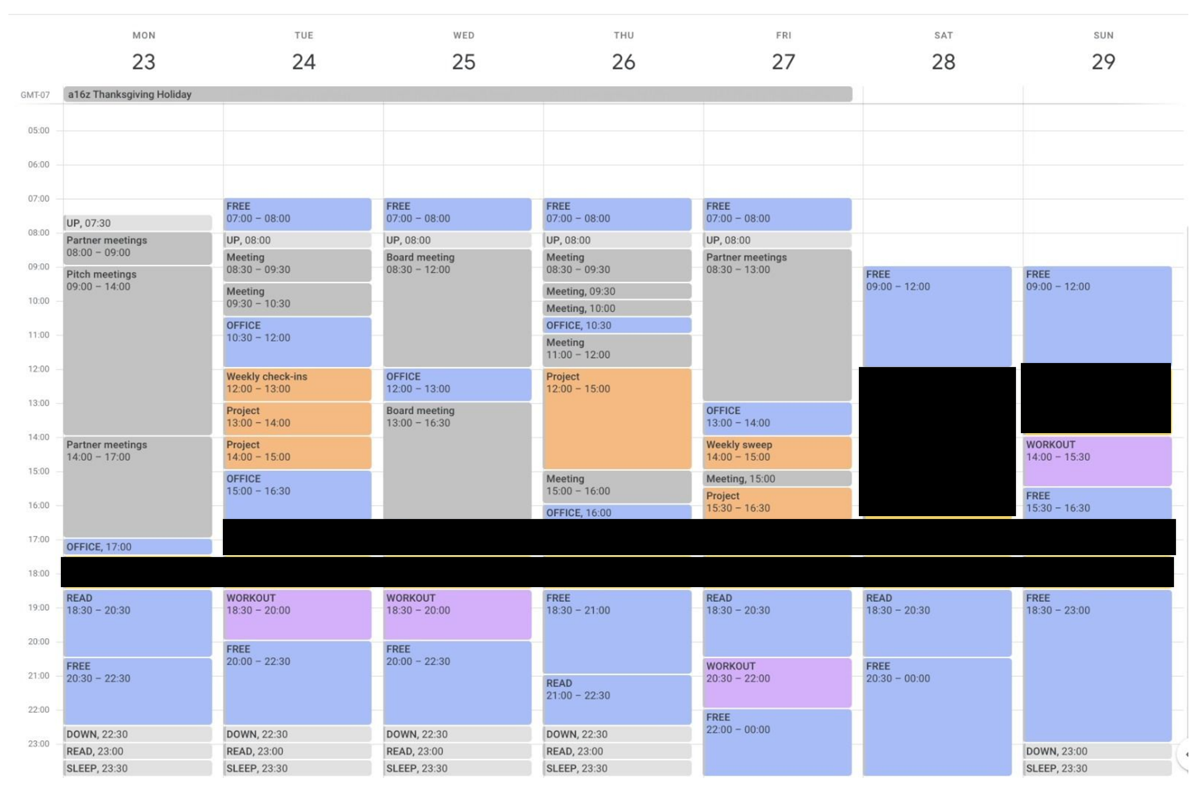
Sriram: In your previous post, you talked about Arnold Schwarzenegger's open schedule and the benefits of having unstructured time in the day and the flexibility it gives you.
Marc:I think Arnold was in "entrepreneur mode" when he did that interview. At that time, he participated in many entrepreneurial projects and opened up many new businesses. I think if you're an entrepreneur in heavy innovation mode, flexible hours are definitely beneficial.
I was as busy as him when I was doing programming in my early years. Basically just keep doing one thing until you burn out. Then get up the next morning and continue. I never had a real schedule. I just know what I'm doing. In a sense, it's the same as not having a schedule. But when you're dealing with things that involve organizational operations or customer service, there are challenges. It's about how we think about our work. If part of your job is dealing with a lot of phone calls or emails, you need to respond promptly without making people wait too long. Maybe some people can reply immediately, but I don't know how.
Sriram: Was there a moment when you decided to change your old system? Was it when you started your company?
Marc:Yeah, to be honest, we started right away when we started the company in 2009. The creation of a company is just an opportunity to cause change. One of our company values is to respect the people we work with, and doing this includes - we will never lose the chain. We ensure prompt responses and we have a Service Level Agreement (SLA) in place to respond within a certain time frame. To paraphrase an old JPMorgan saying, "Do first-class business in a first-class way." If you contact us, you will definitely get a reply. We will do what we promise to do. It is necessary for us to create a system for this.
I think,Venture capital is a very "close to the actual front line" work. Investors should not think about withdrawing from their daily routine. You need to really understand what's going on. You have to be in close touch with what's going on in the market, know the technologies, know what these entrepreneurs are doing.And you have to communicate with a lot of people all the time, so a more structured way of working is necessary.
Sriram: When you wake up on Monday morning or Sunday night and see your schedule, what do you think about?
Marc:I was thinking "God, I'm organized! I have a plan!". Without this, I would panic the first moment I woke up.
first level title
02
On the Value of Open-End Time and Decentralization
Sriram: I think one of the interesting things about your schedule is that you allocate a lot of open time. We often talk about how some of the most interesting and influential people in the world have a lot of open time. It's the exact opposite of the 30-minute schedule that corporate executives schedule from 8 a.m. to 7 p.m.
Marc:We've all worked with executives whose schedules are packed with N things. For such executives, you tend to find these three things.
1. They never have time to really think. And it turns out that thinking is a very important thing.
2. It is difficult for them to adapt to changes in the environment. In venture capital, you have a lot of problems and a lot of emergencies. It's like those classic movie scenes when there's a huge crisis and someone yells at their secretary, "Cancel my schedule!". Well, if you have some flexibility in your schedule, maybe you don't need to.
3. You may have discovered that managers who are "controlled" by this kind of schedule may end up being micromanagers. You've probably seen some of these people overwhelmed by work. The good news is that they know everything about their organization. The bad news is that they have become a bottleneck at work. The extreme form of this situation is that there are always long queues outside their offices. I've worked with a few of these guys. The waiting line stretched down the corridor as people waited to go in and meet him. They are also the bottleneck of the organization. It's very demoralizing to work in such an organization, which is basically the opposite of decentralization.
Sriram: A related topic is decentralization. For many of these people, letting go is hard. Decentralization is often a cliché. easy to say, hard to do. So, what do you do if you want to squeeze some open time into your schedule? How would you actually say, "I'm not going to do this", "I'm going to say no", or "I'm going to have someone else do this"?
Marc:The way I manage is that I don't directly manage anyone.
Sriram: To me, you are an unusual conversation partner because you are not a traditional CEO who runs a large organization.
Marc:That's right. So it's bound to be different, at least to some degree. I don't have the pressure of a traditional CEO to deal with everything one-on-one, and I don't have all the management responsibilities. I'm involved in a lot of the management of the company, but those are the things we discuss in our internal meetings. Then we select great people to run those teams. At some point, all we need to do is figure out what not to do and what we can delegate to others.
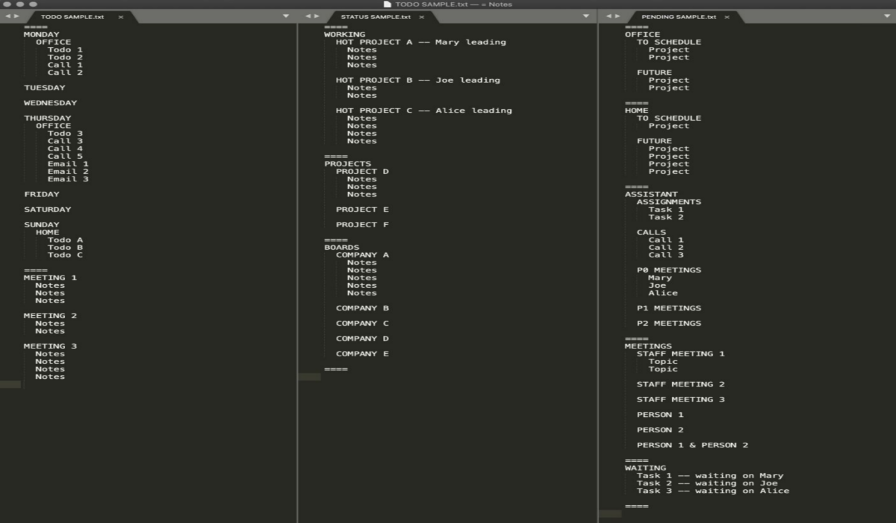
Sriram: Now let's talk about this screenshot you sent me. Every executive must have his own check-in system. Your time is limited, and you have a bunch of projects you care about that demand your attention. So what kind of system do you use?
(Remarks: "check-in system" is a well-known saying in company management. It is easier to understand if you keep the English expression; according to the original text, "check-in system" can be understood as "project progress sign-in system".)
Marc:first level title
03
About Goals and Systems
Sriram: I want to break out of the discussion again. Talk about a schedule with a longer time span, such as years. Is there a week where you meditate on top of a mountain and say, “Okay, I need to spend more time with founders this year,” or “I need to spend more time this year reading scientific papers,” or something like that. A related question is, how do you connect your goals, and the goals of the company, to the way you spend your time and energy? Is there such a mountain top?
Marc:No goddamn hilltop! Keep me away from the top of the mountain, away from the mosquitoes. No, none of these. So here's the thing. One, every six months or so, I would feel overwhelmed and feel like everything was out of my hands. So about every six months, I sit down and do some self-reflection. That's saying to yourself "Okay, you have a great system, but it's overloaded", or "You're saying yes to too many things, you're involved in too many things".
You have to elevate yourself and figure out what is important.I usually spend an hour reviewing what I've been doing, which is basically determining "yes" and "no" thresholds, and I try to revise it once a year.In addition, I will re-create my personal plan every year. Write from scratch what I really want to do and my goals, and then line up related activities. I would like to make one or two points about the allocation of time. First, it's not spreadsheet-driven. All these execs/CEOs you read about are doing this very complicated thing, they use spreadsheets for time management...
Sriram: Steve Ballmer (former CEO of Microsoft) is an example of using spreadsheets for time management.
Marc:Yes, indeed. So they have these detailed analytics, pie charts, reports, etc., which I might understand if you run a Fortune 500 company. You were like a head of state then. You need to meet different voters at different times, do many different things, and you need to hyper-optimize every 10 minutes. I really empathize with people who face this kind of challenge. From my point of view, I don't want to reach such a strict level.
I'm trying to find some intuition about what's going on and how to rebalance. This company was built to achieve what I wanted to achieve. My role is to make that happen in the context of the company. So the answer is always the same. Like, how do we optimize the company? How can I optimize my own work for projects my company is involved in? So, for 11 consecutive years, the answer to this question has been the same every year, and it won't change anytime soon. I think,first level title
04
About Process, Outcome and Stakes
Sriram: This is a very interesting topic because, as you know, there are two schools of thought on how to set goals, both at the individual level and at the organizational level. One is to use the OKR target management model and various indicators to objectively measure the results by looking at some quantifiable objects. The other focuses only on the inputs and process, not on the actual results themselves. And your job is unique because it has a multi-year long-term feedback loop, not a business unit with quarterly results.
Marc:Yeah, we're all basically just looking at inputs. Basically the relationship between process and result. And that's exactly why you said it. Venture capital takes a long time to see results. In our first five years, we really didn't know if it was going to work. So it's, what have I learned? Like, for the first three years, it's going nowhere, what will I learn? Because sometimes these companies struggle for a while, and then they really succeed. Sometimes it's just the opposite, and they succeed quickly, but then run into serious problems.
It's hard to find a good analogy, but it's more like poker, and being a good poker player is really, really, really hard. If you blame yourself when you are unlucky, you will develop this bad habit. You just need a system that allows you to think through the process...
Sriram: Thinking in Bets by Annie Duke is one of the best books on this subject.
Marc:Yes, exactly. Michael Mauboussin (professor at Columbia Business School) has also written extensively about the profession in his book.Investing is a process that separates the process from the result.Our world is almost always trying to optimize processes. The results don't come until 5, 6, 8 or 10 years later. At this point, I'm very skeptical that it's useful to review the causal relationship between what you've done and the results you've gotten. Because this approach is uncertain and unreliable.
Sriram: Causality is really hard to deduce.
Marc:Yeah, so we're not going to spend a lot of time on this.What we're looking at is -- what's the best way to run the process? What's the best way to run a company? What's the best way to help entrepreneurs?By the way, offering too much help is not the best way to help.The best way is to make sure we understand what's going on in the industry, what's the best way to help our network, what's the best way to help our team management. These are all processes.
To be honest, this also kind of fits my psychology, in fact, I don't have the gambling gene. I get no thrill from the bet and the outcome. I sat down and gambled, and nothing happened. My heart doesn't beat faster. And the math part of the brain is like, well, the expected return on this is negative, so what the hell am I doing? So in less than 10 seconds, I lose interest and walk away. Our company does not over-celebrate success, nor do we get excited because of tangible benefits. We care about building a very competitive, but returns are not the focus.
Sriram: It's an interesting point because laymen often compare venture capitalists to gamblers, while insiders see it quite differently.
Marc:I'll never be a professional gambler, but you'll find that one thing that happens to professional gamblers is that they might play poker at night and hang out during the day, making side bets for large sums of money. It's essentially an extra bet, sitting in a restaurant and betting whether there are more red cars going by than blue ones. They are "sharpening" their minds so that they can bet with a purely mathematical perspective and without any emotion. They try to keep themselves from showing off. On the contrary, at the gambling table, they hope that they are facing an extremely emotional person. Because people who show no emotion know best how to "slaughter" emotional people.
first level title
05
about books and reading
Sriram: I'm going to change the subject a little bit. For this interview, I asked a lot of people we all know. One of the most common questions is: How do you read so many books?
Marc:I have been reading since I was very young, and reading is a lifetime.Reading arguably fills in all the great gaps.There is a good saying called "consciousness". Meaning, figure out what the hell happened and why? The world is so complex and dynamic that figuring it out is a life's work.
What I've been experimenting with for the past few years is "barbell" reading. The stuff I read is either the latest or the classics.
Sriram: From the Lindy [effect], you can't go wrong with that. (The Lindy Effect: For things that die naturally, each extra day of life decreases the expected life expectancy. For things that don't die naturally, each extra day of life may mean a longer expected remaining life. Time is the tester of life's tenacity)
Marc:That's right. I want to remove everything in the middle. Because I find that there are very few people in the middle who can write something, who can explain what happened last week, last month, last year, or even the last ten years, and who can objectively interpret the situation and deserve my trust. There are a few, but not many. For example, where we are now, what is actually happening now [under the new crown epidemic], I follow the content of the new crown virus in the field of science and economics every day, because these are very important. And I'll avoid all comments and explanations.
Another, as you say, there are tons of classic books that have really been proven correct over time. You can spend your whole life reading only the classics, and a lot of smart people do.
Sriram: So how do you go from zero to one in a new field? where do you start Breadth first or depth first?
Marc:As a company, we meet and talk to a lot of people. So, yes, a lot of the conversations were face-to-face. usually,The way to know something is because someone told you about it. So, first of all, pay close attention to every conversation. Then someone will tell you something important or a new field.I call them "things from the future". Something is happening in the world, and it's only happening in one place. But... wow, it could very well end up anywhere. I often ask people I know who I can talk to or what books I can read.
Every once in a while, something good happens. When I ask what I have to read, they say, "Well, there really isn't anything". And that's the best case scenario, because it means we could be the first to discover something. If it's something about technology, business or finance, we basically deal with it in-house. I don't personally leave the company for a two-week in-depth study, we let someone else in the company do the work. Because it's part of their own development and role, and it's an opportunity for us to understand what's going on.
Sriram: In a recent podcast, Naval Ravikant [a well-known investor in Silicon Valley] talked about the reasons why he didn't finish the book. He shook off the guilt of needing to read the entire book. Tyler Cowen (American Economist) said something similar. Do you read every book?
Marc:Yeah, I'm really torn. I have a ton of books I haven't finished reading that I really should throw away. Patrick Collison (Stripe founder) also touched on this. Having to read every book will not only cause you to spend time on books you shouldn't read, but it will also cause you to procrastinate on reading. If I can't start the next book until I finish the book, but I don't want to read the book, I might as well watch TV. Before you know it, you haven't read a book for a month, and you're asking yourself "what have I done?!" I think that's part of the reason. This "don't do that" moral threat is so successful at influencing people. Another trick is to read a dozen books at once.
Sriram: How is this done? Do you always have a stack of books by your side? Or do you read on your Kindle on your phone?
Marc:first level title
06
About Learning and Changing Perspectives
Sriram: Michael Nielsen (quantum scientist and computer scientist) and Andy Matuschak (full-stack engineer) talk about the power of "spaced repetition". Some people reread a book to absorb it better. Do you enjoy rereading?
Marc:I aspired to be that guy, but I failed. I can remember the general idea, but not the specifics. I can remember ideas, concepts, and explanations clearly, but not details. I downplay people, downplay specific times, downplay specific conversations.
I take a lot of notes, although I never look at them afterwards. I'm reading a great book on memory. Taking notes is actually a double reinforcement of memory. Another reading tip comes from Chris Dixon (Partner, A16Z). He thinks of book chapters like blog posts. When he sits down to read, seeing the table of contents is like seeing a set of blog posts, oh, those two already look interesting, and then you say, ok, I can throw the rest away. I'm not going to read every single post on the blog, am I? I only read what interests me.
Sriram: In a previous interview, you talked about how happy you are when you are proven wrong. So how do you seek a different opinion?
Marc:It's like an important form of self-improvement. Generally speaking, most people around you hate being told they are wrong most of the time, and they absolutely hate it. As to why, that's indeed an interesting question. The best explanation I can come up with is:People treat their ideas like their children.I have an idea, like I have a child, and if you call my idea stupid, it's like saying my child is stupid. Then the conversation stopped abruptly. I've been trying to spend less time arguing with others. Because people really don't want to change their minds. So I try not to argue with people.
However, there is a group of people who do like to change their minds. Interestingly, this kind of person is not liked by everyone. Hedge fund managers are such people. Really good hedge fund managers seem to have this trait: If you get into a heated argument with them, they actually listen to what you have to say. They don't always change their minds, but sometimes they say "oh, that's a great idea". And then they're like, "Oh, thank you," which is really weird because that's usually not the end of an argument. They thank you because they'll be back in the office the next morning to reverse the deal.
Sriram: To some extent, changing their minds is actually one of their job responsibilities. For example, arbitrage may require changing their minds at any time in order to make money. In most typical leadership roles, identity may be closely tied to strategy, for example, you are embarking on a strategy involving 1000 employees, so proving a certain executive wrong is best for the organization though Things, but not necessarily a good thing for that executive.
Marc:Yes. Hedge fund guys are the perfect example because they literally change their trades every day. They can be long a company on Tuesday and short at the end of the week. They like to throw out old ideas precisely because, as you say, it will make them money doing so. There are times when I really want to have that mindset, but it's so hard.
first level title
07
About progress and drive
Sriram: Changing the subject, Tyler Cowen (American Economist) has an analogy where he asks what is the equivalent of pianist practice or Steph Curry training for knowledge workers. For you, especially given the long-term feedback loop, how do you improve yourself every day?
Marc:You need to keep trying to understand what's going on. Like, what actually happened.
As a typical example, if you ask an entrepreneur how their company is, they will always say "very good". But probably not. You may be facing a hurricane, because that's the norm at work. So what's going on inside the company? What are customers actually buying? What strategy was actually employed? How is the technology actually developing? What has become of market competition? If we go back to the broader question of today, what exactly happened to the new crown virus? The actual death rate from COVID-19 is still a big unanswered question, with new research emerging every day, and despite this, many people are stubborn. You want to ask - "No, no, what is actually happening?" We are in an era of rapid scientific development. own point of view.
I often talk about the concept of "strong opinions, weak persistence" (expressing strong opinions while being open to different opinions from the outside world).I think in any business, you want commitment, you want action, you want action. Obviously, as you know, the venture capitalist is the opposite of the hedge fund manager, and the venture capitalist has to wait 10 years to know the outcome. And we do end up committing to more on this one.
Sriram: You have been investing and focusing on the future, some of it is due to the requirements of your position, but I believe that even if you do not do this job, you will continue to do it every day. What drives you to read a new topic about technology every day?
Marc:Innovation brought about by technology is the most interesting thing in the world.
I am convinced, through years of studying economic and cultural history, that technology is the real driver.After thousands of years of subsistence farming, there was a sudden vertical takeoff hundreds of years ago. The quality of life has exploded around the world. But not at the same time, but from Europe to expand outward. Basically it's all because of advances in technology, like the printing press, the internet, and so on. And then you see this incredible trajectory. Over the next century or centuries, we have the potential to make huge strides that make life better for everyone. Technology is a lever for the efficient use of natural resources to create a better future.
So reading about new topics about technology is just about the most interesting, useful, rewarding thing I can think of.
This article is from the WeChat public account Fat Fu Mantou, reproduced by Odaily with authorization.