a16z founder: Decentralized network will win the third era of the Internet



secondary title
The First Two Era of the Internet
During the first era of the Internet—from the 1980s to the early 2000s—Internet services were built on open protocols and controlled by the Internet community. This means that people or organizations can develop their Internet presence knowing the rules of the game will not change. In this era, huge online properties began to emerge, including Yahoo, Google, Amazon, Facebook, LinkedIn and YouTube. In the process, the importance of centralized platforms like America Online (AOL) has been greatly diminished.
In the second age of the Internet, from the mid-2000s to the present, for-profit technology companies—most notably Google, Apple, Facebook, and Amazon (GAFA)—built software and services that quickly surpassed The ability to open protocols. The explosive growth of smartphones has accelerated this trend, as mobile applications have become the mainstream of Internet usage. Eventually, users migrated from open services to these more complex centralized services. Even when users still access open protocols like the web, they often mediate through GAFA software and services."The good news is that billions of people have access to amazing technology, much of it for free. The bad news is that it makes it harder for startups, creators, and other groups to grow on the internet, but don’t worry about centralized platforms changing the rules for them, taking away their audiences and profits. This, in turn, stifled innovation and made the Internet less fun and less dynamic. Centralization also creates broader societal tensions, with our debates about fake news, state-sponsored bots, user"This is seen in debates on topics such as , EU privacy law and algorithmic bias. These debates will only intensify in the years to come.
secondary title
"Web3": The Third Era of the Internet
One response to this centralization has been government regulation of large internet companies. This response assumes that the Internet is similar to past communication networks such as the telephone, radio, and television. But the hardware-based network of the past is fundamentally different from the software-based network of the Internet. Once hardware-based networks are built, they are nearly impossible to rearchitect. Software-based networks can be re-architected through entrepreneurial innovation and market forces.The Internet is the ultimate software-based network, powered by a relatively simplecore layer
The development of the Internet is still in its early stages: core Internet services will likely be completely re-architected in the coming decades. This will be enabled by the Cryptoeconomic Network, the firstbitcoinintroduced in and inEthereumWhy go to centralization?
Why go to centralization?
text
Decentralization is an often misunderstood concept. For example, it is sometimes argued that crypto web advocates favor decentralization because of government censorship resistance or because of libertarian political views. None of these are the main reasons why decentralization is important.
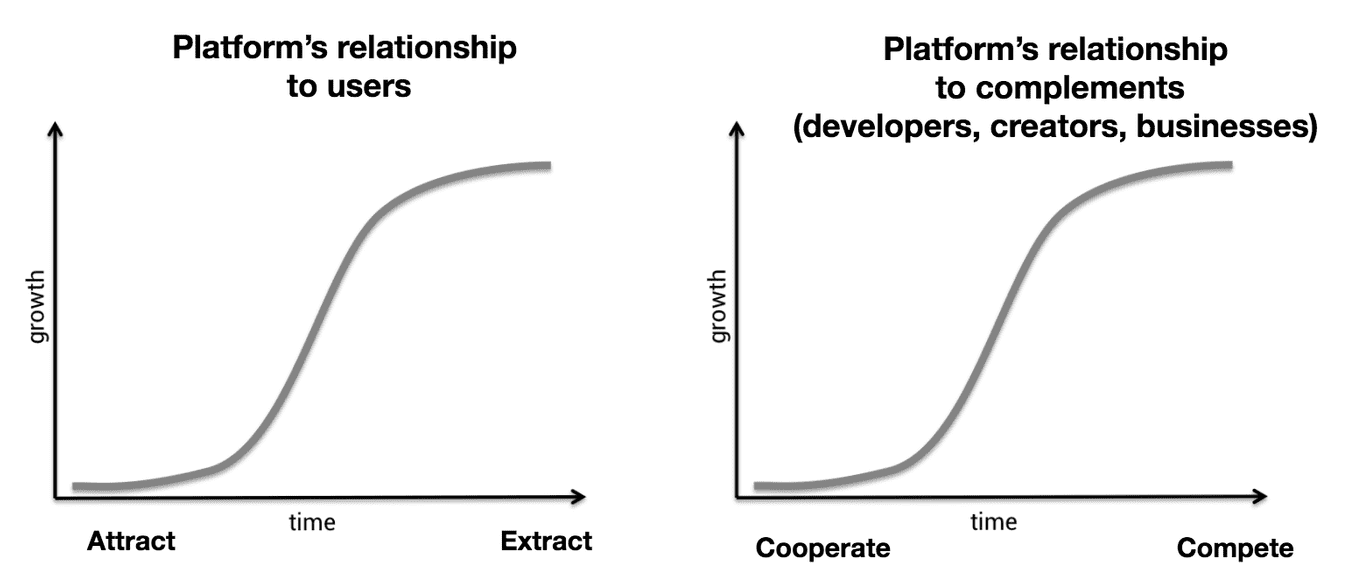
Let's take a look at the problems that centralized platforms can have. Centralized platforms follow a predictable lifecycle. When they start, they make every effort to recruit users and third-party complementers such as developers, businesses, and media outlets. They do this to make their services more valuable, since platforms (by definition) are systems with multifaceted network effects. As platforms move along the adoption S-curve, their power over users and third parties grows steadily.
For third parties, this transition from cooperation to competition feels like a bait and switch. Over time, the best entrepreneurs, developers, and investors have become wary of building on top of centralized platforms. We now have decades of evidence that doing so will end in disappointment. Additionally, users give up their privacy, give up control over their own data, and become vulnerable to security breaches. These problems with centralized platforms may become more pronounced in the future.
secondary title
Enter the encrypted networkGolemAn encrypted network is a network built on top of the Internet, 1) using consensus mechanisms such as blockchain to maintain and update the state, 2) using cryptocurrencies (coins/tokens) to motivate consensus participants (miners/validators) and other network participation By. Some crypto networks, like Ethereum, are general-purpose programming platforms that can be used for almost any purpose. While other encrypted networks are used for special purposes, for example, Bitcoin is mainly used to store value,Filecoinis used to perform calculations, while
For decentralized file storage.Early Internet protocols were technical specifications created by working groups or nonprofit organizations that relied on the alignment of interests of the Internet community to gain adoption. This approach worked well in the early days of the internet, but few new protocols have gained widespread adoption since the early 1990s.encrypted network
These issues are addressed by providing economic incentives in the form of tokens to developers, maintainers, and other network participants. They are also technically more powerful. For example, they are able to maintain state and perform arbitrary transitions on that state, which past protocols could not do."Voice"and"and"Mechanisms constrain them. Participants gain a voice through community management, including"chain"(by agreement) and"Off the chain"Off the chain
(via the social structure around the agreement). Participants can exit by leaving the network and selling their coins, or in extreme cases by forking the protocol.
Today's crypto networks are subject to various constraints that prevent them from seriously challenging centralized incumbents. The most severe limitations revolve around performance and scalability. The next few years will be about fixing these limitations, building the network, and forming the infrastructure layer of the crypto stack. After that, most of the effort will turn to building applications on top of that infrastructure.
secondary title
How can decentralization win?
It’s one thing to say decentralized networks should win, and quite another to say they will. Let's look at specific reasons for optimism.
Both software and web services are built by developers. There are millions of highly skilled developers in the world. But only a small percentage of them work at the big tech companies, and only a small percentage of them work on new product development. Many of the most important software projects in history were created by startups or communities of independent developers."。——Bill Joy
"No matter who you are, most of the smartest people are working for someone else
Decentralized networks can win the third era of the internet for the same reason they won the first: by winning the hearts and minds of entrepreneurs and developers.
An illustrative metaphor is the rivalry between Wikipedia and its centralized rivals like Encarta in the 2000s. If you were comparing the two products in the early 2000s, Encarta was the better product with better subject coverage and higher accuracy. But Wikipedia improves much faster because it has an active community of volunteer contributors drawn to its decentralized, community-curated ethos. By 2005, Wikipedia was the most popular reference site on the Internet. Ankata was closed in 2009.
The lesson is that when you compare centralized and decentralized systems, you need to think about them dynamically as processes, not statically as rigid products. Centralized systems often start out fully fledged, but only get better as employees of the sponsoring company improve them. Decentralized systems start out half-baked, but under the right conditions grow exponentially as they attract new contributors.
In the case of a cryptonetwork, there are multiple compound feedback loops involving developers of the core protocol, developers of complementary cryptonetworks, developers of third-party applications, and service providers operating the network. These feedback loops are further amplified by the incentives of the associated tokens, which, as we have seen with Bitcoin and Ethereum, can supercharge the development velocity of a cryptocurrency community (sometimes leading to negative outcomes like Bitcoin mining excess power consumed).
Centralized platforms tend to come bundled with compelling apps when they launch: Facebook has its core social features, and the iPhone has some key apps. In contrast, decentralized platforms are often launched half-baked and without a clear use case. Therefore, they need to go through two stages of product-market fit: 1) product-market fit between the platform and the developers/entrepreneurs who complete the platform and build the ecosystem, and 2) platform/ecosystem and end users product-market fit. This two-stage process is what causes many — including sophisticated technologists — to consistently underestimate the potential of decentralized platforms.
secondary title
next internet era
Compare the problem of spam on Twitter to that of spam in e-mail. Ever since Twitter made it available to third-party developersclosureclosureAfter taking down their network, the only company dedicated to Twitter spam is Twitter itself. By contrast, there are hundreds of companies trying to fight spam in email, funded by billions of dollars in venture capital and corporate funding. Spam in emails didn't get fixed, but it's a lot better now that third parties knowemail protocol
Is decentralized, so they can build businesses on it without worrying about the rules of the game changing later.
Or consider the issue of network governance. Today, groups of irresponsible employees on large platforms determine how information is ranked and filtered, which users are promoted and which are banned, and other important governance decisions. In a cryptonetwork, these decisions are made by the community using open and transparent mechanisms. As we know from the offline world, democracies aren't perfect, but they're a lot better than they would otherwise be.
Centralized platforms have dominated for so long that many people forget that there is a better way to build internet services. Cryptonetworks are a powerful way to grow community-owned networks that level the playing field for third-party developers, creators, and businesses. In the first days of the internet, we saw the value of decentralized systems. Hopefully we'll see it again in the next era.Medium。