Hackathon DAO: From Industrialized Hackathon to Decentralized Global Hacker Movement


DAOrayaki DAO Research Bonus Pool:
Funding address:
0xCd7da526f5C943126fa9E6f63b7774fA89E88d71
Funding address:
Total bounty: 80 USDC
Voting progress: DAO Committee passed on 7/7
Research Type: DAO, The Hacker Movement
Contributors: Demo, DAOctor @DAOrayaki
Contributors: Demo, DAOctor @DAOrayaki
Original: Decentralize The Hacker Movement
secondary title
Hacktivism
According to reports, the world's first hackathon was organized by a group of Canadian cryptographic developers in 1997, 20 years after Donald Knuth released Tex, one of the world's first open source software.
In 2003, Paul Graham pointed out in his Geeks and Painters that geeks are often confused in university computer science departments because they are taught to write research papers when what they really want to build are beautiful things (software).
So, what is a geek? The geek spirit is well described by Eric Raymond in his article "How To Become A Hacker" (2003):
1. The world is full of interesting problems waiting to be solved.
3. Boredom and drudgery are the devil.
5. Attitude is no substitute for competence.
4. Freedom is wonderful.
5. Attitude is no substitute for competence.
It's a completely different approach - while schools and universities teach that people have to learn something first and then "maybe" create something, geeks identify problems and solve them first. They learn the necessary technologies while building solutions.
Distinctly different approaches lead to different ways of approaching problems. While most people follow the school line, "if you want to build something, you need to learn everything behind it". But attitudes started to change, and there was a huge awakening in the developer community. The geek spirit was widely accepted and gave birth to the geek movement."Hack"The geek movement really took off when open source software started to grow enormously.
There is a connection between the open source/free software movement and the hacker movement. if anyone wants
Something, to solve a problem on her own, she must be able to focus on the problem and take whatever method is available to solve the problem itself. Geeks don't have time to reinvent a wheel - they use whatever resources, knowledge and technology they can to solve a problem. Without the widespread use of open source software, it would be difficult for many to be geeks when intellectual property is controlled by large corporations. A clear example of our time - if Bitcoin hadn't been open-sourced (or worse, assuming the technology was granted a "patent"), Ethereum's founding team would have had a really hard time even launching the project, the world A lot of creativity and fun will be lacking.
The widely available open source technology stack also provides opportunities for university students, community developers, and startup engineers to learn, contribute, and build. With open source software, developers can build without the permission of a large company. They can learn by themselves, build influential technologies and products by themselves, and the era of license-free innovation has begun.
The idea of being a "geek" in Eric Raymond's book came true, and the global geek movement began to rise.
secondary title
Global Hackathon Developments
The hackathon movement was launched in American universities around 2010. The first wave of hackathons was organized in universities around 2010. In 2013, MHacks became one of the largest hackathon organizers among other universities (PennApps, CalHacks, HackMIT, etc.), attracting more than 1000 geeks to participate in one event. Students participating in these hackathons are able to learn new open source technologies, team up with other geeks, contribute to open source projects, and implement their ideas into products. Most importantly, they can focus on one product or one problem with other geeks during the hackathon (24-72 hours).
The movement soon spread to many organizations in other parts of the world and in Europe. CERN hosted the first CERN Webfest since 2012, and later became an annual black card marathon until this year, promoting many open source scientific software, games, toolkits and open libraries, through open source software Solve problems in scientific research and popularize knowledge of particle physics. In the UK, OxHack at the University of Oxford and Hack Cambridge at the University of Cambridge are held annually. Other hacking activities include Hack Kings at King's College, IC Hack at Imperial College, and many more.
Similar movements are happening in India, Southeast Asia, Korea, Japan, Africa and other parts of the world.
Hackathons have also become a way to foster innovation within companies. Before the COVID pandemic, Y Combinator organized hackathons every year, with hundreds of participants at each event. In 2018, about 18,000 developers participated in private hackathons organized by Microsoft, among others.
secondary title
The hacker movement is being industrialized and centralized
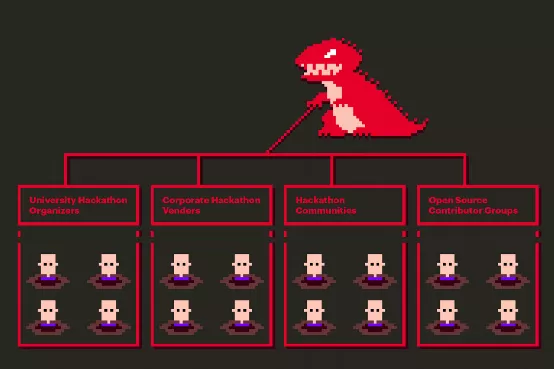
While the hackathon movement contributed many interesting technologies, in the late 2010s it was clear that the hacker movement was moving towards large corporations and moving further and further away from grassroots, bottom-up innovation. The Internet, the main driver of open source innovation over the past 20 years, has become a monopoly. When monopolies dominate economic interests, they also dominate problems and ideas. Hackathon organizers rely on sponsorship fees. When sponsorship money comes only from big corporations, and hackathon organizers are struggling to compete for sponsorship money, hackathons are dominated by centralizers.
In the process, large corporations dominated hacking and the Hacker movement. The most notable event was Microsoft's $8 billion acquisition of GitHub in 2018. One of the largest centralized tech companies has acquired the most important platform of open source software and the hacker movement.
While we can acknowledge the many contributions of the corporate world to open source technology, the open source movement and the hacker movement were created by hackers around the world to free developers and hackers around the world from the monopoly of intellectual property and to innovate freely .
The cryptocurrency space may have become the only permissionless virgin territory for hacktivism and open source innovation. From the invention of Bitcoin and Ethereum to the multi-chain ecosystems we see in 2020/2021, cryptocurrencies are still driving open source innovation everywhere.
However, without fundamental institutional changes, the cryptocurrency geek community may only become as centralized as the Internet era in the next decade.
In order to truly create a geek community for geeks, we need to decentralize the hackathon community and hacker movement — creating a community run by geeks, owned by geeks, and working for geeks.
secondary title
Decentralizing the Hacker Movement
We will not be able to answer these questions all at once. However, we can start creating some components that are critical to our goals.
The good news is - there is a lot of infrastructure available today that can be used to build a decentralized hackathon community. Existing hackathon organizers have a lot of experience and knowledge to share (MHacks, ETH Denver, ETH Global, DoraHacks, etc.). Crypto-native funding mechanisms (such as quadratic funding) have been pioneered by the Ethereum community and widely adopted across the multi-chain cryptocurrency world through Gitcoin and HackerLink.io. Decentralized governance is widely embraced by the cryptocurrency and developer communities, and the dGov toolkit is now widely used.
secondary title
Hackathon DAO: Building a Decentralized Hackathon Community
The DoraHacks community is already supporting a decentralized community called Hackathon DAO that shares the same vision. Hackathon DAO has supported a blockchain hackathon at the University of Southern California and is launching the decentralized community. Still, it's worth discussing in depth what it takes to build such a community.
We need to build a global community of hackathon organizers. Hackathon organizers can be anywhere. Most of the time, great hackathon organizers are not "professional event organizers", they are geeks and open source contributors themselves. The Oxford-MIT-Palo Alto-Tanzania Tele Hackathon organized by Jacob Cole in the Common Room of the Computer Science Laboratory of Oxford University in 2014 (created a visual graph technology based on Graph DB), and the unitaryHack organized by UnitaryFund in 2021 ( Bounty issues for solving some core open source quantum computing open source libraries) are good examples. Geeks have ideas of their own, and they know what to build. More importantly, they don't organize hackathons just to organize hackathons, but to actually build something or solve a problem. By building a community of hackathon organizers, we can connect hackathon organizers in different regions of the world to share key resources for future hackathons.
Hackathon DAOs need community governance. With a community of hackathon organizers and contributors, there is a lot of decision making. Governance work may include proposal processing, DAO spending, executive team elections, and maintaining the rules themselves. Proposals will be primarily about funding hackathons, and plans for DAO development. With a good community governance mechanism in place, the community should be able to guide the DAO to develop a global base of hackathon organizers, make organizing hackathons easier, sustain the DAO itself, and ultimately make The Hacker Movement an infinite game of hacker innovation .
Related Links
Donald E. Knuth -- A.M. Turing Award:https://amturing.acm.org/award_winners/knuth_1013846.cfm
Hackers and Painters. Paul Graham:http://www.paulgraham.com/hp.html
How To Become A Hacker. Eric Raymond:http://vadeker.net/articles/hacker-howto.html
unitaryHack:https://unitaryfund.github.io/unitaryhack/
Microsoft Hackathon:https://news.microsoft.com/life/hackathon