






Kava Swap is officially launched: the last piece of the puzzle of Kava's multi-ecological value transfer


The outlet of cross-chain DeFi has arrived. With the collective explosion of new-generation public chains such as Solana, Avalanche Protocol, and Fantom, users' demand for cross-ecological capital transfers is becoming more and more vigorous, and major projects have also accelerated their pace.
Looking around the entire cross-chain DeFi track, Kava, as one of the earliest cross-chain DeFi projects, has performed well in terms of product stability and community reputation. On August 31, Kava just completed the eighth upgrade of the main network, and officially launched the cross-chain AMM application Kava Swap, which completely completed the last piece of the multi-ecological value transfer puzzle on Kava. In order to learn more about the specific design of Kava Swap and Kava's future development plan, Odaily's 122nd Chaohua Community invited Ticky, the head of Kava's China market, to answer our questions. The following is the essence of this issue of Chaohua, and friends who missed the live broadcast are welcome to read and understand.
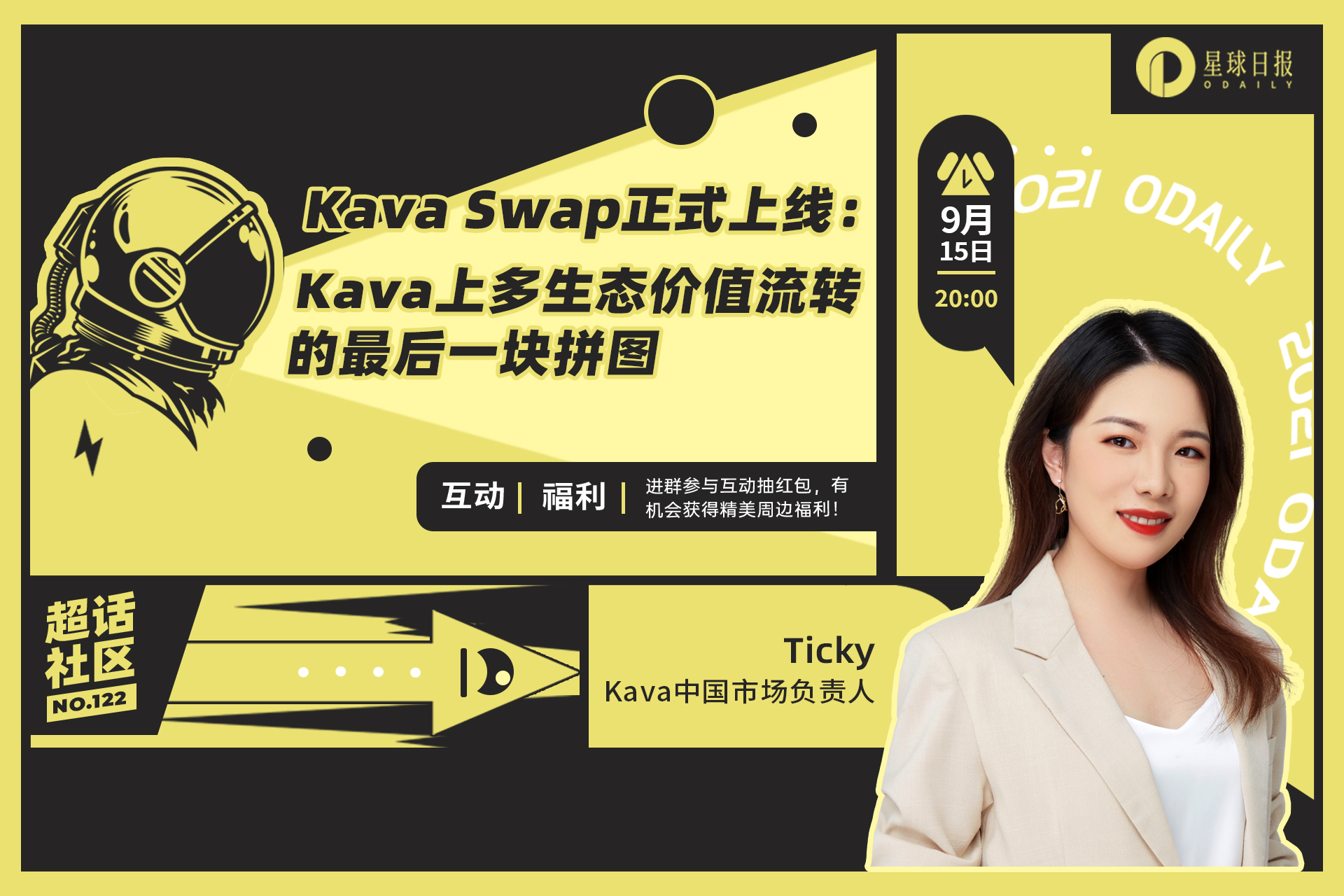
Q1: Can you give a brief introduction to the basic situation of Kava?
Ticky: Kava is a cross-chain DeFi platform based on the Cosmos SDK. We provide users with DeFi services and developers with DeFi infrastructure such as cross-chain functions and Chainlink oracle data. It is a Layer 1 DeFi public chain.
On this basis, an integrated DeFi hub that integrates minting, lending, and exchanging "All-in-One" has been built on the Kava blockchain. This platform currently provides 3 protocols, including the Kava Mint cross-chain lending protocol—— Various collaterals can be used to mint Kava's decentralized stablecoin USDX, Kava Lend cross-chain currency market - supply various assets including USDX minted from Kava Mint to the asset pool, and then lend a certain amount from the asset pool Assets, supply and borrow in Kava Lend can get KAVA and HARD rewards, Kava Swap cross-chain AMM application - trade or add liquidity in various liquidity pools, and add liquidity can get SWP rewards.
The original intention of Kava to design this integrated cross-chain DeFi platform is to provide asset aggregation and seamless exchange for different blockchain ecosystems, DeFi applications, financial institutions and users, so as to improve financial efficiency by leaps and bounds.
Q2: At the end of August, Kava just completed the eighth mainnet upgrade and officially launched the AMM application Kava Swap. Half a month has passed, how is Kava Swap running now? How is the data performance?
Ticky: Kava Swap has been running smoothly for two weeks, and the total liquidity of the platform currently exceeds 25 million US dollars. In terms of transaction volume data, Kava Swap’s single-day transaction volume exceeded 10 million US dollars last week, and the total transaction volume of the platform has exceeded 50 million US dollars.
In terms of liquidity income, now go to Kava Swap to provide liquidity for the liquidity pool. The average yield rate is maintained at about 300%. With the launch of Kava Swap, the value of assets managed by the Kava DeFi platform has increased significantly. Kava Mint The total assets locked on Kava Lend and Kava Lend have exceeded 600 million US dollars.
Q3: Compared with ordinary AMM DEX, what are the special features of Kava Swap in design or function? For different user roles, such as ordinary traders or liquidity providers, what is the appeal of Kava Swap?
Ticky: Kava Swap provides automatic market making (AMM) services, which can provide seamless transaction services for various assets on different blockchains. Users can earn transaction fees and rewards by providing liquidity. Compared with other centralized trading platforms, traders can directly trade with the liquidity pool, and the two types of tokens traded are stored in the liquidity pool, and quoted according to the real-time reserves of assets in the pool.
Kava Swap's initial transaction fee is 0.15%, which is lower than other similar platforms, and all transaction fees will be directly deposited into the corresponding liquidity pool as part of the income of liquidity providers.
The most special thing about Kava Swap is the native cross-chain function and security endowed by the Kava blockchain. Kava Swap is positioned as a cross-chain liquidity center connecting different blockchain ecology and financial institutions. It is currently building a link between BSC and Ethereum Fang’s cross-chain bridge, with Kava’s entire ecological support and proven high-level chain security, Kava Swap can be opened to all trading users and other trading platforms and financial institutions without permission, providing them with additional liquidity and assets Trading scenarios and revenue opportunities.
At the same time, because Kava Swap is rooted in the integrated platform of Kava DeFi Hub, it means that users can not only use their own assets to trade and add liquidity in Kava Swap, but also combine Kava Mint and Kava Lend through DeFi lending to obtain more Multiple income games. For example, the liquidity pool reward of KAVA tokens on Kava Swap is currently the highest, with 7 million SWP allocated each year. Users can purchase KAVA on external trading platforms, use part of KAVA to mint USDX on Kava Mint, and deposit the other part of KAVA Enter Kava Lend to lend other assets such as HARD, and then deposit the obtained HARD and USDX into Kava Swap to provide liquidity. During this process, users can simultaneously obtain KAVA, HARD, and SWP rewards.
Q4: Last month, there were frequent security incidents on the cross-chain DeFi track. Among them, the theft of $610 million from Poly Network became the largest hacking incident in the history of DeFi. As an old player in the cross-chain DeFi track, how does Kava do security risk control? Has the newly launched Kava Swap completed a security audit?
Ticky: As an early team in the industry that has been deeply involved in the DeFi field, Kava has always prioritized security over the utilization of our products. The premise of effective use of funds is security.
Before each application of Kava goes online, we will conduct a complete internal audit first, and encourage more users and nodes to test the carrying capacity of Kava applications through multiple rounds of test network activities, and make improvements to the product on this basis.
After the internal audit is completed, we will cooperate with a professional third-party code audit organization to check the most sensitive and complex parts of the code. All audit reports and problems will be made public by the third-party organization. We have cooperated with the industry professional The audit team Certik has cooperated to conduct multiple historical audits, and these reports can be found on their official website.
In the latest Kava Swap audit, Certik found no major or critical issues during the audit process, and only 7 minor issues were identified and resolved by Kava Labs engineers, and have been verified on the testnet.
In addition, in order to avoid black swan events, Kava has also established a Kava SAFU fund with an amount of up to 10 million US dollars through community governance. When users encounter unforeseen bugs, loopholes, hackers, liquidation failures or other technical problems resulting in financial losses, they can obtain corresponding compensation. We have already carried out the first compensation measures in the 519 black swan market in the first half of the year.
Q5: We learned that shortly before the launch of Kava Swap, Kava just rebranded its product portfolio. CDP is now KavaMint, and Hard is now KavaLend. On the whole, this rebranding has made Kava's product structure much clearer. Can you take this opportunity to reorganize it for everyone?
Ticky: That’s right, Kava has completed its rebranding last month, with the aim of helping users and the market understand the features, functions and values of each application more clearly. This renaming will also more intuitively emphasize to all stakeholders the value of Kava DeFi products as stand-alone applications and the value they can create when used together.
Here I briefly review our three products for you:
The original Kava CDP was renamed Kava Mint, allowing users to use the assets they hold as collateral for stablecoin USDX loans.
The original HARD Protocol was renamed Kava Lend, which supports users to supply and lend assets from the money market to obtain KAVA+HARD rewards.
The product name of Kava Swap remains unchanged. It supports users to buy and sell tokens on the Kava chain, and provides liquidity for the liquidity pool based on the independent market-making service, so as to obtain SWP rewards.
All three applications run on the Kava platform with interoperable cross-chain tools, secure price feeds, and institutional-grade security.
Q6: With the launch of Kava Swap, its governance token SWP has also been issued and circulated. A big confusion for many users about Kava is that different products will involve completely different governance tokens, such as KAVA, HARD, and SWP. The question of this question is, for different products, why does Kava choose to issue brand new tokens instead of directly using KAVA?
Ticky: Kava provides a complete set of DeFi infrastructure, including the underlying public chain with interoperability and cross-chain functions based on the Cosmos SDK and Tendermint consensus algorithm, the price feeding mechanism integrating Chainlink's decentralized oracle, and the elapsed time The tested chain security environment, etc. Based on this infrastructure, Kava currently issues three major DeFi protocol modules and corresponding governance tokens.
The three protocols of Kava Mint, Kava Lend, and Kava Swap all run on Kava, an integrated DeFi platform. Their relationship is independent of each other, and they can be used seamlessly together. We encourage users to nest and use them to obtain compound rewards, but the governance of each protocol should be responsible for its own independent community. For example, Kava Swap is an AMM product similar to a trading platform. Users who only focus on DeFi lending may not care about this business, so they have no interest in participating in governance.
The role of KAVA in the entire Kava ecology is very important. It is essentially a tool to reserve assets and maintain security on the chain. Unified use of KAVA to govern multiple protocols will cause chaos in the token economic model and is not conducive to the blockchain. Safety. KAVA holders are the governors of Kava's underlying blockchain, and Kava hopes to balance the decentralized governance of the entire Kava ecosystem through this form.
Q7: The next question may be a bit sharp. How do you respond to some investors who believe that the multi-token model will dilute the value of the KAVA token itself?
Ticky: The value of KAVA tokens is reflected by the prosperity of the entire Kava ecology. After Kava has established and improved the underlying infrastructure and created multiple native DeFi protocols, it will focus on opening the Kava public chain ecology to more Developer. In the future, the Kava ecosystem will subdivide different DeFi scenarios based on the fundamental attribute of DeFi, and realize the structured layout of DeFi industrial clusters.
The underlying foundation of all this is the Kava blockchain, which is governed by KAVA tokens and ensures network security through node verifiers Stake KAVA. In the multiple DeFi protocols we have created, KAVA is not only an applicable asset in the protocol, but also acts as a reserve asset in Kava Mint and Kava Security Fund SAFU Fund. Everyone knows that in order to promote product usage in the early stage, DeFi products will use a lot of incentives to promote user usage. This is no exception among the three protocols of the Kava platform. As an incentive, it is not conducive to the value of KAVA itself, and it also poses a potential threat to network security.
At the same time, in the token distribution economic models of Kava Lend and Kava Swap, it can be seen that a certain proportion of tokens are allocated to KAVA Stakers. This purpose is to encourage all Stakers on the Kava chain and thank them for staking KAVA on A highly secure network environment is provided on the network. We will encourage such economic model design in the DeFi protocols that Kava will release in the future, including DeFi applications built by external developers.
Therefore, the statement that the multi-token model will dilute the value of KAVA is actually untenable. A simple understanding is that Kava will be on par with Ethereum, which is currently the most prosperous DeFi ecosystem. There are hundreds of erc20 tokens and DeFi applications based on Ethereum. There are thousands, but the value of a single token and the ups and downs of applications will not shake the value of ETH. What Kava does better is that applications within the ecosystem can even directly feed back KAVA tokens.
Q8: The launch of Kava Swap can be said to be the last piece of the puzzle to complete the underlying facilities of Kava DeFi. Looking ahead, what is the next step for Kava to focus on?
Ticky: The focus of Kava's next stage of development is to strengthen the direction of the Layer 1 DeFi public chain ecology, and expand the scale, product performance and asset liquidity of the Kava platform. We will have an announcement in the near future and open our ecological Grants plan. It is worth mentioning that USDC and ETH recharge functions will be added to the Kava platform soon, which will further drive the growth of Kava.
In addition, in the next six months of planning, Kava will unlock more encrypted assets and ecosystems by building a cross-chain bridge between Ethereum and BSC and enabling IBC.
Kava also plans to launch the fourth DeFi application of the Kava ecosystem next year, the robo-advisory service. This product will provide users with services from two levels, one is an intelligent asset allocation combination, and the other is to fully invoke multiple protocols of the Kava platform for optimal portfolio investment. This will help users enjoy automatic investment strategies in various financial services provided by Kava, and will increase user engagement by providing yield generation strategies to more low-active Kava users.
At the same time, Kava will continue to cooperate with more large-scale encrypted financial platforms, such as Binance, Huobi, AscendEx, etc., to develop safer and easier-to-use protocol software, and provide users with an institutional-level DeFi platform with a complete product portfolio.
Q9: Judging from the overall development of the track, the recent growth rate of DeFi has slowed down to a certain extent, and the market seems to be looking for some new growth points. In your opinion, which segments can drive the next explosion of DeFi? Does Kava have a layout for this?
Ticky: The recent growth rate of DeFi has indeed slowed down. Let’s first look at the DeFi field. Now the largest DeFi ecology in the industry is on Ethereum, but there are still huge assets outside of Ethereum that cannot be added due to the impact of the original public chain. In the DeFi world, for the holders of these assets, this is an invisible wall.
Empowering these "non-interest-bearing assets" and making them "interest-bearing assets" that can participate in DeFi is a relatively strong demand in the market at present, and it is also what Kava is currently doing.
From the perspective of user experience, DeFi and even the entire blockchain industry still have many directions worth improving. Most of the current DeFi projects focus on a certain vertical track. When the market fluctuates violently, users need to adjust their asset and loan allocation through multiple centralized and decentralized applications, and the user experience and product security are also more affected. The impact of the underlying public chain. Compared with the user experience brought by centralized exchanges, this is also an obvious shortcoming of DeFi. This is why Kava wants to build an integrated platform.
Recently, GameFi and NFT are hot, and a new batch of public chains are also emerging rapidly. Although Kava has been focusing on the DeFi field, any innovative technology needs a value transfer scenario. Kava can help them better realize "financialization" ". Kava is developing the Grants funding plan of the public chain ecology. Any application that is safe and can motivate users to use will have the opportunity to explode, and it can also be developed within the Kava ecosystem. Kava also has the same strict review process as the App Store to ensure that it is provided to Kava The applications of ecological users are all safe.
Q10: The last question comes from a recent anecdote - the current circulation market value of the Cosmos ecological project Terra has reached nearly twice that of Cosmos. This situation seems to have never happened in other ecosystems. One reason I can think of is that the upper-level projects in networks such as Ethereum need to rely on the bottom layer for security verification, but in the Cosmos network, each project will run independently A chain with its own security mechanism, so there will be no underlying hard-top restrictions on ecological value.
As a member of the Cosmos ecosystem, what does Kava think about this? Has this successful case of a friend business opened up a bigger room for imagination for Kava?
Ticky: Each project in the Cosmos ecosystem runs a public chain independently, which is more secure than applications built on other public chains. Cosmos is essentially a protocol for issuing chains and cross-chains. The entire Cosmos ecology is composed of various subdivided blockchains, and the chains rely on the IBC protocol for cross-chain interoperability. Therefore, compared with other forms of ecology, the native tokens of each blockchain under the Cosmos ecology have a stronger ability to capture the value of their own ecological prosperity. It is not difficult to understand why Terra surpasses the circulation market value of Cosmos.
Returning to Kava itself, Kava was originally established with the goal of a decentralized hub for cross-chain DeFi applications and services, so the current focus of promotion is still on the development of the DeFi ecosystem. The focus includes the following two directions:
1. Expand the scale of Kava ecology, DeFi product performance and asset liquidity
After Kava completes the construction of the cross-chain bridge and enables IBC, more encrypted assets will be unlocked in the Kava ecosystem. This will complement more financial agreements and services established through Kava ecological funding in the future, further increase user participation in products, and create more opportunities for users to earn high returns.
2. Embrace traditional finance and promote the integration of DeFi and traditional finance
While solving the existing DeFi needs in the industry, we also focus on promoting the integration of DeFi and traditional finance, which is why Kava seeks an IPO, establishes cooperation with Circle, and issues USDC on the Kava chain. We are also evaluating the issuance modules of more stable coins such as USDT to promote more connections between Kava and traditional finance.





