


Apifiny: Should Bitcoin be held or left? See what the big guys say


Original source: Benzinga
Compilation: Apifiny Asia Pacific Team
The fourth week of June should have been an ordinary week, but for Bitcoin enthusiasts living in El Salvador, it was unusual.
According to Documenting Bitcoin’s tweet: El Salvador’s President Nayib Bukele said that the El Salvador government will provide $30 in bitcoins to every citizen who registers with the bitcoin wallet Chivo, emphasizing that citizens do not need to change their mobile phones, and that the wallet can be used on any Internet-connected run on the phone.
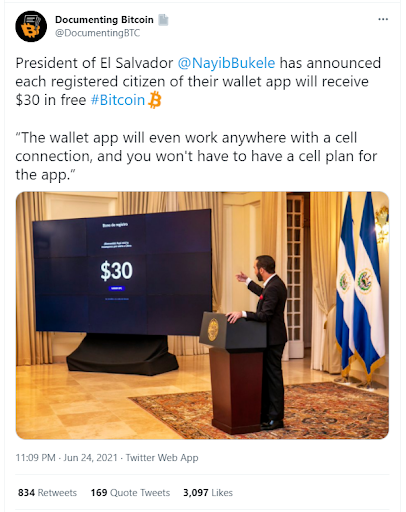
In a speech to the nation, Nayib Bukele announced that the bill "making cryptocurrencies legal tender" will come into force on September 7, Reuters reported.
In the future, it will take time to verify how Bitcoin will develop, but for those who already hold and are about to acquire Bitcoin, they will definitely benefit from some of the following KOL suggestions.
Some Tips About Bitcoin
At the end of June, Bitcoin briefly touched $35,000, but there is still a big gap from the peak of $65,000 in April.
In mid-to-early June, due to fluctuations in currency prices, the encryption field was shrouded in pessimism. As we all know, the prospect of decentralized currency and the specific value of Bitcoin are based on the consensus and active participation of community members. In other words, pessimism can have a very negative impact on Bitcoin.
So for all those watching, holding and wondering when this dip is over and when the march to $100,000 will begin again, FOMO sentiment and consensus are needed to balance the current fear, uncertainty and doubt (i.e. FUD emotions).
For this reason, we specially emphasized to the interviewees in the interview that every system has flaws, and investors should fully exercise their right to know and know themselves and their enemies. Any strong community is inseparable from self-examination and criticism, and the cryptocurrency community is no exception.
First, let's seeBillionaire Investor, Entrepreneur, and Prominent Bitcoin Advocate Tim DraperOpinion: Tim Draper said that there is actually no real FUD emotion (FUD is an acronym for Fear, Uncertainty and Doubt, that is, fear, uncertainty and doubt), and the only thing people need to worry about is that the supply of Bitcoin is in short supply.
"In the future, Bitcoin will become the currency that more retailers want, so it's better to hold some from now on." Tim Draper said: "Retailers can save 2%-4% by using OpenNode. Once the news spreads widely, the conversion from fiat currency to bitcoin will be realized soon.” It is reported that Draper recently announced that he has invested in OpenNode, a bitcoin payment processing platform.
"Bitcoin represents trust and freedom, which are the two cornerstones of the success of any economic system. Trust means that everyone knows that the total number of bitcoins is only 21 million, and people no longer have to trust existing banks or politicians. Freedom is Refers to an open and transparent Bitcoin that can be used anywhere in the world," Draper said.
Bitcoin Foundation Chairman Brock PierceAlso cautiously optimistic: “The amazing thing about Bitcoin and the cryptocurrency market is that they get stronger and stronger over time, and they are able to weather all kinds of tests, as well as the technical and regulatory situation.” All the difficulties that come with it," Pierce said.
According to Pierce, Bitcoin has proven that it can withstand any challenge. “It’s worth noting that while China, India, and other countries around the world (such as New York state) have taken a strong stance and regulations on cryptocurrencies, the market continues to grow and evolve,” Pierce said.

Encryption masters have something to say
The Wolf of Wall Street, podcast host, investor and author: Scott Melker
Scott Melker, a well-known cryptocurrency advocate, is not only a long-term holder of cryptocurrencies, but also often studies its patterns in his podcast and investing. Still, being a realist, Melker acknowledged in the interview that cryptocurrencies are inherently volatile.
"Cryptocurrency is an emerging asset class with high volatility. In view of this, investors must understand the risks that may arise from the huge fluctuations in such portfolios. For non-professional investors, if you do not understand the investment Perhaps we should choose traditional assets with slower returns instead of trying to trade cryptocurrencies. We should look at encrypted assets with a long-term development perspective and treat them as a decades-long investment project.” Melker said.
Still, Melker doesn't think the volatility will change bitcoin's long-term value as an asset. “Bitcoin has the potential to change the world. It is mathematically scarce, the perfect hedge against inflation and abusive monetary policy, and a means of exchange and store of value for long-tail users that cannot be covered by the traditional financial system. The price and value of Bitcoin is not the same, especially if the traditional system fails. Cash is for spending, and Bitcoin is for saving,” Melker said.
Crypto Twitter CryptoFinally: Rachel Siegel
In the interview, Siegel's frankness is refreshing. After all, not everyone can HODL all the time (hold, generally refers to long-term investment strategies that don't care about short-term market conditions). "If you make a profit, it means you haven't held it all the time. It's important to make a wise decision for yourself. The crypto market will not keep rising. Don't get too addicted to Hopium (narcotic hopeism), otherwise you may lose money." Siegel explain.
But in Siegel's view, it's only a matter of time before the rest of the world catches up with bitcoin believers. “Adoption of cryptocurrencies is inevitable. I can’t imagine a world without Bitcoin and blockchain technology, and it’s only a matter of time before others catch up,” Siegal said.
Chief Operating Officer, Sheesha Finance: Benjamin Leff
Benjamin Leff, COO of Sheesha Finance, believes FUD sentiment can be handled well with a few simple rules. “Early before cryptocurrencies, there was fear, uncertainty, and doubt in the market, and that wasn’t a bad thing… I have two suggestions for this: the first is simple, do your own research, and Don't follow others (DYOR), and learn to explore with people you believe in, truly trust, help and support each other. The second suggestion is, don't make decisions before going to bed. Don't think too much before going to bed, so that you can The brain returns to a completely new state the next day, making the right decision," Leff said.
All in all, Leff believes in the power of the blockchain technology that underpins cryptocurrencies. “Bitcoin is the most decentralized cryptocurrency in the world. It can be seen that to stop Bitcoin transactions, you need to shut down the entire Internet, which is impossible...Bitcoin is volatile because it is a currency that is compatible with all traditional The market is completely uncorrelated assets, but Bitcoin's underlying blockchain has been very stable since its inception 12 years ago, and has never been hacked, damaged or negatively affected in any way," Leff said.
Decred.org Head of International Business: Jonathan Zeppettini
Investors should not be easily swayed by media reports on Bitcoin, Zeppettini said. "Investment is a war of all against all. When the big players want to buy, they will shake off the weak players in the 24-hour news cycle (the weak players are characterized by their high cost of holding shares, and they tend to lose money when the market falls. forced to sell) ... if you lack a sense of conviction, it's easy to waver and sell," Zeppettini said.
Zeppettini believes that the power of Bitcoin can change the unfair playing field of traditional finance. “Encryption technology offers us an opportunity to replace a very manipulation-prone system with clear rules that do not favor any stakeholder,” Zeppettini said.
Coinme CEO and Co-Founder: Neil Bergquist
Bergquist emphasized that it is still early days for Bitcoin, although we have seen this pattern in the development of other assets. “Bitcoin is still in its early days. Many assets have periods of volatility, like gold did when it was officially decoupled from the financial system in the 1970s, and the more it increases in value, the more volatile it is. Bitcoin is in a similar phase , that is, there are clear ups and downs," Bergquist said.
According to Bergquist, Bitcoin’s short-term volatility can be addressed with a long-term perspective. “From a long-term perspective, if someone wants to buy Bitcoin as a store of value, when is the right time to buy. Looking at the market lows of each year, Bitcoin has only one year when the low is lower than the previous year All others are showing a consistent positive growth trend. Since the supply of Bitcoin is fixed, coupled with the growth of global adoption, the market value of this asset will continue to grow,” Bergquist said.
CEO and Founder of Apifiny: Haohan
According to Haohan, the main problem facing Bitcoin is regulation. “Since cryptocurrencies are still in a relatively early stage, regulatory uncertainty will affect the development of the industry and the value of encrypted assets,” Haohan said.
However, he believes in the market's need for cryptocurrencies and the control they can provide investors. “Cryptocurrencies, in addition to clearing and settling faster than all the fiat currencies in the world, give individuals more control over their finances, and as institutions let people down more often, people will increasingly want to have that control,” Haohan said.
Founder and Managing Partner, Future Perfect Ventures: Jalak Jobanputra
According to Jobanputra, investors should not pay too much attention to negative news. “Over the past 8 years, we have seen a lot of news stories about the death of Bitcoin, and most of them are based on incomplete information. The difference between the development of cryptocurrency and other major technological and financial paradigm shifts is that , the information that is shared instantly now is rarely verified," Jobanputra said.
Ultimately, to believe in the future of cryptocurrencies is to believe in the capabilities of the people involved and the power of the technology they create. “The development and adoption of encryption technology is faster than we thought 8 to 10 years ago. The reason why countries try to ban Bitcoin is because Bitcoin poses a threat to their power, but every time a country restricts mining or usage Bitcoin, ten countries will embrace the technology, and talent and dollars will follow,” Jobanputra said.
dawn is coming
It's always darkest just before the dawn, but we really can't be sure when the dawn will come.
Earlier, infrastructure plans announced by U.S. President Joe Biden helped boost cryptocurrencies and traditional markets. Positive news about Bitcoin also seems to extend far beyond hubs of blockchain innovation like the U.S. recently — including that Venezuela is considering following El Salvador’s lead and adopting Bitcoin as its national currency.
Perhaps this short-lived decline is an opportunity to innovate in regions that desperately need the solutions Bitcoin provides for them—to provide financial services to the unbanked, serve more people in the world, and ultimately provide services to the world. People of all socioeconomic backgrounds create better lives.
The current volatility may be something some investors don't want to see, but from a security point of view, this wave of market volatility may be regarded as a positive growth period in the later period.





