






Will the comprehensive withdrawal of Bitcoin mining in many places have a major impact? What is the solution to the high energy consumption and pollution problems?


Recently, a piece of news about “Inner Mongolia setting up a reporting platform for virtual currency mining companies” appeared on Weibo hot searches. In fact, cryptocurrency mining has always attracted much attention. This time, Inner Mongolia is not the first province to clear out "mining" companies. Xinjiang and other places have introduced similar policies before.

Due to the influence of "carbon neutrality" and other important international climate issues in recent years, many places may introduce policies to exclude mining in the future, and many people are worried about this. Because we know that the Bitcoin system relies on miners to mine to generate consensus to maintain the security and stability of the system.
secondary title
Why do Inner Mongolia, Xinjiang and other places reject and clear "mining" companies?
This starts with several major "mining holy places" in our country. Since the proof-of-work mining of cryptocurrency is actually carried out through the consumption of "energy", mines usually gather in places with abundant power resources and low electricity prices. Low-cost areas ensure a higher input-output ratio by reducing costs.
At present, Inner Mongolia and Xinjiang are rich in thermal power resources, and Yunnan, Sichuan, Guizhou and other places are rich in hydropower. These places can be called "mining holy lands".
Inner Mongolia and Xinjiang mainly rely on thermal power generation, but thermal power generation runs counter to environmental issues including carbon neutrality.Thermal power generation is the famous "manufacturer" of "three wastes", namely waste water, waste gas, and waste residue pollution. Although it is treated layer by layer for environmental protection, some pollutants that cannot be filtered and treated are still discharged.
In 2020, at the United Nations General Assembly, my country promised to strive to peak carbon emissions by 2030 and achieve carbon neutrality by 2060. And this goal brings a lot of pressure to these places, and the electric tiger "mine" is naturally the focus of rectification.
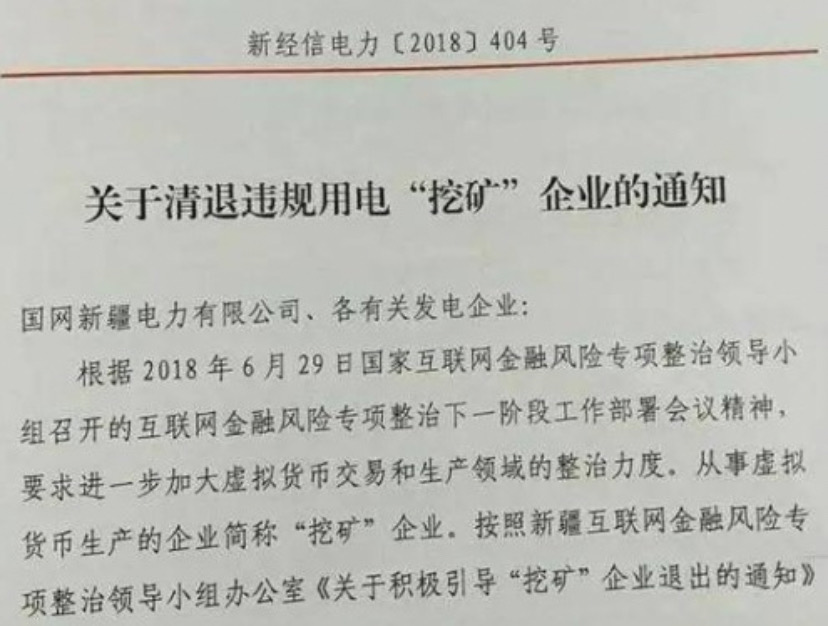
From past announcements in Inner Mongolia or Xinjiang, it is not difficult to find that,In order to obtain low electricity prices, many mining farms have been playing around the corner, packaging themselves as "cloud computing" infrastructure encouraged by policies, and even many parts have been enjoying preferential policies in disguise.
Such illegal mines not only did not bring economic benefits to the local area, but also secretly took away resources and enjoyed support policies. This is also the reason why Inner Mongolia and Xinjiang had to rectify and clear some mines. here we go.
Compared with thermal power plants, Yunnan, Sichuan, Guizhou and other places are indeed facing conflicts in peak power consumption before the arrival of the "wet season".Therefore, even environmentally friendly hydropower, there are times when it is "too much".
secondary title
Will the liquidation of a large number of mines affect the stability of the Bitcoin system?
One month ago, Wu Jihan, the richest man in the mining industry, said at the 2nd Bit Deer 421 Fengshui Festival and Mining Ecology Conference that the impact of carbon neutrality on the mining industry is a problem that the entire industry needs to face. A limitation of the industry, everyone should not take chances on this matter.
Moreover, Bitcoin mining is also facing doubts in China. If miners continue to use unclean energy, they will be at a disadvantage in my country's internal development ecology.
Then, if, as Wu Jihan said, because of the prominent environmental protection problems caused by the use of "unclean energy", if a large number of domestic mines are shut down, will it have a major impact on Bitcoin?
When a large number of mines are closed, the first thing to face is the problem of computing power. If there is no impact at all, it must not be possible, because at least the Bitcoin computing power will be reduced in a short period of time. But in fact, the impact is very small, because Bitcoin is already a global public facility, with nodes all over the world. As a point-to-point distributed system, its biggest feature is "resistance to single point of failure".
However, some people still worry that in particularly extreme cases, if the computing power of a certain country is suddenly shut down, the computing power drops sharply, and the difficulty adjustment mechanism of Bitcoin does not adjust so quickly, in this case The time will be extended.
However, this kind of worry may be unnecessary. The sharp drop in computing power also means that other miners have an opportunity, because it is more profitable to enter mining at this time, and some old mines that are close to being eliminated due to "energy consumption ratio" Machines may be restocked.
That is to say, the mine here has stopped, and the computing power has dropped, and it will soon be slowly replenished by miners in other regions. This can also be regarded as a game between miners under the economic model designed by Bitcoin.
Therefore, even if all mines in Xinjiang and Inner Mongolia are shut down, the impact on the stability of the Bitcoin system will not be too great, let alone the impact on the market.Besides, although mining uses a lot of "non-clean energy", the use of "clean energy" is much more. Driven by long-term environmental protection factors in the future, Bitcoin mining will inevitably turn to the use of clean energy. .
Many people in the mining industry said that they are not too worried about the domestic hydropower issue for the time being, because the hydropower mines in many places are still "investment-attracted" from the local area, which is helpful for the full use of surplus hydropower energy in the "wet season" to create economic benefits.
In fact, many "mining" activities are using excess and "wasted" energy.For example, Reuters just reported recently that North American bitcoin miners are cooperating with oil drillers to use excess natural gas to mine bitcoin.
Because oil and gas often come from the same well, when drillers extract the oil, the gas is wasted in the combustion process, storing the value of "excess energy surplus" that would otherwise go to waste in many areas.
Wu Jihan also said,Miners need to think in the long run, and miners need to find clean energy for mining.secondary title
Can the problem of mining polluting the environment be solved?
As mentioned earlier, clean energy seems to be imperative. Musk has criticized the environmental pollution of Bitcoin more than once. Recently, he said on Twitter that the energy consumption of Bitcoin mining has begun to exceed that of a medium-sized country. of energy usage.

It can be seen that the crazy use of energy by Bitcoin mining is not only a domestic concern, it is already an international problem.So is it so easy to solve this environmental protection problem?
In addition to Wu Jihan’s previous proposal that “miners should be prepared to look for clean energy mining for a long time” and establish a blockchain backtracking mechanism to distinguish clean energy mining products, Musk also proposed his own solution.
He tweeted,An audit of the use of renewable energy by large Bitcoin miners,Might help allay concerns that cryptocurrencies are bad for the environment, an issue that could be easily addressed if the top 10 mining organizations published their audited renewable energy consumption.
Of course, many people (such as V God) said that Bitcoin’s energy consumption is a major flaw, and a better consensus mechanism (such as no POS mechanism) should be chosen to replace it, just like Ethereum’s plan to shift from the POW consensus mechanism to Like a POS mechanism that does not rely on energy consumption. Of course, the POS mechanism is not perfect, so the battle between POW and POS has continued.
In fact, human beings' awareness of environmental protection is constantly strengthening, and science and technology are also constantly advancing. As for the problem of mining pollution, with various governance plans and continuous innovations in clean energy, the future is bound to be endless. Another problem.


