


Opinion: How Professional Traders Can Expand Global Bitcoin Trading?


Summary:
Source link:Bitcoin Magazine
Compilation: Apifiny Asia Pacific Team
Summary:
Even as the legalization of Bitcoin in traditional finance matures, there are still barriers in the industry that prevent professional traders from participating.
Legally holding and trading bitcoin and other digital asset investments has reached new heights. Recent announcements of large institutional investments, the recently announced stablecoin by the Office of the Comptroller of the Currency (OCC), and the rise of CBDC projects around the world point to some form of institutional adoption of digital currencies as an inevitable outcome. Bitcoin and the entire cryptocurrency exchange market also offer professionals ample arbitrage opportunities. The digital currency trading market is ripe for a growing number of professional traders.
Why does this happen?
Why does this happen?
The main reason is that existing trading platforms (such as Binance, Bithumb, Coinbase Prime, Gemini, etc.) are still unable to provide the global liquidity, global price discovery and global transaction execution required by institutional traders. Each platform trades in its own siled market, which severely limits liquidity while causing high spreads, slippage and low order rates.
Haohan, CEO of Apifiny, a digital asset trading network, predicts that when a global platform with institutional strength, global liquidity, global price discovery and global execution capabilities emerges, institutions and professional traders will participate in Bitcoin transactions, and the global transaction volume will Significant increases, thereby improving liquidity and making institutional cryptocurrency trading more attractive.
To understand platform requirements, it is first necessary to understand the types of trading strategies that professionals are pursuing, and the requirements for platforms.
Professional traders execute complex global strategies
Professional traders need access to full global markets for liquidity and price discovery. Imagine AAPL being traded on 300+ different, siled exchanges, each with only one fiat AAPL pair (e.g. USD-AAPL, EUR-AAPL, KRW-AAPL, etc.) The current state of global cryptocurrency trading.
trading pair
trading pair
momentum index
mean reversion
long/short
swing trading
intelligent routing
Algo strategy
Scalping (hat snatching)
Each is exploiting market inefficiencies, and the bitcoin and broader cryptocurrency exchange markets are rife with inefficiencies. Why do you say that? Let's look at a few strategies first.
Algo Strategy: In its simplest form, a trader simultaneously buys a crypto asset on one exchange and sells it on another. Below, we explain why such opportunities abound in cryptocurrencies.
Long/Short Strategies: These strategies involve buying undervalued assets to go long and selling overvalued assets to go short. For example, buy undervalued BTC on Coinbase and sell overvalued BTC on Huobi.
Unfortunately, while arbitrage opportunities have long existed in the cryptocurrency trading market, there is a lack of tools in the market to help execute these trading opportunities.
Bitcoin Exchange Market Structure a Barrier to Global Execution
The cryptocurrency trading market is highly fragmented, and its structure presents a large number of trading opportunities on the one hand, but at the same time presents a large barrier to execution.
Three important factors define the cryptocurrency trading market:
1. Each cryptocurrency exchange is a completely segregated trading "land lake", isolated from each other. For example, traders on Gemini only trade with other Gemini traders and only in relation to Gemini's supply, demand and pricing.
2. Most exchanges only use local fiat currency for transactions. For example, traders can only use Korean Won to deposit Bithumb, but not other currencies.
3. Every exchange requires a registration process that requires compliance with AML and KYC.
The key implications are: first, multiple trading accounts are required for global trade execution; second, pricing can vary widely in different trading markets—especially regional markets; third, reserve requirements are high, and multiple exchanges have reserves gold.
Pricing example: At the time of writing, there was a 0.81% gap between the lowest and highest BTC price across the top 10 global exchanges – Upbit’s BTC/KRW trade was 0.81% more expensive than Coincheck’s BTC/JPY pair.
Accounts with multiple exchanges need to execute trades; the liquidity of each exchange is isolated, independent and different from each other.
Holding multiple trading accounts is expensive and unwise
High-volume institutional trading firms executing global strategies must overcome several management, technical and execution challenges.
Management: Each exchange has a registration process, KYC/AML compliance checks, etc. More exchange accounts will bring more legal and management burdens.
Technically speaking: trading institutions must directly manage each exchange's API. They must manage the inevitable changes and upgrades, with little change in the value of differentiation while increasing the expense of the technology.
Additionally, market data from different exchanges must be normalized in order to make profitable trading decisions. Data normalization is not trivial, and any exchange changing its data format can undo previous efforts.
Global implementation also presents enormous challenges. Transactions that need to be executed simultaneously on multiple platforms can be expensive because of the high capital requirements.
For example, suppose a trader has $1 million in funds and buys BTC at $52,000 on one exchange and sells it at $53,000 on another exchange. The trader has two options.
First, traders can buy on one exchange and then sell on another exchange. This process can take anywhere from 10 minutes to an hour, and the trader needs to use $1 million to execute the transaction. However, while waiting for the transfer, the arbitrage opportunity can easily disappear.
Additionally, traders can store funds on multiple accounts. But again in this case, the trader needs $500,000 on one exchange and $500,000 in BTC on another exchange to execute the trade.
The same $1 million capital, the same transaction, the transaction profit is only half.
Trading strategy development and execution are both core strengths of a successful trader, and each one is important:
Registration is a waste of time and legal resources;
API management is very cumbersome, no trader is willing to bother about API management;
Normalized pricing data is required and internal management costs are high.
there must be a better way
Imagine a world where it didn't take a lot of time for institutional traders to acquire not only the capabilities they need, but eliminate the operational and technical challenges that currently keep them on the sidelines. We've seen this in e-commerce and even in job sites, which provide a unified marketplace for searching for job opportunities and product prices on other sites.
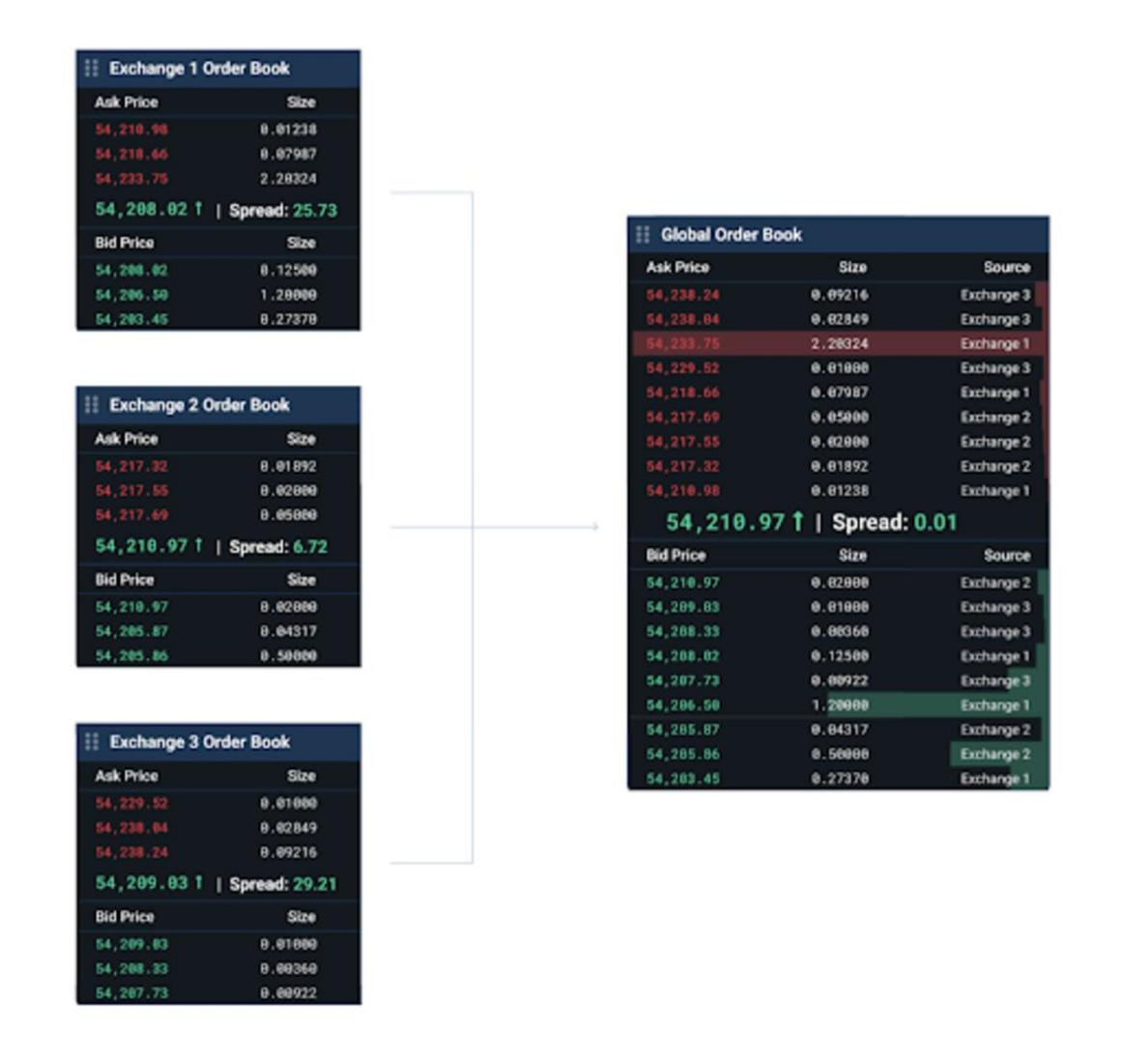
In the world of cryptocurrency trading, this means consolidating numerous order books into one normalized data source through a set of APIs, and trading through one interface or platform.
For example, the image below shows how three actual order books appear as one. See screenshots taken from Coinbase Pro, Kucoin, Huobi on March 9, 2021 at 11:35am (EST) and note the increase in liquidity and the decrease in spreads, which are $29.21, $25.73, and $6.72 USD, while the spreads add up to 0.01 USD.
Seems easy enough, right?
However, currently no professional trading platform can provide these critical functions.
No single platform provides global price discovery and cross-border execution; provides the best global prices in one local currency; aggregates global liquidity; provides direct access to multiple global exchanges; provides global trading through a single account; provides a single , Standardized market data sources.
The growth of institutional trading, especially on a global scale, will not really begin until these important requirements are addressed. At that point, professional bitcoin traders can finally move from the sidelines to the real world of global trading.





