Editor's note: This article comes from,, reprinted by Odaily with authorization., reprinted by Odaily with authorization.
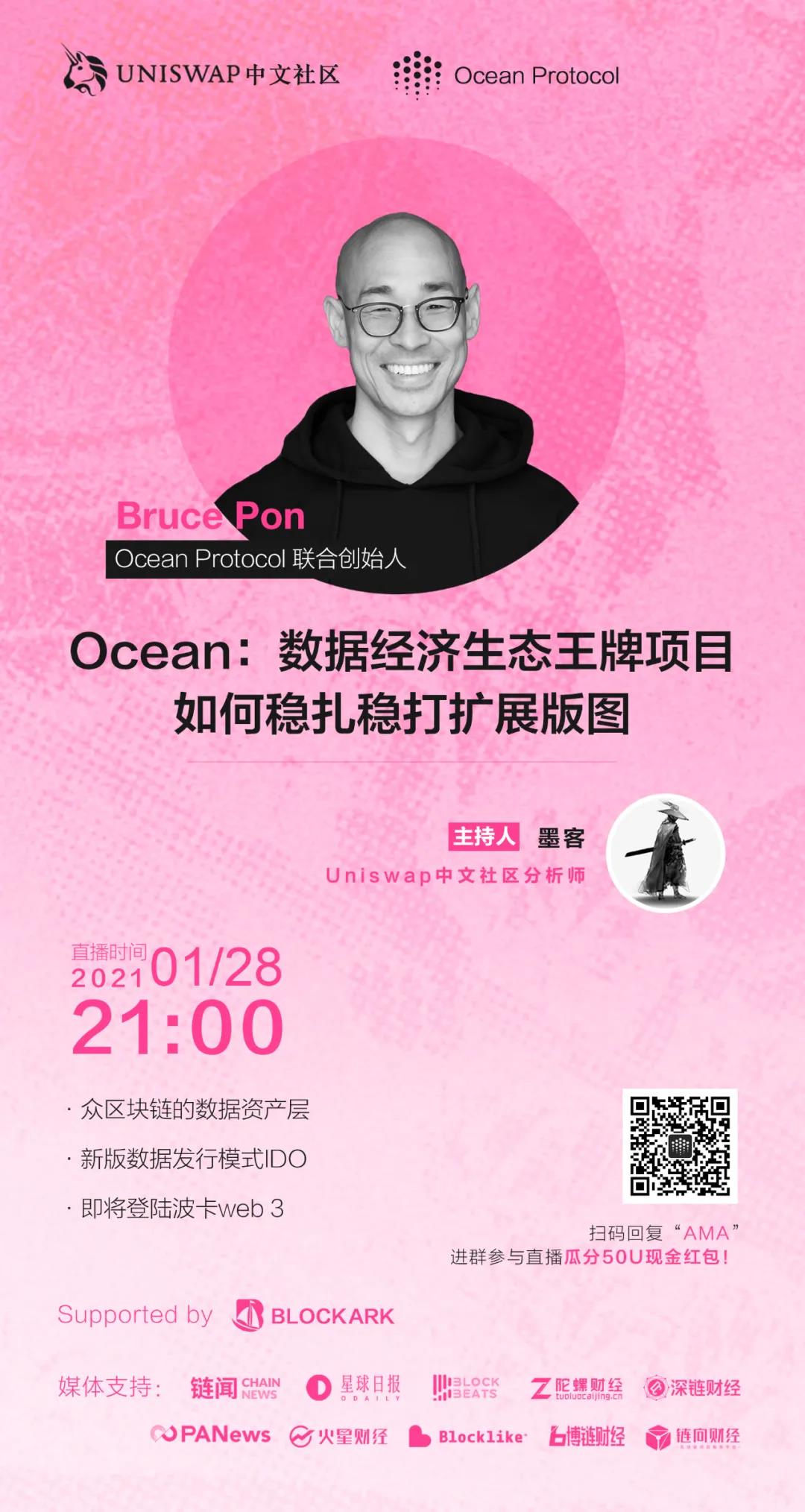
At 9 pm on January 28, 2020, Uniswap Chinese community analyst Mo Ke had a conversation with Bruce, the co-founder of Ocean Protocol, and conducted an AMA event themed "Ocean: the trump card project of the data economy ecology, how to expand its territory steadily and steadily". This live broadcast event is supported by BlockArk, ChainNews, Odaily, BlockBeats, Gyro Finance, Deep Chain Finance, PANews, Mars Finance, Blocklike, Bolian Finance, Link to Finance media support, live sharing content arrangement as follows:
Mo Ke:Hello everyone, I’m Moc, and I’m very happy to invite Ocean to come and share with us.The Ocean Protocol is a decentralized data exchange protocol.The Ocean Protocol team is a team I know that few have a deep understanding of the blockchain. Friends who are interested can read various discussion articles published by their Medium.Hello everyone, I am Moke, and I am very happy to invite Ocean to share with us. Ocean Protocol is a decentralized data exchange protocol. The Ocean Protocol team is one of the few teams that I know of that has a deep understanding of the blockchain. Friends who are interested can read various discussion articles published by them on Medium.Bruce:Nice to see everyone here!Mo Ke:First, let's ask Bruce, the co-founder of Ocean, to introduce ourselves.First of all, we ask Bruce, the co-founder of Ocean, to introduce himself.Bruce:Hi Everyone, I'm Bruce - founder of Ocean Protocol. I'm excited to be here. And I hope I can answer your questions.Hi, I'm Bruce, the founder of Ocean Protocol. I'm so excited to be here. Hope that answers your question too.Mo Ke:Okay, thank you Bruce.Our AMA will start right away. First, we will enter the moderator communication session. After the end, we will have free communication time.OK, thanks Bruce. Our AMA will start soon, first we will enter the moderator communication session, and after the end, we will have free communication time.Mo Ke:Please briefly introduce Ocean's development process. From V1 to V3, what functions have been added or changed in different stages of Ocean? In conclusion, what are the main focus of the Ocean now?Please briefly introduce the development history of Ocean. From V1 to V3, what functions have been added or changed in different stages of Ocean? Finally, to sum up, what are the main sectors of Ocean now?Bruce:Ocean V1 had decentralized access control, and had a basic template to create data marketplaces.Ocean V1 has decentralized access control and has a basic template for creating data marketplaces.Ocean V2 added the ability to buy & sell private data while retaining privacy, via the Ocean Compute-to-Data feature.Ocean V2 adds the ability to buy and sell private data while preserving privacy through the Ocean Compute-to-Data feature.Ocean V3 is Ocean's most important release yet. It introduces the concept of datatokens for access control, securitization of data, liquidity pools for dynamic pricing - all through the Ocean Market. Datatokens makes Ocean tools simpler, easier to work with, and more interoperable with crypto & DeFi tools. Ocean Market is the first community data marketplace, with key features like Compute-to-Data, and automated price discovery using Balancer AMM.Ocean V3 is Ocean's most important release to date. It introduces the concepts of data token access control, data securitization, and data tokens for dynamic pricing liquidity pools, all through Ocean Market. Datatokens make Ocean tools simpler, easier to use, and interoperable with crypto and DeFi tools. Ocean Market is the first community data marketplace with key features including "Compute to data" and automatic price discovery using Balancer AMM.We have a working product and a vibrant community. Our task now is to work with users to fill the Ocean Market with data and services. We see that there is similar work to get adoption and kickstart a Data Economy. If we do our work well, Ocean Market will be play an important role in the Data Economy. Our job for 2021 is to get more data, DApps, and more usage with grassroots developers and with governments and enterprises.We have a viable product and a vibrant community. Now, our task is to fill the ocean market with data and services together with our users. We can see that there is similar work that can be adopted and activate the data economy. If we do our job well, the ocean market will play an important role in the data economy. Our main work in 2021 is to work with grassroots developers and governments and enterprises to get more data, DApps, and get more usageMo Ke:It seems that Ocean has been iterating, which is great. This is a very important feature of a successful blockchain project.It looks like Ocean has been iterating, which is nice. This is an important feature of a successful blockchain project.Mo Ke:We already know that the core component of OceanV3 is data tokens. May I ask Bruce, what exactly are datatokens? Who can create datatokens?We already know that the core component of OceanV3 is data tokens, what exactly is Bruce data tokens? Who can create data tokens (can anyone or must be a project party of another blockchain)?Bruce:Datatokens are ERC20 tokens that represent the value of the data asset and provide access to that data asset. Datatokens radically simplify data sharing, and leveraging existing Web3 mental models for custody, wallets, liquidity, staking and farming. ERC20 tokens that are generated for each published dataset. And since ERC20 tokens are highly compatible with #DeFi, all datatokens can be staked, injected into AMMs and then used as collateral for lending.Data tokens are ERC20 tokens that represent the value of a data asset and provide access to that data asset. Data Tokens radically simplify data sharing and leverage existing Web3 smart models for custody, wallets, liquidity, staking and farming. Every published dataset generates an ERC20 token. And because ERC20 tokens are highly compatible with #DeFi, all data tokens can be staked, injected into AMMs, and then used as collateral for loans.Datatokens let people discover the value of their dataset and encourage liquid trading of data assets through our pioneering approach of using Balancer liquidity pools integrated into Ocean Market.Datatokens enable people to discover the value of their datasets and encourage liquidity trading of data assets through our pioneering approach using Balancer liquidity pools integrated into Ocean Market.Datatokens solves one of the biggest questions we had when we started this - and that is "what is the price of data?" or "what is the value of data?"Datatoken solves one of the biggest questions we had when we started, which was "What is the price of data?" or "What is the value of data?"With datatokens along with AMMs - the market can figure it out. This is a huge breakthrough if people can get a price signal on the value of their data, we think people will be incentivized to share more willingly.With data tokens used with AMMs, marketplaces can solve this problem. If people can get price signals from the value of their data, then this will be a huge breakthrough, and we think people will be incentivized to be more willing to share their data.Mo Ke:Many people don’t understand data tokens. Let me briefly introduce what ocean does is to encapsulate complex data transactions into data tokens, so that everyone can simply use ERC20 tokens to trade data, and can also implement mining, etc. Features.Many people don't understand data tokens. Let me briefly introduce that what ocean does is to encapsulate complex data transactions into data tokens, so that everyone can simply use ERC20 tokens to trade data and realize mining, etc. Function.Mo Ke:The pricing and exchange of datatokens in the Ocean protocol takes place in Ocean Market. Could you pleas e briefly introduce the principles of Ocean Market? Who are the main participants? How are datatokens priced and circulated? How is it different compared to Balancer?The pricing and exchange of data tokens in the Ocean protocol takes place in the Ocean Market. Could you briefly introduce the principle of the Ocean Market? Who are the main players? How are data tokens priced and circulated? How is it different from Balancer?Bruce:Ocean Market is an open-source community marketplace for data.Ocean Protocol is an open source data marketplace.Ocean Market allows publishers to post data for sharing and use. Data can be fixed price or dynamic price. If the data is fixed, people can straight up buy the data using $OCEAN. For dynamic price, the price varies depending on the liquidity pool - the more popular the dataset with liquidity providers, the higher the price. This is out of the box functionality.Ocean Marketplace allows publishers to post data for sharing and consumption. Data can be fixed price or dynamic price. If the data price is fixed, people can directly use $OCEAN to buy data. For dynamic data prices, the price depends on the liquidity pool - the more popular the data set among liquidity providers, the higher the price. That's what it does out of the box.Anyone can stake OCEAN into each pool, to get a cut of sales fees. The more useful datasets will tend to have higher liquidity, higher prices, and higher signal. Over time, the market and community will be able to identify quality datasets faster from pattern recognition. It gives datasets a value signal, which is a key piece to unlock a Data Economy.Under the hood, we used a fork of Balancer to make this happen. We made core contributions to the Balancer code and in the next release of Balancer v2, the code in our fork will be integrated.Anyone can put OCEAN into a single resource pool to save fees. More useful datasets will tend to have higher liquidity, higher prices and higher signals. Over time, the market and community will be able to identify high-quality datasets from pattern recognition more quickly. It provides a signal of value to the dataset, which is the key to unlocking the data economy. Below that, we used a fork of Balancer to achieve this. We made core contributions to the Balancer code, and in the next version of Balancer v2, the code from our fork will be integrated directly.Mo Ke:To make a digression, the two projects, Balancer and Ocean, have a good personal relationship.To make a digression,Balancer has a good personal relationship with Ocean. [Laughs]Mo Ke:Next,In a medium titled "the web3 sustainability loop", we learned that the establishment of OCEAN DAO will provide Grants for some projects. Recently, Ocean also released the first batch of Grant projects. Please briefly explain this Dao governance logic? And what conditions are met to be able to be awarded a Grant?In a medium article titled "the web3 sustainability loop", we learned that the establishment of OCEAN DAO will provide donation funds for some projects. Recently, Ocean also released the first batch of Grant objects. Please briefly explain this Dao governance logic? And what conditions must be met to be granted a donation?Bruce:OceanDAO closes the loop on a “snowball effect” feedback cycle where the health of OCEAN and the Ocean ecosystem rises as the usage of Ocean goes up. In order to qualify to be awarded a grant, the proposals must have help to grow the Ocean ecosystem - technical, outreach or marketing, and be aligned with Ocean's mission. Developers and community members are issued tokens from a pool of network rewards and revenues from the Ocean Market.OceanDAO closes the loop in the “snowball effect” feedback loop, where as ocean usage increases, so does the health of oceans and marine ecosystems. To be eligible for grants, the proposals must contribute to the development of the ocean ecosystem (technologically, outreach or marketing) and be aligned with the ocean's mission. Developers and community members earn tokens from revenue from the network reward pool and Ocean Marketplace.There are Town Halls every Wednesday where community members can ask questions and discuss their project proposals. The second funding round closes on Feb 1. More info on https://github.com/oceanprotocol/oceandao/wikiEvery Wednesday there are Town Halls where community members can ask questions and discuss their project proposals. The second round of financing will close on February 1.For more information, please visit https://github.com/oceanprotocol/oceandao/wikiMo Ke:This has little to do with ordinary users, but generally speaking, the willingness of the project party to launch Grant activities represents enthusiasm and the financial strength to promote ecological development.This has little to do with ordinary users, but generally speaking, the willingness of the project party to carry out Grant activities represents enthusiasm and has the financial strength to promote ecological development.Mo Ke:Ocean has many grant plans recently. In addition to Ocean DAO, it has also released the first batch of Ocean shipyard grant lists and jointly released ecological partner rewards. In such large-scale ecological cooperation construction activities, may I ask Ocean Protocol, How to make use of value in other projects? What plans will be made in the construction of the ecosystem in the future?Ocean has a lot of Grant plans recently. In addition to Ocean DAO, it also released the first batch of Ocean shipyard Grant lists and jointly released ecological partner rewards, etc. In such a large-scale ecological cooperation construction activity, Ocean Protocol will How to play value in other projects? What plans will be made for the construction of the ecosystem in the future?Bruce:Our job is to build the native Web3 infrastructure that allows data sharing to flow. Part of this is to have hooks, tooling and integrations that allow companies, large and small to join in.Our job is to build native Web3 infrastructure that allows data sharing to flow. Part of that is having hooks, tools and integrations that allow all companies to join.To date, we have run several programs to activate community groups and developers. We did Data Economy Challenge which has had interest from 400 teams, Shipyard for startups going for MVPs, Covidathon, a collaboration of projects in the space to see how Web3 tech could be leveraged to support covid19 research efforts and finally OceanDAO. Each of these initiatives appeals to a different flavour of developer and community member. By year end, we hope that a full 100 teams will have received funding, with some of the teams being able to build sustainable businesses on top of Ocean Protocol.To date, we have had several events to activate community groups and developers. We had the Data Economy Challenge, which attracted 400 teams, as well as the Shipyard event - an MVPCovidathon event for those startups working with projects in the space to see how Web3 technologies can be leveraged to support covid19 research work, and finally our OceanDAO event. Each of these initiatives has attracted a different set of developers and community members. By the end of the year, we hope that 100 teams will be funded by Ocean, and some of them will be able to build sustainable businesses on top of Ocean Protocol.Our Enterprise partners challenge us to create cutting-edge technology for real-world use cases with impactful applications. So the intersection of enterprise needs dovetails into our community efforts well.Our enterprise partners challenge us to create cutting-edge technologies for real-world use cases for high-impact applications. So the intersection of enterprise needs fits nicely with our community efforts.Mo Ke:In the recent medium, we see that Ocean’s recent partners are involved in various fields, such as health care, Internet of Things, artificial intelligence, education, public welfare, DeFi, etc., in which application scenario Ocean protocol is most likely to be implemented. ? In which area do you think Ocean protocol will exert the greatest value?In the recent medium, we saw that Ocean’s recent partners involve various fields, such as health care, Internet of Things, artificial intelligence, education, public welfare, DeFi, etc. In which application scenario Ocean protocol is most likely to be implemented ? In which areas do you think Ocean protocol will play the greatest value?Bruce:There is a strong case for the need for data decentralization in the automotive industry. In 2020, Ocean partnered with Daimler, the producer of Mercedes-Benz, to deliver a decentralized data sharing solution pilot to enable the sharing of private data and monetization. We built the end-to-end platform using Ocean tech featuring access control, data discovery, storage, and Compute-to-Data. This solution can be deployed to any other partner that we work with in the future.In the automotive industry, there are strong reasons for the need for data decentralization. In 2020, Ocean partnered with Mercedes-Benz maker Daimler to pilot a decentralized data-sharing solution to enable the sharing of private data and monetization. We built an end-to-end platform using Ocean technology, including access control, data discovery, storage, and computing power for data. This solution can be deployed to any other partners we work with in the future.We are approaching a clear intersection where crypto meets mobility and data monetization. More people are seeing this. For example, financial analysts are estimating that ‘all of Tesla's other data services will be worth more than its car business’. And Ocean is hoping to be right there when it happens - as we move towards a tipping point to mass adoption of mobility, data monetization, and a new Data Economy.We are approaching a clear intersection where encryption meets mobility and data monetization. More and more people are seeing this. For example, financial analysts estimate that "all of Tesla's data services will be worth more than its auto business." Hopefully Ocean will be there when it happens - as we move towards the tipping point of mass adoption of mobile, data monetization and the new data economy.Of course, mobility isn't the only sector where data sharing is needed. Part of the magic of decentralization is that innovation can come from anywhere. So while we have significant efforts in mobility, other areas are starting to show a lot of promise. We're excited for what can rise to the surface in 2021.Of course, mobility isn't the only area where data sharing is required. Part of the magic of decentralization is that innovation can come from anywhere. So while we have made great efforts in mobility, other areas are starting to show a lot of promise. We're excited to see what surfaces in 2021.Mo Ke:Cooperation with a well-known entity such as Daimler is a very good progress. It is a bit like the cooperation between another project FLOW and the NBA recently. These are all good things that can ask the currency circle to bring incremental funds and applications.It is a very good development to cooperate with a well-known entity such as Daimler. It's a bit like the recent cooperation between another project FLOW and the NBA. These are all good things that can bring incremental funds and applications to the currency circle.Mo Ke:Polkadot's parachain auction is about to begin. Seeing that Ocean is also submitting the proposal for the auction parachain slot, what benefits will the successful bidding of the parachain bring to the Ocean protocol?Polkadot’s parachain auction is about to start, and Ocean is also submitting a proposal for auctioning parachain slots. What benefits will the success of the parachain auction bring to Ocean protocol?Bruce:Ocean isn't planning submitting a proposal for an auction parachain slot. We don't need it right now. We are happy to be working with Moonbeam to deploy Ocean smart contracts and Ocean Market on the Kusama network. We think this approach hews to the strengths of our team to focus on data sharing, while allowing others to shine for their talents in deploying Ocean to a new network and running a new Ocean Market.Ocean has no plans to submit proposals for auctioning parachain slots. We don't need it now. We are excited to partner with Moonbeam and deploy Ocean smart contracts and Ocean Market on the Kusama network. We feel this approach leverages our team's strengths, focusing on data sharing while allowing others to bring their talents to life in deploying Ocean to new networks and running new Ocean Markets.Mo Ke:Frankly speaking, KSM has been selected for many projects, of course, I will not discuss comparison here. I personally discussed this with Polkadot’s project team. Those who are interested can calculate whether the income of many IPOs (slot issuance) can cover such a high valuation. This may be a big bubble.Frankly speaking, many projects have chosen KSM, of course, we will not discuss the comparison here. I personally discussed this matter with Polkadot’s project team. Those who are interested can calculate whether the current IPO (slot issuance) income can cover such a high valuation. It may be a big bubble.Mo Ke:If the auction of the parachain is successful, in what form will Ocean join the Polkadot parachain, in the form of a public chain or in the form of a Dapp nested in a parachain? Will there be any changes to the protocol layer?If the auction parachain is successful, in what form will Ocean join the Polkadot parachain, in the form of a public chain or in the form of a Dapp nested in a parachain? Will there be any changes at the protocol layer?Bruce:By working with Moonbeam, we will be a DApp on a parachain - with all the advantages of performance, lower cost and greater accessibility for people that are dipping their toes into the Data Economy.By partnering with Moonbeam, we will become DApps on parachains — bringing performance, lower costs, and greater accessibility to those involved in the data economy.Mo Ke:In the Polkadot ecosystem, there are some other data validation projects such as Litentry. Compared with other data validation projects, what is the core competitiveness of Ocean?In the Polkadot series of projects, there are some other data right confirmation projects such as Litentry. Compared with other data right confirmation projects, what is Ocean's core competitiveness?Bruce:Ocean opens up enormous opportunities for developers and enterprises to explore the data economy. We allow people to turn data into an asset and earn money on their data. By integrating with #DeFi building blocks, people are able to use the latest innovations for a) securitizing data to construct pools of datatokens, just like an index fund - where others can invest into, b) injecting datatokens into automated market makers like Balancer and Uniswap to earn yield or increae liquidity or c) using data as collateral for lending.Ocean presents a huge opportunity for developers and enterprises to explore the data economy. We allow people to turn data into assets and make money from their data. By integrating with #DeFi building blocks, one is able to use the latest innovations to: a) securitize data to build pools of data tokens, like index funds, that others can invest in; b) pool data tokens Inject into Balancer and Uniswap to earn income or increase liquidity, or c) use data as collateral for loans.Mo Ke:The token release model and value source are important references forinvestors in the secondary market. Please briefly describe the OCEAN release model and the logic of destruction, and how to achieve long-term value growth of OCEAN?The token release model and source of value are important references for investors in the secondary market. Please briefly describe the release model and destruction logic of OCEAN, and how to achieve long-term growth in the value of OCEAN?Bruce:First, $OCEAN is a utility token with many uses in the network. $OCEAN can be used to:1) Default pairing for any datatoken for staking3) Vote on OceanDAO proposals4) Emissions of OCEAN for network rewards5) Pay fee commission in the Ocean Market, a portion of which is burnedFirst, $OCEAN is a utility token with many uses in the network. $OSEAN can be used to:1) Mark the default pairing for any data placed3) Vote on the Oceania proposal4) OCEAN emitted for network rewards5) To the ocean market commission, part of which will be destroyedThe token supply has been set since 2017 when we did the initial fundraising. In this model, 10% of tokens wnet to the core team, 20% to investors, 20% to the Foundation for community efforts and 50% to the network rewards.The token supply was set during our initial fundraising in 2017. In this model, 10% of the tokens go to the core team, 20% to investors, 20% to the community effort foundation, and 50% to network rewards.To date, 610m tokens have been minted, with 420m in circulation. The remaining tokens are held by Ocean Foundation.To date, 6.1 million coins have been minted, of which 4.2 million are in circulation. The remaining tokens are held by the Ocean Foundation.We will activate network rewards sometime in 2022 when the OceanDAO is mature and fully tested, where grants can be given to people that perform useful activities on the network. The optimal balance is where the token supply grows with the value of the network and serve to accelerate adoption of the technology. Ultimately, it is the community that will decide the token inflation rate in the long-term.We will activate network rewards sometime in 2022, when OceanDAO is mature and fully tested, grants can be awarded to those performing useful activities on the network. The optimal balance is one where the token supply grows with the value of the network and helps accelerate technology adoption. Ultimately, it is the community that determines the long-term token inflation rate.Mo Ke:There is not much difference between the circulation data and coingecko.There is not much difference between circulation data and coingecko.Mo Ke:Okay, thank you Bruce. Next, we enter the free communication link, friends who have questions can raise questions in the group, both in Chinese and English.【Free question and answer session】【Free question and answer session】@Jimmi:The successful launch of the data market requires a large amount of valuable data. I have seen a lot of data sets released by the beta version of Ocean market, but there is currently no classification or retrieval function, and most data sets are not valuable to me. What is the barrier of the Ocean market now? In addition, will users who issue data tokens in the beta version have rewards in the future? Such as airdrop?A successful launch of a data marketplace requires a large amount of valuable data. I have seen a lot of datasets released in the beta version of Oceanmarket, but there is currently no classification or retrieval function, and most of the datasets are worthless to me. What are the barriers in the ocean market now? Also, will there be rewards in the future for users who issued data tokens in the beta? Like an airdrop?Bruce:Great question. The Ocean V3 release of Ocean Market was amazing. Lots of users and experimentation. What became clear was the following: 1. The dynamics of the market skewed too heavily to the publishers, allowing rug pulls on people adding liquidity2. The main purpose of the market - to get buyers and sellers was hindered by the high cost of gas and transactions. This is why we need to explore other chains that can handle the transaction volume3. The Ocean Market will have deficiencies. Selling and buying data is typically done by the very few - so we will take the best from the existing data marketplaces but give it a web3 flavour. This is the main challenge. We need to give people a user experience that allows htem to understand the data enough to buy it - categories, classification, sorting and analytics. I'm heartened to see so many startups already trying to give this transparency about data sets. But we have work to do on Ocean Market before we can bring on a lot more people at scale.Good question, the V3 release of the Ocean marketplace is amazing. Lots of users and experiments. What becomes clear is:
1. The dynamics of the market affect publishers too much, which makes people increase their liquidity.
2. The main purpose of this marketplace - to attract buyers and sellers - is hampered by the high cost of gas fees and transactions. That's why we need to explore other chains that can handle transaction volume
3. There are deficiencies in the marine market. Buying and selling data is usually done by a very small number of people - so we're going to get the best out of the existing data marketplace, but give it a web3 flavor. This is the main challenge. We need to give people a user experience that enables htem to fully understand the data in order to buy it - classify, classify, sort and analyze. It’s so exciting to me to see so many startups already working to increase the transparency of their datasets. But we still have a lot of work to do in the ocean market before we can reach more people at scale.
@Neil:I saw a discussion about the number of Ocean market data sets before. Now Ocean is still in the beginning of the Moore curve, and a large number of data sets need to be added before proceeding to the next step: forecasting data. May I ask When do you estimate that data can be used to predict data?I saw a discussion about the number of ocean market datasets before. Now Ocean is still in the early stages of the Moore curve, and before proceeding to the next step: predicting data, a large number of data sets need to be added. May I ask when do you estimate when the data can be used to predict the data?Bruce:Along the lines of the answer I just gave, we are working with enterprises under NDA to bring valuable data sets on to the market. The most obvious data streams would be those from the crypto-space - Chainlink feeds, Streamr, Messari, CoinmarketCap/Coingecko, LunarCrush.With this data, cryptotraders can get the information they need to make better decisions.Following the answer I just gave, we are working with companies under the NDA to bring valuable datasets to market. The most obvious data streams will be those coming from the crypto space - Chainlink Feed, Streamr, Messari, CoinmarketCap/Coingecko, LunarCrush, with this data crypto traders can get the information they need to make better decisions.@浥智气:Questions from other groups:Will Ocean move to Polkadot network after participating in the slot auctionWill Ocean migrate to the Polkadot chain after participating in the slot auction?Bruce:Ocean is an L2 protocol that can live on any layer. We see the momentum in Polkadot ecosystem and the technical advancement of it, so we're very confident that having Ocean smart contracts and Ocean Market on Polkadot is the right answer. But there are other technologies that are very good also - Cosmos, NEAR, Binance Smart Chain, etc. - Where-ever there is a vibrant ecosystem, we see that Ocean can function on them, to unlock dataOcean is an L2 protocol that can exist at any layer. We have seen the momentum of the Polkadot ecosystem and its technological advancements, so we are very confident that having Ocean smart contracts and Ocean marketplaces on Polkadot is the right answer. However, there are other very good technologies - Cosmos, NEAR, Binance Smart Chain, etc. As long as there's a vibrant ecosystem, we'll see what Ocean can do on them to unlock data.@先慈生活:How important is the community to Ocean? What have been your biggest challenges in growing the Ocean community? Are you satisfied with what you have achieved so far?How important is community to Ocean? What is the biggest challenge you have encountered in growing the marine community? Are you satisfied with the results you have achieved so far?Bruce:Community is everything. Without community we are nothing. You can copy all of our code and create a clone of Ocean - but you can't clone our community and we're proud of this.We grew out community to 75,000 followers in 2020 from around 30,000. In 2021, we would like to activate community in 10 countries and have 200,000 followers. Every single follower is important. We work for everything. No shortcuts. No fakes. We want people to understand the mission of Ocean and believe in it. Because ultimately, Ocean is about "owning your own data" - data that has value, data that is truly yours. Yes, companies and government can use our data - but it's ours to give. I want our community to believe in this vision and make it their vision.Community is everything. Without community, we are nothing. You can copy all of our code and create clones of Ocean, but you can't clone our community, and we're proud of that. In 2020, our community grew from around 30,000 to 75,000 followers. In 2021, we hope to activate communities in 10 countries and have 200,000 followers. Every follower counts, we work hard for it all, no shortcuts, no fakes. We want people to understand Ocean's mission and believe in it. Because at the end of the day, Ocean is about "owning your own data" valuable data, data that truly belongs to you. Companies and governments can use our data, but we provide it. I want our community to believe in this vision and make it their own@望意我心:Data is most feared by hackers, as hacking means data is stolen and sold, but there have been a lot of hacking attacks in our cryptocurrency world lately, what does Ocean think about this? Does Ocean have its own insurance and guarantees to protect its platform from hackers?Data is what hackers are most afraid of, because hacking means data is stolen and sold, but there have been a lot of hacks in our cryptocurrency world recently, what does the ocean think about this? Does Ocean have its own insurance and guarantees to protect its platform from hackers?Bruce:We think a lot about the negative uses of data. But let's be honest, the negative uses happen when a company has weak security and allows hackers to walk in the front door to steal our data. If companies gave us back our data to control, we would all each share responsibility to manage it. Companies are honeypots for hackers. And we want two things to happen. 1) Companies pay a price for holding our data, and are held accountable if something happens and 2) That people know that their data is valuable. This is the only way to rebalance the power in this matter. For hackers, whenever there are incidents against our community we do everything we can to protect them. We have cooperated with police to hunt down hackers and we will continue to.We think a lot about negative uses of data. But when companies have weak security and allow hackers to walk through the front door and steal our data, there are negative consequences. If companies hand our data back into our control, we share responsibility for managing it. Companies are honeypots for hackers. We will ensure two things. 1) Companies pay to keep our user data and are held accountable when certain things happen; 2) Let users know their data is valuable. For hackers, whenever there is an incident against us, the community does everything to protect them. We are already working with the police to hunt down hackers and will continue to do so in the future.@李玉恒:Hello Bruce, Ocean’s vision is to realize the decentralization of data rights. Data is no longer only owned by monopoly technology companies. How does Ocean ensure fair access to data sets?Hello Bruce, Ocean's vision is to realize the decentralization of data rights. Data no longer belongs only to monopoly technology companies. How does Ocean ensure fair access to data sets?Bruce:Fair access to data happens when every person actually owns their data. In this way, we can exert our rights. Let people have control of their data - it's theirs to use.Right now, its the companies that have control. We need to let them know that web3 technology is going to make it easier and easier to give people control.I enjoyed your questions. Very thoughtful.Access to data is equitable when everyone actually owns their data. In this way, we can exercise our rights. Put people in control of their data, use their data. Now, the company that has control. We need to let them know that web3 technology will make it easier and easier for people to control. I really like your question, very thoughtful.Mo Ke:Okay, thank you Bruce. If you still have questions, you can chat with me privately. Today’s AMA will be organized into an article and sent out.OK, thanks Bruce. If you still have questions, you can chat with me privately. We will organize today's AMA into an article and send it out.(Note: This article is only for research discussion and information sharing, not as investment advice.)*You can follow Ocean Protocol on Twitter, Telegram, LinkedIn, GitHub and Newsletter for project updates and announcements. And can communicate directly with other developers on Discord.Official website: https://oceanprotocol.com/Twitter:https://twitter.com/oceanprotocolMedium:https://blog.oceanprotocol.com/GitHub:https://github.com/oceanprotocolTelegram: https://t.me/OceanProtocol_CommunityDiscord:https://discord.com/invite/TnXjkR5https://oceanprotocol.com/protocol/#papershttps://www.youtube.com/channel/UCH8TXwmWWAE9TZO0yTBHB3A











