In the year of the rise of expansion, the Layer2 "big family" is doing its best to "save" Ethereum



In 2020, DeFi is booming, the Gas fee of Ethereum is high, the network is congested, and capacity expansion has become a topic of continuous concern. Recently, Loopring, the first application based on zkRollup, has surged, and the Rollup expansion solution has become a hot spot in the market.There are many expansion plans in Ethereum. Why did Plasm, which once attracted much attention, decline, and why is Rollup so popular? What exactly is Rollup? Who will win in the end, zk-Rollup or Optimistic Rollup? In 2021, for investors, what projects are worth deploying in the Layer 2 expansion plan?secondary title
Loopring surges, Rollup expansion plan becomes a hot spot in the market
On December 21, the Loopring protocol officially issued a document saying that after Chainlink and Hashgraph, Loopring became another Google cooperation project and became the first zkRollup application case recommended by Google. Loopring Protocol officially stated that it is the world's first zkRollup-based decentralized transaction protocol. Under the premise of ensuring security, the throughput has increased by 1000 times, and the cost has been reduced by hundreds of times.
(Odaily Note: Rollup is mainly divided into two technical routes, Optimistic Rollup and ZK Rollup, which have unique advantages in different application scenarios.)(Odaily Note: Rollup is mainly divided into two technical routes, Optimistic Rollup and ZK Rollup, which have unique advantages in different application scenarios.)For example, the Optimistic Rollup solution chosen by Synthetix will soft launch the mainnet on January 15, and users are expected to experience it in March; Sushi showed in the roadmap released on January 9 that it will choose ZK Rollups as the expansion solution.
secondary title
Why Rollup?
image description
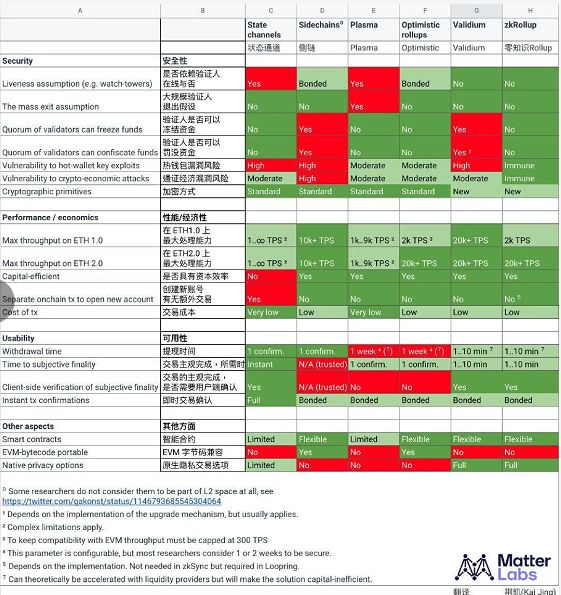
Matter LabsCartography
· The Decline of Plasma
In August 2017, the scaling solution became the main topic of discussion in the Ethereum community at that time. Amid this frenzy, Vitalik Buterin and Joseph Poon published a paper introducing a new layer-2 scaling solution called “Plasma,” which they say can handle “virtually all the financial computations in the world.” Shortly after its release, Vitalik simplified this specification in a new paper titled MVP (Minimal Viable Plasma, Minimal Viable Plasma). MVP proposes a simplified version of Plasma: a simple UTXO-based sidechain that maintains security in the event of data unavailability. A sidechain is a blockchain connected to another blockchain. Sidechains can be operated in many different ways, such as by a trusted third party, a consortium, or a consensus algorithm.
Plasma is designed to minimize trust requirements for sidechain operators. That is, Plasma prevents funds from being stolen even if the operator (or majority in consensus) misbehaves. However, in real-world deployments, Plasma poses more problems than solutions. For example, each user must monitor and verify all transactions on the Plasma MVP chain to detect the behavior of malicious operators and exit in time. Transaction verification is expensive, and this need for monitoring adds significant overhead to participating in a Plasma chain.
The Ethereum community then came up with the Plasma Cash solution, which would allow arbitrarily high transactions per second and solve the problems that plagued its predecessor. Likewise, Plasma Cash presents a new set of problems. While new Plasma architectures continued to emerge with slight improvements over their predecessors, the Ethereum community failed to rally behind any of them.
· The Rise of Rollups
Just when confidence in layer 2 was bottoming out, a user under the pseudonym Barry Whitehat disclosed a proposal called "roll_up" on GitHub. The report describes a new type of layer-2 scaling solution: a Plasma-like architecture that "packages" transactions without relying on trust in the operator, and the correctness of the package can be verified by using a SNARK's On-chain evidence to prove.
This SNARK ensures that it is impossible for operators to issue malicious or invalid transactions and ensures that all sidechain blocks are valid.
Rollup is a Plasma-like Layer-2 scalability solution: a single mainchain contract holds all funds and succinctly encrypts the state of a larger "sidechain" (typically a Merkle tree of accounts, balances, and their states) promise. Sidechain state is maintained off-chain by users and operators and does not depend on Layer 1 storage (which is where the biggest scaling wins come from).
What separates Rollup from Plasma is that it solves Plasma's huge problem: data availability, by publishing some data for each transaction through the Layer 1 network (in Ethereum, tx CALLDATA is used exclusively for this purpose).
So thousands of transactions can be bundled together in a single Rollup block. Although the cost of this approach scales strictly linearly (O(n) in the number of transactions), it can actually improve throughput by a factor of 100 because CALLDATA is cheaper than Layer 1 storage and computation.
· Development and comparison of zk-Rollup and Optimistic Rollup
Vitalik Buterin released an improved version of Barry's scheme, which he calls zk-Rollup. zk-Rollups can avoid Plasma's out-of-game and challenge periods without sacrificing affordability or security. With zk-Rollup, one can use new cryptography to solve all of Plasma's layer 2 scaling challenges at once. But not everyone is pinning their hopes on zk-Rollup. A year after the first zk-Rollup specification was published, John Adler and Mikerah introduced a design they called Merged Consensus. Merged Consensus enables an off-chain consensus system that is fully verifiable on Ethereum without any fancy zero-knowledge cryptography. The Plasma team later released an extended version of the merged consensus design — Optimistic Rollup.
secondary title
Mainstream Layer 2 Solutions and Use Cases
Above we compared the development of Rollup and different technical solutions from the technical level. Next, we sorted out the Layer 2 application from the application level.
· ZK Rollup scheme
The Loopring protocol was created based on ZK Rollup, and the payment can be realized in seconds and with low fees. At present, applications such as Loopring Wallet have been released, and five leading DeFi projects have started two-layer liquidity mining.
zkSync was created by Matter Labs based on ZK Rollup, and now has use cases such as Gitcoin Grants donations, Curve testnet, and zkSync payments.
Sushi stated in the roadmap released on January 9 that it will choose ZK Rollups as the expansion solution.
· Optimistic Rollup Solution
The Optimistic Rollup solution chosen by Synthetix will soft launch the mainnet on January 15th, and users are expected to go online in March.
· xDAI (Sidechain)
As an EVM (Ethereum Virtual Machine) sidechain of Ethereum, xDAI currently has use cases such as the chain game Dark Forest and the decentralized derivatives trading platform Perpetual Protocol.
· Matic Network(Plasma)
secondary title
Investment and thinking about Layer 2 projects
The current DeFi ecology on Ethereum is very prosperous, but there are more and more criticisms about its performance and costs. Layer2 will undoubtedly become a hot spot in the market this year. For investors, what is the value of Layer 2 projects? How to plan and invest? On January 7, 2021, in the "2020 FAT Value Era Summit Forum and Awards Ceremony", well-known investors introduced some investment methods for Layer 2 projects this year.
Mable, a partner of Multicoin Capital, said that the high gas fee actually blocks the issuance of some junk assets, because when everyone chooses to use a certain contract, they will consider "whether or not to spend this money to interact", some of the more important assets Issuing or trading is no problem at the Ethereum layer. For those transactions that are not time-sensitive and less important, they can actually be packaged in batches, and there are many technologies that can achieve this effect.
As for Layer 2, everyone is very concerned about Rollup. The idea of some development teams is to build a two-tier aggregator, which is very meaningful, because it is actually difficult for users interacting on the front end to perceive which technical solution the project team has chosen, so a two-tier aggregator Aggregators are very meaningful, and some people have been doing this recently. Everyone in the Layer 2 network has their own solutions, the more prominent ones are Matter Labs and Optimsm, but the problem of inability to communicate between Layer 2 networks has not been well resolved. I really believe in head effects. For example, if Synthetix chooses Optimsm, other projects will follow. In addition, there may be a group of direct choices based on zkRollup.
Mia Deng, partner of Dragonfly Capital, said that zkRollup will be one of our key layout directions this year. Matter Labs and StarkWare, which we invested in, have also begun to cooperate with some DeFi protocols. For example, StarkWare has begun to reach a deal with the derivatives trading protocol dydx Cooperation; at the same time, we will also have some layout for those public chains (such as NEAR) that are compatible with Ethereum.
Kai Wu, director of investment management at SNZ, said that this year, we have made some layouts in terms of performance and cross-chain. In this regard, we have invested in two relatively new projects, one is BoringDAO, which is an asset cross-chain bridge, and the other is ZKswap, which has just been launched on Uniswap recently.
Summarize
Summarize
The digital age has arrived, and more and more people are beginning to accept Bitcoin and want to use the blockchain network. The congestion problem of Ethereum is imminent, and it has to be solved. This is no longer just a complaint in the blockchain industry, but a practical appeal for blockchain technology to start to be implemented.
If Ethereum cannot solve the scaling problem, then a new batch of high-scalability public chains from Polkadot, Near, Conflux, etc. will snatch the huge traffic that is frantically pouring into the blockchain industry. If Ethereum does not expand, it will die. More and more Ethereum technology developers feel this urgency. Among expansion solutions such as Layer 1, Layer 2, and Layer 0 (represented by Marlin), Layer 2 is currently the most promising, and landing applications are beginning to appear, which is bound to become a hot spot that cannot be missed in 2021. At present, there are many Layer 2 solutions, especially Optimistic Rollup and ZK Rollup, who will win in the end and become the "savior of 2021" of Ethereum is still unknown.
However, judging from the analysis of big names such as Vitalik, the current ZK Rollup solution represented by Loopring seems to be more promising, and investors can pay more attention.