Inclusion of K-lines in Entanglement Theory


Why do we want to talk about this topic today?
Because in the past few days of the New Year, I made a summary of my investment and transaction experience in the past many years, and made a comprehensive plan for the investment direction when I came back.
The past is unbearable to look back on, a history of blood and tears!
But fortunately, I finally survived.
To count the most difficult years, it should be the time when I first entered the market. The biggest difficulty at that time was that there were no sources of news and no channels. I can only silently analyze technology and trends by myself.
Therefore, I know that for a retail investor who has no source of information at all, but has not yet deeply integrated into this industry, then the technical trend is the fairest and easiest information to obtain. It is completely open, and for anyone , are the most direct data.
Of course, this requires in-depth analysis skills. If you really master it and can apply what you have learned, you can indeed make long-term profits based on your proficiency in technical analysis and reasonable application of fund management.
But many small partners do not have their own set of systematic trading methods.
Therefore, today we will talk about how to use the center to improve the utilization rate of funds. Of course this is just a starting point.
In 2002, "Zen Master Shuo Tang" was born. Zen Master pushed the trading technology from the theoretical basis to a new level. He is a master of knowledge in many fields.
A technical analysis theory created by him, Tanglun, is still shining today, guiding many traders to continue to make profits in the financial market.
The significance of this set of theories lies in that, compared with traditional theories, it uses purely numerical arguments and has extremely precise definitions and classifications. Any situation in the market can be classified and dealt with, so learners will have a more essential understanding of the market.
01 Technical analysis of entanglement theory
Inclusion processing of K line
When performing K-line inclusion processing, it must be carried out in chronological order, that is, merge the former ones first, and then merge the latter ones again, otherwise confusion and errors may occur.
As shown in the figure, B and C, C and D seem to be inclusive relationships, but when merging, it is required to merge B and C in chronological order, and compare with D after a new K-line is generated. If the containment relationship still exists, merge it again. If there is no inclusion relationship, of course no inclusion processing is performed. The same is true between E and F, F and G.
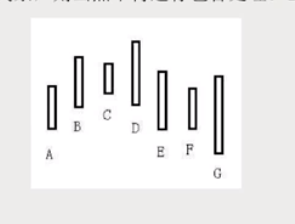
Let's look at a set of cases to observe the entire evolution process of the K-line merger in the trend chart.
As shown in Figure 1, the first step requires merging B and C, because the high point of B is high, and the orientation of B and C is processed, resulting in a new K-line M.
The second step examines the relationship between the newly born K-line M and K-line D, and if M and D are still found to be inclusive, continue to merge. At this time, because the high point of M is higher than the high point of A, the M and D orientations are processed, and a new K line N is generated as a result. As shown in Figure 2:
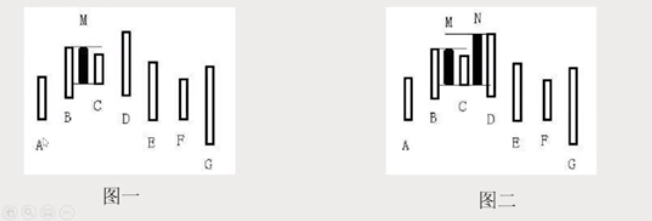
The third step is to merge E and F, because the high point of E is lower than the high point of N, E and F are processed downward, and a new K line O is generated as a result. As shown in Figure 3.
The fourth step is to investigate the relationship between the new K-line O and K-line G, and find that O and G are still inclusive, and continue to merge. Because the high point of O is lower than the high point of N, O and G are processed downward, resulting in a new K line P. As shown in Figure 4.
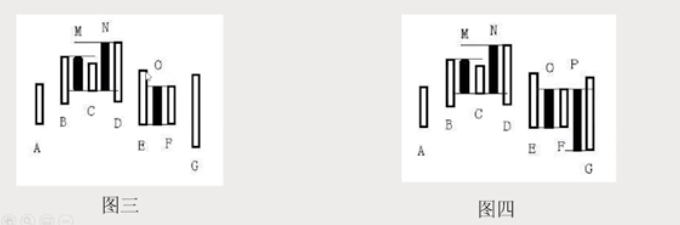
In this way, through merging processing, the K-line trend in Figure 1 becomes three K-lines A, N, and P. As shown in Figure 5.
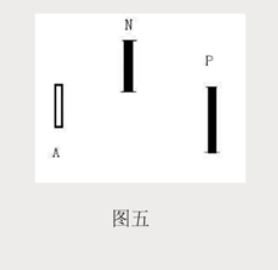
It should be noted here that in the K-line chart after thorough merging processing, there must be no more K-lines containing relationships, otherwise the merging is not complete and there is still a requirement to continue the merging process.
In short, the main purpose of K-line processing and merging is to identify the top-bottom type. Therefore, there is no need for certain merging processing for K-lines that are included in some non-key positions in the K-line chart. As long as you master the method proficiently, you can see the outline of the K-line merging process at a glance. As long as you practice more, practice makes perfect.