Most Analytical Tool: Elliott Wave Theory


The Dow Theory tells us what the sea is, and the wave theory guides us how to surf on the sea.
Being in the ocean is not going to work without learning how to surf.
So, let's talk about the wave theory today, and only by learning the wave theory can we swim in the ocean of investment better.
Overview of the Wave Principle
Elliott Wave Theory is one of the most commonly used trend analysis tools. Group psychology is an important basis for this theory, and it is difficult for an inactive or poorly liquid trading market to play its role.
Wave theory is an analysis tool invented by Ralph Nelson Elliott (RNElliott), a master of technical analysis. Unlike other technical methods of following trends, wave theory can predict when the trend will end when the trend is established. It is the best forecasting tool in existence.
U.S. security analyst Ralph Nelson Elliott (RNElliott) used the Dow Jones Industrial Average (DJIA) as a research tool and found that the ever-changing structural shape of stock prices reflects the beauty of natural harmony. Based on this discovery, he put forward a set of relevant market analysis theories, and refined 13 patterns or waves of the market. Not necessarily reproducible. Then he discovered that these structural patterns can be connected to form larger patterns of the same type. In this way, a series of authoritative deduction rules are proposed to explain the behavior of the market, and the predictive value of the fluctuation principle is particularly emphasized. This is the prestigious Elliott Wave Theory, also known as the Wave Theory.
Wave theory is a tool of special value, embodied in its universality and precision.
To say that it is universal means that we can apply it in many fields related to human activities, and many times it has incredible effects.
To say that it is accurate means that its accuracy in confirming and predicting changes in trends is breathtaking. This is unmatched by other analytical methods. At that time, to be precise, half an hour before the bottom of the US stock market, Elliott predicted that there would be a super bull market in the next few decades. His prediction is diametrically opposed to the market that is still filled with bearishness. At the time, most people could not have imagined that the Dow Jones Industrial Average would surpass its high of 386 points set in 1929. However, it turns out that the Wave Principle was right!
What is a wave?
Waves refer to fluctuations in stock prices, which are the same as natural tides and waves, one wave after another, repeating itself, with a considerable degree of regularity. It advances and reverses in a "recognizable pattern". Repeatedly in form (not necessarily in time and amplitude).
The Origin and Development of Wave Theory
Ralph Nelson Elliott (Ralph Nelson Elliott), is the founder of the wave theory. Born July 28, 1871 in Marysville, Kansas City, Missouri, USA.
In 1891, when Eliot was 20, he left home to work for a railroad company in Mexico. Around 1896, Eliot began his accounting career. Over the next 25 years, Elliott worked for a number of companies, primarily railroads, throughout Mexico, Central and South America. He later suffered a serious illness in Guatemala and retired in 1927. After retirement, he returned to his hometown in California to recuperate. It was during this long recuperation period that he figured out his theory of stock market behavior. He believed that the Wave Principle was a necessary complement to the Dow Theory.
In 1934, Elliott established contact with Charles J. Collins (Charles J. Collins), who was the editor of the stock market newsletter of the investment advisory firm, and told him his discovery. In 1938, Collins was finally so impressed by him that he helped him start his Wall Street career and agreed to publish "The Ware Principle" for him. Collins recommended Elliott as editor of Financial World magazine.
In 1939, Eliot published 12 articles in this magazine, carefully crafting and promoting his theory. In 1946, two years before his death, Eliot completed his masterpiece on wave theory, "Nature`s Law--The Secret Of The Universe".
If I were to choose the most valuable discovery of the 20th century, I would choose "Elliott Wave Principle". Because it is an approximate "mathematical expression model" of the fluctuation law in nature. Basically, it is not on the same level as other stock market analysis methods.
The starting point of the wave theory
Human society is always moving forward, the behavior of human groups is predictable, and the stock market reflects the behavior of human groups. This is the starting point of the wave theory.
Basics of the Wave Principle
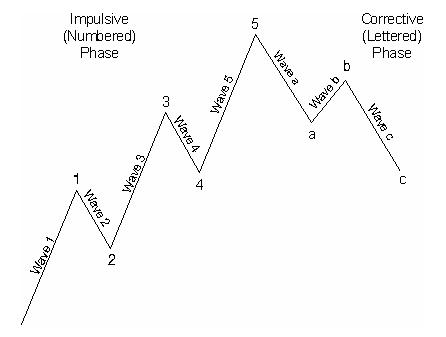
figure 1
As shown in Figure 1, five ups and three downs are the basis of the wave theory.
What is five liters and three downs? In his book "The Principle of Waves" in 1938 and a series of articles in 1939, Eliot pointed out that the stock market has a certain basic rhythm and pattern, five rising waves and three falling waves constitute a complete cycle of eight waves . The three downward waves are corrections of the first five upward waves. Figure 2 shows five impulsive waves (Impulse Waves) and three correction waves (Corrective Waves) representing the upward direction.
There are three important concepts in the principle of volatility: wave shape, amplitude ratio, and duration. The most important of these is type. There are two basic patterns of waves: the impulsive 5-3-5-3-5 and the corrective 5-3-5.
Here we discuss some terms used in this book. First of all, wave 5 refers to a wave composed of five waves 1, 2, 3, 4, and 5 in Figure 2, and wave 3 refers to a wave composed of waves a, b, and c in Figure 2. When we say that the propulsion wave is in the form of 5-3-5-3-5, it means that the propulsion wave can be composed of five sub-waves, and these five sub-waves are respectively composed of 5 waves, 3 waves, 5 waves, 3 waves, and 5 waves composition, as shown in Figure 2.
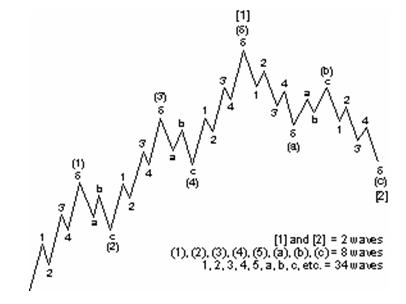
figure 2
Waves 1, 3, and 5 are impulsive waves (Impulse Waves, or directional waves), and the basic shape of the impulsive waves is shown in Figure 3 as ①, which is a 5-3-5-3-5 type. Waves 2 and 4 are Corrective Waves, Wave 2 adjusts Wave 1, Wave 4 adjusts Wave 3, Wave 1, 2, 3, 4, 5 consists of 5 waves, and Waves 3 consists of Waves a, b, and c. . The basic form of the adjustment wave is shown as ② in Figure 2, which is a 5-3-5 form. A complete cycle consists of eight waves, including two categories of waves, Numbered Phase or 5 waves, and Lettered Phase or 3 waves.
Then begins another similar cycle, also consisting of five ascending waves and three descending waves. Then it extended to five rising waves. This completes a larger up 5-wave, followed by a larger 3-wave downward adjustment of the preceding up-wave 5. Each wave of numbers and waves of letters is a wave in itself, and together form waves of a larger order.
Figure 2 shows that two waves of the same level can be divided into eight wavelets of the next level, and these eight wavelets can be divided into thirty-four wavelets of the next level in the same way. That is to say, in the wave theory, any wave of any level can be divided into waves of the next level. In turn, it also constitutes the wave of the upper level. Therefore, it can be said that Figure 2 shows two waves or eight waves or thirty-four waves, but only refers to a certain level.
Fig. 2 Further division of waves of different grades Adjust the patterns of waves (a), (b) and (c). Wave ② shown in Fig. 3 is a 5-3-5 pattern (5-3-5 pattern) . Wave (2) is also the same shape as wave ②, and (1) and (2) are always the same shape as ① and ②, only differing in magnitude.
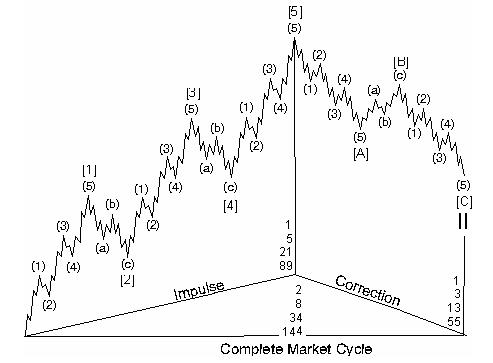
Figure 3 further clarifies the relationship between wave type and wave level, which shows that a complete stock market cycle can be subdivided into waves according to the table below.
·Figure 3 The number of complete waves and secondary waves·,
Cycle level bull market, bear market complete cycle
Cycle Waves 1 1 2
Primary Waves 5 3 8
Intermediate Waves 21 l3 34
Minor Waves 89 55 144
The basic concept of wave formation can be summarized as follows:
1) A movement must be followed by an opposite movement;
2) The advancing wave on the main trend is in the same direction as the main trend, and can usually be divided into five lower-level waves; the adjustment wave is in the opposite direction to the main trend, either rising or falling. Usually can be divided into three waves of lower level.
3) Eight wave movements (five rising and three falling) form a cycle, which naturally forms two branches of the superior wave.
4) The market shape does not change over time. Waves stretch and compress, but their basic shape remains the same.
In practice, every wave is not created equal, it can be compressed, it can be extended, it can be simple, it can be complex. In short, everything depends on the type.