Talk about the financial principles behind DeFi


What are the financial principles behind DeFi?
Before answering this question, let's talk about housing prices in China.
I believe everyone is no longer familiar with the phenomenon of housing prices.
Just at the beginning of this year, because of the outbreak of the epidemic, the Federal Reserve released a lot of water. The U.S. stock market gold, digital currency, etc. have been affected by this incident for a long time in the past, and have experienced a relatively large increase in value. The domestic capital market is more or less affected by external changes.
But our housing prices are still as stable as Mount Tai, and will not be affected in the slightest. why?
This is mainly due to the rise in housing prices in the past 15 years, not only because of additional currency issuance, but also for other reasons, such as the maturity and perfection of the second-hand housing transaction market.
With the introduction of "no housing speculation" and various restrictions on purchases and loans, the freedom of the real estate market has been restricted to a certain extent, and it has become more difficult to buy and sell houses, because some people have no qualifications to buy houses at all, so the rise in housing prices has stopped.
What can we see from this phenomenon?
We can see that, in fact, a simple increase in currency does not necessarily lead to an increase in asset prices. The increase in some asset prices is affected by many factors.
The so-called liquidity of assets must first be able to be sold and traded, so that it has a price, otherwise it has a price but no market. The price of some houses looks high, but in fact the transaction volume is very small, that is, there is a price but no market, that is, the liquidity is not good.
And what factors generally affect the liquidity of assets?
First, affected by the market. That is to say, if the market is restricted, or the market is small and does not exist at all, then any asset is illiquid, because you don’t know where to find buyers, and you don’t know who can buy it.
Second, it is affected by price factors. Just like the current house, the price is already very high, so its liquidity will of course decrease, because there are fewer and fewer people who can afford this house, even if he is eligible to buy it, he may not have so much money to buy it. Buy, so your property can't be sold without a price cut.
Third, it is affected by time. Many enterprises in the real economy have to raise funds, that is, sell some of their accounts receivable at a low price and sell them to financial institutions to obtain funds. why? Because their products are sold, but they don’t actually get the money immediately. In this case, they can’t be called real sales, because you don’t get the money, and you can’t engage in the next round of production. This product is sold. There is no difference between going and not selling. So what to do? They sold assets such as accounts receivable at a reduced price to obtain funds, which also meant that he sold his own goods cheaply. So in this case, the liquidity of assets is actually related to the time when funds are recovered.
Let's take a look at an example. Whether it is a stock exchange, a gold exchange, a foreign exchange exchange, or a futures exchange, what are their biggest characteristics?
First, there is a fixed and large market. Because you can see all the people in this market, they are all placing orders.
Second, the price is transparent. The price of each order is fixed. When you see a price and want to sell it, you can immediately complete the transaction and get the money immediately.
This shows that the exchange is actually the best place to provide liquidity for asset holders.
We say that the existence value of financial institutions is not only exchanges, including banks, insurance companies, lending companies, etc., the greatest value of financial institutions is to provide liquidity.
Why do you say that?
Why do you say that?
Because DeFi is a better mechanism for providing liquidity.
First of all, what DeFi provides is a kind of transparent liquidity.
Two angles, the first transparent market, the second transparent you.
The transparency of the market is very simple, that is, the market information is fully disclosed, and the transaction is certain, that is to say, if you want to buy, you can buy, and if you want to sell, you can sell.
For example: Compound’s lending market.
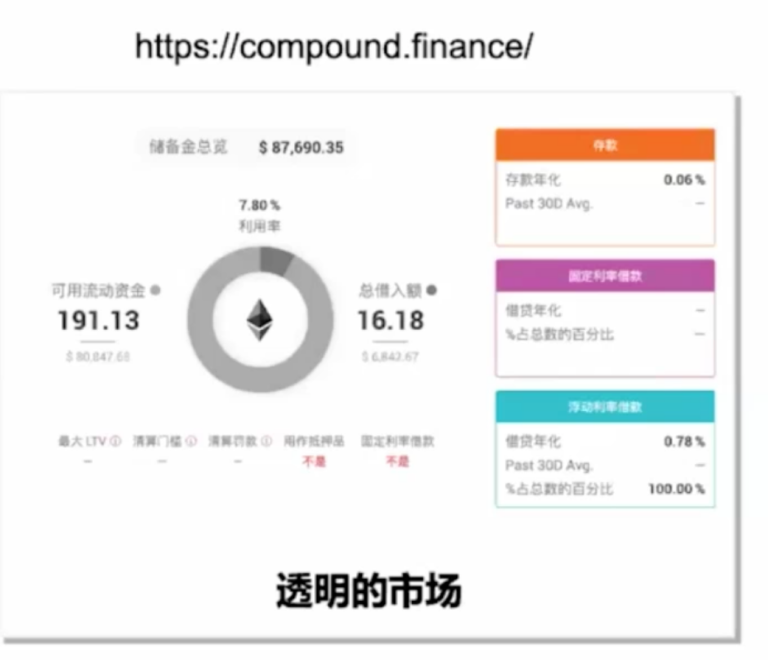
As shown, all these numbers on it are transparent because they are all stored and guaranteed by smart contracts. It is not anyone who tells everyone what the financial situation is like through a financial statement, but it is transparently disclosed to everyone through the smart contract blockchain.
On the contrary, the biggest problem of P2P is its opacity. Put your money in, and you don't know what he did, who borrowed it, and when will it be returned? When you want to take it, you can't take it at any time. These things are not guaranteed.
The transparent lending market of compound's smart contract ensures that these things are guaranteed, including that you want to withdraw money at any time.
Because the market has transparency, its credibility has greatly increased, and everyone has a strong willingness to trade, thus providing more liquidity for the market, so in fact, transparency is a big part of liquidity. Assure.
Transparent you have two concepts: first, you can see your investment, and the whole market can also see it. All traders are transparent, which means that no one can secretly manipulate a certain market, and everyone knows that everyone is completely equal. But he doesn't know your identity, he doesn't know that you are Zhang San Li Si, he doesn't know your ID number, and he doesn't know whether you are male or female. Therefore, any market is not qualified to restrict you from entering the market based on your personal identity attributes. This is another perspective of transparency. In other words, you are a transparent person in the market.
Back to the real estate market. The real estate market can limit your qualifications to buy a house based on your personal identity and allow you to be excluded from the market. In this case, your money will not be able to enter the market. Therefore, the liquidity of the market has been greatly reduced.
So we say that the transparency of the DeFi market allows you to participate in the market without any restrictions, and others will know your situation. In this case, all non-market factors are reduced and everyone’s freedom is expanded. Then naturally this market liquidity will be greatly increased.
Therefore, DeFi is a more liquid mechanism.
The characteristic of DeFi is called borderless liquidity. What does that mean? In our traditional financial institutions, your money is either stored in bank a or bank b, or you buy insurance from insurance company c, or you put your money in the stock exchange to buy and sell stocks. Your money is always locked up in a financial institution anyway. If you want to put it up and put it in another financial institution, it usually takes at least t+1 time. When you find that another trading place has better products with investment value, you can’t immediately put your own The money is taken out and put into a new trading place.
This problem does not exist in the DeFi field. You can host a fund through a smart contract, and you can buy the financial assets you want from multiple exchanges at the best price at any time.
In addition, no matter what kind of agreement the DeFi market is, including exchanges, lending, derivatives, and insurance, they are all composed of smart contracts. Not only can we use funds on multiple exchanges at the same time for transactions, but we can also transfer our own funds between markets such as exchange lending and derivatives insurance.
In this case, our capital efficiency has been greatly improved, and it can also promote competition among multiple markets, such as transaction fees and product prices. So generally speaking, DeFi promotes liquidity and the willingness of market investors. This is what we call the benefits of DeFi through borderless liquidity.
Regarding DeFi, many people hold such a view: I admit that DeFi is better finance, and DeFi can better provide liquidity, but does DeFi help society? Has it promoted the real economy? If DeFi does not help the real economy, will it become a gust of wind like some other financial phenomena?
In this regard, I mainly talk about two aspects.
First, the relationship between finance and entities is actually the relationship between river water and well water. Only when the water volume of a river is large enough, the flow rate is fast enough, and the distribution is wide enough, can it allow water to infiltrate into more wells and into the ground. The inherent characteristic of the entity is a small amount of slow, independent units. It must rely on river water to infiltrate it, so as to make its water more abundant.
So from this perspective, the first priority of finance should be whether the amount of water is large enough and the flow rate is fast enough? Whether the distribution is wide enough, as long as these conditions are met, the possibility of the real economy naturally obtaining water sources will be greater.
We can't think too much about the relationship with the real economy to decide which direction finance should develop, or we must use the relationship with the real economy to judge what is better finance. In fact, finance with a better liquidity mechanism is better finance.
Second, when the asset has been traded in the real economy and cashed out, we will return it to a mortgage lending platform like DeFi through funds, and the asset certificate will be withdrawn, and the entire transaction process will be over.
Is it possible for Chinese SMEs to successfully raise funds overseas? It was impossible in the past, because those who go overseas to raise funds are often large companies with high credit ratings. They issue bonds or issue stock IPOs to raise funds, while small and medium-sized enterprises do not have any ability to issue bonds or issue stocks because of their credit qualifications. Ipo to finance.
But if you use the supply chain financial model plus the DeFi model, this thing is actually completely possible.
Finally, to sum up, my core point is that DeFi is better finance because it can provide better liquidity. In addition, we can also derive a standard for judging DeFi projects. How to judge whether it is good or bad? That is to see if he has created a better liquidity model through code and model design. If so, it's clearly a worthy project. If not, he may be simply imitating others, or even an air hype project.
From this perspective, we actually say that the entire DeFi industry, and each of its projects, ultimately comes down to a standard, whether it can better provide innovation in liquidity.
At the same time, this is also the financial principle behind DeFi.