Bizai Research Institute: Exploration of Polkadot Parachain PLO Auction Economic Model


first level title
1. Overview
BitZ coin has been paying close attention to the Polkadot ecology and its PLO auction in the research institute. Before the Polkadot parachain auction is about to start, we will share with you the research results of the Polkadot parachain auction rules and the economic model calculation of the auction. Help project parties who want to participate in the PLO auction to design an effective incentive plan.
In this article, we focus on what the Polkadot parachain is, the auction rules of the Polkadot parachain, the risk-free rate of return of PLO and its expected rate of return determination model. The core conclusion is:DOT1) It can be found that the core influencing factors of the return rate of the incentive plan for participating in the PLO project are the pledge return rate of DOT, the expected
The lock-up time T, the expected maximum increase of DOT and the risk premium within T time;
BitZ Exchange has done a lot of research and preparation work on the Polkadot ecosystem and parachain auctions, and is willing to work with project parties in the Polkadot ecosystem who want to participate in the PLO auction to design bidding plans and provide crowdfunding funds. multifaceted help.
2. Introduction to Polkadot Parachain
secondary title
2.1 Polkadot network architecture
According to the official Polkdot documentation, the entire Polkdot network consists of three parts: the relay chain, the parachain, and the transfer bridge:
1) Parachain Parachain: Parachain is a blockchain parallel to the Polkadot network. Each parachain can independently design its own architecture according to different business needs. Parallel chains are also used for concurrent transactions to improve scalability, and they are secured by connecting to relay chains.
2) Relay chain: The relay chain is connected to the Polkadot network. The relay chain ensures the security of the parallel chains and realizes the communication between the parallel chains. The content of the communication can be transactions or any form of data.
As shown in the figure below: The Polkadot network is essentially a heterogeneous multi-chain blockchain network. The multi-chain here refers to the number of parallel chains with about 100. Each parachain has its own unique data and P2P network architecture, and is linked to the Polkadot relay chain through the card slot Slot to share security together.
Source: Polkadot official website
secondary title
2.2 Polkadot parachain definition
The parachain is linked to the Polkadot main chain through the "slot" Slot, but due to the limited number of slots, there are only about 100, and it is not open at one time. Therefore, in the early days, the number of slot auctions will be very limited, and only one slot slot will be released in a certain period of time, so a large number of Polkadot ecological projects need to be qualified to become [parallel chains] through auctions, according to There are about 10 Polkadot ecological projects that will participate in the parachain auction in the initial stage of Happy Block, namely Acala, Phala, ChainX, Darwinia, Bifrost, StaFi, Litentry, Zenlink, Crust Network, Plasm Network, as shown in the figure below:
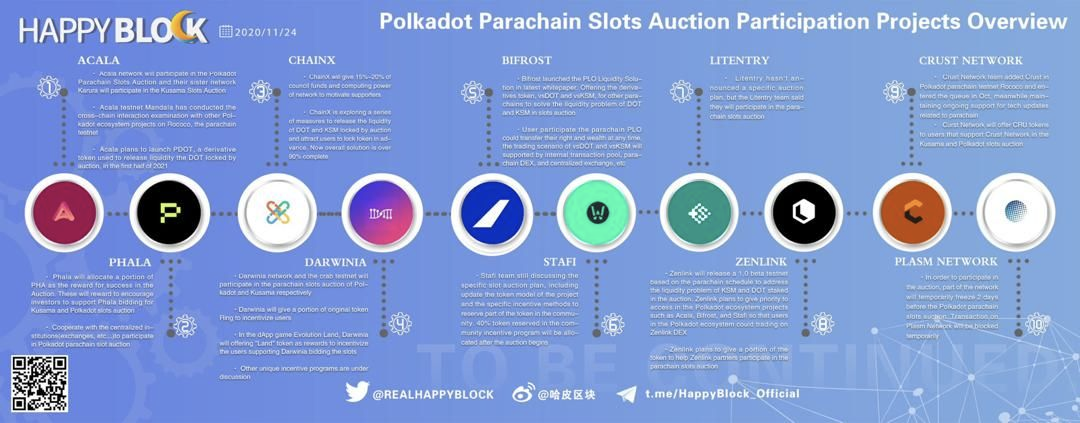
Source: Happy Block
secondary title
Source: Bizai Research Institute
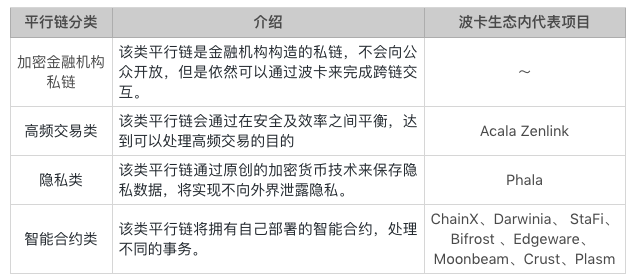
Source: Bizai Research Institute
first level title
In order to ensure that the Slot acquisition method is open and transparent, Polkadot will use candle auctions and PLO's first parallel chain issuance method to conduct parachain auctions.
image description
Source: Polkadot official website
Parachain bidders need to submit the number of DOTs they are willing to pledge and the corresponding parachain card slot lease period. After the card slot lease period ends, the DOT funds pledged in the contract will be returned to the project party, but there is no Staking interest is generated, which also determines that the project parties participating in PLO need to motivate DOT holders participating in their crowdfunding when funds are insufficient.
secondary title
3.1 Candle Auction
According to the bidding plan disclosed by Polkadot on its official blog, the price of the card slot Slot will be determined by candle auction rules. Candle auction is a variant of public auction. It is different from the general principle of traditional public auction that the highest bidder wins, and it also includes a random number of auction time. That is, the end time of the auction is random and unknown. After the end of the auction time, the auction result will be determined according to the principle of the highest bidder.
According to the research of the Web3 Foundation, the reason why the Polkadot parachain chooses the candle auction is mainly to change the situation that the traditional auction mechanism cannot really correctly value the parachain card slot. Because the random closing (retroactive close) under the candle auction rules means that the project party needs to quote what it thinks is a reasonable bidding price immediately after the auction starts, instead of hoping to quote a low price at the beginning and trying to use a relatively low bid price like traditional auctions. The price comes to win the card slot.
3.2 Parachain Lease Offering (PLO)
secondary title
Parachain Lease Offering (PLO), that is, the public offering of parachain auctions. According to Jack Platts of the Web3 Foundation, PLO refers to the act of raising the required DOT funds from other DOT holders through PLO for projects with insufficient DOT funds.
The process of crowdfunding is very similar to the process of users participating in DOT Staking. Therefore, the project party needs to give appropriate rewards to motivate users to participate in PLO and help them raise DOT funds.
secondary title
3.3 Choose after the auction fails
If the project party fails to obtain the parachain slot through the auction, it does not mean the final failure of the Polkadot ecological project. In fact, they still have the following four alternatives:
1) It is possible to switch from bidding parachains to parathreads. Although parathreads cannot provide them with the same transaction speed and efficiency as parachains, they can still obtain the security and cross-chain functions of the relay chain by paying according to the number of uses.
2) Bid for Kusama's parachain. Kusama's technical framework and consensus mechanism are similar to those of Polkdot, but the cost of the required parachain is relatively low, so if you fail to bid for Polkadot's parachain, you can try to bid for the parachain on Kusama.
4) Run as an independent public chain and connect to Polkadot through a bridge or parallel thread. This requires the project party to design its own consensus mechanism and recruit validators.
4. Research on the economic model of PLO
secondary title
4.1 The risk-free rate of return of PLO
When the project party designs an incentive mechanism to do PLO crowdfunding, the first thing to consider is the risk-free rate of return of DOT holders, that is, the rate of return that users can obtain by holding DOT funds to participate in DOT pledges. Only when the rate of return given by the PLO project party to users participating in the crowdfunding is significantly higher than the risk-free rate of pledge DOT, it is a reasonable behavior for users to participate in the crowdfunding of the project. Therefore, it is very important to study the risk-free rate of return of DOT holders to design the incentive mechanism of POL.
Assuming that the risk-free rate of return of pledged DOT is Rα, the user's rate of return Y under the POL incentive mechanism needs to be:
The β coefficient here is a constant, which can be understood as the risk premium for users to participate in POL crowdfunding. This risk premium is related to the risk preference of the entire market. In an overall upward market, the user's risk preference will be greater, resulting in a β coefficient that will increase. Relatively low; but in an overall downward market, users' risk appetite will decline, resulting in a relatively high β coefficient.
Obviously, according to the POL rate of return formula, assuming that the risk preference of the market is determined, the value of Y needs to be determined, and the numerical distribution of the risk-free rate of return Rα must be studied clearly.
The risk-free rate of return Rα of DOT held by users is mainly composed of 1) the annualized rate of return Rs of staking DOT pledged; 2) the expected maximum price increase of DOT within time T. The above two factors determine the maximum opportunity cost for DOT holders to give up participating in DOT Staking and participate in PLO crowdfunding. The time T is the default time for users to pledge from 6 months to 24 months;
From the calculation formula of the above-mentioned risk-free rate of return Rα, it can be seen that the higher the average staking rate of return Rs in the Polkadot network, the greater the price increase of DOT in the future, and the higher the risk-free rate of return Rα will be. Although the parameters of the increase in the price of DOT legal currency are completely determined by the market and cannot be accurately estimated, the DOT pledge rate of return is determined by the Polkadot network system, and the relevant value range can be estimated more accurately.
secondary title
4.2 DOT's staking rate of return
The relationship between DOT user pledge rate of return and pledge rate is shown in the following figure:
image description
image description
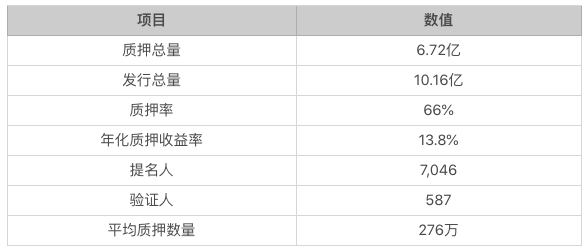
Source: Bizai Research Institute
Therefore, according to Polkdot’s staking return rate design mechanism and the current Staking return rate data in the network, we can basically think that the return rate of users holding DOT is expected to be 10% to 20%, with an average of 15%.
secondary title
4.3 Expected rate of return of PLO incentives
According to our research on POL's risk-free rate of return and DOT pledge rate of return, we can find that the expected rate of return of POL incentives will be determined by the following formula:
image description
Source: Bizai Research Institute
It can be seen that the fluctuation range of the price ratio P2/P1 of DOT price in the next year is (100%, 300%), that is, the price increase is from 0 to 200%, and the fluctuation range of the risk premium β coefficient is (10%, 100%) When , the minimum expected rate of return Y of PLO incentives fluctuates from 17% to 490%. Among them, the ideal value is 161%, the corresponding risk premium coefficient is 50%, and the price increase of DOT is 80%.
first level title
5 Conclusion
According to our research on the parachain auction mechanism, that is, the auction model, we can find that the core influencing factors of the rate of return of the incentive scheme participating in the PLO project are the pledge rate of DOT, the expected DOT lock-up time T, the expected maximum increase of DOT within T time, and Risk premium, under the assumption that Rs takes an average of 15% and time T takes 1 year, the ideal value of the minimum expected rate of return Y for PLO incentives is 161%. That is to say, the token incentive scheme provided by the project party will only have a more obvious incentive effect when the incentive expected income created for users participating in crowdfunding is greater than or equal to 161%.
In order to allow users to better estimate the rate of return of crowdfunding, the project party can design different schemes when issuing token incentives to crowdfunding users:
1) In addition to the main network currency incentives, some rewards are paid in stable coins;
2) In addition to the main network currency incentives, part of the rewards are paid in DOT;
Both of the above two schemes can create better incentive expectations for users than the pure airdrop project main network currency. When the user’s prediction of future income is easier to grasp, the value of the risk premium coefficient β will be reduced, which in turn can reduce the user’s minimum expectation. expectations of yield.
In addition to the reward payment method, the lock-up time of airdrop tokens will also have a significant impact on the minimum yield expectation Y. Therefore, when the PLO project party designs a token airdrop plan to motivate users to participate in crowdfunding, it can consider a variety of ways to achieve the desired desired effect.