UBI is here again, a full analysis of the suddenly popular Circles design logic


「Hey! Check out my Circles profile!」
If you are in various cryptocurrency communities on a daily basis, you will most likely see the above sentence in the past two days (usually with a link behind it). What's new? Is Circle launching any new products? Can you stud?
In fact, the above sentence is a forwarding language that comes with the system when a new project called Circles activates the account. Circles is not affiliated with Circle, and its founder is Martin Köppelmann, who is also the founder of the prediction market platform Gnosis.
Circles was officially launched yesterday, and on the first day, it received the attention and discussions of V God, Hayden Adams (the founder of Uniswap) and many other big Vs. What exactly does this project do? What is its magic? and take a look.
Let's first try to define Circles by ourselves, let's call it temporarily"Social UBI Currency Network"Well, importing the offline "trust relationship" into the chain is the core logic of this project.
UBI
Before understanding what Circles are, let's review what UBI is. The full English name of UBI is Universal Basic Income, also known as the "Universal Basic Income Plan". To explain UBI in the simplest terms, it is that the government sends money to residents, and each resident gets the same amount, and no qualifications or conditions are required to get this money.
The concept of UBI was born very early, and many well-known figures in modern history, such as Martin Luther King, Hawking, etc., are supporters of UBI. Today, UBI is becoming increasingly popular as the global gap between rich and poor widens, reducing the purchasing power of inflation-adjusted income. Although many countries have tried UBI, and even during the epidemic this year, the US government also tried "sprinkling money for the whole people". But for now, it is difficult for UBI to break the national concept, and the lack of international cooperation prevents UBI from becoming a global plan.
Because of the fair and transparent nature of the blockchain, there have been many UBI projects in the currency circle that have received attention before, such as Humanity Dao, which was also recommended by V God, including the project that was once called "the first airdrop in the currency circle" The ENU avocados that died heroically and so on.
These visionary projects have encountered many problems in the implementation and failed to really work. However, there have been a lot of discussions on the Internet about the advantages and disadvantages of UBI. Can its unique design support its vision of establishing UBI on the chain.
money network
With the development of blockchain and smart contract technology, for the first time in human history, we have the technical conditions to create a global, decentralized financial application.Bitcoin proves that money doesn’t need to be issued by a central government, and what Circles wants to prove is that UBI doesn’t need to be run by a government either.
As mentioned in the definition above, Circles is a currency network made up of multiple different currencies. No permission is required, everyone can join Circles using a blockchain account. When a user joins Circles, the Circles smart contract will create and assign a personal currency to that user. for example:
When Alice joins Circles, she will get her personal Alice coin;
Bob also joins Circles, and will also get Bob coins representing him personally.
The creation, distribution and issuance of all personal currencies will be executed according to the same rules.
Continue with the example:
Continue with the example:
Assume that the current issuance rate of Circles is 1 coin/minute (only hypothetical data, the current actual data is 8 coins/day, and the annual inflation rate is 7%).
Alice joined Circles and created AliceCoin;
Five minutes later, Alice will have 5 Alice Coins, at this time, Bob joins the system and creates Bob Coin;
In another five minutes, Alice will have 10 Alice Coins and Bob will have 5 Bob Coins.
Alice saw that her friend's wallet balance was too low, so she gave Bob her 5 Alice Coins.
After another five minutes, Alice will have 10 Alice Coins, Bob will have 10 Bob Coins and 5 Alice Coins.
At this time, someone may ask, UBI requires everyone to get the same amount of money, if Alice does not transfer money to Bob, will Bob always get less money than Alice?
In terms of absolute numbers, this may be true, but in fact, the relative difference between Alice and Bob’s assets has been shrinking. If Alice did not transfer money to Bob, then Alice will now have 15 Alice Coins and Bob will have 10. Bob Coin, 10:15=2:3, which is closer to 1:2 (5:10) five minutes ago. As the timeline elongates, the relative difference in the amount of currency obtained by the two will become smaller and smaller.
From the perspective of wealth distribution, this also means that the total amount of wealth obtained by each person will be getting closer and closer.
social attributes
One of the most essential functions of money is a medium of exchange.
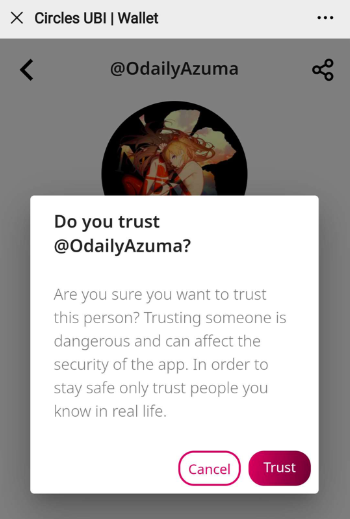
Circles wants to do this in a social way. In order to give each personal currency its usefulness, it must not become a useless number. Circles introduces the concept of "Trust", where users can choose to trust each other's personal currencies to facilitate transactions. When a user clicks "Trust" and chooses to trust someone else's personal currency, it is telling the system that the selected personal currency is equivalent to any other currency they already own. This means that anyone who owns this trusted currency can trade that currency with their own currency (not necessarily their own) at a 1:1 exchange rate.
Another example:
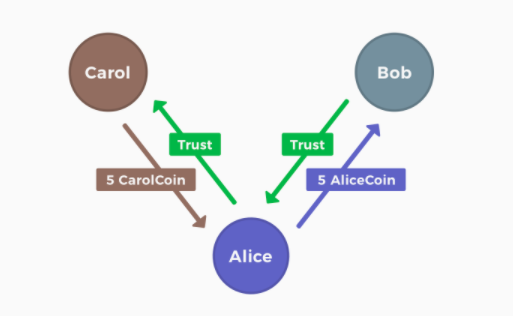
Bob trusts Alice, and Alice trusts Carol;
Carol needs to pay Bob 5 personal coins;
Carol can use 5 Carol Coins to exchange 5 Alice Coins in Alice's hand, and then pay to Bob.
Continue with the example:
Continue with the example:
After the above transaction happened, Bob and Alice broke up and no longer believed in Alice;
At this time, Bob still has 5 received Alice Coins.
Others can no longer use Alice Coin to exchange for Bob's Coin in Bob's hand, but Bob can use his own Alice Coin to trade with other people who trust Alice, and exchange it for other currencies he wants to hold.
Due to the transitivity of social networks, the usability of personal currency will increase with the continuous expansion of social networks. If a user can be well integrated into the Circles network and can establish a large number of mutual trust relationships with other users, his personal currency will also It can serve as a better medium of exchange.
Circles mentioned the theory of Six Degrees of Separation (Six Degrees of Separation) - each person can know any stranger in the world through up to five people.This is also the theoretical basis for Circles to realize the transformation from a social network to a transaction network. As more and more users join and more and more mutual trust relationships are established, Circles will become a real currency transaction network.
Risk response
Speculators are never absent.
In the real world, if the government decides to implement UBI, one of the big problems it will solve is how to avoid impersonation.
In the virtual world, this problem is even more serious, because everyone can freely create a large number of blockchain accounts, and Circles uses accounts to distinguish identities. With a large number of different individual tokens available, fairness is out of the question. In fact, the social attributes of Circles can perfectly solve this problem, because currency transactions must be transmitted through social networks. Let's continue with the example:
Bob trusts Alice and accepts all Alice Coins;
Alice has evil intentions, secretly creates a fake account, and trusts the fake account herself (that is, accepts counterfeit money);
Alice now has 10 Alice Coins, but secretly there are 10 counterfeit coins;
Alice wants to buy some goods worth 10 currency units from Bob;
No matter which account Alice uses, she must pay Alice Coin when she finally buys goods, and counterfeit coins cannot complete the transaction.
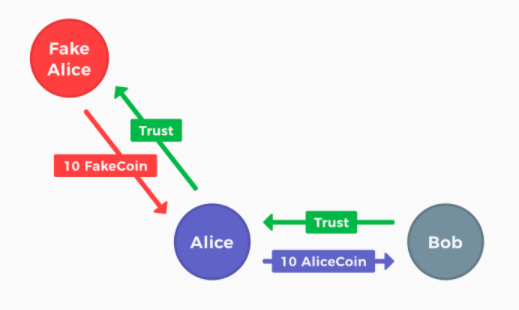
This example proves that if Alice wants to complete the transaction, she can only pay other users in the currency they choose to trust. Even if Alice opened 100 fake accounts and got them to trust each other, she would never be able to spend more currency than she owns in Alice Coin, because Alice Coin is the only currency other users trust.This is why users need to be cautious about all mutual trust relationships, because a wrong trust establishment may cause all your funds (currency) to be lost.
how to participate
how to participate
Official websiteOfficial websiteTo register (Sign Up), the specific process can be completed in accordance with the official guidance. It should be noted that two specific conditions are currently required to activate an account: 1. The trust of three friends is required (some users reported that this step is no longer required for new registration); 2. A small amount of xDAI is required.
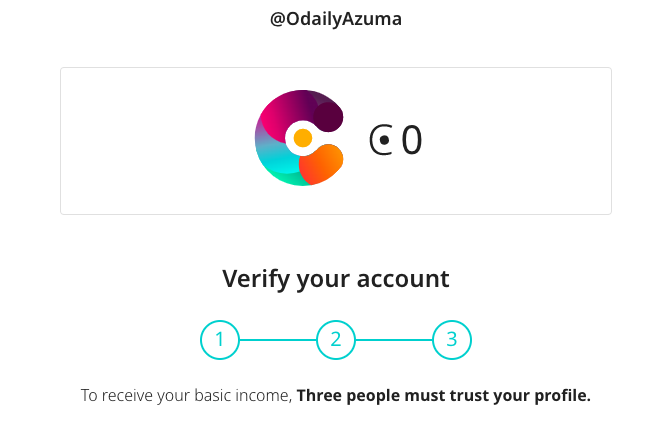
At present, many users are "seeking mutual trust" on major social media platforms in order to complete account activation quickly, but as mentioned above, a wrong trust establishment may cause all your funds (currency) to be lost, so users Be cautious; as for why you need xDAI, it is because Circles is built on the xDAI network, and users who need xDAI can go tofaucet addressClaim by yourself (October 18 shares seem to have been applied for, and users who are eager to activate can use other addresses to transfer xDAI to the registered address).
After the activation is successful, the prompt is as follows:
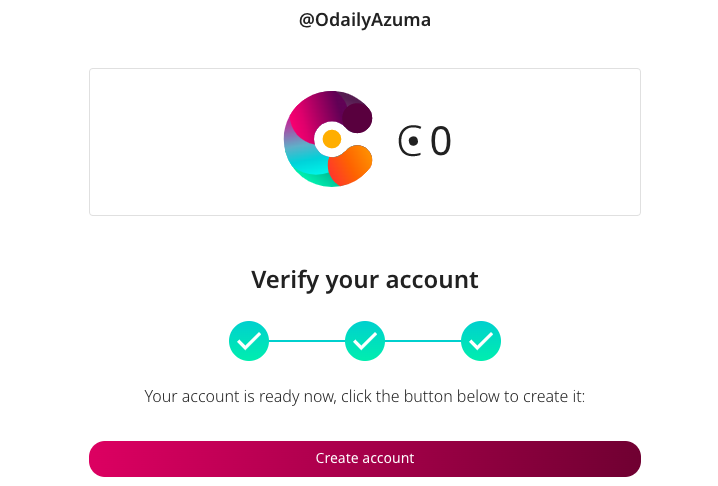
Overall, the emergence of Circles has caught everyone’s eyes. The innovative spirit behind this project is the core driving force for the sustainable development of the cryptocurrency industry. However, as Uniswap founder Hayden Adams pointed out, the project still has a lot of room for improvement in terms of details.
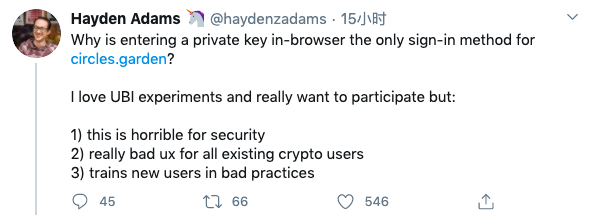
Hayden believes that Circles' login method that requires entering a private key in the browser is not secure enough. In addition to the bad experience, it will also make new users develop bad habits. In addition, perhaps due to the high user participation, a large number of users reported this afternoon that the Circles server was obviously unable to do what it wanted—"Try it for 10 minutes, and it was loading in 9 and a half minutes." After the Odaily trial, I really felt that the slow webpage response speed and congested network seriously affected the user experience.
Technology is only one of the challenges that Circles faces. As mentioned above, there were many projects that tried UBI on the blockchain before Circles, but in the end they failed to mature due to various problems. DeFi has been cold in the short term, and today’s blockchain industry is eagerly waiting for hot hype. Circles has taken the first step to gain attention, and UBI will probably be discussed again. However, what will happen to the project in the future still needs to wait for the test of time.