The more fried the hotter? Inventory of "tearing" events in the DeFi industry


Odaily Translator |Bitcoin.com, original author: Terence Zimwara
Odaily Translator |

Unless the leaders of major projects in the DeFi community stop fighting each other, the end result of this emerging industry is likely to "implode".
If we look at the tweets of the “big guys” who have great market influence in the DeFi industry on Twitter, we will find that they are full of various mutual attacks, such as:
1. Sasha Ivanov, creator of the Wave blockchain, previously described the DeFi ecosystem as a "Ponzi scheme 2.0", after which the industry launched an incentive debate on "Ponzi scheme 2.0" vs. "Financial Services 2.0";
2. Sam Bankman-Fried (SBF), the current head of another decentralized financial project "Sushi" Sushiswap, also posted on Twitter, expressing his concerns about "food" tokens, which he believes are actually spreading DeFi Bubbles also sparked heated discussions in the community;
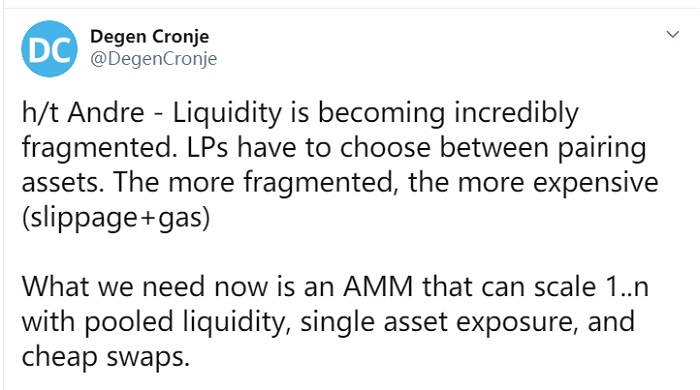
3. There is also Andre Cronje, the founder of Yearn Finance, who raised the topic on Twitter that the liquidity is too fragmented, and the decentralized financial industry has to face various challenges brought about by it;
4. The recent "mutual tear" incident that has attracted the attention of the industry is the dispute between the anonymous founder of yieldfarming.insure Insurance Chef and the investor Azeem Ahmad...
secondary title
Wave founder Sasha Ivanov vs. YFI founder Andre Cronje
Although a considerable part of the DeFi industry believes that automated market makers are a good solution, Sasha Ivanov insisted in a tweet that "Finance 2.0" will eventually appear, so automated market makers are not a real solution. He explained:
"Automated market makers are not as groundbreaking as the liquidity pool mechanism. In my opinion, liquidity pools are really good, but automated market makers have not reached this level, no matter how high the trading volume is now."
(For those who don’t know much about automated market makers, Mr. Odaily will give a brief explanation here. Automated market makers are entities responsible for creating price behavior on exchanges. For exchanges, if there is no trading behavior No liquidity.)
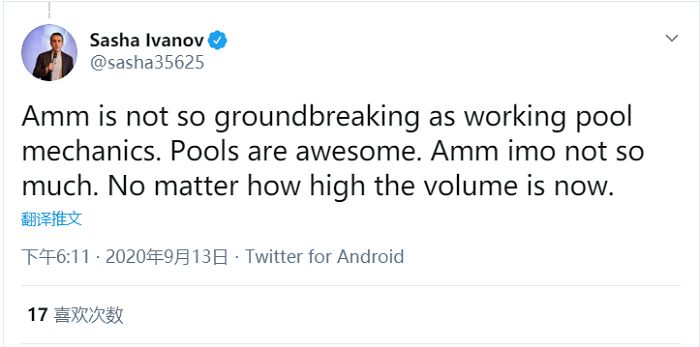
Before severely criticizing automated market makers, the "optimistic" Sasha Ivanov also recommended some projects on Twitter that he considered truly groundbreaking, such as Aave, Curve, etc., but people with a discerning eye found that Sasha Ivanov was on his recommendation list No mention of YFI in the list - which seems to annoy YFI founder Andre Cronje.
Soon, Andre Cronje gave an "indirect response" to Sasha Ivanov's remarks. As the creator of Yearn Finance, Andre Cronje has played an important role in promoting the development of the DeFi industry to the tens of billions of dollars. Just a few hours after Sasha Ivanov tweeted that "automated market makers have no breakthroughs", Andre Cronje also released In a tweet explaining why the decentralized finance industry needs automated market makers, he noted:
secondary title
YFI founder Andre Cronje vs. "Sushi" Sushiswap head SBF
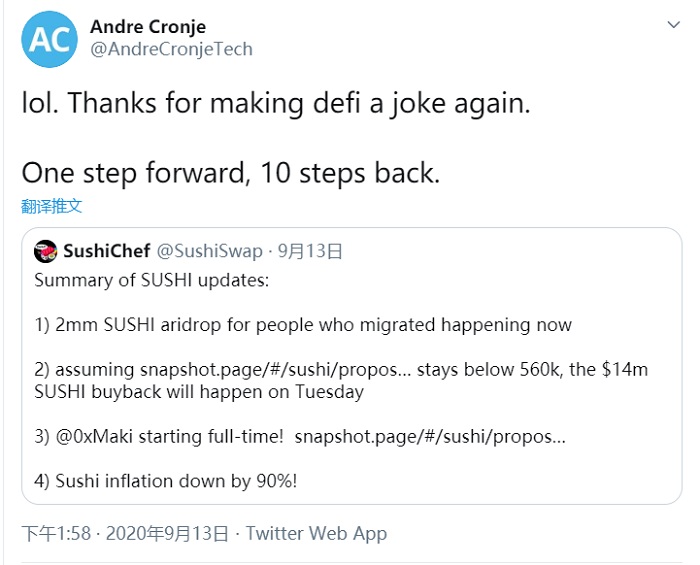
Although YFI founder Andre Cronje and Wave founder Sasha Ivanov have differences on some issues, the two actually have some common views, namely: the DeFi industry is being occupied by "bad guys". Andre Cronje complained in his earlier tweets that the "Sushi" Sushiswap controversy has "made the DeFi industry a joke again."
The reason why Andre Cronje made such amazing remarks is mainly because of a series of unbelievable behaviors of "Chef Nomi", the anonymous founder of "Sushi" Sushiswap. About three or four weeks ago, "Chef Nomi" suddenly exchanged the millions of SUSHI tokens he held for ETH, which caused the overall liquidity of his platform to drop sharply in an instant. For many DeFi projects, it is very incomprehensible for the founders to do this kind of behavior, because this practice usually brings a fatal blow to the project itself, and it will damage the confidence of the encryption community in the project, which will bring great harm to the future development of the project. irreversible consequences.
Sure enough, just after Chef "Nomi" cashed out, the price of SUSHI tokens plummeted from 5.05 USDT to 1.3 USDT that day, and then he/she was "forced" to announce that he/she would give up the control of "Sushi" Sushiswap and handed over this power to FTX founder Sam Bankman-Fried (SBF). Even though “Chef Nomi” subsequently announced that he would return all the previously cashed-out ETH tokens to the community and use them to repurchase SUSHI tokens in an attempt to restore the community’s confidence in the project, the results did not seem to be great.
Andre Cronje unceremoniously slammed on Twitter, saying that the "Sushi" Sushiswap project took one step forward, and then took ten steps back.
Perhaps Andre Cronje's words were too blunt, which stimulated Sam Bankman-Fried, the current head of "Sushi" Sushiswap, to respond. In his post, he criticized the income farming "food" token and asked three questions in a row:
1. Is yield farming sustainable?
2. Is Yield Farming Stupid?
3. Is Yield Farming Really Revolutionary?
Like Sasha Ivanov, Sam Bankman-Fried attempted to defend certain DeFi tokens that he felt had "obvious utility." Sam Bankman-Fried also listed some overlooked but important yield farming projects/protocols, including Compound Finance, Aave, and Balancer. Sam Bankman-Fried specifically mentioned two DeFi projects, "Sushi" Sushiswap and "Ice Cream" Creamdot Finance, and called them "the most useful forked products."
Not only that, but Sam Bankman-Fried also turned his gun and slammed Andre Cronje's project YFI. He said that "YFI is a strange case. At present, YFI is mainly farming, and it has almost become the king of income farming. It has become a kind of" meta-farming’ tokens, so it seems plausible to get a fair share of rewards from it.”secondary title
Yieldfarming.insure Founder Insurance Chef vs. Investor Azeem Ahmed
DeFi insurance mining platform yieldfarming.insurance was created by anonymous developer Insurance Chef. The platform supports two types of NFT assets: yNFT (ETH) and yNFT (DAI), which are insurance policies for ETH and DAI assets respectively. yieldfarming.insurance is underwritten by Nexus Mutual, and the policy is NFTized in the ERC-721 token format, and the generated assets are called yNFT. Allows users to stake yNFT tokens from yInsure, Rarible, and Nexus Mutuats (WNXM), which can act as liquidity provider (LP) tokens on the platform, which can then be used for yield farming to obtain yieldfarming.insurance's native governance token Coin SAFE.
However, due to the discord between Insurance Chef and project investor Azeem Ahmed, the fourth liquidity pool of SAFE tokens was not properly deployed in Balancer, resulting in an accidental permanent lock of 10,000 SAFE tokens in the smart contract . Not only that, Insurance Chef also found that Azeem Ahmed violated the original intention of the project by putting his own SAFE tokens into the market for trading, and had already obtained millions of dollars in proceeds through the SAFE agreement through the early listing of Rarible's yNFT secondary market. It even listed several other "crimes" of Azeem Ahmed, including:
1. Azeem Ahmed brought in many VCs/whales and decided to run the protocol in his own way, forcing Insurance Chef to act according to his vision, otherwise he will be kicked out, there is a group of cryptocurrency industry leaders in the yieldfarming.insure telegram group At present, they all support Azeem Ahmed. I don’t know what Azeem Ahmed is bewitching to these big names in the industry;
2. Before the opening of the fund pool, Azeem Ahmed purchased a large number of yNFT tokens to ensure that he owns a large part of the No. 1 to No. 2 fund pools; Pool No. 4 is required to be deployed immediately. Although Insurance Chef thinks this is unfair to users, he has to use the BPT address to create Pool No. 4 as a last resort. Later, Azeem Ahmed found that the problem of impermanent loss (IL) in Pool 4 was too serious, and withdrew all liquidity funds within a few minutes, and instead accused Insurance Chef of confusing the two liquidity pools;
3. The project was completely manipulated by Azeem Ahmed during the week when the project was launched, and finally made Azeem Ahmed earn millions of dollars, and Azeem Ahmed even slandered and slandered him all the way to completely take over the yieldfarming.insure agreement.
Azeem Ahmed was also not to be outdone, and kept breaking the news to the public and publicly released a lot of evidence on Medium, pointing the finger at Insurance Chef, thinking that it was because of his inexperience that he ruined the promising project yieldfarming.insure (but this articles that published evidence have now been deleted by Azeem Ahmed).
On September 19th, Insurance Chef, as well as its core developers and consultant team announced the migration of SAFE tokens to the new COVER protocol. The newly released governance token COVER will enable the buying and selling of insurance policies and provide "insurance mining" liquidity mining Mining incentives become possible. Insurance Chef candidly made a mistake as the creator of SAFE in handling the SAFE token issuance process. To avoid repeating the same mistakes, the developers have also coined a new term "shield farming" (shield farming), which aims to improve yield farming measures and also added two new core developers. It is worth mentioning that the project consultant list includes some heavyweights in the DeFi industry, such as Andre Cronje, Blue Kirby, as well as FTX exchange and Serum founder Sam Bankman-Fried and well-known cryptocurrency developer Ivan Martinez.
For the yieldfarming.insure fork, Azeem Ahmed was obviously very angry. He said on Twitter that Insurance Chef's announcement of the start of the fork has marked the "killing" of yieldfarming.insure, which was only a week old:
Summarize
Summarize
Ryan Selkis, founder of encryption market analysis and research company Messari, compared today's DeFi market with the initial coin offering (ICO) bubble in 2017. He concluded:
“ICOs have been around for a while because everyone (ridiculously) thought there was going to be a coordinated utility token for every industry. DeFi is now also turning into a huge pool of money, and stirring this The pool is a small group of insiders and mercenaries who will quickly drain your money and run away."
In fact, any unregulated market will attract some "bad actors", and DeFi is no exception. As an emerging industry that has not been born for a long time, bad actors in the DeFi market try to use some so-called "legal means" to game with agreements/projects and profit from them. Maybe only time will tell which projects actually provide value and which ones come under the guise of falsehood. In this process, "good actors" will inevitably conflict with "bad actors".
After all, where there are people, there are rivers and lakes, where there are rivers and lakes, there are grievances, and rivers and lakes are hard to retreat.