Don't think that the 2017 encryption market carnival will reappear, DeFi is still dominated by giant whales and speculators


This article is from:cryptobriefing, original author: Anton Tarasov
Odaily Translator |

Decentralized finance (DeFi) is developing faster than anyone imagined, and the yield is surprisingly high, but many people don't understand that this niche market is still dominated by giant whales and unscrupulous speculators .
Content overview:
Content overview:
1. Although the DeFi industry has good long-term development prospects, the current market is still driven by "hype";
2. The number of DeFi users is growing rapidly, but the relative number is still small, mainly composed of giant whales and risk-taking speculators;
3. The limited throughput and transaction processing speed of Ethereum prevents DeFi from being adopted on a large scale.
Borrowing, lending, providing liquidity, arbitrage and fundraising, these "routines" may allow the blockchain industry to subvert the traditional economy, but it is actually the large companies in this field that have the real "subversive" potential. Therefore, if you observe the DeFi industry carefully, you will find that this niche market is still dominated by giant whales and speculators who dare to take risks. What activities have been done to earn high profits, and why these activities can attract many speculators to enter the market.
secondary title
DeFi loans
DeFi loans are like a kind of "proxy" for investors' fixed income. Users can lend ETH tokens on platforms such as Compound or Aave, and then lend the funds to others for interest.
Compared with traditional high-yield savings accounts, the annual yield (APY) provided on DeFi platforms is more profitable. For example, the annual yield of the DAI stablecoin on Compound exceeds 3%, while the highest annual yield of savings offered by Bank of America is only 1.05%. In addition to considerable annualized income positions, DeFi platforms like Compound will also incentivize users by distributing COMP governance tokens. In some cases, the annual rate of return including COMP token incentives can even be close to 6%—this is Obviously, the savings interest offered by traditional banks is much higher.
However, it should be noted that the loan interest rate in DeFi comes from the needs of margin traders and arbitrageurs, and lending usually requires a mortgage of 150% of the loan size locked. How meaningful.
Decentralization realizes the most extreme form of liquidity mining. Since anyone can freely deploy smart contracts on Ethereum, more and more underlying projects with governance tokens have begun to appear. But the problem is that such projects are extremely risky, because usually very professional teams are required to create these projects, and there are only a handful of truly "professional" teams in the market. Even so, that doesn’t seem to be stopping adventurous speculators from plowing millions of dollars into these smart contracts.
secondary title
Liquidity provision
Before the DeFi boom, tokens with smaller market caps had been struggling with illiquidity and high slippage. While liquidity mining can help improve this situation, there is actually another transaction-based Incentives form of fees, also known as decentralized exchanges (DEX).
Although the core of automated market makers is to automatically execute liquidity management, the return of each liquidity pool still depends on many other factors, so choosing "mobile investment" may be the best strategy, and using tools such as Uniswap ROI It may be a good choice for liquidity providers to monitor investment in real time and adjust investment strategy in time.
secondary title
DeFi borrowing
From a simple point of view, DeFi protocols are essentially smart contracts. These protocols do not know who the users are, so many DeFi platforms choose to use an over-collateralized loan policy, which can ensure that they will not suffer losses during market price fluctuations. The most mature lending platform in the field of DeFi borrowing is Compound, which allows users to lock up collateral such as ETH and then acquire other token assets. The upper limit of token assets that users can obtain depends on the collateral. Taking ETH as an example, for every $100 of ETH mortgaged, a maximum of 75 DAI can be obtained. This concept of over-collateralization has led to a significant reduction in the range of potential use cases for borrowers. For example, if you want to borrow money to start a business or buy a car, it does not seem to make much sense to lock 1,000 ETH with only 75% of the value of the loaned funds, so at this stage DeFi Borrowing in the field is basically short-term speculation like leveraged trading.
It is important to note that some blockchain industry participants very much hope to expand the scope of DeFi lending services to real-world applications, such as commercial credit and consumer credit. However, this area is still in the exploratory stage for now, and it is unlikely that we will see any meaningful progress, at least in the current market cycle.
Not only that, although a large number of incentives are provided, DeFi's liquidity is still very limited, coupled with high transaction fees, the entire market environment is actually not too gas-guzzling for institutional and retail investors. It can be said that the liquidity of this niche market of DeFi is still not enough to support institutional activities. In addition, Ethereum’s expensive transaction fees prevent many retail players who hold small amounts of cryptocurrency from entering the DeFi market.
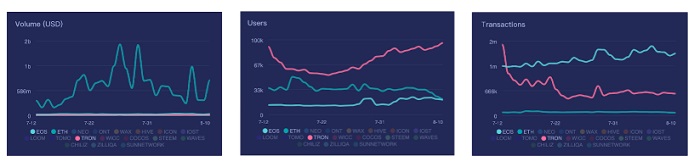
In addition, the small size of the DeFi market is also reflected in many other indicators. For example, although the number of active users continues to grow, it does not actually bring enough transaction volume to Ethereum.
The graph above shows a comparison of transaction volume, users, and transaction value on Ethereum, Tron, and EOS. Source: Dapp Review.
secondary title
leveraged trading
leveraged trading
By combining loans and borrowings, traders can build leveraged positions on DeFi. Leveraged trading undoubtedly increases the upside potential of the market, but it also brings more risks.
Here, let's look at a simple example:
Imagine if Alice predicts that the price of ETH will soar from $400 to $500 in the next week, then with 1 ETH on hand, she must want to earn extra profit, so she decides to use Maker, Compound, or Aave to establish a leveraged transaction. Assuming Alice locks 1 ETH on Maker and gets 264 DAI (equivalent to 66% of $400), then she goes to Uniswap to convert DAI into ETH, and then returns to Maker to increase ETH collateral. After repeating three times, she can finally use $1,200 worth of ETH collateral and 800 DAI in debt create up to 3x leveraged trades.
If the market is favorable for Alice, for example, the price of ETH really rises to $500, then the mortgage value will increase to $1500, and her debt is still 800 DAI, then after repaying the DAI and interest, her pocket will be That's about $700 more, and considering Alice originally put in $400 herself, that means she's gained about $300 in total.
But if the market is unfavorable to Alice, assuming that the ETH price drops to $300, the risk of her assets being liquidated will become higher at this time, and the value of the mortgaged ETH will drop to $900 at this time, which is lower than the 150% mortgage required by Maker rate, at which point it would take $300 ($1200-$900) to fill the mortgage gap instead of just paying $100 on an unlevered loan.
Of course, the above example may be exaggerated, but at least we can see that the 150% mortgage rate is actually not safe, and it also shows that there is a risk of error, so we must be careful when using leverage, because even in the long run, ETH will gradually increase. Appreciation, but short-term fluctuations may also trigger the liquidation mechanism and cause your funds to be lost.
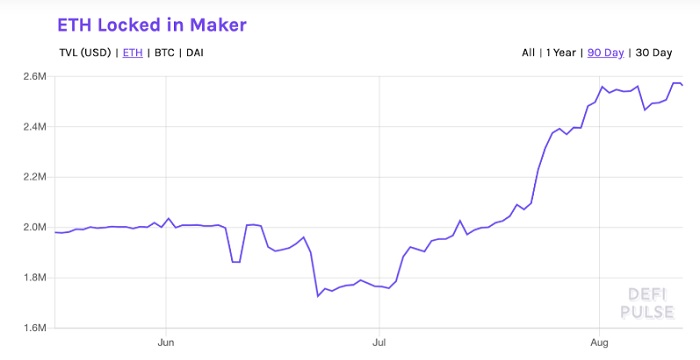
In fact, DeFi's ever-expanding total locked-up volume is achieved through internal and external leverage and speculation. Total locked-up volume (TVL) is often used to evaluate the growth of the DeFi industry, although locked on various DeFi platforms The number of ETH tokens has increased, but it is really insignificant relative to the growth in US dollar valuations, thus distorting people's perception of the size of the DeFi industry-the main reason for this phenomenon is leverage and speculation.
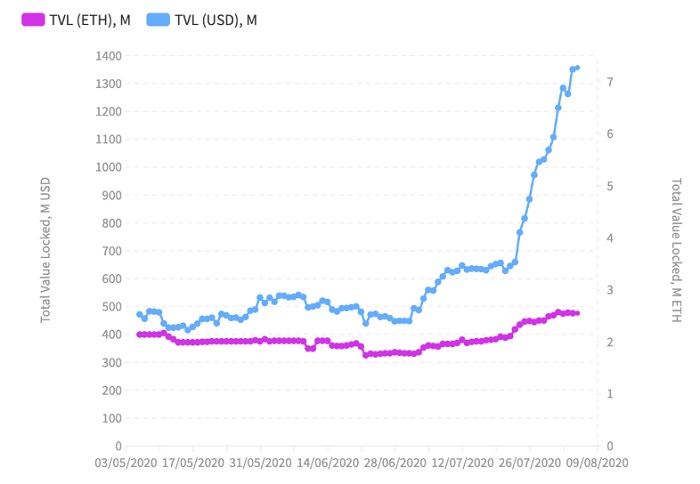
The picture above shows the trend of the total locked value of ETH ETH (purple) relative to USD (blue) in Maker, source: Dappradar.
secondary title
short-term loan arbitrage
The concept of arbitrage is actually quite simple: buy something cheap and sell it where it's expensive. In many traditional markets, including stocks and commodities, we can see traders and investors using arbitrage transactions, but DeFi has introduced a new operation in arbitrage: flash loans (flash loans).
The emergence of flash loans is largely due to the programmability of Ethereum. Since most DeFi platforms are smart contracts, the interaction between them can automate many complex transactions. One of the biggest advantages of flash loans is that it eliminates the risk of counterparties holding assets.
Let's look at another example:
Imagine if Bob noticed that the ETH token on the Huobi exchange was selling for $390, while the ETH token on Binance was selling for $400. In theory, he could buy ETH on Huobi and then sell it on Binance, pocketing the difference. However, if the price of ETH on Binance suddenly drops at the moment of the transaction, then Bob not only loses the trading opportunity and passively becomes an ETH holder, but also has nowhere to close the position to make a profit.
Still, arbitrage trading isn’t in everyone’s favour, given the ever-increasing gas transaction costs on Ethereum. If you want to ensure that your potential losses are not so large, you have to increase the transaction size (use a large transaction volume to offset the transaction fee cost), otherwise a smaller portfolio may cause the arbitrage transaction to fail once it encounters a spread problem.
secondary title
And now… there’s a whole new kind of ICO: the IDO
In addition to those mentioned above, DeFi seems to be becoming a testing ground for the renaissance of the concept of initial coin offering (ICO), because it is the stimulus of ICO that led to the bull market in 2017. Now, a new type of financing method has emerged in the DeFi market, called: Initial DEX Offering (IDO).
In contrast, IDO further improves the ICO model by maintaining on-chain fundraising and providing instant liquidity, while the decentralized nature of IDO also makes it more transparent than IEO. But on the other hand, decentralization also opens the door for some low-quality projects and fraudulent scams. In contrast, IEO projects usually require cryptocurrency exchanges to conduct due diligence on users and review risk issues, and inform users if there are "red flags" in the project, while ICOs and IDOs do not. Therefore, we should also treat IDO with extra caution.
secondary title
Just bubbles?
There is no doubt that DeFi still has a long way to go before it can be adopted on a large scale. Many places need to be optimized. For example, Ethereum needs to continue to improve in terms of scalability. At the same time, the DeFi industry also needs to implement innovative tools such as credit scoring. History has shown that some hyped new projects tend to attract speculators easily, and those who enter first often fail to obtain the expected return on investment, just like many speculators during the 2017 ICO bubble.
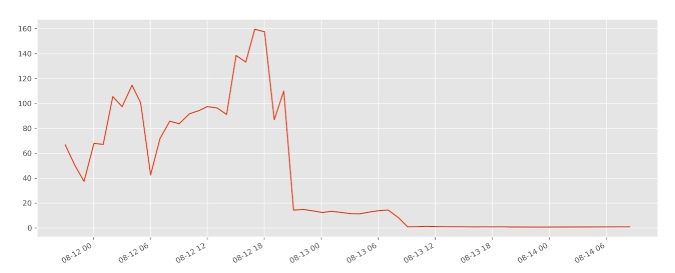
A recent example of “crazy” yield farming is the Yam.Finance project, which attracted nearly half a billion dollars in funding in one day, but their smart contracts were not audited at all. Sure enough, when YAM tokens were advancing all the way, the project found that there was a loophole in the flexible supply adjustment contract, which would cause a large number of additional YAM tokens to be minted during the flexible supply adjustment (rebase). Although the development team claimed that the user's funds were safe, they still urgently appealed to YAM token holders to entrust their tokens and voted to pass an emergency proposal to fix the loophole. However, the founder of the project soon confirmed that the bug could not be fixed and would cause the agreement to be unenforceable , YAM also quickly declared bankruptcy. The volatility of the project’s token price, which briefly exceeded $150 before quickly dropping below $1 (as shown above, source: CoinGeko), clearly shows just how risky the DeFi market is right now — of course , maybe this project should indeed spend some money to do an audit before going live.