More than Ethereum, all roads lead to DeFi


This article comes fromcryptobriefing, original author: Anton Tarasov
Odaily Translator |

This article comes from
Odaily Translator |
The DeFi ecosystem is rapidly emerging, from lending agreements, bond tokens to cryptocurrency derivatives, and decentralized exchanges (DEX), and now we have seen DeFi gradually evolve into an unstoppable new force. But the problem is that the capacity limitation of Ethereum is hindering the development of DeFi, coupled with the unsatisfactory expansion speed, the encryption community has begun to find that some DeFi projects seem to want to "escape" from Ethereum.
It is undeniable that as the popularity of DeFi increases, the on-chain activity on Ethereum is also growing. This situation will make the processing speed of Ethereum transactions slower and slower, and it seems difficult to improve in the short term. Indeed, with the growing popularity of DeFi projects, the Ethereum blockchain has been pushed to its limits, and it is even suspected that Ethereum's poor scalability may hinder the rise of ETH token prices, but off-chain solutions are being implemented It may be able to alleviate the urgent need.
secondary title
As DeFi popularity grows, so does on-chain activity on Ethereum
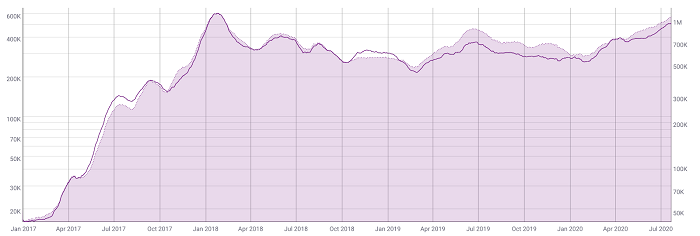
In 2020, the on-chain activity of the Ethereum network soared to the level during the previous 2017-2018 bull market, and data shows that this market trend is mainly due to the rapid development of the DeFi industry. While the growth of on-chain activity is good for Ethereum, the lower throughput of Ethereum itself may cause high transaction fees under heavy network load-in turn, high transaction fees will also hinder the development of DeFi.
Although Ethereum 2.0 seems to be able to solve many scalability problems in the current network, the speed of the upgrade does not seem to be satisfactory, at least not likely to be launched soon. At the same time, a number of scaling solutions are available, designed to accommodate the growing activity on the Ethereum network.
In 2020, both the average daily active address and the average daily transaction volume of Ethereum have shown a steady growth trend, which indicates that more and more people are using the Ethereum network. More importantly, most people are using ERC-20 tokens, and the average daily transaction volume of ETH has remained at around 2 million in recent months.
The graph above shows Ethereum’s average daily active addresses (purple solid line) vs. daily average transaction volume (purple dashed line), source: CoinMetrics.
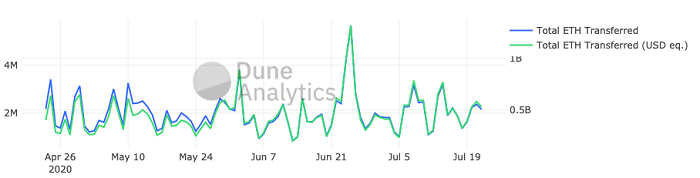
The graph above shows the average daily transaction volume (blue line) and USD price (green line) of transferring ETH tokens on the Ethereum blockchain. Source: Dune Analytics.
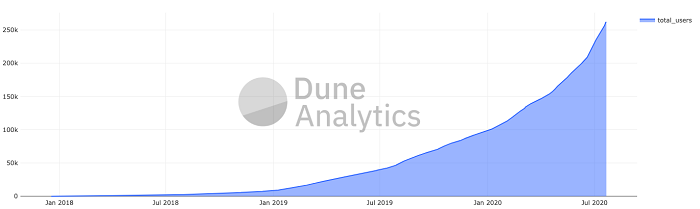
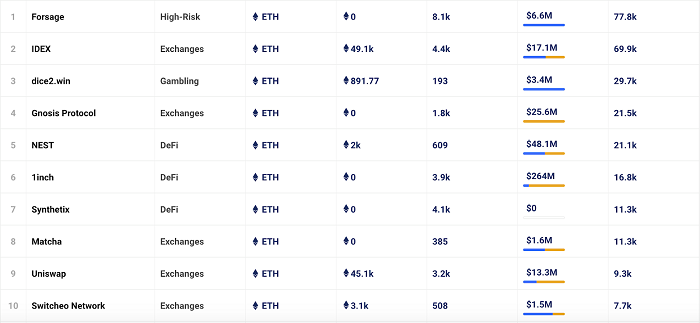
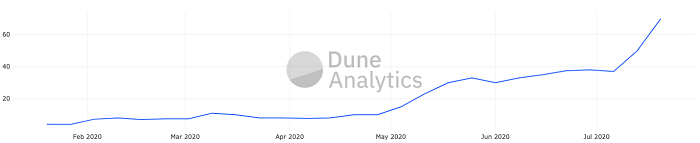
As can be seen from the data, many of the platforms with higher transaction volumes are from the DeFi space, such as 1inch.exchange, Synthetix, and Matcha, indicating the main reason for the surge in activity on the Ethereum chain when decentralized finance transactions. The chart below shows the growth of DeFi users on the Ethereum blockchain over time (source: Dune Analytics):
The following figure is the ranking of the top ten platforms in Ethereum’s 7-day trading volume. Source: DAppRader:
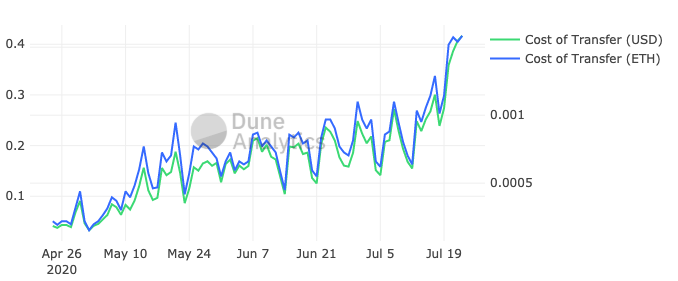
As activity on the Ethereum chain continues to increase, the network becomes more and more congested. The result of this situation is that transaction costs become higher and more expensive.
The chart below shows the trend of transaction costs in ETH (blue) and USD (green) on the Ethereum blockchain, sourced from Dune Analytics:
The network throughput of 14 TPS is indeed not a "good-looking" number, which will also cause the delayed transaction pool to be filled quickly. If the delayed transaction queue continues to grow, the cost of pushing transactions to the front of the queue will also increase significantly. The result of this situation is that the Ethereum network becomes inefficient and expensive under heavy load. In fact, this is not the first time that Ethereum has encountered this kind of problem. Previously, both Crypto Kitties (encrypted cats) and FCoin have caused considerable network congestion problems.
It is to solve this network bottleneck that developers in the Ethereum community are working harder and harder, trying to move the network consensus algorithm from proof-of-work (PoW) to proof-of-stake (PoS), which is expected to be a great success for Ethereum users. Bring a cheaper and more efficient use experience. But unfortunately, the upgrade of Ethereum 2.0 has been delayed again and again. If the upgrade cannot be carried out smoothly, the TPS barrier will exacerbate transaction costs, and the prosperity of DeFi will undoubtedly be limited to a certain extent.
secondary title
Don't worry, Ethereum 2.0 is not the only solution
The main reason for the delayed launch of Ethereum 2.0 is risk, and due to the increasing number of on-chain (value) transactions and on-chain activities, the risky transactions of Ethereum-based collateral tokens have become very large. To address the current bottleneck, developers initiated the "Ethereum 1.x" initiative, which focuses on improving existing network governance while building Ethereum 2.0 in parallel.
Several teams are currently working on various proposals related to Ethereum 1.x, including Ethereum improvement proposals EIP-1108, EIP-1844, EIP-2028, and EIP-2200, which can reduce on-chain transaction fees and Build on-chain strengths for implementing off-chain solutions.
Until Ethereum 2.0 is live and functioning, one of the most sensible ways to scale Ethereum is to move some transactions "off" the blockchain, although "Layer 2" networks have different levels of security than the underlying layers (like Bitcoin Lightning Network), but relatively speaking, both security and practicality can be considered. In fact, Ethereum developers have been experimenting with off-chain settings. Off-chain transactions are a use case that includes transaction status and payment channels, enabling multiple users to quickly lock ETH tokens on Layer 1 without causing network congestion. , and perform transactions or change state on Layer 2. Taking the Plasma network as an example, it is like a state and payment channel, providing services to users as Layer 2.
However, a major drawback of state channels and Plasma is that they do not have strong support for smart contracts, which limits their wide-scale application. Therefore, another option, Optimistic Rollups, began to appear in the market, which can increase the transaction efficiency to 1000 TPS on the basis of supporting smart contracts. In response, EthHub co-founder Eric Conner said on Twitter:
Optimistic rollups provide a similar setup to Proof of Stake as an off-chain aggregator that can act like a validator (node). All transactions that occur on Layer 2, such as smart contract interactions, etc., are regularly aggregated by nodes that have mortgaged tokens, and then submitted to Layer 1. Anyone can verify these commits, but as long as the node is found to be performing malicious actions, they lose all staked tokens.
Another way to take computations off-chain is to use zero-knowledge proofs. Zero-knowledge proof allows the party involved in the calculation to prove that it has actually completed the calculation without telling anyone how it was calculated. A zero-knowledge proof does not provide a complete history of operations, but a mathematical proof of the creation of this history. These proofs are much smaller in capacity than verifying transactions directly on the blockchain, allowing for more efficient use of blockchain space while still ensuring data integrity. Zero-knowledge proofs are very useful for decentralized exchanges (DEXs), because trading platforms can move order processing operations off-chain, ensuring that the Ethereum network has enough bandwidth to process transactions, which in turn makes decentralized exchanges easier to use .
To sum up, we currently have at least four effective scaling solutions for Ethereum, namely: State channels, Plasma, Optimistic Rollup, and zero-knowledge proofs.
secondary title
The next question is, who is building these Ethereum scaling solutions for DeFi?
There is no doubt that Ethereum currently has the largest developer community in the blockchain industry. The reason why developers can converge on Ethereum is mainly because the Ethereum community has a huge user base, but the problem is that they must Only by overcoming the limitations of the Ethereum platform can services be provided under the current lower TPS limit. So, who is building these Ethereum scaling solutions for DeFi? Let Mr. Odaily (WeChat: o-daily) take a look with you:
1. Raiden Network, Peruen Network, State Channel, Celer Network, Machinomy, FunFair, and Liquidity Network are all building Ethereum state channels, but state channels have a small niche market and are not yet widely popular. For example, Raiden Network used to be a leader in this vertical field, but now it ranks only 300-400 on CoinMarketCap;
3. Optimistic Rollup may be the Ethereum scalability solution that has attracted the most attention from DeFi projects. Among them, Unipig is worth noting, which is jointly built by Plasma Group and Uniswap exchange. Uniswap Protocol stated on its official Twitter that Optimistic Rollup is an exciting Layer 2 solution that can expand the interoperable and universal Solidity smart contracts on Ethereum, so that DeFi can be further developed. After the release of Unipig, Synthetix followed suit. The exchange tokenized traditional financial instruments (such as commodities and foreign exchange) and made them available for cryptocurrency trading, and the transaction confirmation time was compressed to sub-second level, thereby ensuring user experience Comparable to other centralized exchanges;
4. DeFi projects have also recently adopted zero-knowledge proofs in the form of ZK-STARKS. ZK-STARKS was developed by StarkWare, which received $4 million in financial support and 6,000 ETH rewards from the Ethereum Foundation. ZK-STARKS can enable zero-knowledge proof based on trust-free. A good example is the decentralized exchange Ethfinex, which is also the first decentralized exchange to implement ZK-STARKS. The current transaction throughput can reach more than 9,000 TPS ;
5. In addition to the expansion direction, there are other Ethereum solutions that support DeFi. For example, 1inch, a DEX aggregation service provider, introduced Chi Gastoken. This token allows users to buy and store gas at low prices, but the main disadvantage is When the Ethereum network continues to be congested, the gastoken minted earlier will be exhausted, and at the same time, there will be no chance to mint new tokens due to the high gas price, which in turn makes the solution unable to perform as expected.
secondary title
Summary: More than Ethereum, all roads lead to DeFi
Although many important DeFi protocols are built on Ethereum, with the rise of Cosmos and other blockchains, and FTX recently announced its entry, a nascent cross-chain ecosystem is emerging. Investors have discovered that DeFi In fact, it is not limited to Ethereum, they are also becoming more and more excited about cross-chain DeFi.
Ethereum is unlikely to transform into a fully functional proof-of-stake network in the short term, but the imagination of DeFi and other applications has become larger and larger, and its fate is far from doomed. Recently popular DeFi projects have adopted the above-mentioned Layer 2 scalable solutions, which shows that these solutions still have practical value. Because the scale of the blockchain industry is still small, the additional throughput of several thousand TPS based on the support of smart contracts is enough for Ethereum to continue to take advantage of the popularity of DeFi.
From MakerDAO, Compound, to Synthetix and Uniswap, you will find that almost all mainstream DeFi applications are built on Ethereum. In the past two years, DeFi has attracted a lot of investor interest, but people have also found that all services are limited to the Ethereum blockchain.
Recently, however, this is changing.
The news of FTX launching non-custodial trading services on Solana has greatly boosted the popularity of non-Ethereum DeFi protocols. Although the broader altcoin market has corrected sharply in the past few months, Kave, ThorChain, Switcheo and Band Protocol, etc. DeFi tokens have recently seen an increase of more than 10%. These agreements are all helpful to realize the vision of a cross-chain DeFi ecosystem, such as:
1. Kava, built on the Cosmos SDK, is a multi-asset lending protocol that allows encrypted assets such as Bitcoin (BTC) and Ripple (XRP) to be used as collateral to recreate MakerDAO;
2. ThorChain (RUNE) is a DEX on Binance Chain, which will eventually migrate to its own blockchain and allow cross-chain asset exchange;