What exactly can blockchain do for businesses of all kinds?


By Olya Green, Taraxa
8 min read
The usefulness of blockchain technology will depend on the ability of trusted intermediaries to bridge the gap between the digital and physical worlds.
—Harvard Business Review, 2019
When a company fully deploys a new technology architecture, the questions that executives often ask are:"How much will it cost?"secondary title
The dangers of extreme thinking
secondary title
The Potential of Technology to Transform Enterprise Trust and Reputation is Overstated
There is no doubt that blockchain technology has the potential to subvert the trust mechanism of enterprises and even the whole society. But most startups have not yet realized that blockchain technology solutions will eventually be integrated into larger enterprise systems—Microsoft, Google, Walmart and JP Morgansecondary title
False expectations on the part of user applications
secondary title
There is no place for crypto anarchism in the enterprise
While there’s nothing wrong with that, such extreme thinking can also create untrustworthy and unrealistic expectations that can ultimately dissuade business leaders looking for next-generation technologies. Especially enterprise blockchains that don't have the time to make idealistic guesswork. We need to realistically build applications that are viable and useful in the real world. Here are a few areas of research a company might do before applying blockchain solutions to optimize internal and external business processes:
cost and efficiency
The important questions every management asks are:
What kind of bottlenecks will we encounter when we replace the original system with blockchain technology?
What are the main costs we will incur when deploying blockchain technology?
Another common misconception in the business world is that blockchain solutions are expensive. Again, it depends on which blockchain you adopt. For example, it is not appropriate to use the Ethereum blockchain to process internal data logs, because in addition to architectural issues, the upper limit of the TPS (transactions that can be processed per second) of the Ethereum blockchain is very low, which will inevitably lead to slow processing, high cost issues. It is important to note that every enterprise needs to carefully examine all aspects of a blockchain's technical details.
Regulation and Governance
The important questions every management asks are:
What impact does the current regulatory policy have on our application of blockchain technology?
What aspects of our application will regulators want to know about?
Should we adopt public chain or private chain?
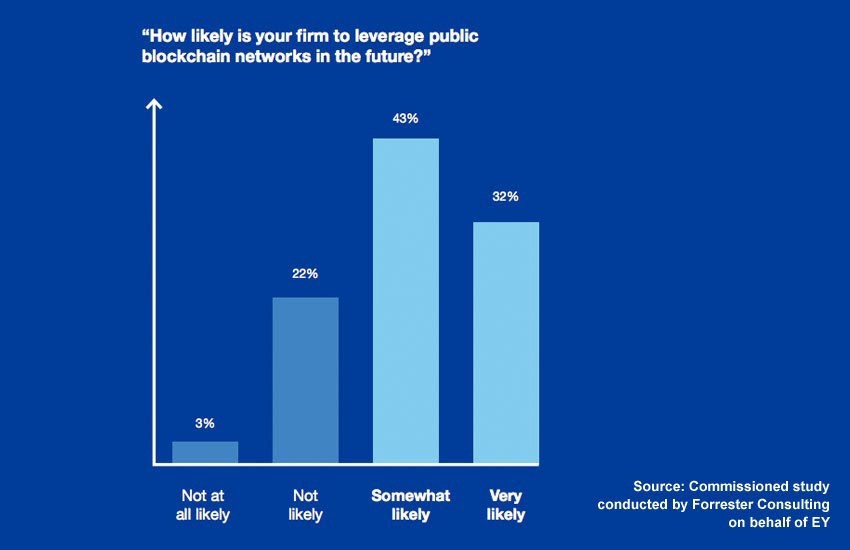
In practical industry applications, regulatory policy has always been the most concerned issue. When choosing a public-private chain, you may consider the public chain, because the public chain is more common and more transparent than the private chain, so regulators will feel more friendly. This applies to regulation in all areas, whether financial or otherwise, such asCMS in the medical field。
From the perspective of governance, if you want to preserve the important concept of corporate responsibility and taste the sweetness of decentralization, then useprivate networksafety
safety
In terms of technology: Is the blockchain really "unhackable"? So far, there have been no successful cases of hacking the Ethereum or Bitcoin blockchains - except for a few buggy Bitcoin/Ethereum smart contracts that have been hacked. However, no technology is completely safe from hackers. Fortunately, there is a communityConstantly research potential vulnerabilities and submit new fixes. Although there are also opinions that private chains are more secure, there are currently a large number of teams developing security enhancement tools for public chains. For example, the Ethereum blockchain already has several mechanisms to ensure the privacy of network participants, including ring signatures, hidden addresses, and storage of public chain private data. For another example we chooseBlock DAGsecondary title
Quickly recognize the fact that blockchain technology is also not good at
When distilling the usefulness of blockchain, let's first think about what makes this technology unique: it is the integration of economic incentives and encryption to ensure that at any point in time there is a digital record that reflects the relationship between major players. Real consensus. Then, we can understand what aspects of blockchain alone cannot be achieved without online or offline auxiliary tools, which is also helpful for evaluating blockchain business models.
100% authentic
Let’s imagine this scenario first: When you transfer coins to a cryptocurrency exchange, or download a dApp, there will be a group of people running nodes in the background to maintain the software. Although there are interfaces online and offline, any technology still relies heavily on reliable intermediaries to effectively connect individuals, businesses, or devices that are separated from digital records, and blockchain technology is no exception. Therefore, keeping digital records in sync with offline counterparties is not an easy task for any current blockchain.
be the only source of truth
Digital records can be immutable and verifiable, but how do I know which asset this digital record is? How can you be sure that the operational data of the warehouse is collected by this particular sensor? This is why we have always emphasized that both identity information and transmission/processing must beProtect data security at the source. To do this, we need to attach a physical identifier, such as a chip or a tag, to the target object so that it can be associated with a specific digital record. However, this cannot be achieved by blockchain alone. Here we need auxiliary tools such as sensors and specific software to realize.
Protecting poorly written smart contracts
Smart contracts should act as a safeguard to ensure that transactions are not initiated until the terms of the transaction are guaranteed. But the problem is that smart contracts themselves can be tricked by malicious actors trying to disrupt the network.
Eliminate the risk of human error
For example, you use blockchain technology to track boxes in a warehouse, but you are likely to scan the same box twice, resulting in accidental tampering of records.
But don’t get discouraged, even if we strip away the godlike veneer about DLT technology, there is still one thing that can prove the true value of DLT: the ability of blockchain to provide an immutable record of transactions (or digital audit trail). , and can be used to verify the integrity of the data. So, which scenarios can really play the value of this advantage? Just imagine all the use cases where the actions of parties need to be recorded to track accountability. Creating encrypted identities on the blockchain provides a high level of assurance that participants are as stated, which applies to scenarios where responsibility is traced to each party along the supply chain. In our application case, we use digital signatures and private keys to build an immutable virtual identity audit log, thereby reducing the chance of fraud in the telecommunications industry.
Considering the potential of DLT technology in all aspects, it should by no means be confined to the small circle of cryptocurrency enthusiasts. It can quickly process operational data, reduce costs, and create a 100% reliable audit log by completely eliminating third parties, and ultimately bring a series of feasible solutions for enterprise development and user acquisition—this is where the capabilities of DLT lie.
Ultimately, after being properly understood and properly applied, the functions of the blockchain will play a role in various industries, helping the industry launch a new business model and take the lead in achieving innovation and optimization.