






Weekly Editors Picks (0916-0922)


Weekly Editors Picks is a functional column of Odaily. In addition to covering a large amount of real-time information every week, it also publishes a lot of high-quality in-depth analysis content, but they may be hidden in the information flow and hot news and pass you by.
Therefore, our editorial department will select some high-quality articles worth spending time to read and collect from the content published in the past 7 days every Saturday. From the perspectives of data analysis, industry judgment, opinion output, etc., we will provide those in the encryption world with You bring new inspiration.
Next, come and read with us:

Investment and Entrepreneurship
Arca Chief Investment Officer: Nine key takeaways from running crypto funds over the past five years
Adjust assumptions and risk models; interpretation trumps speed; detailed documentation is critical; balance the long and short; hire people who are passionate about the industry; everyone wears multiple hats; trading operations is the most important department; the sell-side becomes more Things are getting better; the investor community is getting smarter.
DeFi
RWA through the eyes of the Fed: Tokenization and financial stability
As of May 2023, the market size for tokenization on permissionless blockchains is $2.15 billion.
Tokenization can bring many benefits, including allowing investors to enter markets that previously had high investment barriers and were difficult to access. The programmability of the token and the ability to utilize smart contracts allows some additional functionality to be embedded into the token, which may also benefit the market for the underlying asset. Tokenization may also facilitate lending by using tokens as collateral and may also improve liquidity in the underlying asset market.
The tokenized market size below a billion dollars is relatively small for the entire crypto market or the traditional financial market, and does not cause overall financial stability problems. However, if the tokenized market continues to grow in volume and size, it could pose financial stability risks to the crypto market as well as the traditional financial system. In the long term, the redemption mechanisms involved in tokenization between the crypto-asset ecosystem and the traditional financial system may have potential impacts on financial stability. Additionally, tokenized assets may be problematic due to lack of liquidity in the underlying assets. Another financial stability risk is the token asset issuers themselves. Tokenization may package riskier or less liquid underlying assets into safe and easily tradable assets, potentially resulting in higher leverage and risk taking. Once the risk is exposed, these assets will trigger systemic events.
Frax Finance in-depth research report: a new chapter in the stablecoin track
Frax Finance is a DeFi protocol that offers three stablecoins and staking derivatives (FRAX, FPI, frxETH) for earning income, providing liquidity and staking in DeFi. The protocol uses innovative sub-protocols and native governance tokens (FXS, FPIS) to ensure price stability and user governance. It is a major player in the global cryptocurrency market with over $800 million in value locked.
Fraxswap is the first constant product automated market maker with built-in Time Weighted Average Market Maker (TWAMM); Fraxlend is a lending platform that allows anyone to create a market between a pair of ERC-20 tokens; Fraxferry is a wireless Permissioned, non-custodial and secure cross-chain bridge. In June of this year, Frax Finance announced plans to launch its own second-layer scaling solution, Fraxchain, by the end of the year.
Frax Finance has established a significant user base and business presence. It has become more than a single currency agreement. Instead, it is forming a DeFi ecosystem centered on the stablecoin FRAX, supported by key features such as LSD (frxETH), and its coverage is also expanded to include elements such as DEX (FRAXSwap) and lending (FRAXLend). Frax Finances core strength lies in its comprehensive narrative on LSD and stablecoins. Frax Finance partners with Curve to tap liquidity-liberating opportunities in the multi-billion dollar LSD market, a strategic move with great promise. In addition to taking advantage of the increased LSD profits, it is also possible to shape a new stablecoin landscape by utilizing crvUSD and the native stablecoin FRAX.
Detailed explanation of Uniswap v4 Truncated Oracle: concept, operating mechanism and function
The truncated oracle is an on-chain price oracle that uses the geometric mean formula to record the price of assets in the Uniswap liquidity pool, and then truncates the price feed of the oracle - this means that within a single block, recording The price can only move up or down to the maximum value.
This truncation helps eliminate the long-term impact of large transactions on price—whether these large transactions are legitimate or malicious, because if a malicious actor attempts to manipulate the price, the manipulation must continue across multiple blocks. , which makes the operation cost of truncated oracles very high. By truncating the extent of recordable price (point) fluctuations, the oracle can ignore outliers and eliminate the impact of large transactions on price, making it safer.
Currently, Uniswap v4 and truncated oracle Hook are still under development, and the final specifications may change.
GameFi
Folius Ventures: A journey in search of Web3 gaming’s north star
For many game manufacturers who are limited by version numbers and purchase fees, Web3 is a good choice.
Web3 is an industry with imperfect infrastructure but extremely high profit margins. A generalist team can reap the biggest dividends, but a team without generalist capabilities will have more difficulties and a higher error rate. There is a huge gap between waist and head manufacturers, and most manufacturers may not reach the volume threshold, which requires the team to have strong evolutionary capabilities iteration speed. Business model innovations are emerging one after another. The more liquidity dries up in this era, the more innovation and change are required. The Web3 business model changes with market hot spots/new asset forms, and the team needs to innovate with a full understanding of the market economic model. The traffic diversion potential of L1/2 and the platform is gradually declining, and the super ecology and traffic portals that surpass the single L1/2 have emerged and are expected to compete in the next cycle. Project parties need to choose good trees as soon as possible or take the initiative to open up new paths for UA.
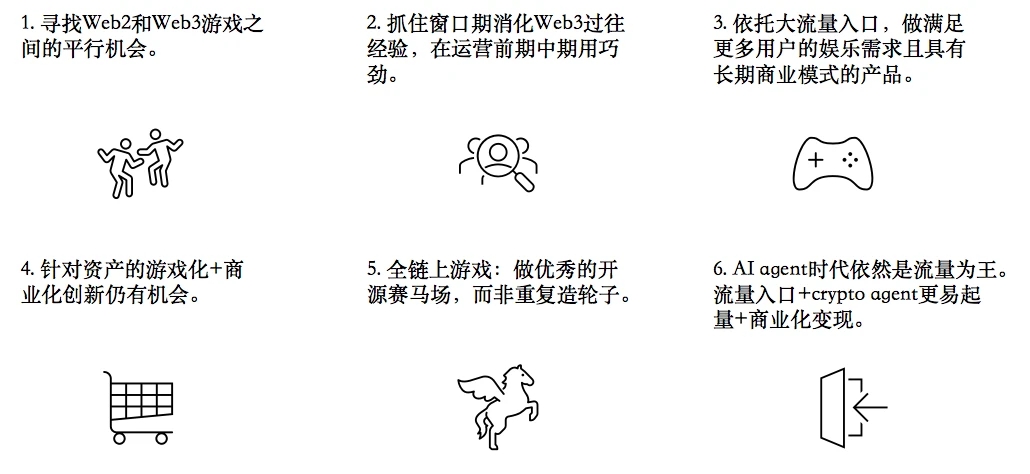
The Web3 game team also has the following directions worth exploring:
Ethereum and Scaling
On the first anniversary of the Ethereum merger, what changes have occurred in the MEV supply chain?
As MEV supply chains evolve into complex supply networks, tracking the order flow lifecycle across the entire stack becomes challenging. While MEV-Boosts open relay data API helps understand the final steps before on-chain settlement, the initial entry point for tracking orders remains elusive.
Flashbots remains committed to providing transparency into the MEV ecosystem and providing research data to contributors and collaborators. Ethereum’s transition to proof-of-stake, coupled with the rise of MEV-Boost, has fundamentally reshaped the dynamics of the transaction supply chain. While this achievement is significant and worthy of celebration, MEV’s centralizing power will continue to pose inherent challenges to the neutrality and decentralization of blockchains.
Is Rollup Summer coming? Discuss in detail the overview, ecology and future prospects of RaaS
RaaS brings cheaper, efficient and equally secure application chains and higher interoperability, and is also a testing ground for innovative ideas.
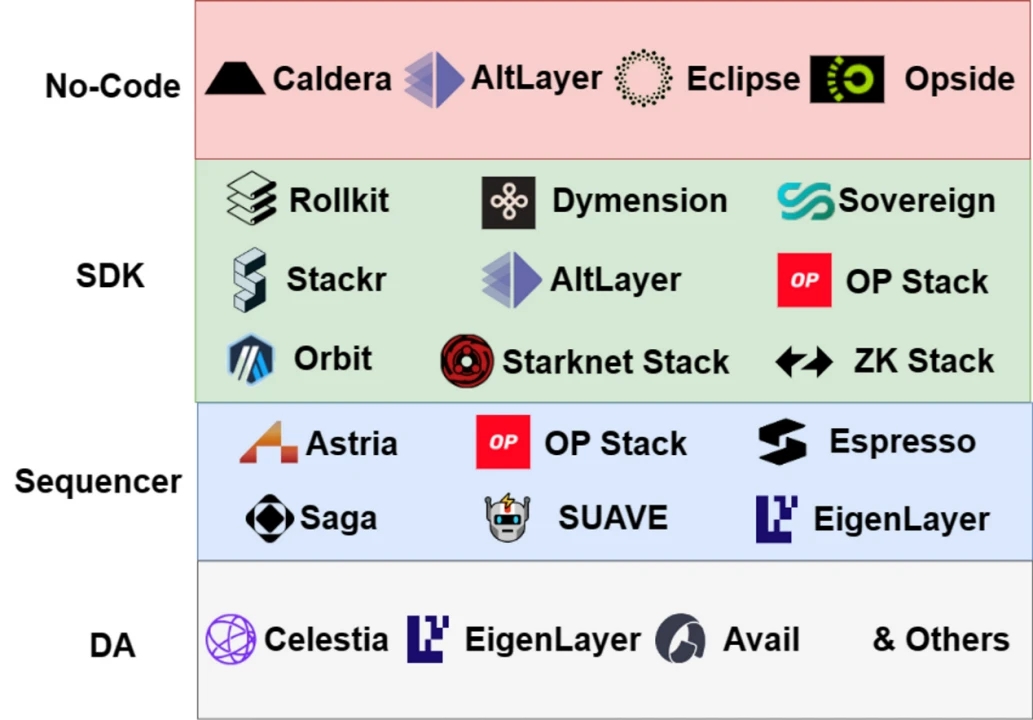
The future of RaaS will be more zk, non-Ethereum, modularity, customization, interoperability, multi-collateralization.
Detailed explanation of ERC-7521 draft: adding user intent to account abstract wallet
The key to enabling universal intent is to use smart contract-based abstract accounts. Similar to ERC-4337, intents are signed as messages and then verified on-chain via separate transactions. These signed messages are then propagated in their own memory pool.
The goal of this specification is not to create a framework for smart contract wallets to integrate and automatically support the broad range of possibilities defined by the signed intent itself.
The EntryPoint contract in ERC-4337 is imitated, but also split into two different parts. The first part, called the entry point, is the main entry point for submitting intent solutions and is responsible for validating intent signatures and running high-level intent processing logic. The specific content of the intent processing logic is defined in a separate contract, called the intent standard, which is specified by the signed intent itself. Entry points call these contracts to handle an intent. It is the intent standard that defines how attached intent data and execution are handled, as well as the basic off-chain rules related to denial of service attack vectors inherent to intents.
The focus of the specification is to define a basic framework for smart contract wallets so that they can connect and unlock powerful expressions of intent for users, even as the landscape continues to evolve. Defining intents as a collection of smaller intent segments provides a great experience for the user and reduces the number of times the user needs to sign. Intent segmentation and shared background data also help unlock powerful capabilities without using large amounts of gas. Intents can trust that all their segments will be processed sequentially without manual inspection.
OKX Ventures: The past, present and future of the system analysis account abstraction track
Since EIP 4337 does not require changes to the consensus layer, it can basically be regarded as the final plan of Ethereum AA.
There are two routes to multi-chain account abstraction: 4337 compatible method and native account abstraction.
The combination of AA and MEV: AA, Sequencer and intent essentially extend the chain of on-chain operations. MEV requires a longer chain of bribes. AAs Bundler and intent solve may cooperate with roles such as Searcher in the MEV chain to form MEV. share form.
In essence, there is no necessary binding relationship between intent and AA. Intent is essentially innovation in the user experience layer, better and faster understanding and decomposition of user needs, turning them into one or more UserOperations; AA is back-end optimization, better execution of user instructions. Telegram bot is a typical Intent innovation, but the backend still uses the EOA wallet, which does not affect the user experience.
Biconomy, Stackup and Pimlico are the more mature 4337 solutions currently on the market. Continuing to improve the SDK and modular solutions will help occupy the leading market and achieve high market coverage of technical solutions. Currently, Stackup has implemented two types of Paymaster and Bundler Model, in the future full-process solutions + multiple component libraries will be the way for such leading projects to continue to expand their advantages.
The future development of AA: In the short term, it will focus on expanding the market and forming a joint promotion model with layer 2; in the mid-term, it will focus on the implementation of modular Bundler and Paymaster and the deployment of SDK, while optimizing the user experience in details (such as reducing gas costs, adding Optional EOA-to-ERC-4337 conversion, etc.); in the long term, forced conversion of EOA wallets will be considered.
Multiple ecology
Solana DeFi Renaissance: Taking stock of Q3 progress of ecological projects and Q4 prospects
In Q3, some attention-grabbing events catalyzed the Solana ecosystem: MakerDAO hopes to use Solanas virtual machine (SVM), Maple Finance returns to Solana, EUROe stable currency is launched on Solana, and CNBCs evaluation of Solana surpasses BCH and LTC.
Q4, there is a lot of activity in the derivatives and synthetic asset space (Zeta Markets, Drift, Cypher); there are some key innovations that can further expand the use cases of LST (Marinade, JitoSOL, SolBlaze, Sanctum); lending is further flourishing Solana’s DeFi ecosystem Laying the foundation for development (MarginFi, Solend, Kamino Finance, Lifinity).
Hot Topics of the Week
In the past week,Hong Kong’s unlicensed exchange JPEX case continues to develop(Topics);
In addition, in terms of policy and macro market,The U.S. House of Representatives Financial Services Committee will approve an amendment bill to ban the application and testing of unapproved CBDC,SEC Asks Court for Approval to Examine Binance.US,Gary Gensler will appear before the House Financial Services Committee on Oversight of the SEC hearing next week,Japanese government will allow startups to raise capital in cryptocurrencies;
In terms of opinions and voices, Coinbase reports:FTX’s sale of cryptocurrency holdings unlikely to severely impact markets,Matrixport:Bitcoin price could hit $37,000 by year-end,WSJ:Tether is lending out stablecoins again, less than a year after promising to “reduce secured loans in reserves to zero”, CZ responded to executive departures:Binance added more than 600 new employees during the same period;
In terms of institutions, large companies and leading projects,Citi launches token service to convert customer deposits into digital tokens for transfers,The Aave community has voted to pass the proposal to increase the GHO lending interest rate to 2.5%,PolkaWorld:Having suspended operations for half a month, Polkadot’s new governance framework OpenGov is forcing the outflow of ecological projects,Tip Coin is open to claim tokens TIP,friend.tech has launched a web version;
NFT and GameFi areas,Huang Licheng’s proposal to purchase Yuga assets such as BAYC with 11 million APE and issue the governance token DAM has been approved...Well, it’s been another week of ups and downs.
Attached is the Weekly Editors Picks seriesportal。
See you next time~





